Cascading Strategy Explained: Your Blueprint for Growth
Last updated on : January 15, 2026
Ever wondered why well-crafted strategies often fail to deliver results? For many managers, the problem isn’t the plan – it's the execution. Goals get lost between departments, KPIs don’t align, and teams pull in different directions. Add constant pressure for quick wins, limited resources, and endless meetings, and it’s easy to see why progress stalls. Without a clear way to connect top-level objectives to everyday actions, managers end up battling instead of leading. This is where Cascading Strategy steps in – bringing clarity, alignment, and accountability so your strategy actually works. In this blog, we’ll explore what cascading strategy is and why you need it, how cascading strategy aligns goals and KPIs, benefits of implementing cascading strategy, steps to implement effective cascading strategy, how Hoshin Kanri X Matrix helps in cascading strategy, and how LTS Data Point offers various tools and software solutions for the same.
Cascading strategy: What it is, and why you need it
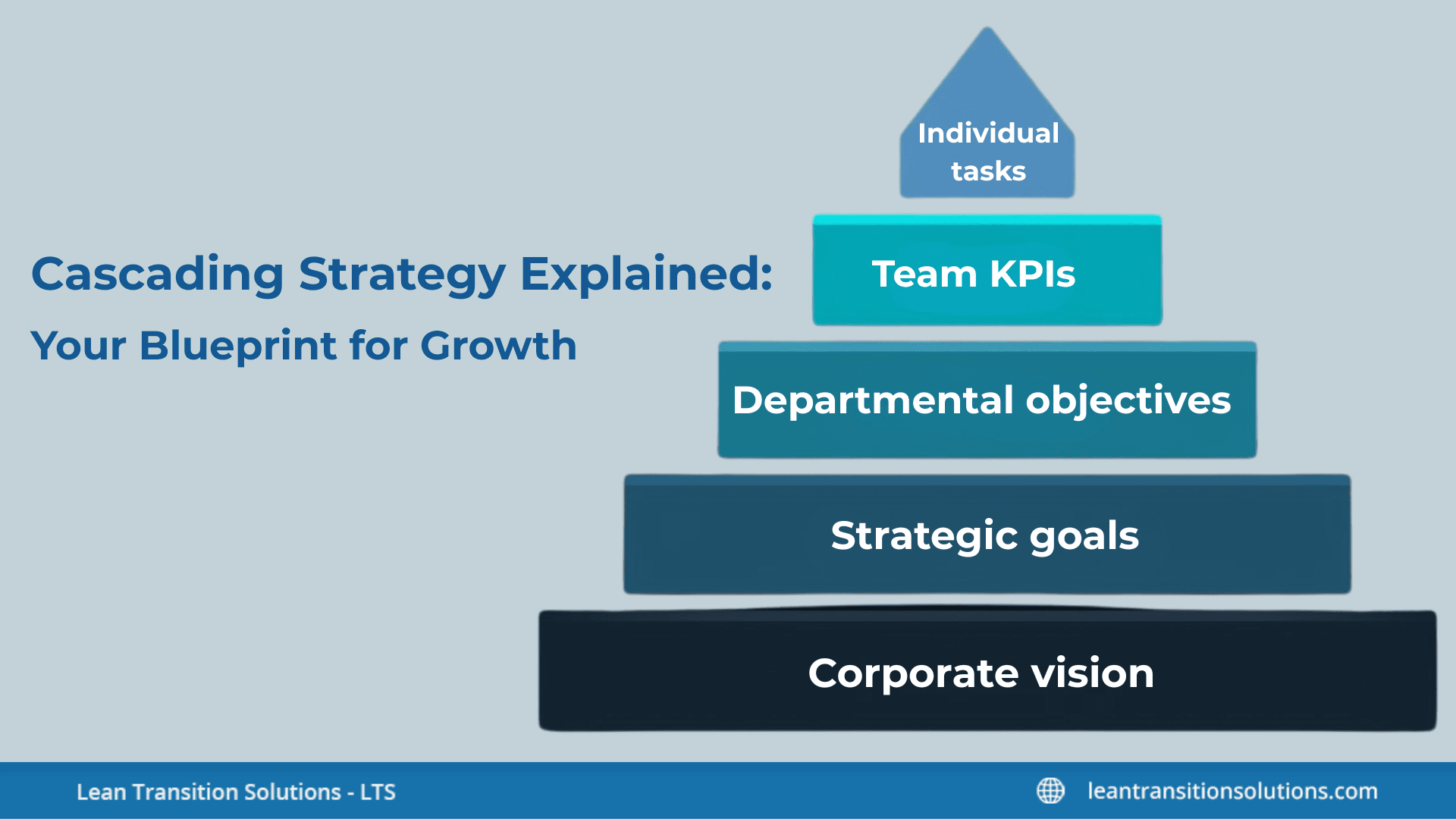
Cascading strategy is a method of taking your industry’s top-level goals and breaking them down into smaller, clearer objectives for every department, team, and individual. It makes sure that the big strategic priorities don’t remain only at the leadership level – they flow downward in a structured way.
A strategy cascade links high-level objectives to everyday work. Leadership sets the main aims, departments translate them into functional targets, teams turn those targets into projects or Key Performance Indicators (KPIs), and individuals receive specific tasks or responsibilities that directly support the overall strategy. Organisations using OKRs will recognise this pattern - cascading strategy applies the same objective-and-key-result logic across every level of the organisation, not just at the team level.
In short, cascading strategy aligns the entire organisation so every employee is working toward the same goals, with clarity on what to do and how their work contributes to the bigger picture. This kind of organisation-wide alignment is exactly what strategic alignment as a discipline is built to sustain, well beyond the initial cascade.
Why strategies fail without cascading
When industries don’t cascade their strategy, even the best plans fall apart on the shopfloor. Here are the core reasons why strategies fail without cascading:
➤ Misaligned KPIs: Without cascading, teams create their own KPIs that may have nothing to do with the company’s strategic goals.
For example, if leadership wants to enhance customer delivery time, instead the manufacturing team focuses only on output volume, which leads to rushed batches, rework, and late shipments.
➤ Siloed teams: Department end up working in isolation, each prioritising what they think is relevant.
For example, in a company without cascading strategy, maintenance tries to cut costs, while operations push machines harder for output, and quality focuses on tighter checks. With no shared direction, everyone pulls in different paths.
➤ Unclear accountability: If goals don’t flow down to roles, no one knows who owns what.
For example, a plant manager might have aimed on the target for reducing downtime, but must have not communicated clearly, leading to supervisors and technicians not knowing specific actions or KPIs tied to it. This directly results into time-consuming discussions and lack of measurable progress.
Without a cascading strategy, organisations get effort – but not results. Cascading gives every team clarity, alignment, and ownership, transforming strategy from a data into daily execution.
How cascading strategy aligns goals and KPIs
Cascading strategy is simply stage-by-stage translation of the big-picture intent into everyday work. Here's the flow and what matters at each step:
Corporate vision -> Strategic goals
Management defines the long-term vision and 3-5 strategic goals – enhance customer on-time delivery by 20%. These goals are directional, quantifiable, and time bound.
What to do: State goals plainly, include target numbers and deadlines, and explain the “why.”
Strategic goals -> Departmental objectives
Each process converts the corporate goals into departmental objectives that indicate how that function will contribute – production: lower changeover time by 30%; logistics: improve route efficiency).
What to do: Chart each department objective back to the specific corporate goal it supports so there’s no doubt where it connects.
Departmental objectives -> Team KPIs
Teams turn departmental objectives into specific KPIs and projects they can control – maintenance team KPI: Mean Time to Repair (MTTR) ≤ 2 hours; scheduling team KPI: schedule adherence ≥ 95%.
What to do: Keep KPIs SMARTER (specific, measurable, achievable, relevant, time bound, evaluate, readjust) and cap the number to what the team can realistically influence.
Team KPIs -> Individual tasks
Managers break KPIs into daily or weekly tasks and assign owners – technician A: implement standardised changeover procedure; planner B: update daily schedule and log deviations).
What to do: Assign clear owners, set expected outputs, and connect tasks to the team KPI they move.
Both clarity and transparency are a must for achieving corporate goals. Clarity hinders different teams from interpreting goals differently – everyone knows what success looks like. Transparency verifies everyone can see the connection between their work and the company objective, which builds accountability and motivation.
Discover how to cascade strategy with LTS Data Point
Quick checklist to keep the cascade tight
- Use one-line goal statements and show the parent objective beside every derived goal or KPI.
- Limit KPIs per level (3-5 is a good rule).
- Publish a single source of truth (dashboard or scorecard) that reflects goals, KPIs, owners, and status.
- Schedule short regular reviews (weekly team huddles + monthly cross-functional review).
- Make ownership obvious – name people, not roles.
When done well, strategy cascade turns from a statement on a slide into clear daily action – aligned, measurable, and owned.
Get your customised tools to cascade strategy from LTS Data Point
Benefits of implementing cascading strategy
A cascading strategy turns high-level objectives into clear, practical targets for every team and individual – improving alignment, execution, and performance across the organisation. Benefits of implementing cascading strategy include:
- Faster strategy execution: When targets and KPIs are clearly linked from the top down, teams know exactly what to focus. This lowers delays, eliminates confusion, and leads to quicker project delivery and faster decision-making.
- Better cross-functional collaboration: Breaks down silos by connecting departmental aims to shared strategic goals. Teams understand how their KPIs impact others, leading to stronger coordination, fewer conflicts, and smoother workflows.
- Higher accountability and ownership: With clear owners for every KPI and task, accountability becomes built-in. Supervisors gain visibility, individuals know what they’re responsible for, and organisations usually see a significant boost in KPI adherence.
- Consistent alignment at all levels: From leadership to frontline teams, everyone pulls in the same direction. Cascading eliminates competing priorities and makes sure every action contributes to the company’s strategic plan.
Steps to implement an effective cascading strategy
Define clear strategic objectives
Begin with a focused set of top-level goals that describe what the industry must achieve. These should be measurable, time-bound, and easy for everyone to comprehend.
Example: Enhance customer delivery performance by 20%.
Break down goals for each department
Change each strategic objective into specific departmental goals. Every function – operations, quality, HR, Finance – should be aware of how they contribute to the overall strategy.
Example: Production lowers changeover time; logistics enhances scheduling visibility.
Assign KPIs and owners at team and individual level
Translate departmental aims into team KPIs, then into individual responsibilities. Allot clear owners, targets, and timelines.
Example: Maintenance owns MTTR; planning owns schedule adherence; individuals own daily tasks.
Monitor progress and adjust regularly
Use dashboards, scorecards, or digital tools to track KPI in real time. Hold weekly and monthly reviews to spot issues, make corrections, and keep everyone aligned. Strategy becomes a continuous process – not an annual exercise.
Know more on how LTS Data Point aids in cascading strategy
Hoshin Kanri X Matrix for cascading strategy
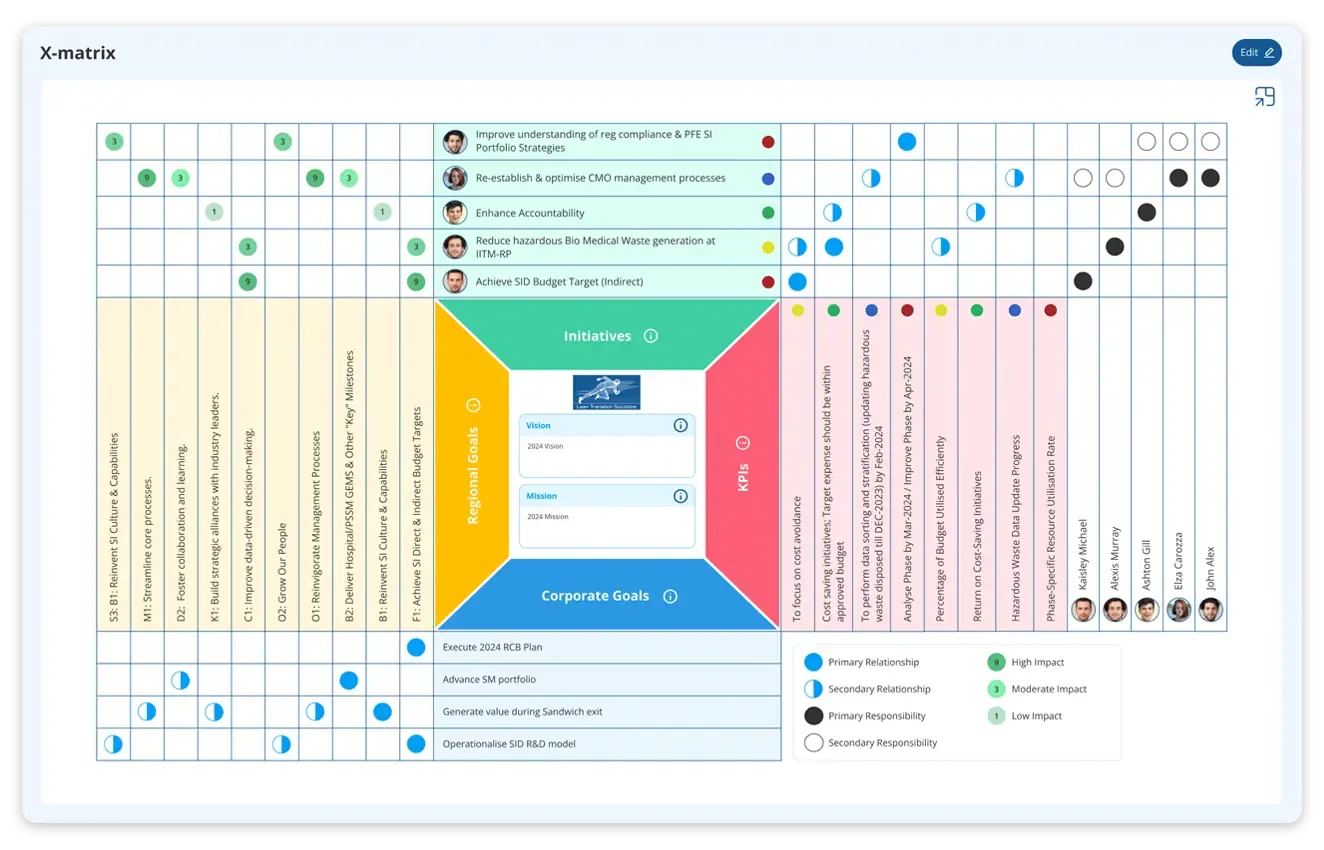
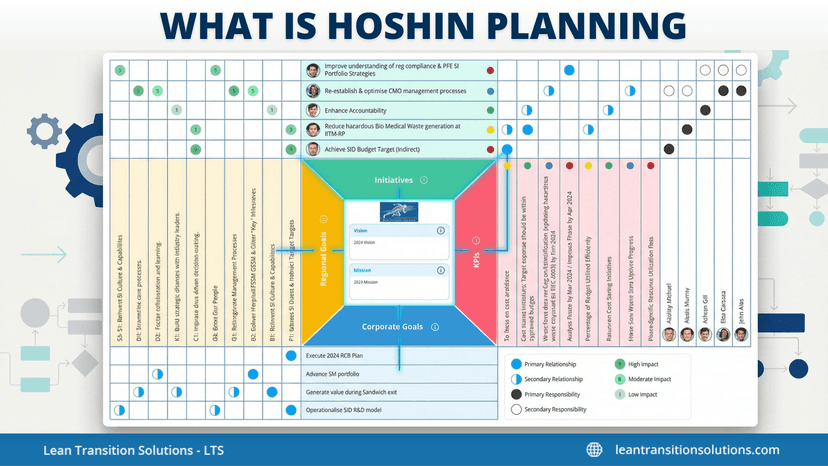
The Hoshin Kanri X Matrix is one of the most powerful tools for cascading strategy because it visually connects long-term goals with the specific actions, owners, and KPIs required to achieve them. Instead of keeping strategy at the leadership level, the X Matrix ensures every goal flows clearly down through departments, teams, and individuals.
How the X Matrix Supports Cascading Strategy
The Hoshin Kanri X Matrix uses a structured, four-quadrant layout to link every part of the strategy:
- Breakthrough objectives (top-level goals): These are the organisation’s key strategic priorities — the big outcomes to achieve in the next 1–3 years.
- Annual objectives (department-level goals): Each breakthrough objective is translated into departmental targets that move the strategy forward.
- Key initiatives or projects (team-level actions): Teams define the projects or improvement activities they will execute to hit the department goals.
- KPIs and ownership (individual-level accountability): Every initiative has measurable KPIs and clearly named owners, ensuring transparency and accountability.
This single-page visual makes cascading strategy simple: everyone can see how their actions directly support the organisation’s big goals.
Discover how to effectively integrate X Matrix with LTS Data Point
How LTS Data Point powers an effective cascading strategy

Implementing a cascading strategy becomes much easier and far more effective when supported by the right digital tools. LTS Data Point offers an integrated platform that links goals, KPIs, teams, and daily actions in one place, making strategy execution seamless from top to bottom.
Hoshin Kanri X Matrix with LTS Data Point
LTS Data Point digitises the Hoshin Kanri X Matrix, making it dynamic instead of static:
- Live updates verify progress is always visible.
- Automatic KPI tracking links team and individual performance to strategic goals.
- Cross-functional alignment becomes natural as every department sees how its goals connect to others.
- Integrated dashboards and scorecards keep strategy execution measurable and on track.
- Corrective actions can be triggered directly from underperforming KPIs.
The result: a digitally powered X Matrix that turns cascading strategy into a daily management system.
Tools and techniques that enables effective cascading strategy
LTS Data Point brings together the essential tools industries need to cascade strategy with accuracy and speed:
- Balanced scorecard: Aligns corporate objectives with departmental and team-level KPIs in a single structured framework.
- Live KPI dashboards: Offer real-time visibility into performance, enabling managers and teams to track progress, spot bottlenecks, and take quick action.
- Automation and alerts: Automatically updates KPIs, sends notifications on deviations, and secures accountability without manual admin work.
- Integrated corrective actions: Connects underperforming KPIs to CAPA workflows so teams can repair issues at the root cause.
Why leaders choose Hoshin Kanri + LTS Data Point
- Clear visibility from top-level strategy to frontline actions
- Stronger alignment and collaboration across departments
- Faster execution through real-time tracking
- Built-in accountability at every level
- A single source of truth for strategy, KPIs, and performance
Cascading strategy in action: Real-world example
Manufacturing and aerospace companies using LTS Data Point have transformed their strategy execution by breaking down high-level objectives into measurable outcomes:
- Manufacturing: Plants enhanced OEE by aligning Production KPIs, Maintenance KPIs, and Quality KPIs inside a unified scorecard, ensuring every team worked toward shared aims.
- Aerospace: Teams achieved tighter delivery performance and reduced defects by connecting strategic objectives directly to live dashboards, allowing faster decision-making and consistent compliance.
These examples mirror how cascading becomes actionable and results-driven when supported by digital alignment tools.
Key takeaways for leaders
Adopting a cascading strategy is no longer optional — it’s essential for organisations that want to execute faster and stay competitive. With LTS Data Point, leaders can:
- Align goals and KPIs across all levels
- Improve cross-functional collaboration
- Strengthen ownership and accountability
- Achieve quantifiable improvements in performance and delivery
- Turn strategy into a living, real-time system instead of a static document
At the end of the day, strategies don’t fail because they’re bad – they fail because they’re not connected to real work. Cascading strategy fixes that by making sure everyone knows what the big goals are and how their daily tasks help hit them. It’s about clarity, accountability, and speed, not endless meetings and guesswork. If you want your plans to turn into results, start cascading today – it's simpler than you think and the impact is huge.
No waiting, start cascading strategy with LTS Data Point
FAQs
1. How is cascading strategy different from traditional goal setting?
Traditional goal setting often stops at the leadership level, while cascading strategy breaks goals into clear objectives for every department, team, and individual – ensuring alignment and accountability.
2. Can cascading strategy work in remote or hybrid teams?
Yes. Digital tools like KPI dashboards and scorecards make it easy to cascade goals virtually, track progress in real time, and keep distributed teams aligned.
3. What industries benefit most from cascading strategy?
Manufacturing, aerospace, healthcare, and tech sectors see major gains because they rely on precise KPIs and cross-functional collaboration for success.
4. How often should a cascading strategy be reviewed?
Weekly team huddles and monthly cross-functional reviews are ideal to keep goals relevant, address bottlenecks, and adjust KPIs as needed.
5. Does cascading strategy require expensive software?
Not necessarily. While advanced platforms like Balanced Scorecard software help, smaller organisations can start with spreadsheets or simple dashboards.
6. What's the biggest mistake when implementing cascade strategy?
Failing to link KPIs back to strategic objectives. Without clear connections, teams work in silos, and the cascade loses its purpose.
7. How does cascading strategy improve accountability?
By assigning clear owners for every KPI and task, making performance visible, and connecting individual actions to organisational goals.
8. How does the X Matrix differ from a Balanced Scorecard?
While a Balanced Scorecard tracks performance metrics, the X Matrix focuses on cascading strategic objectives into actionable initiatives with clear ownership.
9. What is strategy cascade and how does it differ from cascading strategy?
They refer to the same concept – breaking down strategic goals into actionable objectives across all levels.

Geandra Queiroz, Operations Management Consultant
Geandra is an Operations Management Consultant at Lean Transition Solutions, specialising in Lean philosophy, Lean Six Sigma, and strategic planning across manufacturing and healthcare. She is currently completing her PhD in Industrial Engineering at the Federal University of São Carlos, researching the integration of Operations Strategy, Lean, and Green Manufacturing.