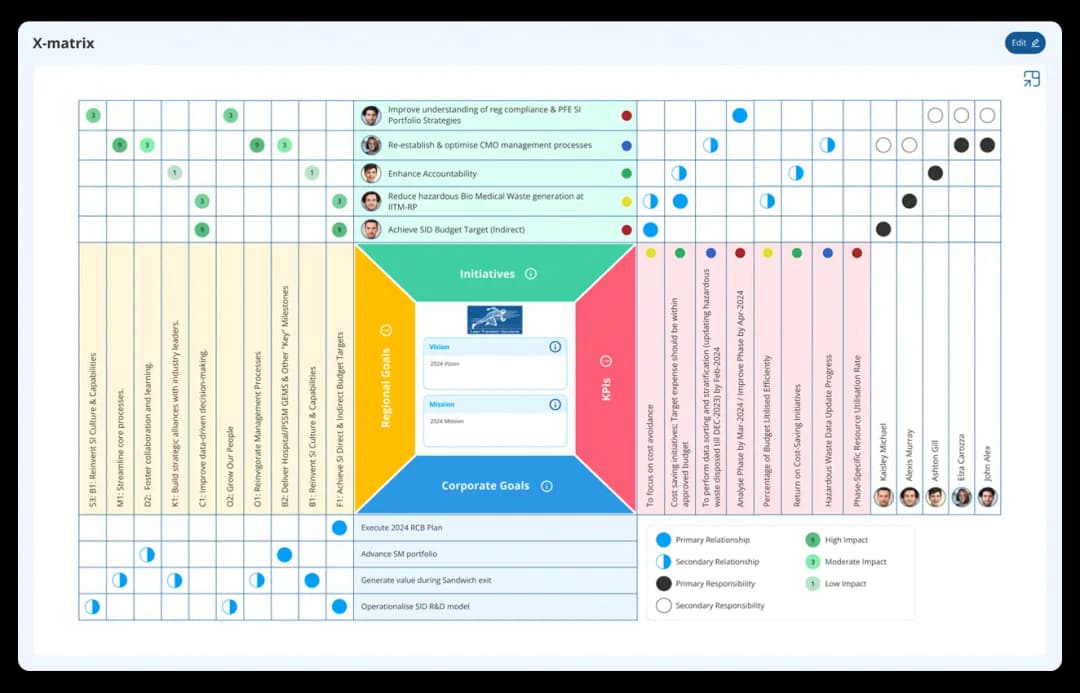
Hoshin Kanri X Matrix for strategic alignment and goal execution
To ensure that everyone is pulling in the same direction — from leadership to front-line teams — the Hoshin Kanri X Matrix provides a clear, visual framework for connecting long-term strategy to day-to-day actions. Achieve organisational alignment, focus and accountability of agreed goals with Hoshin X Matrix.
How does the Hoshin Kanri X-Matrix drive effective strategy deployment?
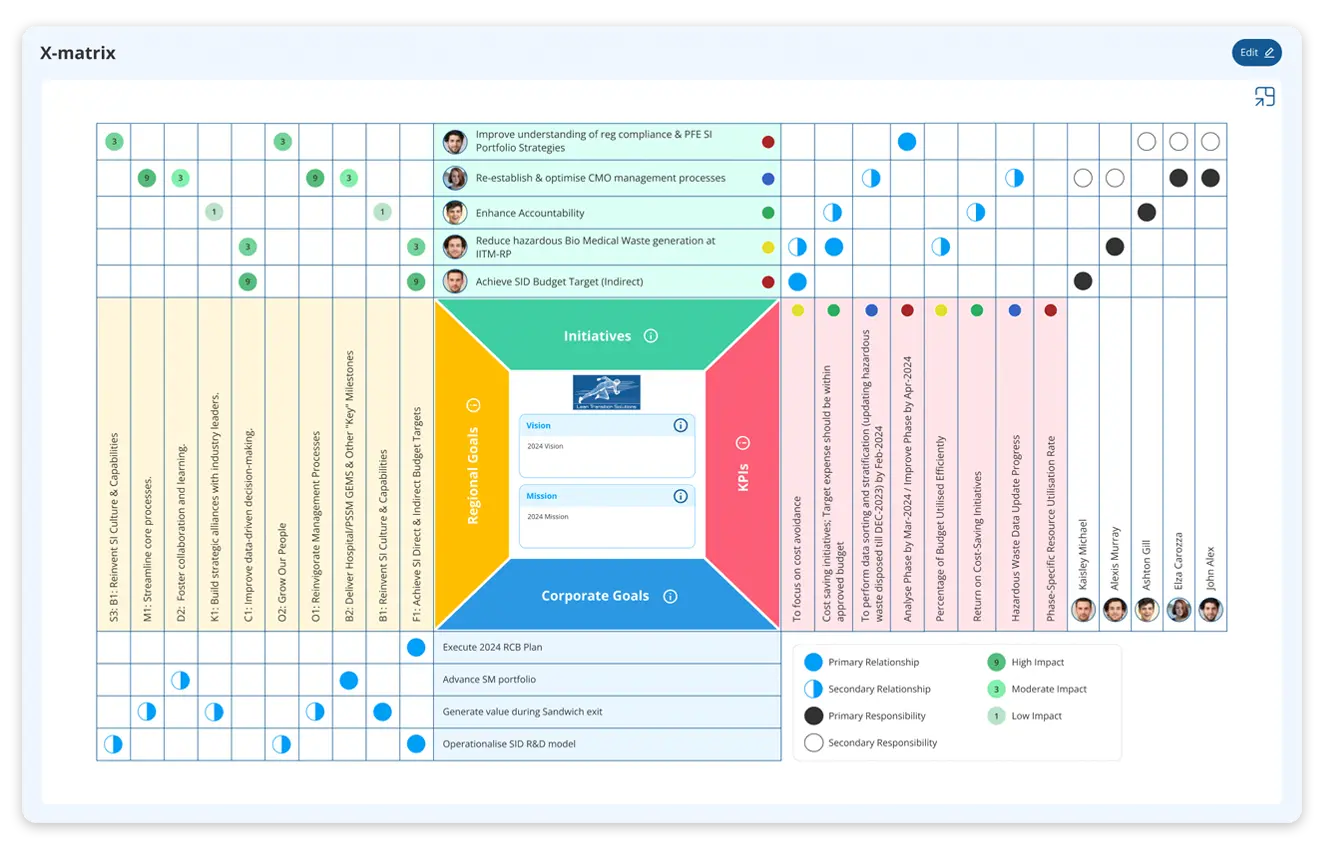
With the Hoshin Kanri X-Matrix, organisations can link strategy to execution through four core elements:
- Long-term goals
X Matrix Hoshin Planning helps to define where the organisation aims to be in three to five years, ensuring alignment with its strategic vision. - Annual objectives
Policy deployment Matrix set clear yearly targets that break the long-term vision into actionable milestones. - Top-level priorities
Hoshin Kanri roadmap identifies the key initiatives and projects required to achieve those annual objectives. - Metrics to improve
Strategic X Matrix track and analyse key performance indicators (KPIs) to measure progress and identify areas for improvement.
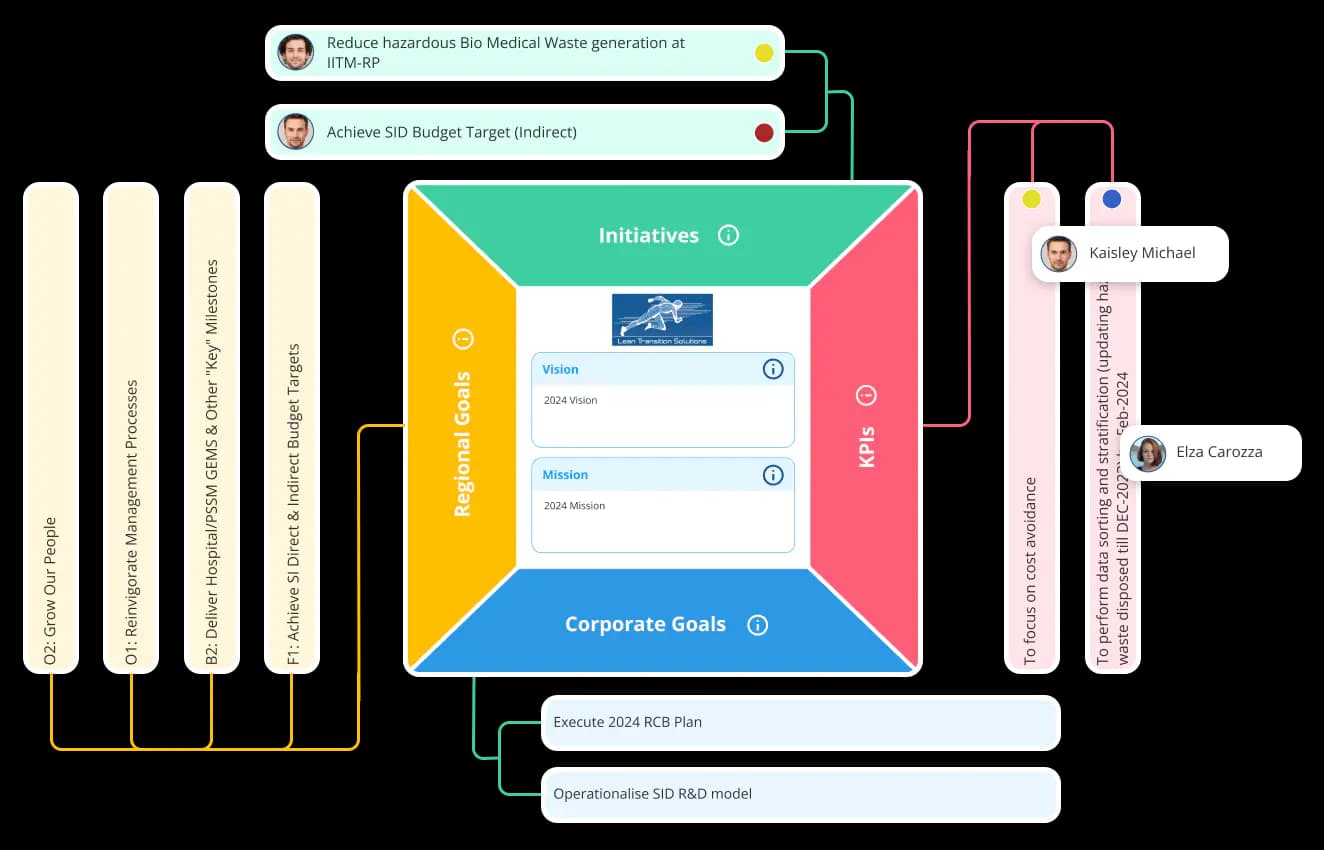
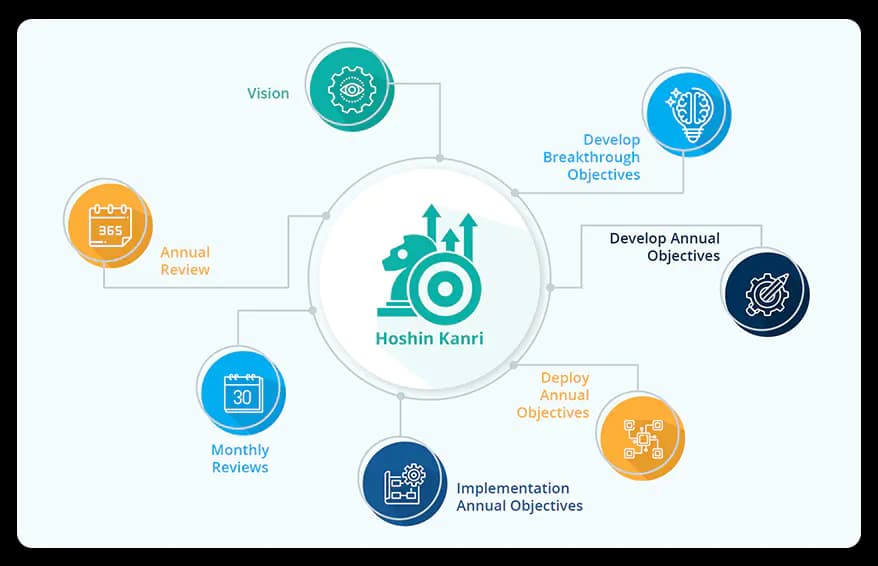
To achieve meaningful results with Hoshin Kanri, follow these key 7 steps—from defining your vision to reviewing outcomes—to ensure every initiative drives progress towards your strategic goals.
- Set the vision
Define your organisation’s vision, mission, and core values. Clearly visualise the long-term destination and purpose. - Identify breakthrough objectives
Establish bold, high-impact goals to achieve within 3–5 years. These should drive significant organisational change. - Define annual objectives
Break down breakthrough goals into yearly targets, assigning responsibility across departments, teams, and individuals. - Deploy objectives
Develop action plans and allocate them to the right people with the necessary skills and resources. - Implement and monitor
Execute the plans while tracking progress against key performance indicators (KPIs) to ensure alignment with the strategy. - Monthly reviews
Hold regular progress reviews to identify challenges early and make timely adjustments. - Annual review and improvement
Evaluate results against the plan, highlight successes, identify gaps, and refine the strategy for the next cycle.
Ready to implement a structured approach to strategic planning?
What the digital Hoshin Kanri X Matrix helps you achieve?
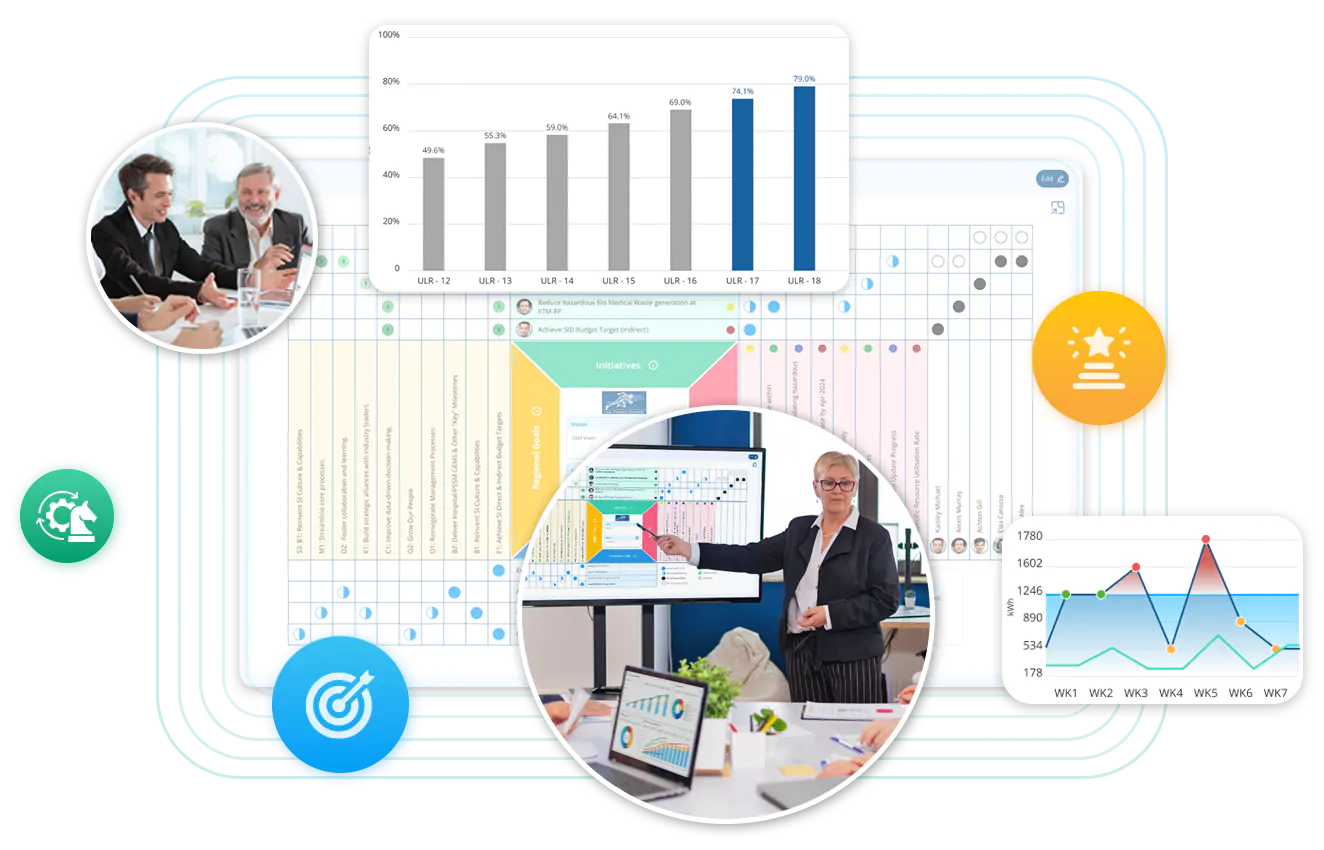
The Data Point Hoshin Kanri X Matrix ensures that high-level business objectives translate into actionable plans. By connecting goals, initiatives, KPIs, and responsible teams, organisations can drive strategic alignment and accountability across all levels.
- Cascades corporate goals down to departments and individuals
- Eliminates misalignment by providing a structured approach to execution
- Ensures clarity in responsibilities and key success factors
Example use case: A plant operations manager used the board to align production schedules with corporate sustainability goals, ensuring daily tasks directly supported a 25% waste reduction target.
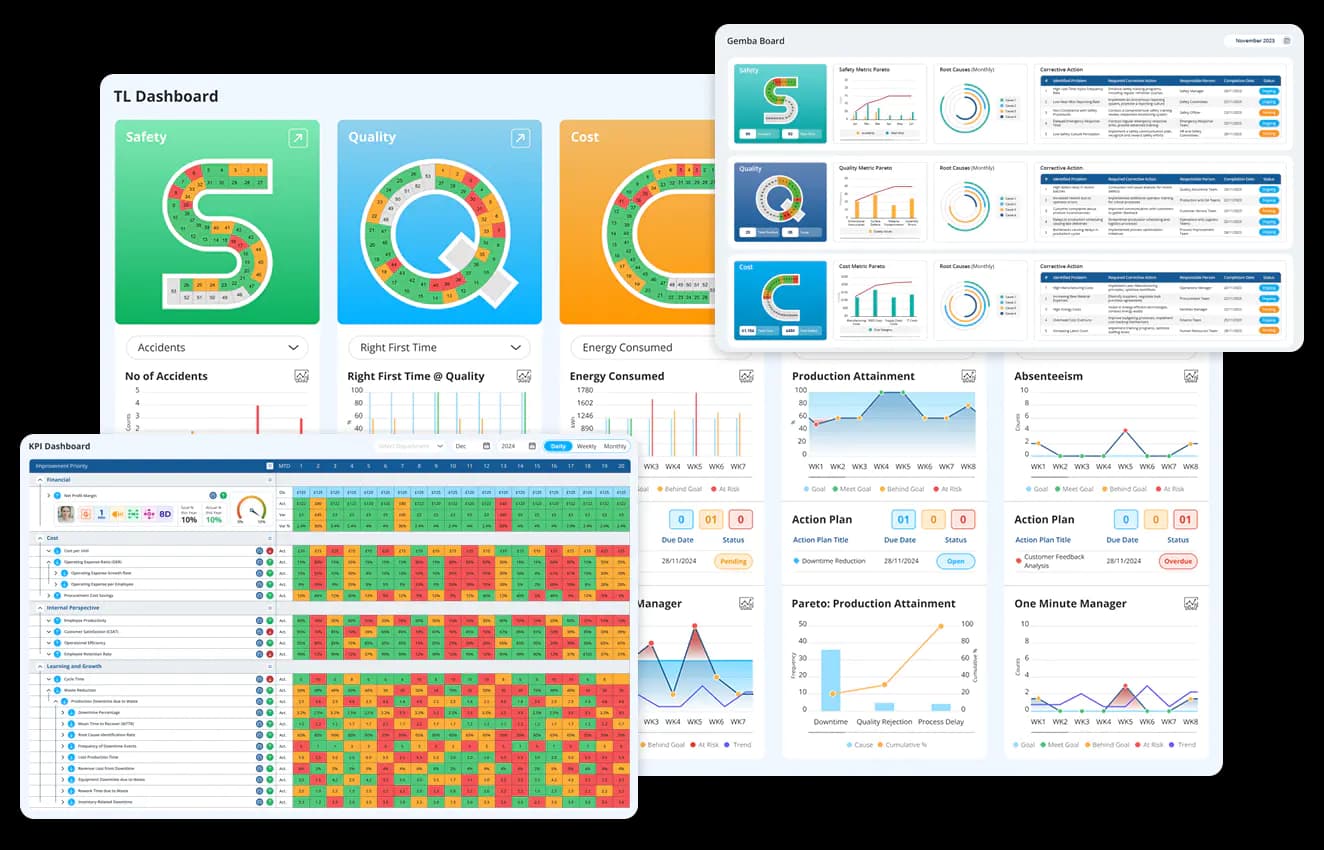
The Data Point real-time dashboards make it easy to track KPIs linked to strategic goals, ensuring organisations stay on top of performance metrics and make informed decisions.
- Provides real-time insights into progress and goal achievement
- Links KPIs directly to initiatives for measurable outcomes
- Enhances decision-making with data-driven performance tracking
Example use case: A regional sales director tracked monthly revenue KPIs in real time, spotting underperforming territories early and reallocating resources to meet quarterly targets.
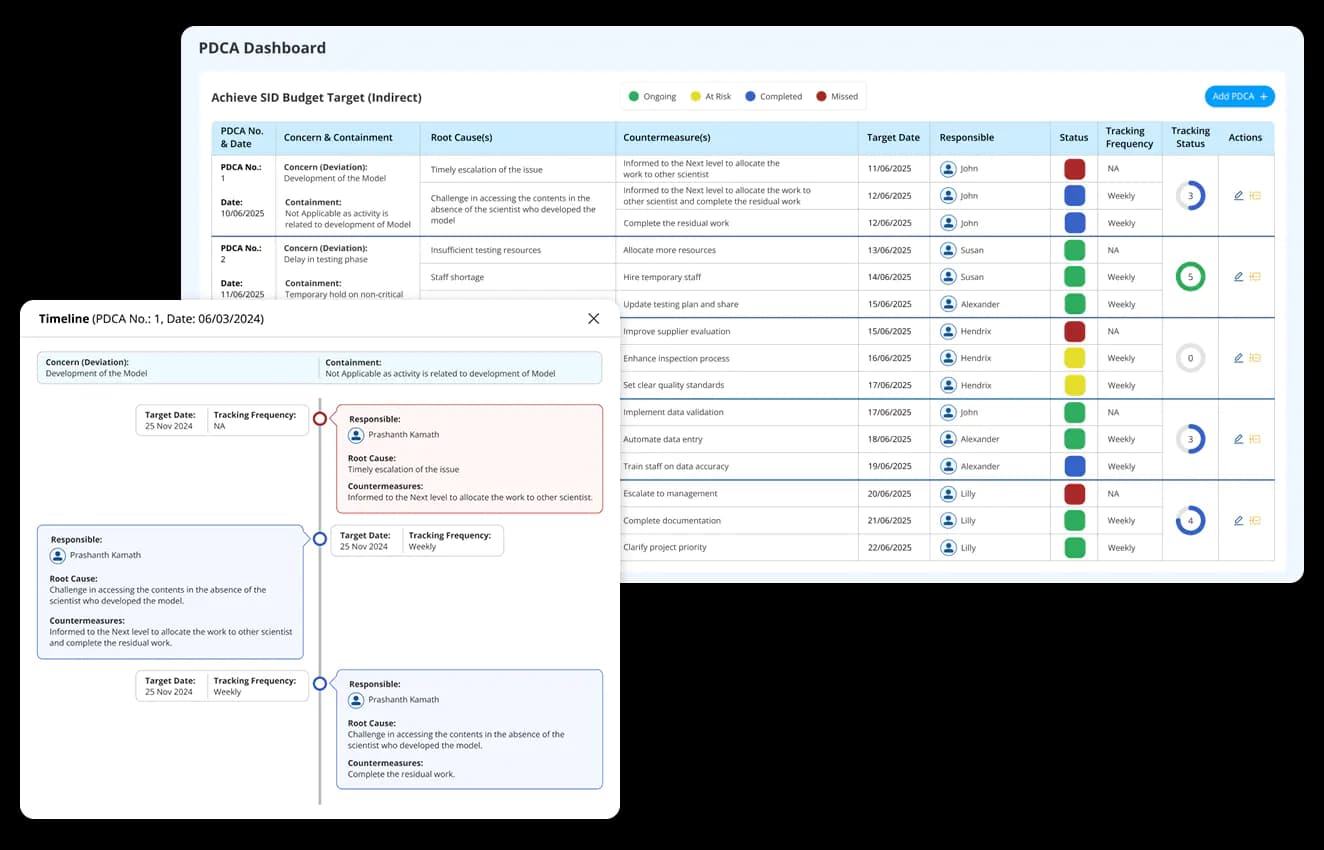
Adapting strategies based on performance is key to long-term success. The Plan-Do-Check-Act (PDCA) cycle in Data Point helps businesses regularly review progress, identify gaps, and refine execution plans.
- Promotes a culture of continuous improvement
- Enables proactive decision-making by identifying risks early
- Refines strategies dynamically based on real-time performance insights
Example use case: A quality control lead ran weekly PDCA cycles through the board, cutting defect rates in a packaging line by 12% within two months.
Get your free Hoshin Kanri X-Matrix Excel template and start aligning goals, KPIs, and priorities today
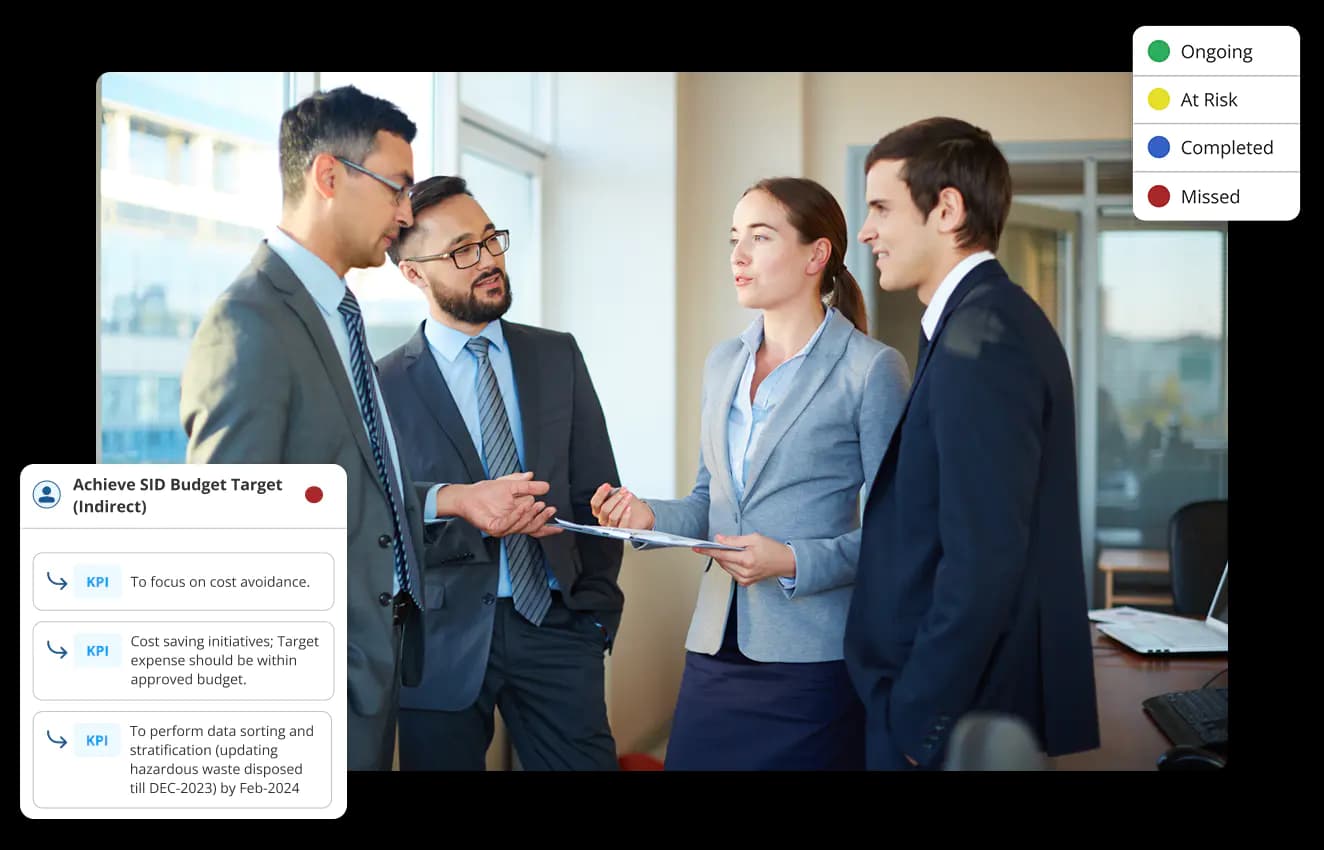
For effective execution, different teams must work together seamlessly. DataPoint’s role-based access and real-time updates foster transparency and collaboration across departments.
- Improves coordination between teams by aligning priorities
- Enhances visibility of strategic initiatives and ownership
- Refines strategies dynamically based on real-time performance insights
Example use case: A project manager shared product development milestones with design and procurement teams, reducing delays caused by missed handovers.
Hoshin Kanri X-matrix lean tool eliminates waste that occurs due to poor communication and inconsistent direction. The ultimate aim of X-matrix is to align strategic goals and plans with organisational initiatives and action plans and to drive continuous improvement across the organisation. Using X Matrix, organisations can cascade goals more effectively.
- Improve total engagement
- Assure better organisational alignment
- Increase employee engagement
- Develop effective strategic plan
- Eliminate roadblocks to success
- Improve communication
- Simplify decision-making

Simplify your startegic planning with Data Point Hoshin Kanri X- Matix board
Choice of industry leaders and Fortune 500 companies


















How Hoshin Kanri X-Matrix transforms your strategic planning?
The Hoshin Kanri X-Matrix simplifies strategic planning by aligning long-term goals, annual objectives, and actionable priorities into a single, cohesive framework.

Goal alignment
Ensure every team works toward shared strategic objectives with a clear roadmap.

Prioritised actions
Identify and focus on key activities that have the most impact on achieving goals.

Performance tracking
Monitor progress with integrated metrics to ensure continuous alignment and improvement.
Drive results with structured X Matrix strategic planning
Learn more about Hoshin Kanri X Matrix


Hoshin Kanri X Matrix: The Complete Guide to Strategic Alignment and Goal Deployment
Learn how Hoshin Kanri X Matrix software helps organisations align strategic goals, cascade objectives, track KPIs, execute initiatives, and connect long-term strategy with daily operational performance.
How do the four directions of the X Matrix (South, West, North, East) work together to structure the plan?
The X shape is not decorative. Each of the four points holds a distinct layer of the strategy, and the relationships between them are what the matrix is designed to expose. Long-term goals sit at one point. Annual objectives sit at another. Top-level priorities and initiatives sit at a third. Metrics to track progress sit at the fourth.
Filling out an X Matrix means starting with long-term direction and working inward; defining where the organisation aims to be in three to five years first, then breaking that into annual objectives, then identifying the specific initiatives required to hit those objectives and finally attaching the metrics that will confirm whether each initiative is actually working. The value of the format is that all four layers sit on one page, so the relationship between a metric and the long-term goal it ultimately supports is visible without flipping between separate documents. Organisations already using OKRs will recognise the structure - annual objectives paired with metrics follows the same underlying logic Objectives and Key Results is built on. A strategy map takes a similar approach from a different angle, using cause-and-effect relationships across financial, customer, process, and learning perspectives rather than the X-Matrix's four-direction layout
How does the PDCA cycle integrate with X Matrix objectives to keep the plan adjusting as conditions change?
A strategy set once a year and executed without revision assumes the assumptions behind it will hold for twelve months. In practice, conditions change faster than that, and a plan with no built-in mechanism for adjustment either gets quietly ignored when it stops fitting reality or gets formally revised only at the next annual cycle, by which point the gap has already cost time.
Running Plan-Do-Check-Act cycles against the X Matrix objectives gives the plan a shorter feedback loop than the annual review alone provides. Progress is reviewed, gaps are identified, and execution plans are refined within the year, not just at the end of it. This is what keeps the X Matrix a living framework rather than a document that describes intentions that may no longer match what is happening on the ground.
How does role-based, real-time access change collaboration between departments working on interdependent initiatives?
Strategic initiatives frequently depend on more than one department delivering their part on time. A product development milestone that depends on design and procurement both finishing their pieces on schedule is only as reliable as the visibility each team has into the other's progress.
Role-based access with real-time updates means each team sees the status of interdependent initiatives as they happen, not through a status meeting scheduled after a delay has already occurred. This is what prevents the specific failure mode where one team assumes another has completed their part, proceeds accordingly, and only discovers the handover was late once their own deadline is already at risk.
What is the difference between a monthly review and an annual review within the same X Matrix, and why do both cadences matter?
A single review cadence, whichever frequency is chosen, misses something. Reviewing only annually means problems compound for months before anyone formally checks whether the plan is on track. Reviewing only monthly, without a longer-horizon check-in, risks losing sight of whether the broader multi-year direction still holds.
Monthly reviews are built for catching execution problems early, identifying where a specific initiative or KPIs has drifted off track while there is still time in the year to correct it. The annual review serves a different purpose: evaluating the full year's results against the original plan, identifying what worked and what did not, and refining the strategy for the next cycle. Running both means short-term course correction and long-term strategic learning happen on the timeline each requires, rather than being forced into a single review rhythm that serves neither well. This two-tier review rhythm mirrors the review-and-evaluation stage of the broader strategic planning and management process, which treats performance evaluation as its own distinct step rather than an afterthought.
How does the seven-step Hoshin Kanri process translate into something a digital X Matrix tracks, rather than just describes?
The seven-step methodology, from setting the vision through to annual review, is often presented as a planning philosophy. The harder question is what happens to each step once the planning workshop is over and the organisation moves into execution.
A digital X Matrix gives each step somewhere to live beyond the workshop. The vision and breakthrough objectives are captured once and remain visible throughout the cycle rather than existing only in a slide deck. Deploying objectives means action plans are assigned to specific people with the resources attached, not just discussed. Implementation and monitoring happen against live KPI data rather than a status update someone compiles for the next meeting. The monthly and annual review steps then have something concrete to review: a record of what was tracked and how it moved, not a reconstruction from memory of what was agreed months earlier.
How does cascading a corporate goal down to department and individual level avoid the disconnect that usually happens between strategy and daily work?
A corporate sustainability target set at leadership level does not automatically tell a production supervisor what to do differently on a Tuesday. The gap between a strategic statement and a specific daily task is where most strategy execution fails, not at the point the goal was set.
Cascading corporate goals down to departments and individual within the same matrix structure means the daily task a supervisor is scheduling is explicitly linked back to the corporate objective it supports. This is different from simply communicating the goal downward. It means the connection is structurally built into the plan, so a plant operations manager aligning production schedules with a sustainability target is working from the same matrix the corporate objective was defined in, not interpreting a summary of it second-hand. For a broader look at how this cascading process works across frameworks beyond the X-Matrix, see our complete guide to cascading strategy.
How does linking KPIs directly to initiatives change what a leadership review discusses?
A review meeting built around initiative status updates tends to become a discussion of activity rather than impact. A team can report that an initiative is progressing on schedule while the KPI it was meant to move has not actually shifted, and that disconnect only becomes visible if someone specifically checks for it.
Linking KPIs directly to the initiatives meant to influence them closes that gap. The review is not asking whether the initiative is on schedule in isolation. It is asking whether the initiative is producing the intended effect on the metric it exists to move. A regional sales director tracking territory-level revenue in real time can identify underperformance and reallocate resource within the same cycle, rather than waiting for a quarterly report to confirm what was already visible in the data weeks earlier.
How does integration with other lean tools like SQDC boards, Gemba boards, and OEE monitoring keep the X Matrix connected to daily operational reality?
A strategic framework that exists separately from the tools teams use every day risks becoming an exercise leadership engages with while operational teams continue working from entirely different systems. The X Matrix objectives can look complete on paper while having no actual touchpoint with the daily huddles and shopfloor reviews where real operational decisions get made.
Integrating the X Matrix with SQDC boards, Gemba boards, and OEE monitoring systems means the strategic layer and the daily operational layer are working from connected data rather than parallel, disconnected processes. A deviation flagged during a daily Gemba walk can be traced back to the strategic initiative it affects, and progress on that initiative reflects the same data being reviewed on the shopfloor. For teams wanting to understand the mechanics of goal negotiation across these levels in more depth, the Hoshin Kanri catchball process is where that cross-level alignment gets formally negotiated rather than simply cascaded downward.
Hear it from our customers

MARC ROBINSON
Director, Global Operational Excellence


“By providing a central location to input, analyse and share our KPIs, 'Data Point' enables site management to more easily focus on the entire business as a team. Its ability to allow automated data entry and trend analysis gives us more time for improvement rather than just reporting numbers. Combined with a disciplined approach within our SQDC meeting process, I believe 'Data Point' will help us continually focus on key issues and drive business excellence in all areas.”
Align your vision with Hoshin Kanri X-Matrix
Share your goals and priorities to power up strategic focus and drive unstoppable progress!