Take the free SQCDP quiz now and see if your team meets SQCDP standards
Last updated on : July 23, 2025
You track production numbers. You monitor quarterly budgets. But if you’re not measuring Safety, Quality, Delivery, Cost, and People (SQCDP) in real time, you’re flying blind.
A machine malfunction results in extensive downtime. A disengaged team leaks 20% of productivity. When delivery service is delayed it causes customers to lose trust in the business. The catch? Most leaders think they’re on top of SQCDP—until a crisis hits.
Take this 5-minute SQCDP Performance Self-Assessment quiz to uncover your hidden gaps and for daily SQCDP checks in lean manufacturing. Then, learn how a digital SQCDP board or SQDCP dashboard like Data Point Balanced Scorecard automates tracking, so you can prevent fires instead of fighting them. Also include this SQCDP quiz as a Lean manufacturing audit quiz in your continuous improvement checklist for best organisational performance management.
Great teams don’t just measure SQCDP — they fix it fast with digital dashboards
Are you really measuring performance? Take this free SQCDP quiz
Through effective SQCDP management organisations not only prevent risks but create resilient teams that work efficiently and maintain high levels of motivation. However, with a lack of clear visibility into these metrics, a well-intentioned process can fall short. That is why you need to test your SQCDP knowledge. This SQCDP quiz will help you understand the path to operational excellence.
Why does an SQCDP quiz matter?
This SQDCP quiz is designed to help you objectively assess how your organisation identifies, measures, and acts on SQCDP data. Unlike generic audits, it focuses on:
- Actionable insights: Pinpoint gaps between intent and execution.
- Cultural alignment: See if frontline teams and leadership share the same priorities.
- Process efficiency: Evaluate whether manual workflows are slowing progress.
Why does your participation matter?
- For leaders: Uncover gaps between strategy and execution.
- For teams: Highlight cultural or process barriers to success.
- For growth: Turn insights into an actionable plan.
How the SQCDP Quiz works: Simple steps to evaluate your SQCDP health
Answer honestly
Answer the 10 questions related to SQDCP metrics. Each question focuses on one SQCDP pillar (Safety, Quality, Delivery, Cost, People). Select the option that best reflects your current practices and note down the point.
Use the SQCDP scorecard
Every answer earns points based on maturity. Each option contains a particular score.
🟥 1 point = Reactive
🟨 2 points= Progressing
🟩 3 points= Proactive
Here is the quiz:
Calculate and find your SQCDP score
Add up your points (max 30). Your score reveals how effectively your organisation translates SQCDP goals into daily actions.
- 10–15 Points: Foundation Phase
Your organisation is reactive, relying on manual efforts or outdated systems. This creates risks like missed safety incidents, quality defects, or budget overruns.
- 16–25 Points: Building Momentum
You’re tracking SQCDP metrics, but gaps in consistency or visibility hinder progress. This creates disconnected workflows, partial automation, and delayed decision-making.
- 26–30 Points: Leading the Way
Your organisation proactively aligns SQCDP goals with daily operations. This helps to maintain accountability and strategic agility.
You measured your SQCDP performance. What is next?
Scoring your SQCDP performance is with an SQDCP quiz is only the beginning. The real value lies in what you do next.
Whether your organisation is in the Foundation Phase, Building Momentum, or already Leading the Way, your quiz results act as a mirror—revealing blind spots, missed opportunities, and strengths to leverage. Here’s how to use your score as a strategic starting point:
- Identify immediate priorities
Focus on the lowest-scoring pillars (e.g., Safety, Cost, or People). These are your high-impact improvement areas. Use your results to guide your next improvement sprint or team discussion.
- Start conversations
Share your score with department leaders or cross-functional teams. Openly discussing where you stand helps align perceptions and foster shared responsibility for improvement.
- Build a roadmap
Use your insights to create an action plan. What can be digitised? Which metrics need better visibility? Where are bottlenecks most harmful? Translate ideas into small, measurable steps.
- Reassess regularly
Make SQCDP assessments a habit. Quarterly or monthly pulse checks can reveal trends and ensure you’re moving in the right direction.
- Upgrade to a digital system
Manual tracking leads to delay, inconsistency, and miscommunication. As you’ve now measured your performance, the next step is enabling it—digitally. Data Point’s SQCDP dashboard helps teams automate monitoring, close feedback loops faster, and align efforts across every function.
Turn SQCDP quiz insights into action: How to elevate your SQCDP performance with Data Point Balanced Scorecard Software?
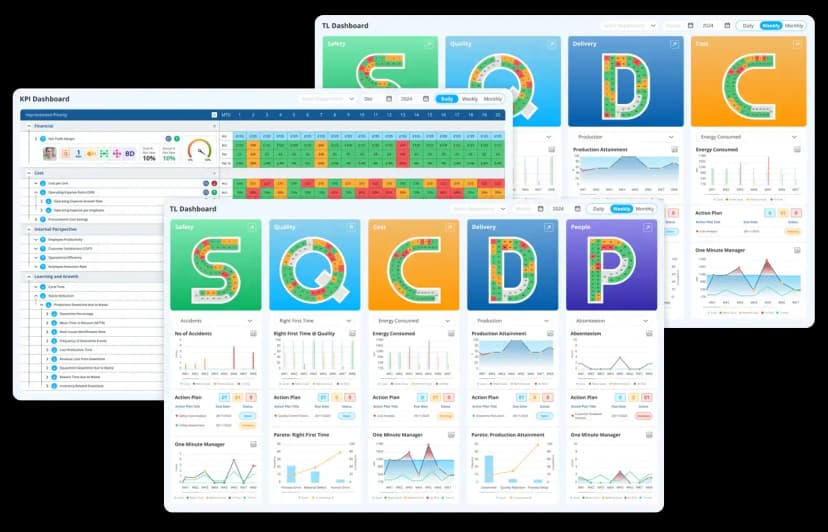
No matter what your score, closing gaps and sustaining progress requires the right digital tools. Here is where Data Point Balanced Scorecard software plays a crucial role as the best example of lean daily management system with its digital SQCDP board.
Wherever you are in your SQCDP journey—foundation phase, building momentum, or leading the way, Data Point delivers the right tools to elevate performance. Data Point provide the best digital SQCDP performance tracking tools, that can help your business achieve the desired goals with continuous improvement. Here’s how its real time SQCDP dashboards can transform your approach:
- Automate tracking: Replace manual spreadsheets with live dashboards for Safety, Quality, Cost and other metrics as per your requirement.
- Standardise processes: Turn audits and incident reports into actionable workflows.
- Integrate systems: Sync Delivery and People data across departments for end-to-end visibility.
- Optimise strategically: Leverage predictive analytics to stay ahead of market shifts.
- Scale excellence: Embed SQCDP accountability into every team.
- Real-time alerts: Instant notifications for safety breaches, quality defects, cost overruns, or delivery delays.
- Automated action plans: Make corrective action plans if any KPIs fail.
- Smart reporting: Generate compliance reports, KPI summaries, or executive briefings in one click.
- Customised solution: Provide balanced scorecard integrated customisable dashboards for every team.
Stop guessing, start solving with Data Point
Whether you’re fixing gaps or refining excellence, Data Point- the SQCDP visual management software gives you the tools to:
- Act faster with real-time alerts and action plans.
- Analyse smarter with Pareto and RCA tools.
- Align teams with visual, data-driven dashboards.
Ready to lead? Get your custom SQCDP Dashboard today!
FAQs
1. How can I evaluate my SQCDP performance?
You can assess your SQCDP performance with a free self-assessment test that highlights improvement areas and recommends digital solutions.
2. Why should I take the Safety, quality, delivery, cost and people performance quiz?
A structured SQCDP assessment framework allows you to compare your current tracking approach with industry benchmarks and best practices. This quiz helps you assess how well your team tracks SQCDP metrics and identifies improvement areas for better operational efficiency.
3. Who should take the SQCDP self-assessment?
Manufacturing managers, supervisors, and continuous improvement teams looking to evaluate and enhance their SQCDP practices.
4. How can I improve my SQCDP performance based on my test results?
Focus on automating data collection, using digital SQCDP boards, and enhancing real-time visibility to address weak areas highlighted in your evaluation.
5. How can I start implementing a digital SQCDP system?
Start by assessing your current SQCDP tracking process, identifying gaps, and exploring digital solutions that integrate with your existing workflows.

Amer Jumah, Senior Lean Consultant
Amer is co-founder of Agile Solutions and a certified Six Sigma Black Belt, Lean Black Belt, and PMP, with over nine years of experience implementing Lean, Six Sigma, and Agile principles across diverse industries. He specialises in process optimisation, waste elimination, and delivering cost savings through organisational change.