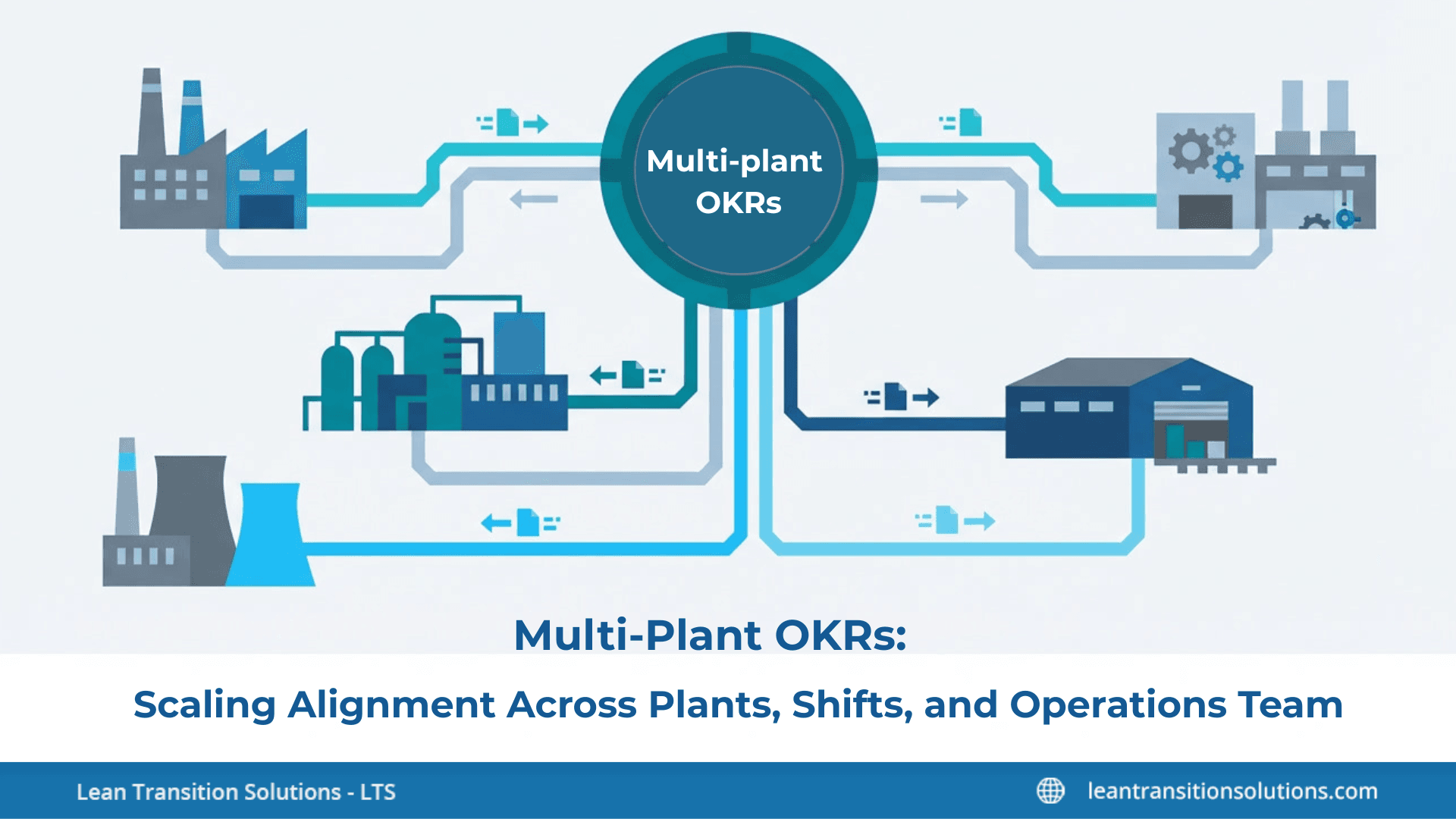
Multi-Plant OKRs: Scaling Alignment Across Plants, Shifts, and Operations Team
Last updated on : January 28, 2026
Managing multi-plant OKRs is one of the biggest challenges for operations teams. When objectives and key results span multiple plants, shifts, and teams, keeping alignment, visibility, and accountability becomes complex. Without a structured approach, OKRs risk becoming static documents rather than tools for operational execution. This guide explores the role of multi-plant OKRs in complex environments, how operations teams plan multi-plant OKRs across plants and shifts, how to structure key results for multi-plant OKRs without losing local relevance, what to consider when managing the OKR process across distributed operations teams, tracking multi-plant OKRs across operations without manual reporting, and why operations teams use LTS Data Point to scale multi-plant OKRs.
See how multi-plant OKRs are tracked across plants and shifts using LTS Data Point
Multi-plant OKRs in complex operations environments
Running multi-plant objectives and key results (OKRs) across multiple plants introduces execution challenges that go beyond goal setting. In complex operations environments, teams often struggle to balance OKRs with existing performance measures – raising practical questions around OKR vs KPI usage in daily operations.
Key realities operations teams face include:
- Distributed accountability: Objectives may be shared, but ownership of outcomes varies across plants, shifts, and roles.
- OKR vs KPI tension: Key performance indicators(KPIs) track ongoing performance, while OKRs drive change – confusion between the two can slow execution.
- Shift and plant variations: Operational processes, capacity, and KPIs differ, impacting how objectives and key results are applied.
- Limited cross-plant visibility: Without clear monitoring, it’s difficult to see progress across the entire operations network.
- Consistent alignment: Multi-plant OKRs ensure each plant contributes to overall strategic goals.
- Operational focus: OKRs must connect directly to daily activities, not remain high-level statements.
- Scalable execution: Properly structured OKRs allow operations teams adapt and maintain focus as plants grow or new shifts are added.
By identifying these realities early, operations leaders can design OKRs that drive clarity, accountability, and computable results across all sites.
How operations teams plan multi-plant OKRs across plants and shifts
Effective OKR planning verifies that multi-plant OKRs are aligned across all sites and shifts. For operations teams, structured planning prevents misalignment and keeps execution focused.
Key considerations include:
- Defining clear objectives: Begin with strategic goals and translate them into quantifiable OKR goals for each plant.
- Involving local teams: Make sure site managers and shift leaders participate when setting OKRs to capture local nuances.
- Prioritising alignment: Cross-check objectives to avoid conflicts between shifts or plants.
- Standardising cadence: Establish consistent planning cycles so all OKRs for operations managers follow the same timeline.
- Linking to daily operations: Each objective should bind to tasks, KPIs, and outcomes relevant to the team’s daily work.
- Recording expectations: Keep plans transparent to enable accountability tracking across all plants.
By embedding these steps in OKR planning, operations leaders ensure setting OKRs translates into practical execution that scales across plants and shifts.
Discuss how multi-plant OKRs can be structured and tracked across complex operations environments
Structuring key results for multi-plant OKRs without losing local relevance
Designing effective key results for multi-plant OKRs means balancing network-wide alignment with local plant realities. Each site may have different processes, shifts, and production challenges, so a one-size-fits-all approach rarely works. Operations teams must customise objectives and key results while making sure they contribute to overall strategic goals.
Multi-plant OKR examples by site
Here's how an OKR system can be adapted across different plants:
Plant A – High-volume production
- Objective: Improve production efficiency
- Key results: Increase first pass yield by 5%, reduce lead time by 8%
- Focus: Streamlined workflows for high-output operations
Plant B – Customised orders
- Objective: Enhance order fulfilment accuracy
- Key results: Achieve 98% on-time delivery, maintain <2% defect rate
- Focus: Flexible scheduling and quality control
Plant C – Mixed shifts, multi-line operations
- Objective: Reduce operational bottlenecks
- Key results: Improve OEE by 10% across all lines, implement live OKR tracking software for shift handovers
- Focus: Visibility and cross-shift accountability
Plant D – New automation line
- Objective: Maximise automation uptime
- Key results: Accomplish 95% machine up-time, reduce scrap rate by 5%
- Focus: Integration of OKR tracking with automated alerts
Explore how LTS Data Point supports OKR tracking and execution visibility for distributed operations teams
Managing the OKR process across distributed operations teams
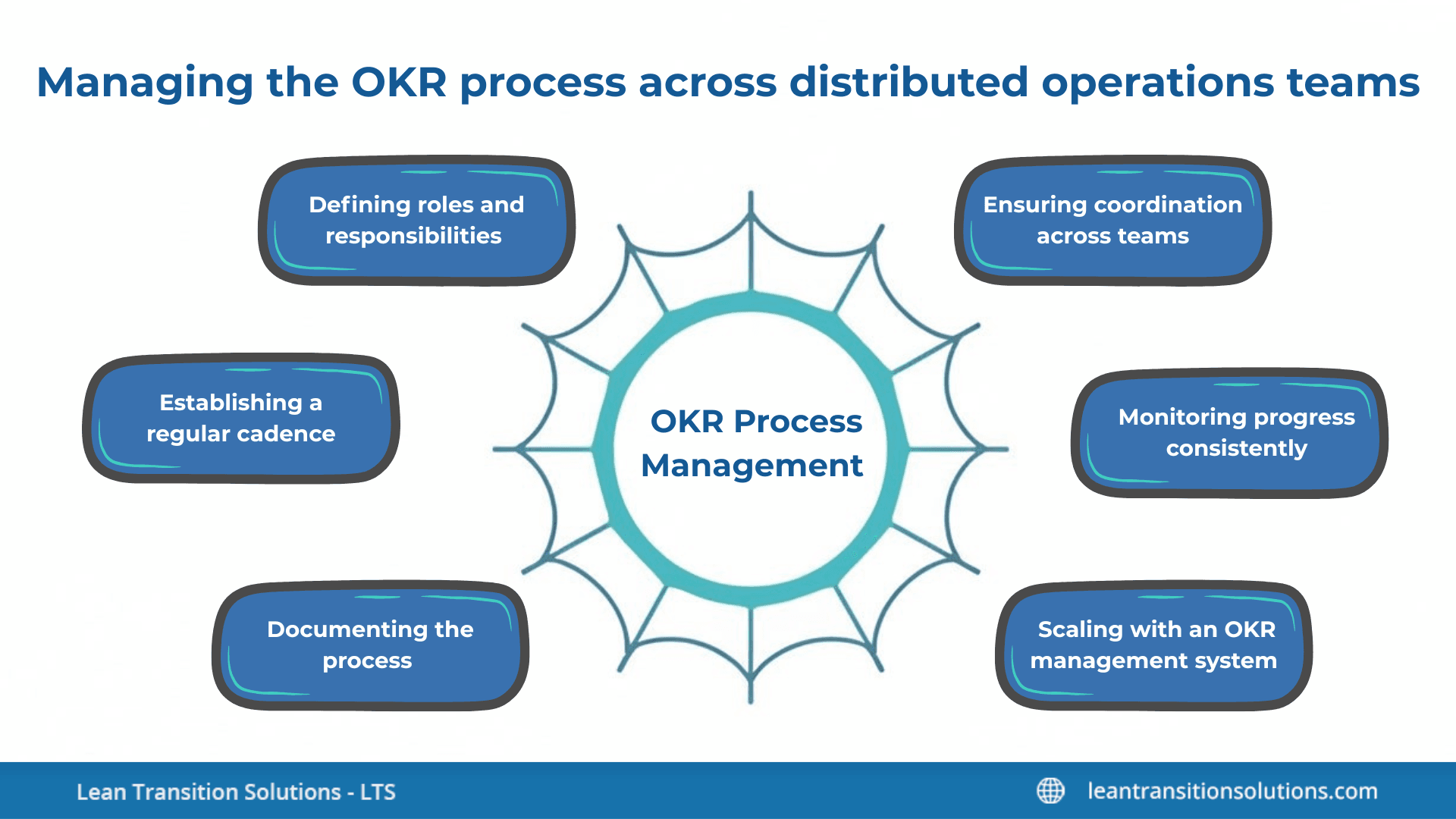
For operation leaders, establishing a clear OKR process is critical when teams are spread across multiple plants and shifts. Success relies on consistent cadence, defined ownership, and coordinated execution.
Key consideration include:
- Defining roles and responsibilities: Assign ownership for each objective and key result to verify accountability at plant, shift, and team levels.
- Establishing a regular cadence: Schedule planning, check-ins, and reviews so all teams follow the same OKR methodology.
- Documenting the process: Standardised procedures for updating, reporting, and observing objectives help maintain clarity across the network.
- Ensuring coordination across teams: Use shared communication channels or an OKR system to align cross-functional teams and prevent duplicated efforts.
- Monitoring progress consistently: Regular reviews help teams adapt quickly, maintaining focus on achieving results rather than just reporting them.
- Scaling with an OKR management system: A central platform guarantees distributed teams can manage objectives efficiently while maintaining transparency across the enterprise.
A well-managed OKR process transforms distributed operations into a coordinated, accountable, and goal-driven network – enabling leaders to scale objectives without losing execution focus.
Tracking multi-plant OKRs across operations without manual reporting
Maintaining visibility over multi-plant OKRs is critical for operations teams. Manual reporting often slows decision-making and reduces accuracy. Effective OKR tracking ensures alignment, accountability, and timely interventions.
Key practices include:
- Centralised tracking: Use a single platform to observe objectives and key results across all plants and shifts. This supports consistent OKR tracking software usage.
- Live updates: Allow teams to update progress immediately, offering leadership with precise insights without waiting for reports.
- Automated notifications and reminders: Keep teams on schedule for OKR project management, lowering the risk of missed key results.
- Dashboards for visibility: Custom dashboards help operations managers quickly detect bottlenecks or underperforming plants.
- Integration with existing systems: A unified OKR software approach links production, quality, and performance metrics with objectives.
- Historical performance tracking: Calculate trends over time to adjust strategy and enhance future OKR tracking cycles.
Implementing structured OKR tracking empowers operations teams to maintain focus, accelerate execution, and enhance accountability – without the delays or errors of manual reporting.
Get guidance on improving OKR execution and visibility across distributed operations teams
Why operations teams use LTS Data Point to scale multi-plant OKRs
As multi-plant OKRs mature, operations teams often outgrow spreadsheets and disconnected tools. Scaling objectives across plants and shifts requires an OKR management system that assists visibility, accountability, and execution – without adding operational overhead.
Operations teams typically choose LTS Data Point as an OKR management platform when they need to:
- Maintain a single source of truth: A central OKR system ensures objectives and key results remain consistent across all plants and teams.
- Enable role-based visibility: Leaders, plant heads, and shift managers can view OKR progress relevant to their responsibilities.
- Connect OKRs to execution: LTS Data Point is designed to link OKR monitoring with operational workflows rather than static reporting.
- Support cross-plant coordination: Distributed teams can manage dependencies and alignment through a shared OKR software environment.
- Scale without complexity: The platform assists enterprise-wide OKR project management without needing heavy customisation of framework dependency.
Operations teams adopt LTS Data Point as an OKR management system when they require scalable visibility and execution control across multiple plants – while keeping OKRs grounded in daily operations.
Step-by-step guidance to implement multi-plant OKRs using LTS Data Point
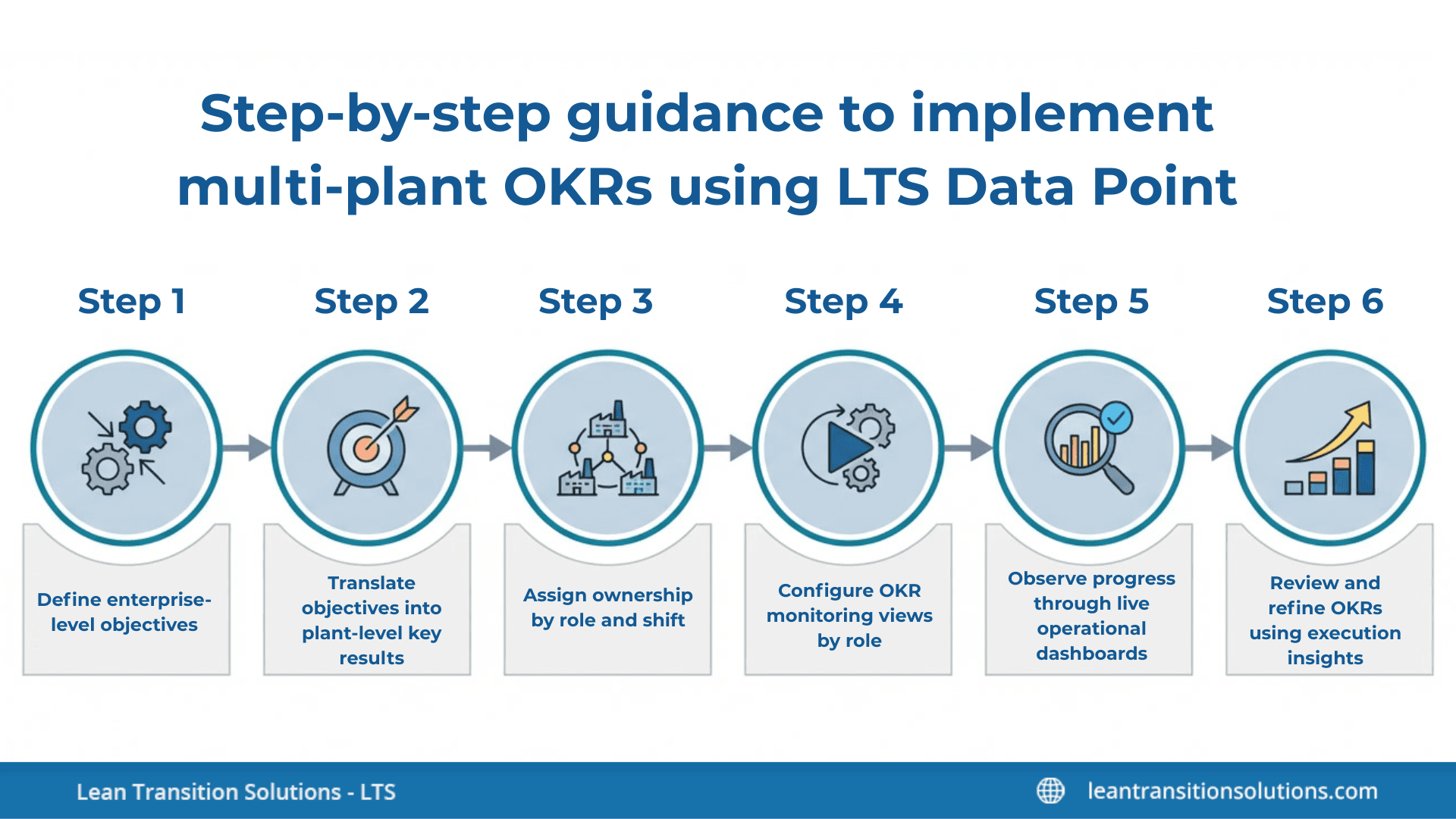
For operations teams scaling multi-plant OKRs, implementation works best when execution visibility is built in from the start. A typical approach using LTS Data Point as an OKR software platform follows these steps:
Define enterprise-level objectives
Set objectives that reflect shared operational priorities across all plants, such as throughput, quality, or delivery performance.
Translate objectives into plant-level key results
Break each objective into measurable key results that account for local processes, capacity, and constraints at each plant.
Assign ownership by role and shift
Clearly allocate responsibility to plant heads, shift leads, and team owners to verify accountability at every execution level.
Configure OKR monitoring views by role
Set up role-based views so leadership, plant managers, and operations teams see only the OKRs relevant to them.
Observe progress through live operational dashboards
Track OKR progress continuously using real-time dashboards instead of depending on manual status updates or spreadsheets.
Review and refine OKRs using execution insights
Use performance trends and execution data to adjust OKRs regularly and keep them aligned with operational realities.
This step-by-step approach allows LTS Data Point as an OKR management system to support consistent execution, clear accountability, and scalable visibility across multiple plants – without adding reporting overhead.
Key takeaways for operations teams
Scaling multi-plant OKRs needs more than shared objectives – it relies on organised planning, locally relevant key results, disciplined execution, and continuous visibility across plants and shifts. With LTS Data Point, operations teams can achieve:
- Scale multi-plant OKRs with consistent visibility across plants and shifts using LTS Data Point as an OKR management system.
- Translate enterprise objectives into plant-level key results without losing local relevance.
- Maintain clear ownership and accountability across distributed operations teams.
- Track OKR progress in real time and reduce dependence on manual reporting.
- Use execution insights from LTS Data Point to review, refine, and sustain OKRs at scale.
When operations teams manage OKRs as a linked system rather than isolated goals, alignment improves, accountability becomes clearer, and execution remains consistent at scale. The right OKR management approach enables leaders to translate strategy into daily operational outcomes across complex, distributed environments.
Consult an expert on aligning objectives and key results across multi-plant operations
FAQs
1. How often should multi-plant OKRs be reviewed?
Most operations teams review multi-plant OKRs monthly, with lighter weekly check-ins to monitor execution and address issues early.
2. Can different plants use different metrics under the same OKR?
Yes. While objectives remain consistent, key results can vary by plant to reflect local processes, capacity, and constraints.
3. Who would own OKRs in a multi-plant operations setup?
Ownership is typically shared between enterprise leadership for objectives and plant or shift leaders for execution-level key results.
4. How many OKRs should operations teams manage at once?
To maintain focus, most teams limit active OKRs to 3-5 objectives per cycle, with a small number of measurable key results.
5. Do multi-plant OKRs work for both discrete and process manufacturing?
Yes. The structure remains the same, but key results are tailored to production models, workflows, and operational priorities.
6. How do operations teams handle conflicts between plant-level OKRs?
Conflicts are resolved by prioritising enterprise-level objectives and adjusting local key results to maintain alignment.
7. Can multi-plant OKRs be linked to daily operational metrics?
Yes. Many teams connect OKRs to operational metrics such as throughput, quality, or delivery performance for better execution tracking.
8. What is the biggest challenge when scaling OKRs across plants?
The most common challenge is maintaining visibility and accountability without increasing manual reporting or administrative overhead.

Geandra Queiroz, Operations Management Consultant
Geandra is an Operations Management Consultant at Lean Transition Solutions, specialising in Lean philosophy, Lean Six Sigma, and strategic planning across manufacturing and healthcare. She is currently completing her PhD in Industrial Engineering at the Federal University of São Carlos, researching the integration of Operations Strategy, Lean, and Green Manufacturing.