OKRs vs KPIs: Understanding the Differences (With Examples)
Last updated on : January 14, 2026
OKRs vs KPIs is one of the most common comparisons organisations make when improving goal setting and performance management. While both frameworks help teams measure success, they serve very different purposes. Understanding the difference between OKRs vs KPIs, and how to use them together is essential for executing strategy effectively.
This guide explains OKRs vs KPIs in simple terms, with examples, comparisons, and practical guidance to help you decide when to use each framework.
What are OKRs?
OKRs (Objectives and Key Results) are a structured goal-setting framework designed to align teams around strategic priorities. Popularised by Intel and later adopted by companies like Google and LinkedIn, OKRs focus on direction, alignment, and outcomes, not just activity tracking.
An effective OKR framework consists of two components:
Objectives
An Objective is a clear, qualitative statement describing what you want to achieve within a defined timeframe (typically quarterly or annually). Objectives should be ambitious, easy to understand, and strong enough to guide decision-making across teams.
Key results
Key Results are measurable outcomes that indicate whether the objective is being achieved. Strong key results act as OKR metrics and are written to be SMART.
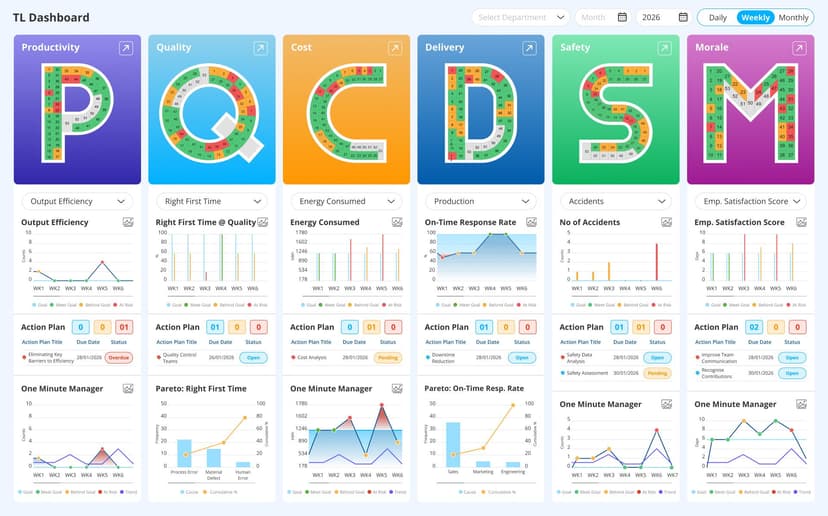
Digital platforms like Data Point help teams manage OKRs visually and connect them directly to execution.
OKR examples (Company and Team Level)
Company-level OKR
🔹Objective: Improve operational efficiency across manufacturing plants
🔹Key Results:
- Increase OEE from 72% to 80%
- Reduce unplanned downtime by 15%
- Decrease rework incidents by 20%
Team-level OKR
Objective: Improve on-time delivery for customer orders
Key Results:
- Increase on-time delivery rate from 90% to 97%
- Reduce order processing delays by 25%
- Improve cross-team handoff accuracy to 98%
These examples highlight how OKRs define direction, while metrics confirm progress.
Benefits of implementing OKRs in an organisation
- Performance monitoring: KPIs provide objective insight into what is working and what is not.
- Accountability: Clear targets help teams own results. Read The power of digital Accountability Boards for Organisational Excellence.
- Benchmarking: KPIs allow comparison across teams, plants, or industry standards.
- Data-driven decisions: Historical KPI trends support better planning and optimisation.
- Continuous Improvement: The iterative nature of OKRs fosters a culture of learning and continuous
OKRs vs KPIs: Key differences
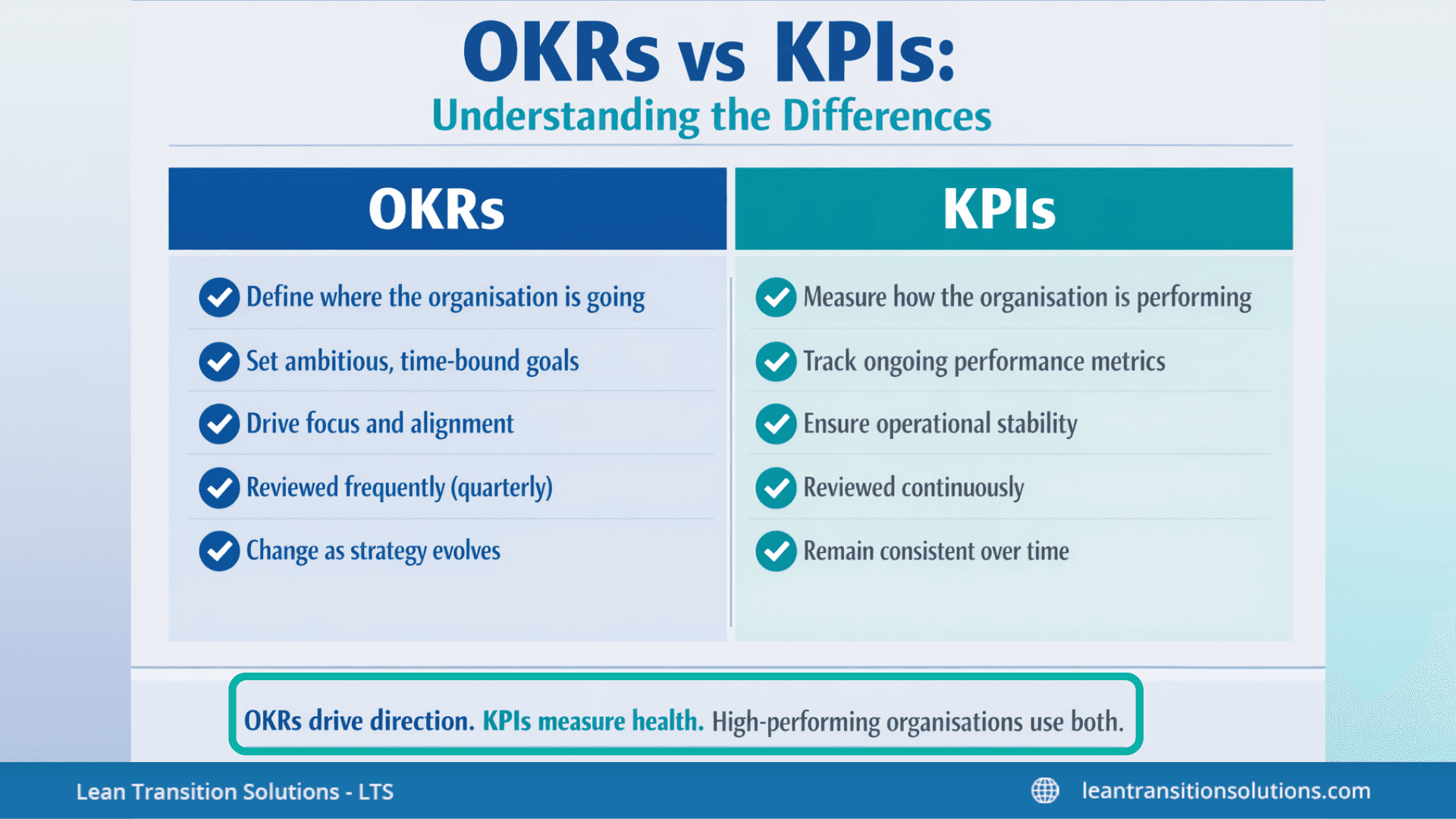
Understanding OKRs vs KPIs becomes easier when viewed side by side.
OKRs vs KPIs comparison table
OKRs vs KPIs are not competing frameworks; they serve complementary roles.
OKRs vs KPIs: Examples in practice
- OKR: Improve customer satisfaction
- Key Results: Increase NPS to 60, reduce complaints by 30%
- KPI: Customer churn rate
- Target: Maintain churn below 5% monthly
In this example, the OKR defines direction, while the KPI tracks ongoing health.
When to use OKRs and KPIs together
Most high-performing organisations use OKRs and KPIs together:
- Use OKRs to define strategic priorities and change direction
- Use KPIs to track stability and performance health
- Promote KPIs into Key Results when they drive strategic change
- Keep KPIs stable while OKRs evolve quarterly
- Review both in the same performance cadence
Connect OKRs with live KPIs using Balanced Scorecard dashboards and create full line-of-sight from strategy to execution
How to choose between OKRs and KPIs
Considerations when determining OKRs
- Ambitious yet achievable: Set challenging OKRs that inspire and stretch the organisation, but also ensure they are realistically attainable.
- Focus and prioritisation: Limit the number of OKRs to maintain focus and prioritise the most important objectives for each period.
- Balanced approach: Maintain a balance between aspirational objectives (stretch goals) and operational objectives (day-to-day operations) to drive innovation and stability.
Consideration when determining KPIs
- Quantitative: KPIs are typically numerical or statistical indicators that measure performance in specific areas such as sales, customer retention, or operational efficiency.
- Benchmarking: KPIs involve benchmarking against industry standards or internal targets to assess performance and identify areas for improvement.
- Longevity: KPIs are long-term indicators that remain consistent over extended periods, allowing organisations to track progress over time.
- Departmental focus: KPIs are tailored to individual departments or functions, enabling teams to monitor and optimise performance within their respective areas.
Learn how to measure KPIs in the right way, before you start implementing them for business success.
Final thoughts: OKRs vs KPIs
OKRs vs KPIs is not a choice between strategy and measurement — it’s about using the right tool for the right purpose. OKRs drive direction, alignment, and change. KPIs provide stability, insight, and performance tracking.
When implemented together using the right OKR management system and KPI dashboards, organisations gain clarity, accountability, and execution speed. Here comes the name of LTS Data Point Digital Balanced Scorecard system. Know more about how the digital system with the Balanced Scorecard approach support the best OKR and KPI management.
Using Balanced Scorecard and OKRs together
Understanding the difference between OKRs vs KPIs is only the first step. Real impact comes from applying the right OKR framework and OKR methodology consistently across teams, backed by the right execution system.
The Balanced Scorecard (BSC) framework provides a comprehensive approach to measuring and managing performance across multiple dimensions. LTS Data Point helps organisations move from theory to action by providing a structured OKR management system that connects objectives, key results, and KPIs in one place. Instead of managing goals through spreadsheets or disconnected tools, teams can standardise their OKR process, track progress in real time, and maintain alignment at every level. For more insights read: Using the OKRs with Balanced Scorecard for strategy planning.
Why should you use LTS Data Point for better OKR and KPI management?
With built-in customisable KPI tracking software, OKR management tools, visual OKR dashboards, and powerful OKR software features, Data Point enables organisations to:
- Translate strategic objectives into measurable outcomes
- Link OKRs directly to live KPIs and Balanced Scorecard metrics
- Monitor progress through real-time dashboards instead of manual reports
- Maintain accountability through structured reviews and execution workflows
Whether you are introducing OKRs for the first time or scaling them across departments, LTS Data Point provides the structure, visibility, and control needed to make OKRs and KPIs work together.
Explore how LTS Data Point helps teams operationalise OKRs and KPIs
FAQs
1. What is the difference between OKRs and KPIs?
KPIs measure performance using specific metrics and targets, while OKRs are a goal-setting framework designed to align teams around strategic objectives by pairing qualitative objectives with measurable key results.
2. What are the two parts of an OKR?
An OKR consists of an Objective and Key Results. Objectives describe what you want to achieve, and Key Results measure progress toward that objective.
3. What makes a good Objective in OKRs?
A good Objective is clear, qualitative, and motivating. It should guide decisions and align teams around a common goal.
4. What makes a good Key Result?
A good Key Result is measurable and outcome-focused. Strong key results follow the SMART framework.
5. How many Key Results should you set per Objective?
Most teams set 3 to 5 key results per objective to maintain focus and clarity.