Why Your Shopfloor Data Isn’t Delivering – and How to Fix It

Last updated on : February 5, 2026
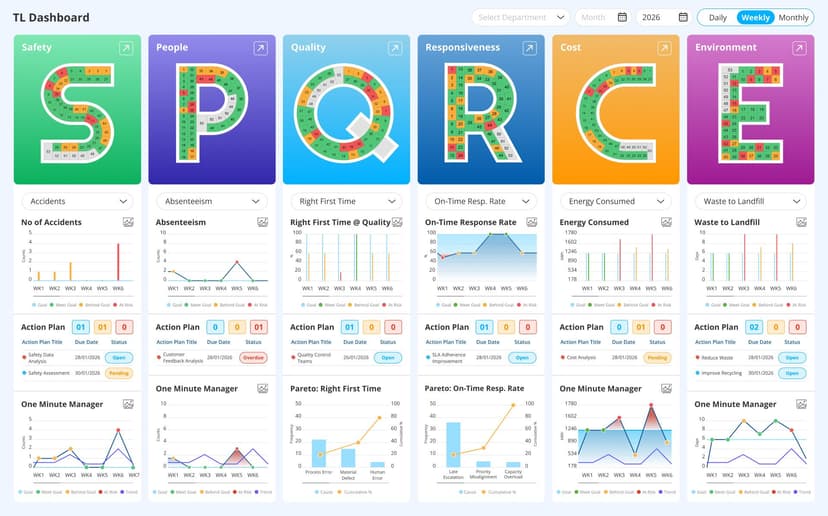
You’ve invested heavily in digital tools, sensors, and dashboards, yet the shopfloor still feels stuck in neutral. Data is everywhere – charts, KPIs, reports – but decisions lag, and improvements stall. It’s frustrating, isn’t it? You’re under pressure to deliver efficiency, reduce waste, and stay competitive, but raw data alone doesn’t move the needle. The real challenge isn’t collecting information; it’s turning those insights into meaningful action that drives measurable results. Let’s talk about why this gap exists and how to close it for good. In this blog, we’ll discuss why shopfloor data alone doesn’t deliver results, the hidden cost of unused shopfloor data, common pitfalls in shopfloor data utilisation, turning shopfloor data into practical insights, shopfloor data utilisation strategies that work, leveraging live shopfloor data for faster decisions, the role of leadership in driving shopfloor data success, and future-proofing operations with smart shopfloor data.
Struggling with your ineffective shopfloor data?
Why shopfloor data alone doesn’t deliver results
Gathering shopfloor data is easy – transforming this data into real operational impact is the tricky part. Many teams believe that once the information starts flowing, improvement will magically follow. But without structure, alignment, and action, even the cleanest dashboards end up as nothing but a digital wallpaper.
Let's look at some of the reasons why this happens:
- Lack of context and clarity: Raw numbers don’t explain why issues occur; they only show that they happened.
- Data without aligned goals: If teams don’t share a common direction, shopfloor metrics drift without guiding enhancement.
- Siloed insights: Operators, supervisors, and managers often utilise different systems or interpretations, breaking the flow from data to decision.
- Lack of daily action routines: Without systematic daily meetings and assessments, issues stay instead of being resolved at the source.
- Missing accountability loops: Documents don’t drive behaviour – functions do. Without clear ownership, nothing changes.
- No live visibility: Delayed or manually collected details keep teams reactive rather than proactive.
- Dashboards without decisions: Pretty colours don’t guarantee better results unless bound to actions, escalations, and continuous follow-up.
The hidden cost of unused shopfloor data
Manufacturers stockpile thousands of data points every day, and a surprising amount of it goes untapped. When shopfloor insights sit gathering dust, the losses aren’t just operational; they silently bleed money, productivity, and improvement potential.
Let's pinpoint where the real costs show up:
- Rising operational inefficiencies: Missed patterns mean repeating lags, slower changeovers, and persistent bottlenecks.
- Quality issues left unaddressed: Defect, scrap, and rework data that are not used results in frequent mistakes and escalating waste.
- Invisible downtime becomes normal: Breakdown and stoppage details that are not assessed properly keeps maintenance reactive and expensive.
- Inaccurate planning and scheduling: When performance trends aren’t examined, planners depend on guesswork instead of facts.
- Missed improvement opportunities: Teams overlook trends that could drive quick wins, cost savings, or process optimisation.
- Higher labour and overtime costs: Inefficiencies compel teams to compensate with extra hours, rushed repairs, and firefighting.
- Lost competitive advantage: While other factories act on live insights, those who neglect data fall behind.
Solve your shopfloor data issues with LTS Data Point
Common pitfalls in shopfloor data utilisation
Even with best intentions, several leaders unknowingly limit the impact of their shopfloor data. From vague preferences to overcomplicated systems, these pitfalls can leave teams frustrated instead of empowered.
Some of the common mistakes leaders make are:
- Piling up too many details with no clear purpose: When everything is calculated, nothing sticks out – teams end up suffocating under a pile of numbers instead of clarity.
- Concentrating on dashboards and not decisions: Colourful visuals are useless if they don’t trigger action, escalation, or accountability.
- Neglecting frontline involvement: Operators are the ones who usually comprehend the reports best, but their awareness is overlooked in decision-making.
- Using inconsistent definitions across shifts: Variations in how metrics are recorded or interpreted make trends unreliable.
- Depending on delayed, manual records: By the time issues show up, the window for quick fixes has passed.
- Reacting to symptoms rather than root causes: Leaders jump to fixes without assessing patterns that explain why issues repeat.
- Overcomplicating tools and workflows: If the system is hard to use, teams stop using it – and data quality declines.
- Lack of follow-up: Without verification, actions dissolve and the same complications keep returning.
Turning shopfloor data into practical insights
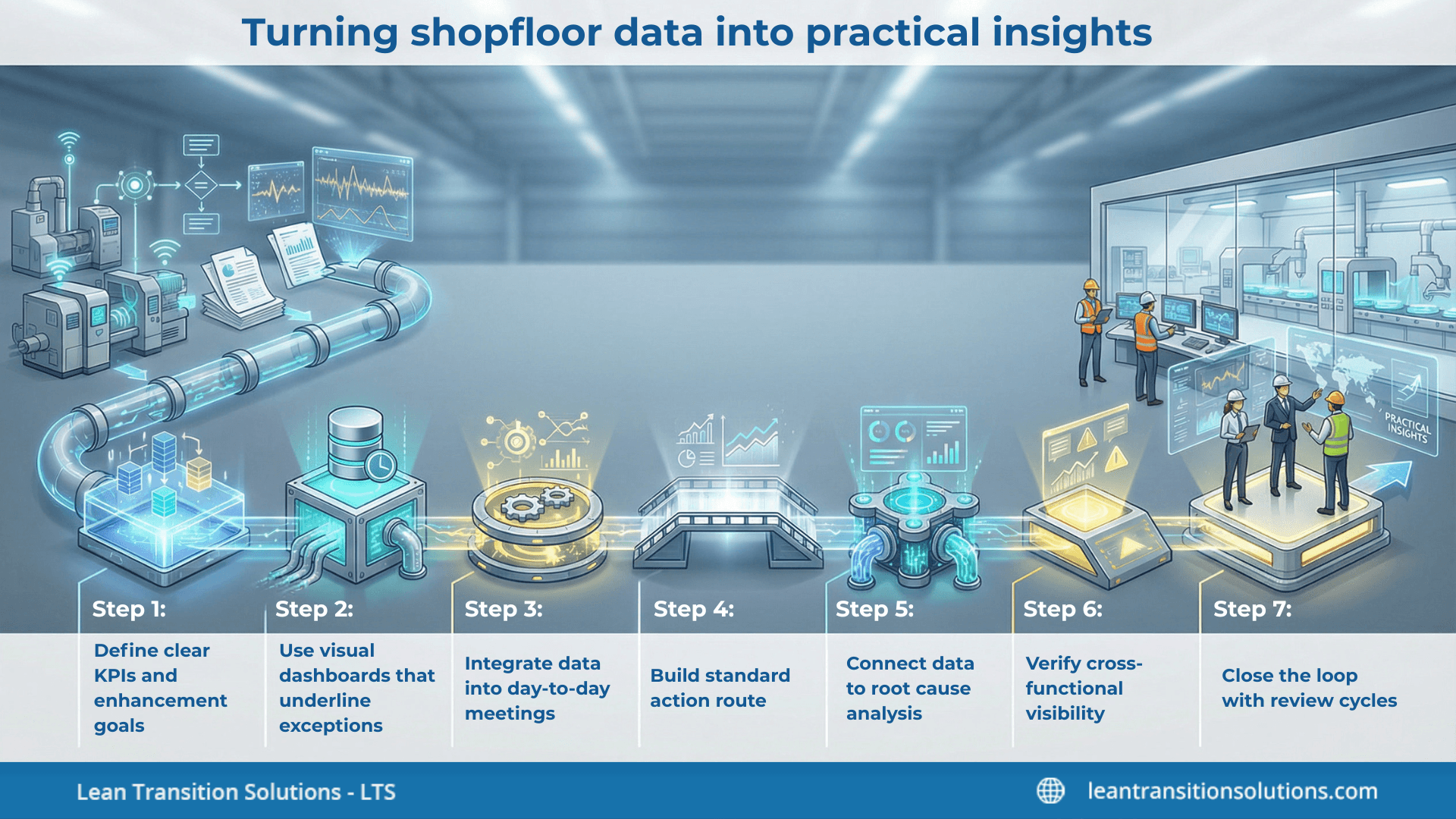
Gathering shopfloor data is only half the work; the real value comes from transforming it into decisions, behaviours, and improvements. When teams know how to interpret, prioritise, and proceed on the right signals, records become a powerful engine for daily performance.
Steps to turn data into real action
Define clear KPIs and enhancement goals
Clarity makes sure the information you monitor actually aligns with what you want to improve.
Use visual dashboards that underline exceptions
Colour-coded triggers and trend views make problems impossible to neglect.
Integrate data into day-to-day meetings
When perceptions mould the conversation, teams respond quicker and more consistently.
Build standard action route
Escalation rules, countermeasure templates, and responsibility matrices keep improvements moving.
Connect data to root cause analysis
Operators and supervisors untangle issues faster when they can link events to patterns.
Verify cross-functional visibility
Maintenance, quality, planning, and production all benefit from shared, live insights.
Close the loop with review cycles
Actions taken should be observed, verified, and examined for impact – otherwise issues resurface.
Transform your shopfloor data into practical insights with LTS Data Point
Shopfloor data utilisation strategies that work
It's not enough to pile up details, you need recurring habits, connected tools, and reasonable workflows that transform every data point into forward motion. These strategies aid teams convert raw shopfloor documents into consistent, quantifiable developments.
Some of the practical strategies that deliver results include:
- Standardise data collection across shifts: When formats and definitions are consistent, trends become meaningful and applicable.
- Use live dashboards for instant visibility: Live performance views assist managers react before complications escalate.
- Adopt tiered daily management routines: Structured daily huddles at operator, supervisor, and leadership levels keep perceptions flowing up and actions flowing down.
- Prioritise exceptions: Spotlight deviations, spikes, and abnormalities – that's where upgradation opportunities remain.
- Automate alerts and notifications: Trigger-based prompts make sure downtime spikes, quality failures, or delays never go unnoticed.
- Integrate data with root cause and problem-solving tools: Fishbone analysis, Pareto charts, 5 Whys, and A3 problem solving become far more productive with accurate shopfloor inputs.
- Assign clear ownership for every metric: Accountability converts reports from passive information to active responsibility.
- Review actions and outcomes weekly: Short review cycles help teams refine solutions, validate impact, and sustain growth.
Leveraging live shopfloor data for faster decisions
In modern manufacturing, speed is never a luxury, but a competitive advantage. Real-time shopfloor data offers teams the visibility to act instantly, prevent losses, and stay ahead of shifting production demands. When every second counts, live insights become the contrast between reacting late and guiding the pack.
Let's explore how live data allows faster smarter decisions:
- Immediate visibility into performance deviations: Managers can detect anomalies as they occur, not hours later.
- Quicker response to downtime and stoppages: Real-time signals assist teams intervene before issues snowball.
- Faster quality control decisions: Spot trends early and prevent faults from spreading across batches.
- Dynamic workload balancing: Teams can adjust staffing, machine loading, or priorities on the fly.
- Reduced reliance on manual reporting: Automatic capture removes lags caused by paperwork and end-of-shift updates.
- More accurate scheduling and planning: Live cycle times and throughput data keep planners aligned with reality.
- Developed escalation and decision pathways: Clear triggers make sure problems move up the chain without waiting for meetings.
- Stronger responsiveness to customer demands: With real-time reports, manufacturers adapt quickly to urgent orders or sudden changes.
Leverage your shopfloor data for faster decisions
The role of leadership in driving shopfloor data success
Shopfloor data doesn’t impart transformation on its own – leadership does. When the C-suite sets the direction, defines the behaviours, and champions a data-driven culture, the entire industry moves from passive reporting to proactive development.
The role leaders play in driving shopfloor data success are as follows:
- Setting clear priorities and performance expectations: Executives define what “good” looks like, making sure teams compute what truly matters.
- Building a culture of accountability and transparency: When leaders model data-driven behaviour, teams naturally follow.
- Investing in the right digital systems: Selecting accessible, integrated tools secures data flows endlessly from operators to top-level dashboards.
- Ensuring alignment across departments: Production, quality, maintenance, and planning remain connected when leadership drives unified goals.
- Empowering frontline teams: Leaders inspire operators and supervisors to interpret data, raise problems, and take ownership of improvements.
- Making data central to decision-making: Strategic choices become sharper and faster when supported by real shopfloor insights.
- Reviewing progress through structured routines: Tiered meetings, cross-functional reviews, and KPI checkpoints keep improvements on track.
- Rewarding problem-solving and continuous improvement: Identifying teams for acting on data upholds the behaviours that fuel long-term success.
Future-proofing operations with smart shopfloor data

By now, you already know that future-ready manufacturing isn’t built on assumptions, but it’s definitely built on smart, connected, live data that fuels stronger manufacturing performance management. With LTS Data Point at the heart, teams shift from reactive fixes to insight-led execution, assisted by lean manufacturing boards, real-time manufacturing dashboards, and intelligent analytics that reinforce resilience in a fast-changing production landscape.
Let's look at what role LTS Data Point takes up in future-proofing your operations:
- Live visibility: With a unified manufacturing production KPI dashboard, leaders get immediate clarity on performance trends and can act before problems escalate.
- Integrated performance data across production, quality, and maintenance: Data Point combines information from multiple sources into a single manufacturing metrics dashboard, minimising silos and upgrading strategic alignment.
- AI-driven analytics and predictive trends: Smart algorithms power advanced manufacturing analytics software, uncovering abnormalities and patterns crucial for proactive process optimisation in manufacturing.
- Scalable workflows that grow with your business: Modular dashboards and configurable KPIs evolve effortlessly as functions expand, or product lines change.
- Digitised daily management for consistent execution: Seamless merging with lean manufacturing boards and live views make sure daily actions are directly led by real-time data.
- Enhanced traceability and compliance readiness: Data Point supports digital record-keeping, allowing smooth audits and quality checks with its manufacturing intelligence dashboard capabilities.
- Developed workforce empowerment: Intuitive interfaces and real-time manufacturing tracking software provide operators clear visibility of objectives, complications, and improvement opportunities.
- A competitive edge through operational agility: Fast, precise knowledge allow sharper scheduling decisions powered by a centralised live manufacturing dashboard, helping manufacturers respond swiftly to customer demands.
In the end, shopfloor data isn’t just numbers on a dashboard — it’s your factory trying to tell you something. When teams actually listen, connect the dots, and act on those insights, the whole operation starts to run smoother, faster, and smarter. With the right routines, the right mindset, and tools like LTS Data Point keeping everything in sync, manufacturers don’t just solve today’s problems — they get ready for whatever tomorrow throws at them. And honestly? That’s where the real competitive edge lives.
No more unnecessary spending. Make your shopfloor data smart with LTS Data Point.
FAQs
1. What is shopfloor data and why is it important?
Shopfloor data refers to real-time information collected from machines, processes, and operators on the production floor. It’s vital for improving efficiency, reducing waste, and driving continuous improvement.
2. How can poor shopfloor data utilisation affect profitability?
When shopfloor data isn’t used effectively, inefficiencies persist, downtime increases, and quality issues go unresolved – leading to higher costs and lost competitiveness.
3. What tools help in shopfloor data utilisation?
Modern solutions like real-time dashboards, IoT sensors, and manufacturing analytics platforms enable accurate data capture and actionable insights for faster decision-making.
4. Why do manufacturers struggle to act on shopfloor data?
Common reasons include siloed systems, lack of context, delayed reporting, and absence of clear accountability – turning valuable data into unused information.
5. How can leadership improve shopfloor data utilisation?
By setting clear KPIs, fostering a data-driven culture, and ensuring cross-functional alignment, leaders can transform raw data into measurable operational improvements.
6. Is real-time shopfloor data essential for Industry 4.0?
Absolutely. Real-time shopfloor data is the backbone of smart manufacturing, enabling predictive maintenance, agile scheduling, and rapid response to market changes.
7. What's the first step to fix shopfloor data gaps?
Start by defining clear goals and standardising data collection across shifts. Then integrate live dashboards and daily management routines to turn insights into action.

Geandra Queiroz, Operations Management Consultant
Geandra is an Operations Management Consultant at Lean Transition Solutions, specialising in Lean philosophy, Lean Six Sigma, and strategic planning across manufacturing and healthcare. She is currently completing her PhD in Industrial Engineering at the Federal University of São Carlos, researching the integration of Operations Strategy, Lean, and Green Manufacturing.