Airline Balanced Scorecard: KPIs and Framework for Measuring Airline Performance

Last updated on : January 30, 2026
Airline executives face increasing pressure to balance safety, operational reliability, cost control, and customer experience – often across complex networks, multiple stakeholders, and tight regulatory environments. While airlines monitor dozens of key performance indicators (KPIs), leadership teams frequently struggle with fragmented performance views, lagging indicators, and limited alignment between strategic goals and frontline execution. A well-designed airline balanced scorecard addresses this gap by offering a structured framework that links strategy to measurable outcomes, allows cross-functional accountability, and supports consistent performance governance across the industry.
What you’ll learn in this blog
- How an airline balanced scorecard translates strategy into measurable outcomes across operations, safety, finance, and customer experience
- The benefits of using a balanced scorecard framework and performance measurement systems in airlines
- How airlines track key metrics with operational KPIs, customer satisfaction metrics, and supplier scorecards
- The role of aerospace manufacturing KPIs and vendor performance in supporting airline operations
- Common balanced scorecard frameworks used in the airline industry for strategy execution and performance visibility
- How performance management software, performance review software, and OKR balanced scorecards integrate into airline performance tracking
- Ways LTS Data Point enhances balanced scorecards for continuous improvement, accountability, and strategic alignment
Discover how LTS Data Point can transform your airline balanced scorecard into real-time performance management tool
Airline balanced scorecard framework for strategic airline performance
An airline balanced scorecard translates strategy into computable outcomes across operations, safety, finance, and customer experience. It provides an organised, multi-perspective view of performance rather than tracking isolated KPIs.
Built on the balanced scorecard framework, airlines can translate strategy into measurable outcomes across operations, safety, finance, and customer experience. This approach not only provides a practical tool for balanced scorecard for strategy evaluation but also ensures strategic execution with balanced scorecard across teams and functions.
But why do airlines use this framework? Let's see why:
- Connects long-term strategy with daily operational decisions
- Balances financial, operational, safety, and customer-focused metrics
- Lowers siloed KPI tracking across departments
- Upgrades visibility into performance trade-offs and priorities
- Enables a shared business scorecard for leadership and functional teams
- Supports consistent performance reviews using common metrics
- Offers a foundation for integration with performance measurement systems and performance management tools
Airline balanced scorecard for airlines as a performance measurement system
An airline balanced scorecard is more than a reporting tool – it functions as a performance measurement system that binds airline strategy to daily operations. It aids leaders observe whether strategic objectives across safety, operations, finance, and customer experience are being accomplished consistently.
By integrating with a performance management system, the scorecard makes sure that metrics are not only gathered but also assessed, reviewed, and acted upon in a structured way.
Key benefits of using a balanced scorecard as a performance system
- Offers a holistic view of airline performance across departments
- Aligns operational KPIs with strategic goals
- Supports performance management tools for tracking, reporting, and decision-making
- Allows consistent reviews using performance review software or dashboards
- Bridges gaps between strategy and execution through balanced scorecard frameworks
- Enhances customer satisfaction metrics and on-time performance tracking
- Helps connect supplier performance to airline KPIs using supplier scorecards
Common performance areas measured
- Operations: Turnaround time, fleet utilisation, on-time departures
- Safety & quality: Incident rate, audit findings, CAPA closure time
- Finance: Cost per available seat kilometre, revenue per flight
- Customer experience: Complaint rate, CSAT, NPS
- Strategic alignment: Objectives tracked with OKR balanced scorecards
- Supplier performance: Vendor metrics like on-time delivery, defect rate, quality compliance, including aerospace manufacturing KPIs from engine, avionics, and parts suppliers
Get guidance on using LTS Data Point to integrate supplier and operational KPIs
Airline balanced scorecard example: Tracking performance with proven frameworks
A practical airline balanced scorecard assists airlines track and manage performance across strategy, operations, safety, finance, and customer experience. Rather than only reporting results, it links daily operational metrics with strategic objectives, allowing timely decision-making and accountability.
How an airline balanced scorecard tracks performance
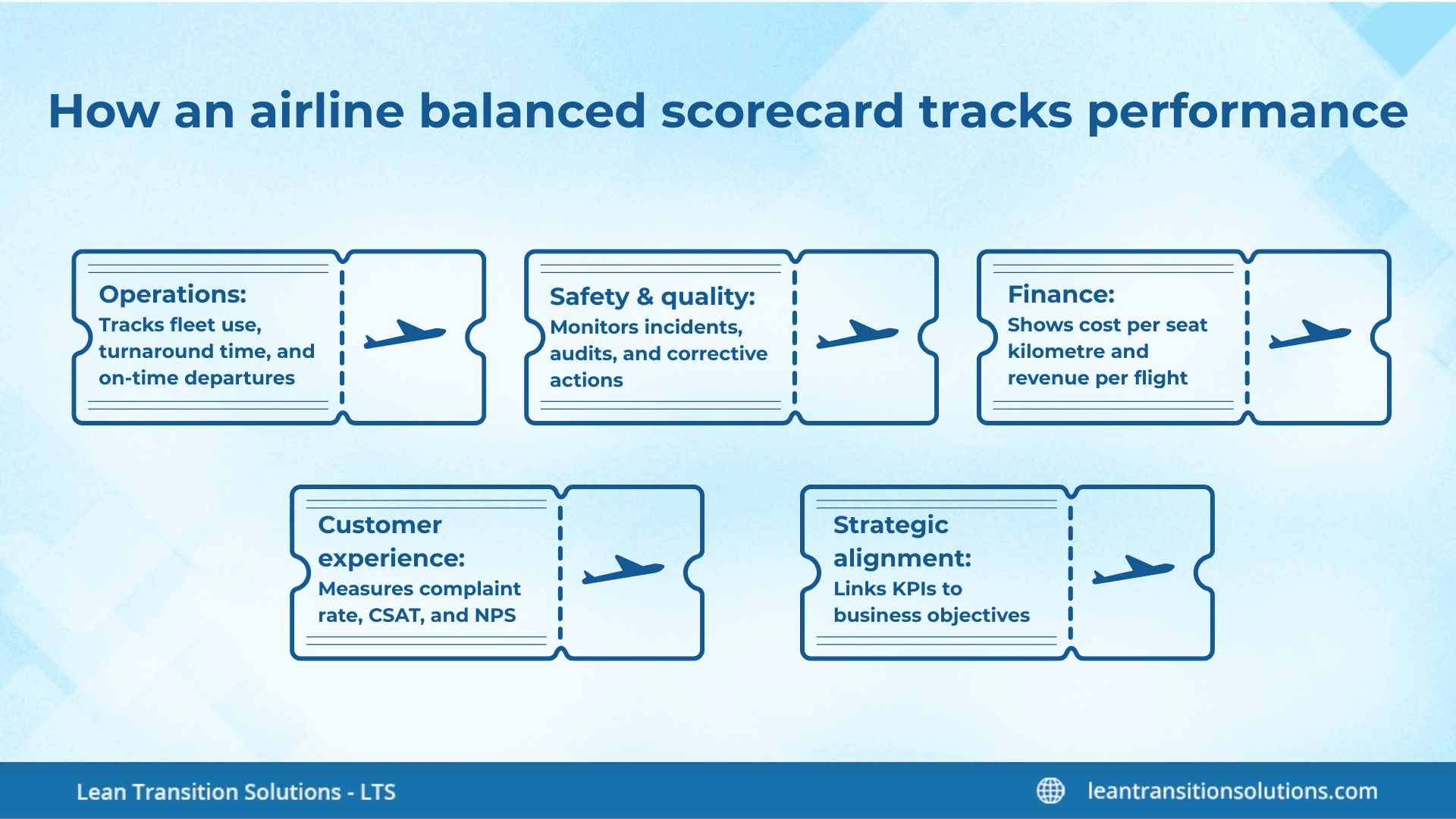
- Operations: Observes fleet utilisation, turnaround times, and on-time departures through integrated dashboards, spotlighting bottlenecks before they affect schedules.
- Safety & quality: Monitors incident rates, audit results, and corrective actions, making sure compliance and continuous improvement.
- Finance: Offers visibility into cost per available seat kilometre, revenue per flight, and overall operational efficiency.
- Customer experience: Calculates complaint rate, CSAT, and NPS, helping airlines act quickly on customer feedback.
- Strategic alignment: Charts KPIs to corporate objectives, ensuring teams prioritise the most impactful initiatives
Most used balanced scorecard frameworks in airlines
- Classic four-perspective framework: The four perspectives of balanced scorecard – financial, customer, internal process, and learning & growth—ensure comprehensive strategy execution across all airline departments.
- Strategy map framework: The strategy map provides a visual representation of objectives across departments, helping airline teams see how initiatives are connected and dependencies managed.
- Performance dashboard framework: Provides live visibility into KPIs, supporting faster decision-making and operational control.
When implemented effectively, these frameworks transform the scorecard into a living performance management tool, not just a static report. Teams can see trends, gaps, and improvement areas across all processes, allowing proactive interventions rather than reactive fixes.
Experience how LTS Data Point integrates supplier scorecards and aerospace manufacturing KPIs seamlessly
Airline balanced scorecard and the role of supplier scorecards
An effective airline balanced scorecard extends beyond internal teams to include partners, vendors, and aerospace suppliers, ensuring the entire value chain contributes to strategic and operational goals.
Supplier scorecards feed directly into the airline balanced scorecard, linking vendor performance with airline KPIs and creating a holistic view of operational performance.
Key areas tracked by supplier scorecards are:
- Maintenance providers: Reliability, on-time servicing, and aerospace manufacturing KPIs like defect rates, component quality and production lead times
- Ground handling: SLA adherence, turnaround efficiency, and process compliance
- Catering and fuel suppliers: Consistency, delivery timelines, and cost efficiency
- Parts and avionics suppliers: Compliance with quality standards, timely deliveries, and contribution to fleet reliability
Connecting supplier metrics to the airline balanced scorecard enhances accountability across the value chain without fragmenting reporting. It also enables airlines to spot upstream operational risks, track performance trends, and ensure suppliers meet the same standards that support strategic goals.
Explore LTS Data Point dashboards for continuous improvement and strategic alignment in airlines
Airline balanced scorecard for performance management and continuous improvement with LTS Data Point
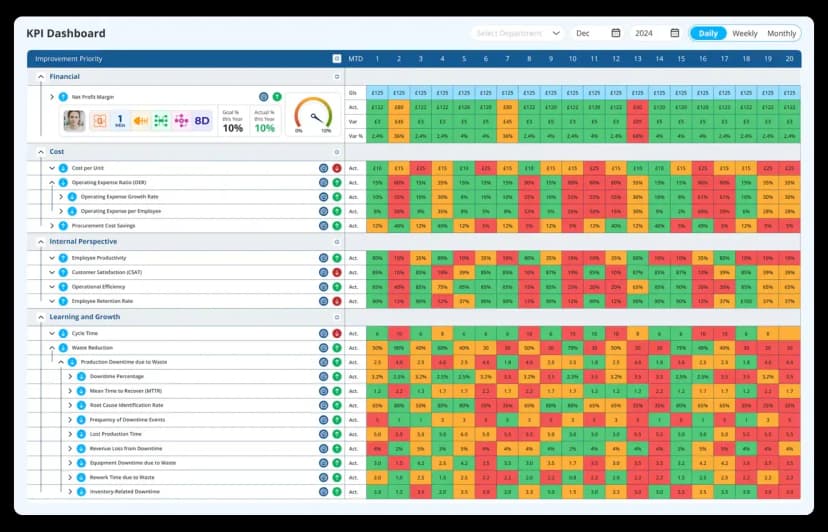
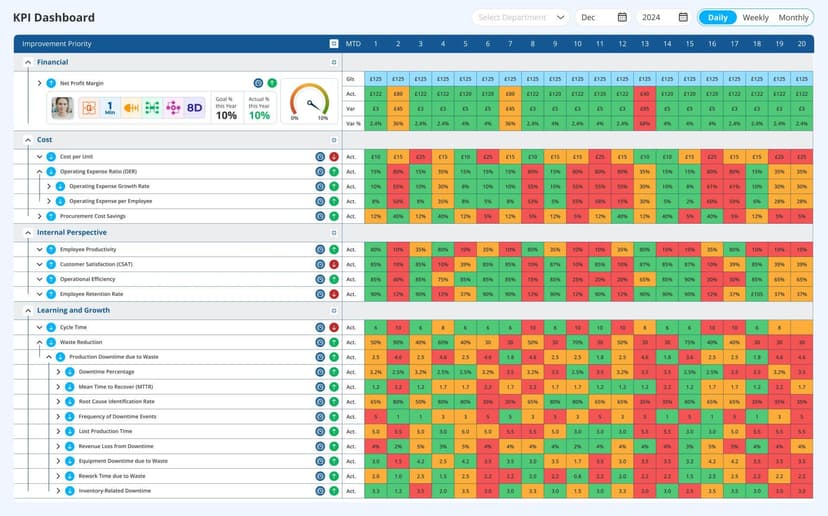
An airline balanced scorecard is most effective when it is part of a digital performance management system that allows continuous improvement and strategic alignment. When integrated with performance management software, an airline balanced scorecard becomes a powerful balanced scorecard for business improvement, helping teams track trends, close performance gaps, and enhance operational, financial, and customer outcomes. LTS Data Point transforms the scorecard into a living tool, assisting airlines monitor operations, safety, finance, customer experience, and supplier performance in real time.
By integrating with performance management software and performance review software, airlines can move from static reporting to actionable insights that drive decisions across teams and functions. Even though LTS Data Point is widely used in manufacturing and service environments, its existing balanced scorecard frameworks and KPI tracking capabilities map directly to airline needs – including operational, safety, financial, and customer metrics, as well as supplier and aerospace manufacturing performance.
How LTS Data Point enhances airline balanced scorecards
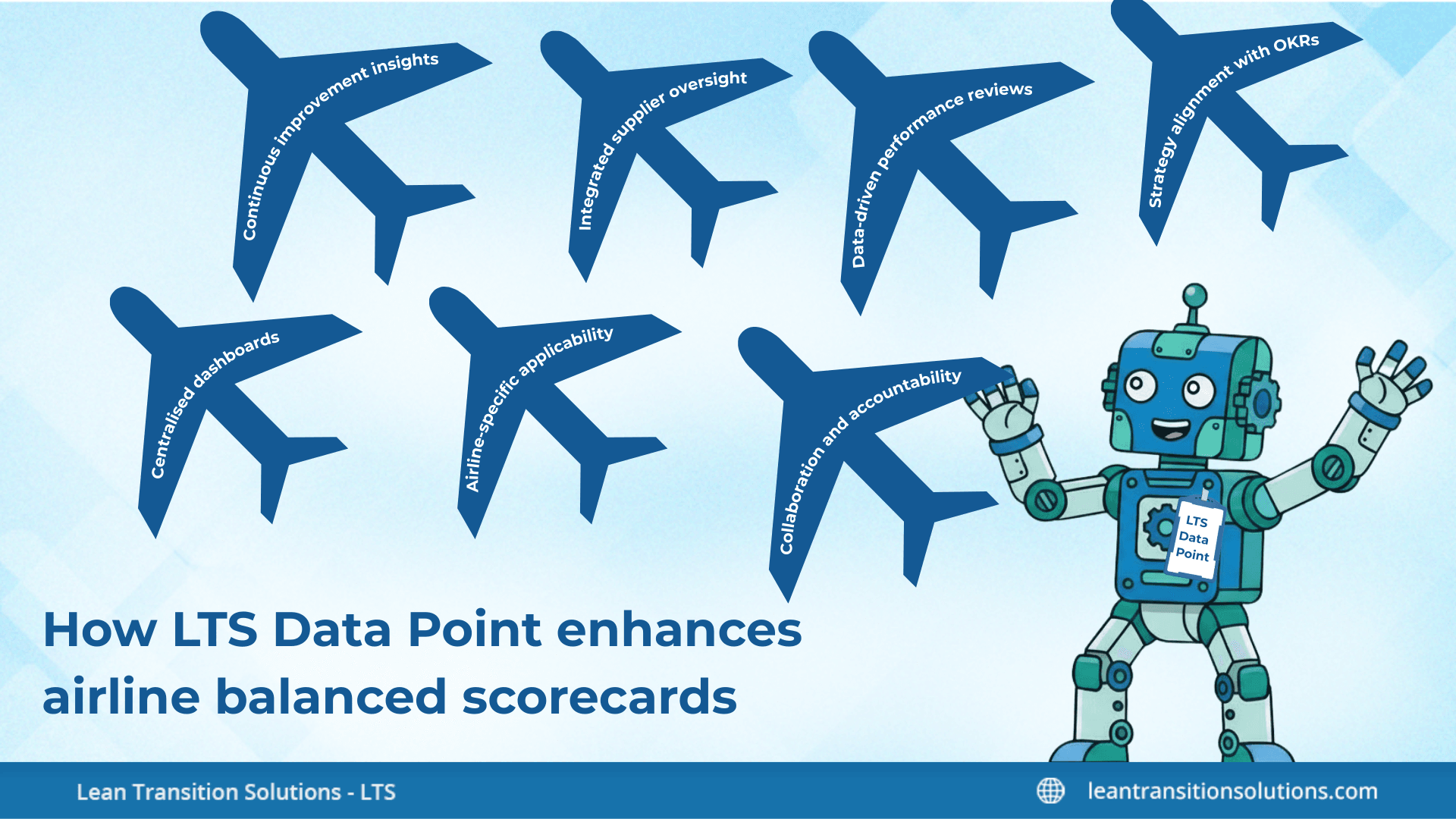
- Centralised dashboards: Track operational KPIs, on-time departures, fleet utilisation, safety incidents, and customer satisfaction in one platform
- Integrated supplier oversight: Track supplier scorecards and aerospace manufacturing KPIs such as defect rates, component quality, and delivery timelines
- Data-driven performance reviews: Conduct organised reviews using automated workflows and metrics tracking
- Strategy alignment with OKRs: Map KPIs to corporate objectives using OKR balanced scorecards for consistent goal execution
- Continuous improvement insights: Spot trends, gaps, and areas needing corrective action across operations, finance, and customer experience
- Collaboration and accountability: Share dashboards across teams and vendors, connecting internal and external metrics in single business scorecard
- Airline-specific applicability: Leverage frameworks designed for manufacturing and service environments to observe fleet, maintenance, safety, and supplier KPIs, making them suitable for airline performance management
By leveraging LTS Data Point, airlines can close performance gaps, improve accountability, and ensure proactive decision-making, turning the balanced scorecard into a true performance management tool rather than a static reporting document.
In today’s complex airline organisation, an airline balanced scorecard is essential for translating strategy into measurable results across operations, safety, finance, customer experience, and supplier performance. When implemented with a robust performance management system and supported by performance management software or performance review software, it becomes a living performance management tool that drives accountability, continuous improvement, and strategic alignment. Integrating supplier scorecards, aerospace manufacturing KPIs, and OKR balanced scorecards make sure airlines can monitor critical metrics, close performance gaps, and make proactive data-driven decisions across all functions.
Speak to an expert about implementing LTS Data Point for your airline balanced scorecard and performance management needs
FAQs
1. What is an airline balanced scorecard?
An airline balanced scorecard is a performance management framework that translates airline strategy into computable outcomes across operations, safety, finance, and customer experience.
2. How does a balanced scorecard help airline performance?
It tracks key metrics, aligns team objectives with strategic goals, monitors supplier and operational KPIs, and enables continuous improvement.
3. Can aerospace manufacturing KPIs be included in airline scorecards?
Yes. Supplier and aerospace manufacturing metrics like defect rates, component quality, and delivery timelines can be integrated into the airline scorecard to ensure operational reliability.
4. How do supplier scorecards work with airline balanced scorecards?
Supplier scorecards track vendor performance, SLA compliance, and quality metrics, feeding directly into the airline balanced scorecard for a holistic view of operational performance.
5. Can software improve the effectiveness of a balanced scorecard?
Yes. Performance management software and performance review software automate KPI tracking, centralise dashboards, and enable data-driven decision-making.
6. What is an OKR balanced scorecard?
It links objectives and key results (OKRs) to the airline balanced scorecard, ensuring team and individual goals are aligned with strategic priorities.
7. How does a balanced scorecard support continuous improvement?
By monitoring trends, identifying gaps, and providing actionable insights, it allows airlines to proactively address issues and optimise performance across all functions.
8. Is a balanced scorecard suitable for both airline operations and strategy?
Yes. It provides a structured way to monitor daily operations while ensuring alignment with long-term strategic objectives.

Amer Jumah, Senior Lean Consultant
Amer is co-founder of Agile Solutions and a certified Six Sigma Black Belt, Lean Black Belt, and PMP, with over nine years of experience implementing Lean, Six Sigma, and Agile principles across diverse industries. He specialises in process optimisation, waste elimination, and delivering cost savings through organisational change.