Why Operations Meetings Fail — And What High-Performing Teams Do Differently

Last updated on : January 5, 2026
Operations meetings are meant to drive alignment, accountability, and action – but too often, they don’t. Teams spend hours reviewing updates, debating metrics, and revisiting the same issues week after week, yet little actually gets done. The result? Wasted time, frustrated employees, and stalled progress. In this blog, we’ll discuss about common pitfalls, why operations meetings fail when monitoring is manual, why they fail without contextual metrics, how high-performing teams fix it, and how digital tools help in making it more effective.
See how operations meetings can drive real execution with LTS Data Point
Why operations meetings fail: Common pitfalls
Operations meetings are supposed to keep teams aligned, accountable, and focused on execution. Yet, many meetings end up feeling repetitive, unproductive, and even frustrating. The reasons these meetings fail often lie in their design, priorities, and follow-through.
Here are the key challenges:
- Focus on updates, not decisions: Many meetings spend most of the time, sharing updates rather than making practical decisions. Teams leave without clear steps.
- Lack of accountability: When ownership isn’t allocated, issues recur week after week. Decisions are made in the moment but rarely observed or applied.
- Information overload: Using spreadsheets, slides, or emails to monitor metrics can overwhelm participants, making it hard to pinpoint on what really matters.
- Metrics without context: Assessing KPIs without linking them to actions or outcomes can leave teams busy but ineffective.
- Manual tracking breaks follow-up: Whiteboards, notes, and static dashboards do not offer continuity, so progress stalls frequently between meetings.
Ultimately, operations meetings fail because they prioritise reporting, not execution. Understanding these common pitfalls is the first step toward transforming your meetings into action-driven sessions that actually move the business forward.
Why operations meetings fail when monitoring is manual
Several operations meetings fail because teams depend on manual tracking methods such as spreadsheets, whiteboards, or slide decks. While these tools may seem sufficient at first, they often create more problems than they solve. Manual tracking slows down meetings, minimises visibility, and makes it hard to follow up on action items.
Some of the main challenges include:
- Time-consuming updates: Manually compiling reports or updating spreadsheets takes significant time before, during, and after meetings.
- Lack of live visibility: Static tools don’t mirror real-time changes, so decisions are typically based on outdated or incomplete information.
- Follow-up falls through cracks: Without a centralised system, tracking who owns each action and whether it’s completed becomes inconsistent.
- Increased risk of errors: Manual data entry is prone to mistakes, leading to incorrect insights or misaligned preferences.
Discuss your current operations meeting challenges with LTS expert
Why operations meetings fail without contextual metrics
Operations meetings often fail when teams prioritise numbers without comprehending the story behind them. KPIs and metrics are only useful if they are interpreted in context and bound to actionable decisions. Without this, meetings become an exercise in assessing data rather than driving meaningful outcomes.
Most common challenges include:
- Numbers without narrative: Teams monitor metrics but don’t discuss why the numbers changed or what they mean for operations.
- Disconnected KPIs: Metrics may exist in isolation, not tied to specific actions, functions, or team responsibilities.
- Overemphasis on reporting: Spending time reading dashboards or slides can overshadow problem-solving and decision-making.
- Missed root causes: Concentrating solely on what happened rather than why it happened prevents lasting solutions.
When metrics lack context, meetings turn into busy work sessions, leaving teams informed but not licensed to act. They key is to connect data to decisions, accountability, and next steps, building a foundation for execution rather than just observation.
Why operations meetings fail and how high-performing teams fix it
1. Problem: Meetings spend most of the time on updates, not decisions.
Fix: Begin with the issue, not the report. High-performing teams prioritise decisions that need to be made today, converting meetings into action forums.
2. Problem: Actions are discussed but not assigned, so follow-up fails.
Fix: Every action has a named owner and a clear deadline, making sure accountability and follow-through.
3. Problem: Metrics are evaluated in isolation, without context.
Fix: KPIs are interpreted with trends, operational realities, and risks, aiding the team concentrate on what truly matters.
4. Problem: Information is static – spreadsheets, slides, or whiteboards are outdated by the time of meeting.
Fix: Use live dashboards or collaborative platforms to maintain visibility, so meetings are for problem-solving, not reporting.
5. Problem: Meetings are seen as one-off events rather than part of a continuous workflow.
Fix: Communication and monitoring are continuous, making meetings a checkpoint for decisions and actions, not just updates.
6. Problem: Teams feel meetings are recurring and unproductive.
Fix: High-performing teams design meetings around execution, guaranteeing each session drives tangible results and lowers wasted time.Turn status meetings into action-driven reviews
Turn status meetings into action-driven reviews
Why operations meetings fail: How digital tools help in fixing it
Manual monitoring methods – whiteboards, spreadsheets, and slide decks – simply can’t keep up with the speed and complexity of modern operations. Updates take too long to compile, follow-ups are easily lost, and decisions are frequently based on outdated details. Digital and automated tools, on the other hand, give live visibility, continuous tracking, and actionable insights, allowing teams to transform meetings from status reports into execution engines.
1. Problem: Manual documentation and scattered information slow everything down.
Data Point fix: It automates data gathering and centralises performance metrics, removing repetitive entry and providing teams a single source of truth they can trust during meetings.
2. Problem: Meetings concentrate on reviewing outdated or decoupled reports.
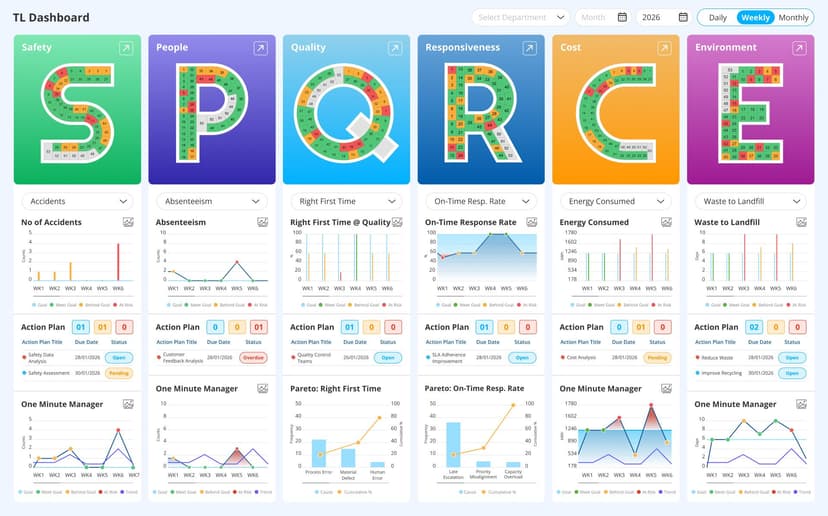
Data Point fix: With live dashboards and visual huddle boards, LTS Data Point verifies all meeting participants see the latest data at the same time, so meetings focus on outcomes, not catching up.
3. Problem: Action items aren’t observed consistently between meetings.
Data Point fix: The platform links actions, owners, deadlines, and KPIs, making follow-up visible and computable – so nothing “falls through the cracks.”
4. Problem: Metrics lack operational context and aren’t linked to decision-making.
Data Point fix: It supports structured frameworks (like SQDCPS and Lean scorecards) that bind metrics with continuous improvement practices – assisting teams interpret why numbers move and what actions they should trigger.
5. Problem: Disconnected systems and spreadsheets create silos.
Data Point fix: By integrating KPI tracking, Lean daily management tools, root cause analysis, and visual management into a single platform, it breaks down silos and aligns teams around shared goals.
6. Problem: Action tracking and accountability are manual and inconsistent.
Data Point fix: The platform’s interactive dashboards and built-in analytics convert raw data into insights that lead daily execution and long-term improvements – keeping teams aligned and accountable.
In essence, operations meetings stop being about chasing updates and start being about making informed decisions that stick. With automation, live visibility, and structured performance frameworks, digital platforms like LTS Data Point transform meetings from administrative chores into engines of execution and continuous improvement.
See how LTS Data Point brings clarity, ownership, and follow-through
Manual tracking vs. Digital operations management with LTS Data Point
Manual tools weren’t designed for today’s operational complexity. They slow meetings down, hide accountability, and make follow-through unreliable. Digital platforms like LTS Data Point change the role of meetings completely – from reporting sessions to execution checkpoints.
With live visibility, centralised tracking, and clear accountability, teams spend less time explaining what happened and more time deciding what needs to happen next.
The difference thus, is clear: when operations meetings depend on manual monitoring, progress slows and accountability fades. When performance data, actions, and ownership are visible in one place, meetings become focused, purposeful, and outcome driven. This is exactly where digital platforms like LTS Data Point play a major role – not by replacing meetings, but by allowing teams to make better decisions, faster, and sustain execution beyond the meeting room.
Get expert advice on moving beyond manual monitoring with LTS Data Point
FAQs
1. How often should operations meetings be held to stay effective?
Operations meetings are most effective when held at a consistent cadence that matches decision needs – daily for frontline teams and weekly or monthly for operations manager, without overloading calendars.
2. Who should attend an operations meeting and what is its ideal length?
Only participants who can contribute to decisions or own actions should attend. The meetings should be short and focused – usually 30-45 minutes – so as to ensure effectiveness.
3. How do you prevent operations meetings from becoming blame sessions?
By focusing discussions on process gaps and data trends rather than individual performance, teams can keep meetings constructive and solution oriented.
4. What should be reviewed before the meeting instead of during it?
Routine updates, background data, and historical trends should be reviewed in advance, so meeting time is reserved for decisions and issue resolutions.
5. How do effective teams handle escalations in operations meetings?
High-performing teams define clear escalation paths, so unresolved issues are quickly moved to the right level without slowing down progress.
6. Can operations meetings work across multiple sites or locations?
Yes, but only when teams use shared visibility and standardised reporting, ensuring everyone works from the same information regardless of location.
7. What role does leadership behaviour play in meeting effectiveness?
Leadership sets the tone. When leaders focus on decisions, accountability, and follow-through, meetings naturally become more disciplined, and outcome driven.
8. How do you measure whether an operations meeting is actually effective?
Effectiveness can be measured by decision closure rates, action completion, and whether the same problems reappear repeatedly.
9. When should organisations consider moving from manual to digital tools?
When meetings repeatedly run over time, actions aren’t closed, or teams struggle to trust the data, it’s a strong signal that manual methods have reached their limit.

Amer Jumah, Senior Lean Consultant
Amer is co-founder of Agile Solutions and a certified Six Sigma Black Belt, Lean Black Belt, and PMP, with over nine years of experience implementing Lean, Six Sigma, and Agile principles across diverse industries. He specialises in process optimisation, waste elimination, and delivering cost savings through organisational change.