Strategic Alignment Challenges: Why Teams Struggle to Align with Strategic Plans and Goals
Last updated on : February 6, 2026
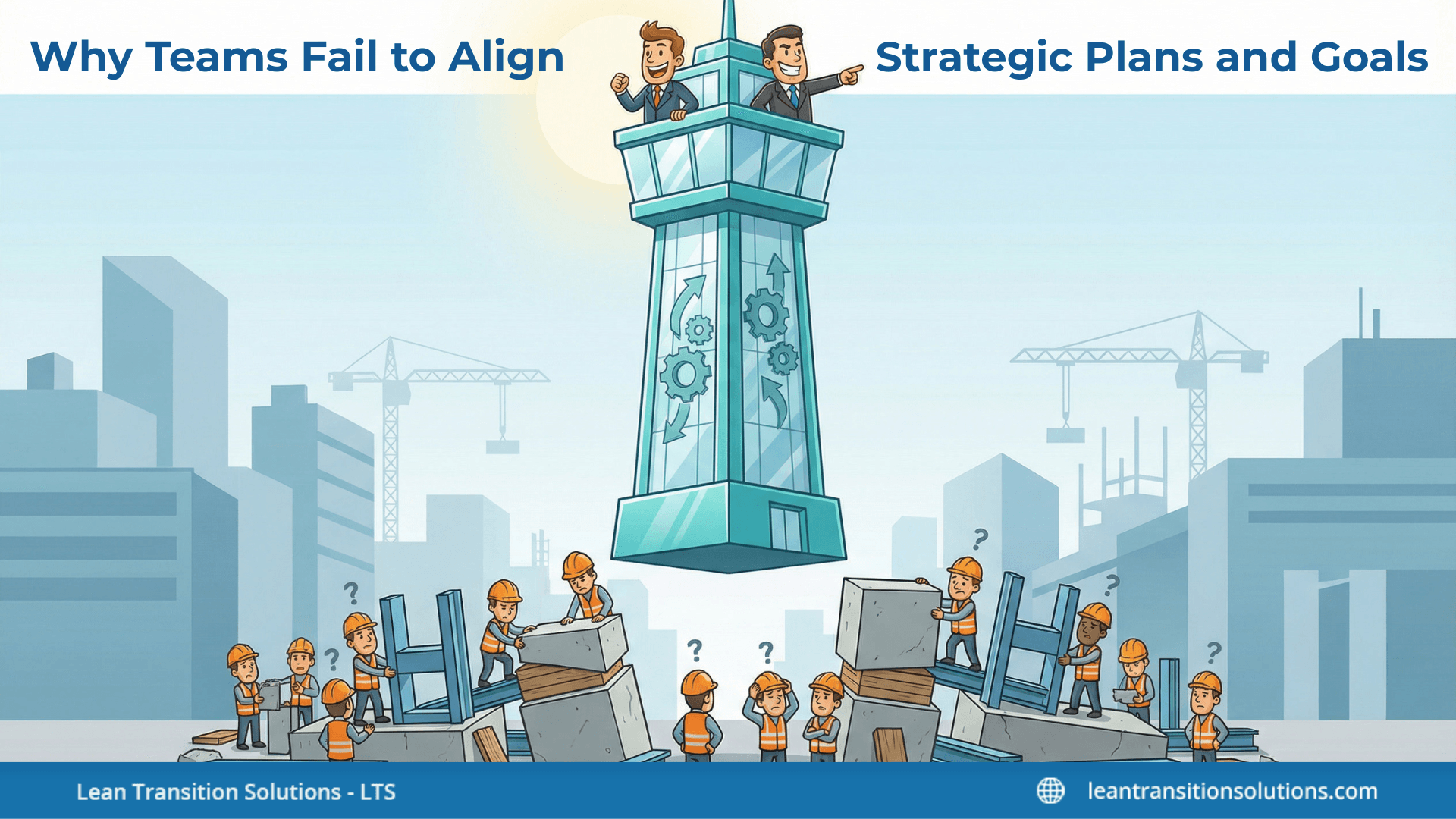
Most teams genuinely want to deliver on the strategy, yet alignment slips somewhere between planning and execution. Goals appear crystal clear at the top, but on the ground, the priorities are muddy, progress fragments, and teams remain busy without real impact. These strategic alignment challenges silently drain focus and pace. The good news? Alignment doesn’t need more meetings or complex tools. With the right structure and habits, strategic plans can transform into clear priorities and consistent action across teams. In this blog, we’ll see why teams can’t align with strategic plans and goals, where they break down in execution, how leadership communication dilutes strategic plans and goals, the role of KPIs in disconnecting them from strategic plans and goals, why teams lose line-of-sight to them, what strategic alignment looks like, and how to realign teams with strategic plans and goals.
Facing strategic alignment challenges? Discover what LTS Data Point has to offer
Why teams can’t align with strategic plans and goals
Most alignment issues take birth from how strategy is translated (or not) into day-to-day work. Here's where things really break down:
1. Strategy isn’t turned into clear priorities
- Strategic goals are shared as themes, not choices
- Teams don’t know what to start, stop, or to focus on
- Everyone works hard, but on different interpretations of the plan
2. Too many strategic goals compete at once
- Everything is labelled “critical” or “high priority”
- No obvious trade-offs between goals
- Teams fall back on urgent tasks instead of strategic ones
3. Teams lack line-of-sight to strategic plans and goals
- People can’t explain how their work assist strategy
- Goals live in decks, not in daily conversations
- Alignment becomes guessed, not confirmed
4. KPIs don’t mirror strategic intent
- Metrics monitor activity or output, not strategic outcomes
- Teams hit numbers while missing the point
- Strategy and performance calculation drift apart
5. Ownership for alignment is unclear
- Leaders “own” strategy, managers “manage” work
- No one owns alignment end-to-end
- Misalignment goes unnoticed until results get hurt
6. Review cadences reinforce reporting, not strategic alignment
- Meetings concentrate on updates, not decisions
- No space to course-correct preferences
- Strategy remains static while reality changes
Where strategic plans and goals break down in execution
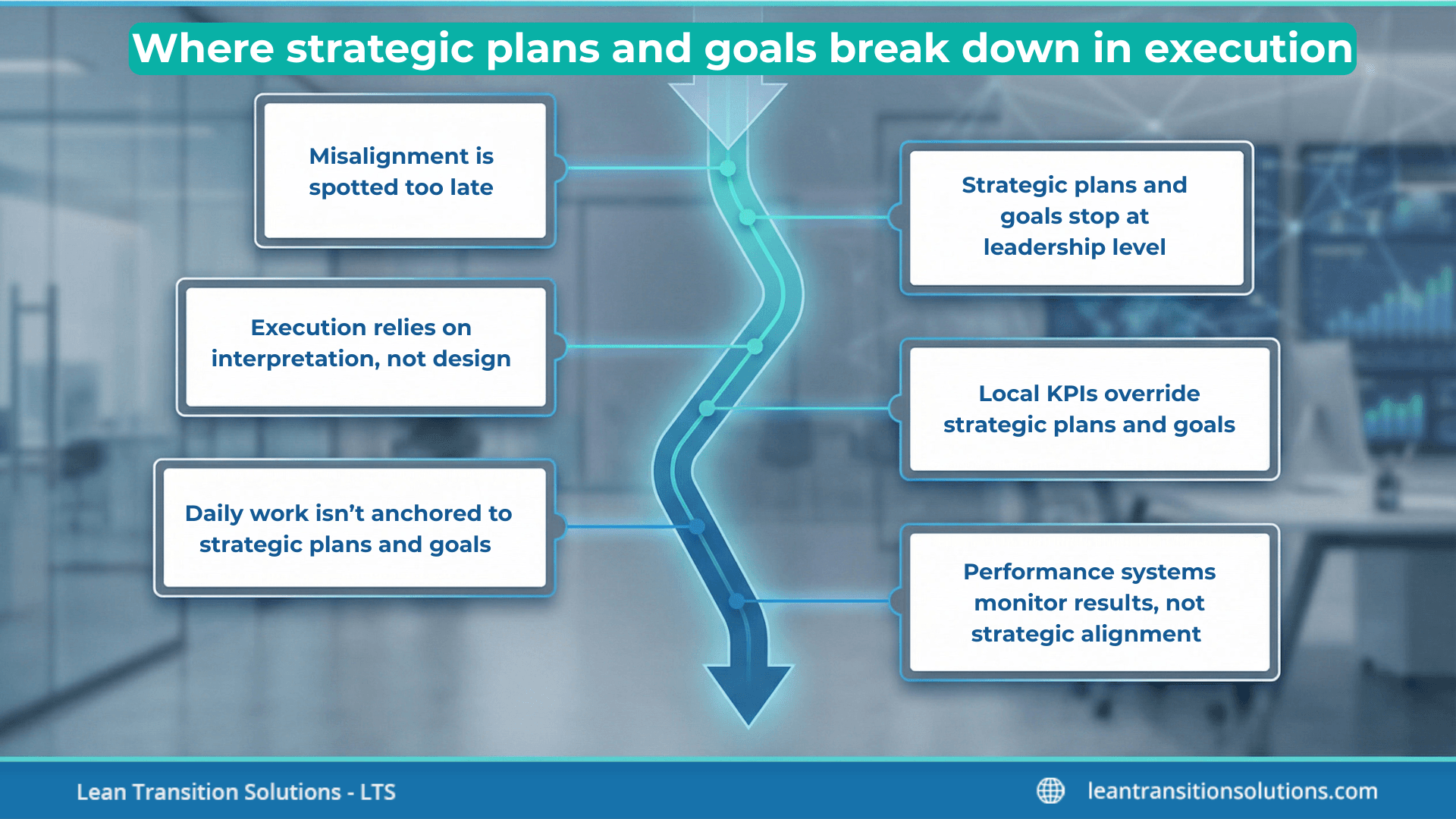
Strategic plans and goals usually collapse during execution because they aren’t built into how work is emphasised, assessed, and corrected daily. The most common failure points are:
1. Strategic plans and goals stop at leadership level
- Strategy discussions remain in leadership conferences
- Managers receive objectives without full context
- Teams act on diluted or inconsistent messages
2. Execution relies on interpretation, not design
- Teams understand strategy differently
- Alignment varies by function and supervisor
- No standard way to translate plans into actions
3. Daily work isn’t anchored to strategic plans and goals
- Task lists don’t indicate strategic focus
- Urgent work offsets strategic work
- Strategy runs parallel to execution, not through it
4. Misalignment is spotted too late
- Reviews occur monthly or quarterly
- Teams learn they’re off track after outputs slip
- No early flags to course-correct strategic execution
5. Performance systems monitor results, not strategic alignment
- Dashboards visualise outcomes, not intent
- Teams see what happened, not why
- Data aids reporting, not decisions
6. Local KPIs override strategic plans and goals
- Teams optimise for their own metrics
- Cross-functional alignment weakens
- Strategic progress stops while local KPIs seem healthy
Struggling to realign strategic plans and goals?
How leadership communication dilutes strategic plans and goals
Clear strategy doesn’t always mean clear interpretation. What leaders intend and what teams hear typically aren’t the same – and the gap widens with every layer.
1. Strategy is shared as vision, not direction
- Leaders talk about where the industry is going
- Teams demand clarity on what changes in their work
- Without guidance, vision remains abstract
2. Messages change as they cascade
- Each level simplifies or restructures the strategy
- Nuance and intent get lost along the way
- Teams get mixed or partial signals
3. One-way communication replaces dialogue
- Strategy is announced, not discussed
- Teams aren’t offered space to challenge their comprehension
- Misalignment goes unnoticed until execution aches
4. Strategic goals and plans aren’t repeated often enough
- Strategy is discussed during launches or quarterly updates
- Daily conversations pinpoint on delivery, not direction
- What aren’t repeated stops feeling relevant
5. Leaders assume alignment instead of checking it
- Silence is mistaken for understanding
- Teams nod along, then focus differently
- Alignment is assumed, not verified
6. Competing messages undermine strategic priorities
- Short-term pressures override long-term targets
- Leaders unintentionally alert conflicting preferences
- Teams follow what’s strengthened, not what’s stated
The role of KPIs in disconnecting teams from strategic plans and goals
Once strategy is communicated, teams look to metrics to understand what really matters. That's where strategic alignment often starts to slip, because measuring KPIs is no flip of a coin.
Teams follow KPIs because KPIs mould priorities, rewards, and pressure. If those metrics don’t reflect strategic goals and plans, alignment erodes – even when the strategy is clear.
- Lagging indicators dominate decision-making: KPIs often emphasise outcomes, not progress. Teams react after results are locked in, leading to little room for course-correction.
- Activity metrics replace strategic outcomes: Effort is measured but the impact isn’t. Busy teams appear effective while missing the point, thus strategy becoming secondary to throughput.
- Local optimisation takes over: Each team protects its own numbers. Cross-functional alignment weakens making strategic goals suffer silently.
- KPIs stay static while strategy evolves: Metrics remain the same even when strategic focus shifts. Teams keep optimising for yesterday’s aims.
When KPIs don’t change with strategy, teams don’t either. Alignment fails not because people ignore strategic goals and plans – but because performance systems quietly point them elsewhere.
Try out various tools and techniques from LTS Data Point to realign your strategy
Why teams lose line-of-sight to strategic plans and goals
Alignment doesn’t usually break in one big moment. It fades when teams stop seeing how their work links to the bigger picture. This is because the strategy is somewhere else. When strategic goals and plans aren’t obvious in daily work, they gradually disappear from attention.
- Quickly changing priorities: Short-term fixes take over as new requests arrive daily. Strategy doesn’t adapt at the same speed, resulting in teams responding to what’s loud, not what’s relevant.
- Fragmented work: Goals remain in decks, KPIs sit in dashboards, and tasks stay in trackers. No single view shows how today’s work assists strategic plans and goals.
- Managers act as translators: Teams align to their manager, and not the firm. Consistency breaks across functions as each manager interprets strategy in their own way.
- Alignment is left unchecked: Teams are often asked what they’re doing, rarely why they’re doing it. Misalignment remains hidden until outcomes slip.
What strategic alignment looks like
Alignment isn’t a feeling or slogan. You can see it and hear it in how teams work every day.
- Teams can explain the “why” behind their work: Ask anyone what they’re working on, and you’ll hear how it supports strategic goals and plans. There's no assuming, no vague answers, and no need to check a slide deck.
- Strategic plans and goals shape daily priorities: Work is planned around what matters most, not just what’s urgent. When trade-offs come up, teams know what to deprioritise because the strategy is clear.
- KPIs change when they change: Metrics aren’t fixed forever. When priorities shift, KPIs shift too – keeping teams focused on the right outcomes, not outdated targets.
- Alignment shows up in regular conversations: Strategy isn’t discussed once a quarter. It's referenced in huddle meetings, assessments, and problem-solving sessions, keeping direction visible and relevant.
- Teams detect misalignment early: People notice when work drifts off course and course-correct quickly. Alignment isn’t enforced – it's self-correcting.
When alignment is working, teams don’t just know the strategy – they make use of it to make decisions. Strategic goals and plans stop being background noise and starts leading daily actions.
Ready to turn strategy into action?
How to realign teams with strategic plans and goals
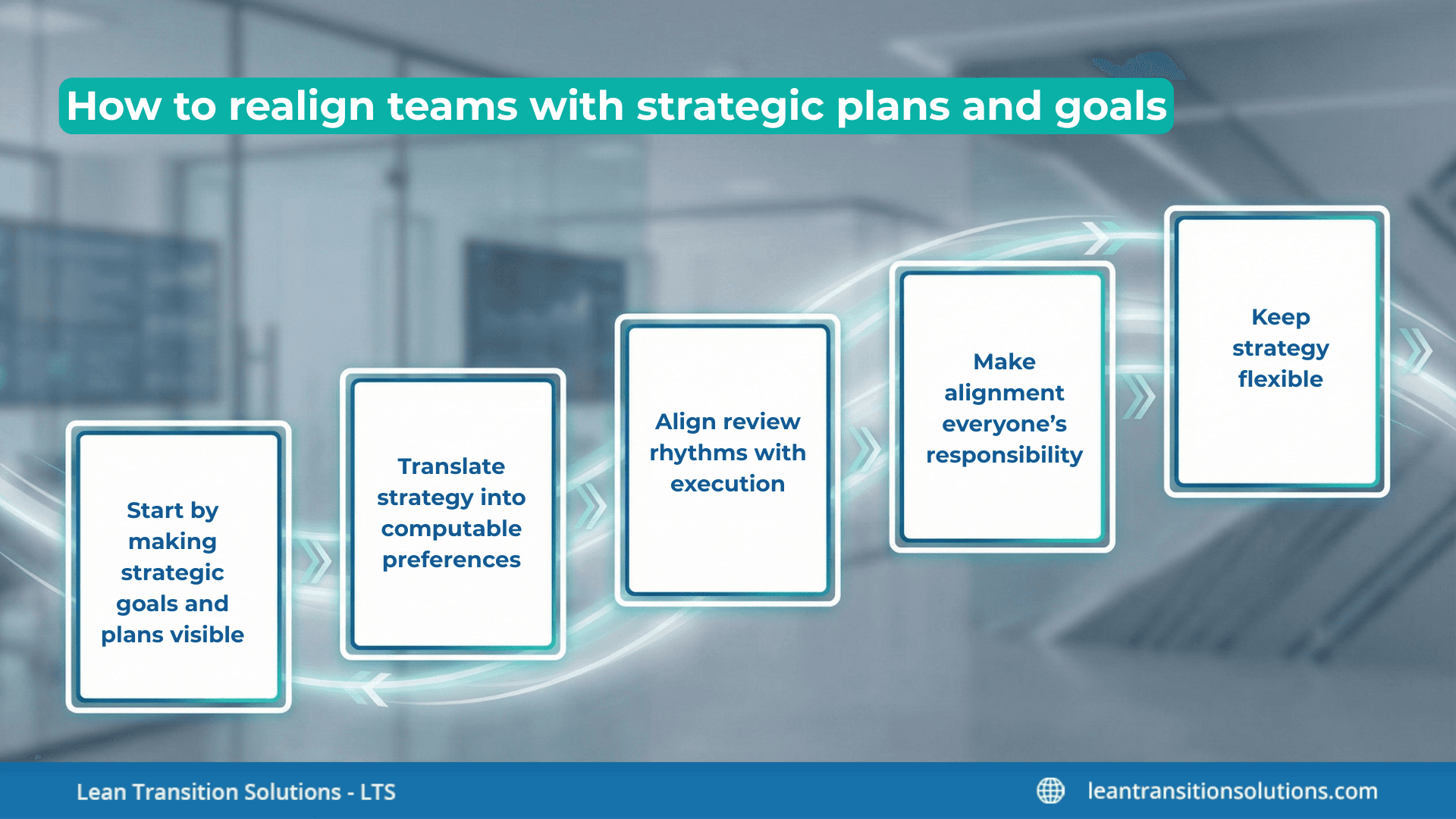
Realignment doesn’t always begin with motivation or messaging. It begins by fixing how strategy shows up in everyday work.
1. Start by making strategic goals and plans visible: If teams can’t see the strategy daily, they won’t act on it. Strategic plans and goals need to live where work happens – not just in presentations or leadership reviews.
- How LTS Data Point helps: Using strategy deployment dashboards and digital balanced scorecards, LTS Data Point keeps strategic objectives visible at every level, so teams always know what matters right now, not just at quarterly revies.
2. Translate strategy into computable preferences: Alignment enhances when teams know exactly what success looks like. That means connecting strategic goals and plans to clear KPIs and outcomes teams can influence.
- How LTS Data Point helps: It links strategic aims to operational and team-level KPIs through KPI hierarchy mapping and line-of-sight alignment, eliminating ambiguity and priorities.
3. Align review rhythms with execution: Strategy doesn’t fail in planning – it fails between evaluations. Short, frequent check-ins assist teams identify early and correct course before results suffer.
- How LTS Data Point helps: With real-time performance dashboards and daily/weekly review templates, LTS Data Point supports systematic performance conversations that concentrate on decisions, not status updates.
4. Make alignment everyone’s responsibility: When alignment sits only with leadership, it breaks under pressure. Teams need the ability to see, question, and adjust their work against strategic goals and plans.
- How LTS Data Point helps: Shared visual management boards and role-based views provide teams and leaders the same version of the truth, inspiring ownership and cross-functional alignment.
5. Keep strategy flexible: As priorities shift, measures and focus must shift too. Alignment sticks when systems adapt as fast as the business does.
- How LTS Data Point helps: Using dynamic goal and KPI configuration, LTS Data Point enables teams to update priorities without losing historical context or visibility, keeping alignment intact during change.
When teams struggle to follow strategic goals and plans, it’s rarely a commitment issue – it's a clarity issue. Too many priorities, disconnected measures, and delayed feedback quietly pull execution off course. Fixing that doesn’t require louder messaging or more meetings, but a better way to link decisions, data, and direction. With the right structure and support in place, teams stop reacting to targets and begin moving deliberately towards what actually matters.
No more waiting. Start acting. Choose LTS Data Point
FAQs
1. What is the difference between strategic alignment and tactical alignment?
Strategic alignment ensures all teams work towards long-term organisational objectives, while tactical alignment focuses on short-term actions that support those broader goals.
2. How does organisational culture influence strategic alignment?
A culture that promotes transparency and collaboration accelerates alignment. Conversely, siloed or rigid cultures often create barriers to translating strategy into action.
3. Why is cross-functional collaboration essential for alignment?
Cross-functional collaboration prevents teams from prioritising local objectives over enterprise-wide goals, ensuring decisions support the overall strategy rather than isolated metrics.
4. Can technology alone fix alignment issues?
No. Technology can make strategy visible and measurable, but true alignment also requires clear leadership communication, shared accountability, and adaptive processes.
5. How frequently should strategic alignment be reviewed?
Weekly or fortnightly check-ins are ideal for spotting misalignment early. Relying solely on quarterly reviews often results in delayed course correction.
6. What role does employee engagement play in alignment?
Engaged employees are more likely to understand and act on strategic priorities because they feel connected to the organisation’s purpose and outcomes.
7. How do external market changes affect alignment?
Rapid market shifts can render static strategies obsolete. Organisations must adapt goals and KPIs dynamically to maintain alignment during change.
8. What are early warning signs of misalignment?
Indicators include conflicting priorities across teams, KPIs that don’t reflect current strategy, and employees unable to explain how their work supports organisational goals.

Abel Jiménez, Lean Consultant
Abel is a Lean Consultant with over 30 years of expertise in operational analysis, process improvement, and organisational change across Mexican industries. Currently serving as Director of Insurance Promotions at CESCEMEX, he helps organisations leverage technology and lean practices to improve efficiency and manage change with continuity.