How a Takt Time Tracker Helps Manufacturing Teams Maintain Production Flow

Last updated on : January 27, 2026
In manufacturing, meeting customer demand consistently depends on how well production pace is controlled on the shop floor. Even when takt time is clearly defined, many teams struggle to translate it into day-to-day execution due to limited visibility, manual tracking, or delayed reporting. As a result, deviations in process time, cycle time, and lead time often go unnoticed until performance is already impacted.
A takt time tracker helps bridge this gap by continuously tracking actual production against takt, enabling teams to respond faster to imbalances, stabilise workflow, and maintain steady production flow.
In this blog, we’ll explore what takt time in manufacturing operations mean, how a takt time tracker uses the takt time formula to set production pace, difference between takt time tracker and process time and cycle time in manufacturing, using a takt time tracker to balance lead time and production flow, takt time tracker in lean manufacturing and takt lean management, industry applications of takt time tracker, relevance of takt time tracker in VSM and the takt time system for execution, and why LTS Data Point is the right takt time tracker for manufacturing execution.
Experience how LTS Data Point optimises takt time tracking in your operations
Takt time tracker: Understanding takt time in manufacturing operations
A takt time tracker helps manufacturing teams maintain the right production rhythm by aligning output with customer demand. In simple terms, takt time defines how often a finished unit should be produced and tracking it ensures that manufacturing takt time is consistently achieved across shifts, lines, and processes. Without visibility into takt time in manufacturing, teams often rely on assumptions, leading to uneven flow, delays, and missed targets.
In manufacturing operations, a takt time tracker supports:
- Clear production pacing: Establishes a defined takt manufacturing rhythm so every process works to the same demand-driven cadence.
- Consistency across operations: Helps standardise manufacturing takt time across multiple lines and teams.
- Early detection of imbalance: Spotlights when actual output drifts from planned takt time, before delays compound.
- Improved operational visibility: Makes takt time in manufacturing visible at the shopfloor and management levels.
- Better decision-making: Allows supervisors to act on real performance data instead of end-of-shift reports.
- Stronger alignment with demand: Ensures production output matches customer requirements, not internal assumptions.
By making takt time quantifiable and visible, a takt time tracker becomes the foundation for stable flow, predictable output, and disciplined execution in modern manufacturing environments.
How a takt time tracker uses the takt time formula to set production pace
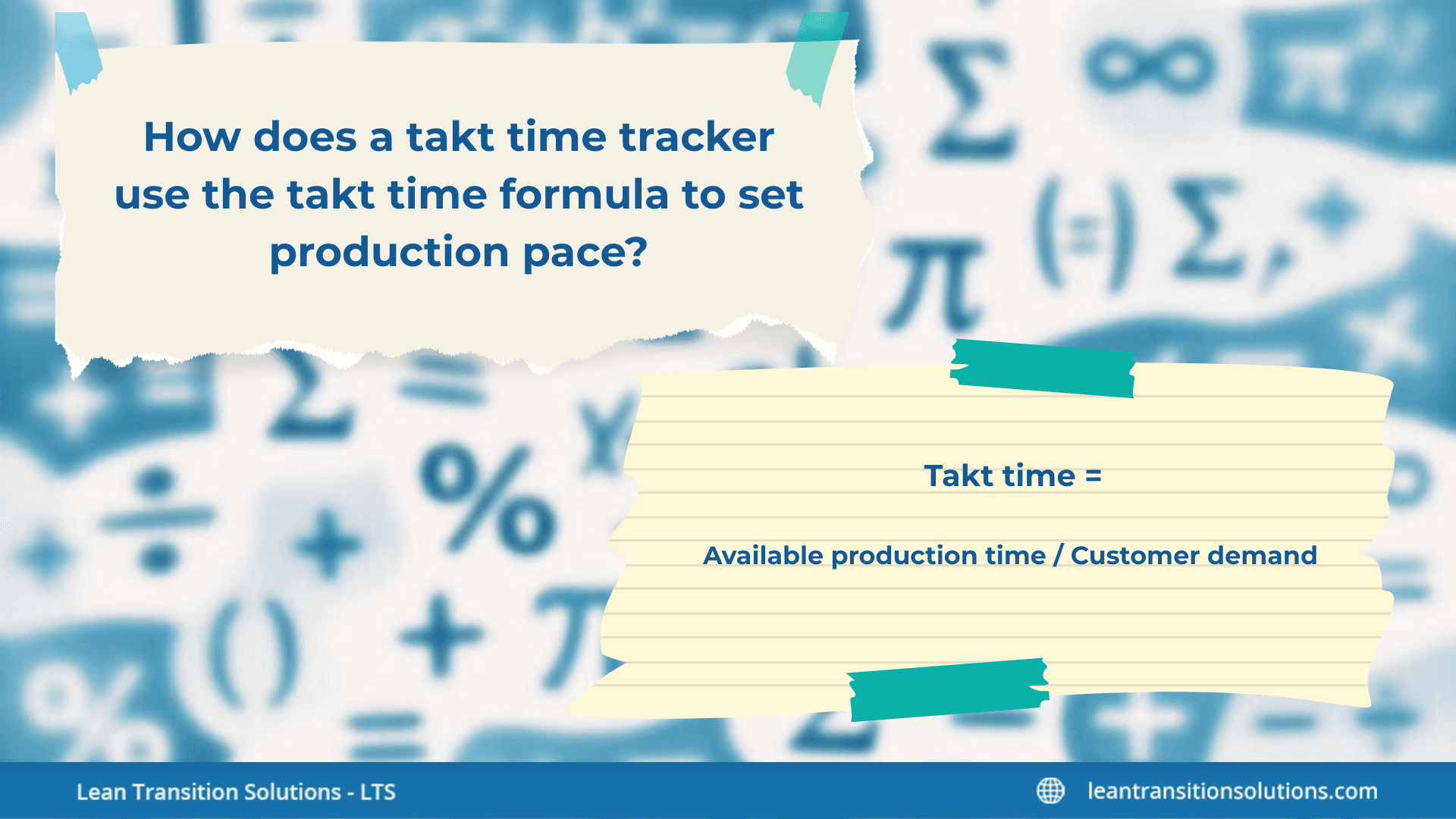
At its core, a takt time tracker translates customer demand into a clear, executable production rhythm using the takt time formula. This formula defines the ideal time allowed to produce one unit so that output remains aligned with demand, forming the basis of production takt time across manufacturing operations.
The standard takt time formula is:
Takt time = Available production time / Customer demand
A simple takt time calculation example:
- Available production time: 480 minutes per shift
- Customer demand: 240 units per shift
- Takt time: 2 minutes per unit
This result establishes the required takt time – one finished unit every two minutes – to meet demand without overproduction or delays.
How a takt time operationalises this calculation:
- Converts formulas into live targets: Applies the takt time formula directly to real production schedules and demand data.
- Visualises production takt time: Displays expected vs actual output at each stage of the process.
- Tracks takt rate adherence: Highlights when teams are ahead of or behind the required takt rate.
- Supports rapid adjustments: Allows supervisors to rebalance work or resources when takt deviations occur.
- Standardises execution: Makes sure the same production takt time is applied consistently across shifts and lines.
By embedding takt time calculation into daily operations, a takt time tracker turns theoretical planning into practical, demand-driven production control.
Connect with our specialists to improve production flow using LTS Data Point
Takt time tracker vs process time and cycle time in manufacturing
Understanding the difference between takt time, process time, and cycle time is critical for manufacturing teams. While takt time tracker sets the production rhythm based on customer demand, process time and cycle time measure how long actual tasks take on the shopfloor. Confusing these metrics can lead to inefficiencies, overproduction, or missed delivery targets.
Key distinctions and how a takt time tracker helps:
1. Process time vs cycle time:
- Process time is the actual time a worker or machine spends on a specific task.
- Cycle time is the total time to complete one unit, including waiting and handoffs.
2. Takt time vs cycle time:
- Takt time is demand-driven, defining the pace required to meet customer needs.
- Cycle time shows whether the current production speed aligns with the takt time, cycle time, and lead time expectations.
3. Spotting bottlenecks: A takt time tracker spotlights where process time cycle exceeds the allowed takt time, enabling timely interventions.
4. Optimising workflow: By comparing takt time with actual process time and cycle time, teams can balance workloads, reduce delays, and standardise output.
5. Connecting to lead time: Understanding takt time, cycle time, and lead time ensures that production flow aligns with overall delivery commitments.
Using a takt time tracker alongside process and cycle time metrics provides a clear picture of production performance, allowing manufacturers to maintain steady output and meet customer demand reliably.
Using a takt time tracker to balance lead time and production flow

A takt time tracker not only ensures production keeps pace with demand but also helps balance lead time across manufacturing processes. By connecting takt time and lead time, teams can synchronise production schedules, reduce waiting periods, and deliver on time without overburdening resources.
How a takt time tracker balances lead time and flow:
- Aligns production with demand: Connects lead time and takt time to real customer needs preventing overproduction.
- Highlights workflow bottlenecks: Reveals areas where takt time, cycle time, and lead time are mismatched, causing delays.
- Supports predictive planning: Helps plan tasks and resources so that every process stage meets its takt-driven timeline.
- Reduces variability: Verifies consistent output across shifts, keeping both takt time and overall lead time under control.
- Improves on-time delivery: By observing the relationship between takt time and lead time, manufacturers can dependably meet delivery commitments.
- Drives continuous improvement: Provides data to optimises both cycle and lead times, enhancing flow and customer satisfaction.
With a takt time tracker, manufacturers can see exactly how production speed affects delivery schedules, making it a critical tool for synchronising operational planning with real-world performance.
Discover how LTS Data Point transforms takt time into actionable insights
Takt time tracker in lean manufacturing and takt lean management
In lean manufacturing, maintaining a smooth and predictable production flow is essential. A takt time tracker plays a key role by aligning operations with lean takt principles, helping teams achieve consistent output with waste. By embedding takt time in lean manufacturing practices, manufacturers can balance workload, optimise resources, and support continuous improvement.
How a takt time tracker strengthens lean execution:
- Implements lean takt time: Ensures each process step adheres to the demand-driven pace defined by lean takt principles.
- Supports takt lean management: Monitors production in real time, making deviations visible and allowing corrective actions quickly.
- Reduces waste and inefficiency: Spotlights overproduction, waiting time, and uneven workloads, core concerns in takt time in lean manufacturing.
- Standardises work across teams: Motivates consistent application of takt-driven processes across lines and shifts.
- Enhances continuous improvement: Provides data to refine workflows, improve cycle times, and sustain operational excellence.
- Visualises flow for decision-making: Makes lean takt adherence visible to supervisors and management, allowing faster problem-solving.
Using a takt time tracker within lean frameworks ensures that production is not only faster but also smarter, minimising a stable, predictable flow.
Industry applications of a takt time tracker
A takt time tracker is not limited to traditional factory environments. Its value lies in aligning work pace with demand, making it relevant across multiple organisations where flow, timing, and predictability matter. From labour-intensive operations to complex project-based environments, takt time tracking aids teams stabilise output and enhance execution.
Key industry applications include:
1. Takt time in the garment industry: Supports line balancing in apparel manufacturing, where manual operations, style changes, and variable demand make maintaining consistent output challenging. A takt time tracker helps synchronise stitching, finishing, and packing activities to daily demand.
2. Takt time in healthcare: Applies to patient flow, diagnostics, and service delivery. Monitoring takt time helps hospitals and clinics balance workloads, lower waiting times, and align care delivery with patient demand without overburdening staff.
3. Takt time in construction: Allows structured, zone-based execution where tasks must follow a defined cadence. Using takt time in construction enhances coordination between trades, reduces idle time, and increases schedule reliability.
4. Discrete manufacturing: Common in automotive, engineering, and assembly-based environments, where a takt time tracker makes sure each workstation meets the required production pace to maintain line flow.
5. Process manufacturing: Relevant for organisations such as chemicals, pharmaceuticals, food and beverage, and FMCG, where takt time helps align batch cycles, changeovers, and packaging operations with demand.
6. Metals and heavy manufacturing: Supports production planning in high-capital environments by making delays and capacity constraints visible against takt-driven targets.
7. Multi-line and multi-shift operations: Assists industries standardise production rhythm across plants, shifts, and teams, verifying consistent performance regardless of scale.
By applying a takt time tracker across these organisations, industries gain a shared demand-driven reference point for execution. This versatility makes takt time tracking a practical tool not just for manufacturing, but for any operation focused on flow, predictability, and delivery performance.
Get hands-on walkthrough of LTS Data Point takt time tracker
Takt time tracker in VSM and the takt system for execution
A takt time tracker becomes especially powerful when applied at the value stream level. In digital value stream mapping (VSM), takt time serves as the reference point for examining whether each process step can meet customer demand. By anchoring the entire value stream to a shared pace, companies can move from isolated improvements to coordinated execution.
How a takt time tracker supports VSM and the takt system:
- Establishes VSM takt time: Defines VSM takt time as the baseline against which process performance is calculated across the value stream.
- Connects strategic planning to execution: Translates value stream design into daily operational targets through a structured takt system.
- Spots flow disruptions: Spotlights where cycle times, queues, or handoffs fail to meet takt time in VSM, revealing constraints early.
- Supports takt manufacturing solutions: Allows consistent application of takt-driven execution across lines, cells, and departments.
- Enhances cross-functional alignment: Makes sure upstream and downstream processes function to the same takt, lowering local optimisation.
- Drives sustainable execution: Strengthens takt adherence as part of a recurring execution model rather than a one-time improvement effort.
By embedding a takt time tracker within the takt system, manufacturers can make sure that value stream designs are executed as intended – delivering stable flow, predictable output, and reliable performance at scale.
Why LTS Data Point is the right takt time tracker for manufacturing execution
While takt time principles are well understood, execution often breaks down due to disconnected data, delayed visibility, and inconsistent tracking across operations. LTS Data Point addresses this gap by allowing teams to monitor, see, and act on takt performance as part of daily manufacturing execution – supporting stable process flow and value stream mapping without depending on manual reporting or fragmented tools.
Why manufacturing teams choose LTS Data Point for takt time tracking:
- Centralised takt visibility: Enables consistent tracking of takt adherence across processes, shifts, and production areas.
- Execution-focused design: Supports real-world manufacturing workflows where takt deviations need immediate attention.
- Operational alignment: Helps teams align production pace with demand while maintaining flow across the value stream.
- Scalable across operations: Supports takt tracking across multiple lines and plants without changing execution discipline.
- Data-driven improvement: Provides reliable performance data to support continuous improvement and operational decision-making.
Rather than treating takt time as a static measuring, LTS Data Point helps industries use it as a live execution signal across the value stream.
Step-by-step guidance to implement takt time tracking using LTS Data Point
Define customer demand and available production time
Establish the baseline inputs required to quantify takt time accurately.
Configure takt targets at the process or line level
Set clear takt expectations aligned to real production constraints and process flow requirements.
Map takt to operational workflows
Align takt targets with existing production stages to support effective value stream mapping.
Enable live performance tracking
Track actual output against takt to detect disruptions in process flow early.
Visualise takt adherence for teams and supervisors
Ensure takt performance is visible across the value stream, where decisions are made.
Review takt performance regularly
Use monitored data to reinforce process flow and value stream mapping through continuous improvement.
Continuously refine execution
Adjust takt targets and workflows as demand or capacity changes to maintain alignment.
By embedding takt time tracking into daily execution, LTS Data Point supports consistent process flow, strengthens value stream mapping, and enables demand-driven manufacturing performance without disrupting existing operations.
A takt time tracker brings structure and predictability to manufacturing operations by aligning production pace with real customer demand. When takt time is clearly defined, tracked, and acted upon, teams gain better control over process flow, lead time, and delivery performance. By linking takt time to daily execution and value stream thinking, manufacturers can move beyond reactive firefighting toward stable, repeatable, and continuously upgrading operations.
Get personalised guidance on LTS Data Point takt tracking for your facility
FAQs
1. How often should takt time be reviewed in a manufacturing environment?
Takt time should be reviewed whenever customer demand, available production time, or shift structures change.
2. Can takt time tracking work in high-mix, low-volume manufacturing?
Yes. Takt time can be applied by grouping products into families and adjusting takt based on demand variability.
3. What happens when actual cycles time consistently exceeds takt time?
It indicates a capacity or flow imbalance that requires process improvement, workload rebalancing, or resource adjustment.
4. Is takt time tracking useful for non-production teams?
Takt principles can be applied to support functions like maintenance, logistics, and quality to improve responsiveness and flow.
5. How does takt time tracking support continuous improvement initiatives?
It provides a stable performance baseline, making deviations visible and improvement opportunities easier to prioritise.
6. Can takt time be applied across multiple shifts with different staffing levels?
Yes. Takt time can be recalculated per shift based on available time and staffing constraints.
7. What is the difference between takt adherence and productivity?
Takt adherence focuses on meeting demand rhythm, while productivity measures output efficiency – both must be balanced.
8. Does takt time tracking replace production planning tools?
No. It complements planning by ensuring execution aligns with planned demand and schedules.