Real-Time Takt Time tracking for optimised production efficiency
Enhance production flow with real-time takt time monitoring, automated alerts, and seamless shift transitions to maximise efficiency and minimise delays.
Why Takt Time tracking matters?
Takt Time Tracking ensures production aligns with customer demand by maintaining an optimal production pace. Takt time is crucial for maintaining production efficiency and avoiding bottlenecks. By tracking real-time performance, manufacturers can enhance workflow precision, reduce downtime, and meet production targets effectively. With automated takt timers, alerts, and performance tracking, this feature supports lean manufacturing and continuous improvement.
- Ensure consistent production flow by tracking real-time takt time.
- Minimise delays and downtime with automated alerts and logging.
- Enhance operational efficiency with seamless shift transitions.
- Improve data accuracy through automated logging and delay tracking.
- Support lean manufacturing goals by reducing production waste.
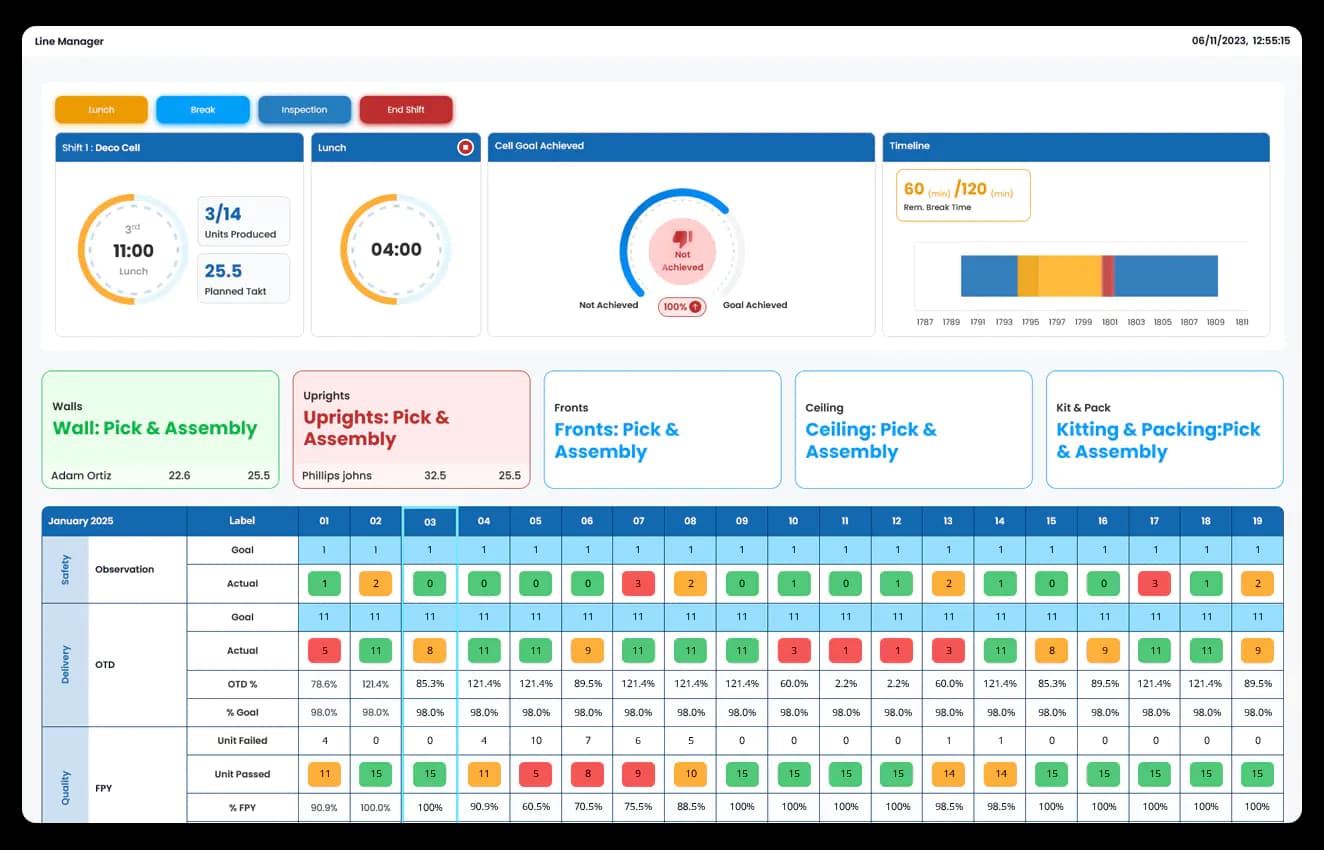
Gain real-time insights and keep your production aligned with takt time targets.
Precision-Driven Takt Time management for peak efficiency
Track, analyse, and optimise every second of your production cycle with real-time insights, automated controls, and seamless shift transitions.

Real time Takt Time monitoring
Track production lives with a dynamic Takt Time clock that turns red when limits are exceeded, helping operators stay on pace and meet production targets.

Seamless cycle & shift transitions
Effortlessly reset Takt Time for each production cycle and automate shift closures and handovers to prevent overruns and maintain continuity.

Accurate break & downtime management
Automatically pause and resume Takt Time during breaks and inspections, ensuring accurate cycle tracking and compliance with break limits.

Goal oriented production tracking
Display real-time target vs. actual Takt Time with color-coded indicators for immediate feedback, guiding operators to hit production goals.

Delay detection & Root Cause Analysis (RCA)
Instantly capture reasons for Takt Time breaches, enabling detailed delay analysis to drive improvements and reduce recurring inefficiencies.

Comprehensive data logging & compliance
Log cycle times, operator inputs, delays, and inspections, ensuring error-free records that support pre-shift compliance, performance reviews, and continuous improvement.
Takt Time Tracking Software: The Complete Guide to Real-Time Production Monitoring and Efficiency Improvement
How does automated takt time alert system work, and why does the timing of an alert matter?
An alert that fires after the shift ends is not an alert. It is a report. The value of automated takt time alerts is that they fire at the moment a limit is exceeded, while there is still time to respond within the same production cycle.
The dynamic takt time clock turns red when a cycle exceeds its limit. That visual signal is the alert. It is immediate, unambiguous, and requires no interpretation. The operator does not need to check a separate system or wait for a supervisor to flag the deviation. The response begins at the same moment the deviation occurs. Over a full shift, that reduction in response time across multiple cycles is the difference between a production target that is recovered and one that is written off in an end-of-shift summary
How does automatic break and downtime management improve the accuracy of cycle time data?
Manual break tracking is inconsistent by nature. If an operator starts a break two minutes early or returns two minutes late and the takt time clock runs throughout, every cycle tracked during that window is inaccurate. Over a shift, those inaccuracies compound into performance data that does not reflect what actually happened on the line.
Automatic pause and resume during breaks and inspections removes that inconsistency. The clock stops when a break starts and resumes when production restarts, with no manual input required. The cycle time data logged reflects actual production time rather than elapsed time. For operations where inspection pauses occur at defined points in the process, the same logic applies. The result is a compliance record and a performance dataset accurate enough to act on rather than approximate enough to be questioned.
How does seamless shift transition prevent production loss at changeover?
Shift handovers are one of the most consistent sources of production loss in manufacturing. The outgoing shift finishes. The incoming shift takes time to get up to speed. Equipment may sit idle. The takt time clock, if reset manually, may not restart at the right moment. Over a week of three-shift operations, those gaps accumulate into significant unplanned downtime.
Automated shift closures and handovers remove the dependency on manual action at the transition point:
- The takt time resets automatically for each new production cycle
- Shift closure happens without requiring an operator to trigger it
- Continuity of tracking is maintained across the handover without a gap in the data
For operations where production targets are set per shift rather than per day, this also means the incoming shift starts from a clean baseline rather than inheriting trailing data from the previous shift.
How does pre-shift compliance logging reduce the risk of production issues before a shift begins?
Most production problems that surface mid-shift have preconditions that were present before the shift started. Equipment that was not checked. A process that was not set up correctly. An operator who was not briefed on a change to the production plan. Pre-shift compliance logging creates a formal record that the checks required before production begins were completed.
That record serves two purposes. First, it creates accountability at the start of the shift rather than at the end of it, which is when accountability is still preventive rather than reactive. Second, it provides an audit trail. When a quality issue or a safety incident occurs mid-shift and the investigation asks what the pre-shift state was, the compliance log provides a documented answer rather than a reconstructed one.
How does a colour-coded target versus actual display change the speed of operator response?
A number on a screen requires interpretation. A colour requires a decision. When the takt time display turns red, the operator does not need to calculate whether performance is on track. The signal is immediate and unambiguous. The time between a deviation occurring and a response beginning is measured in seconds rather than in the minutes it takes to read and process a numerical display.
This matters most at the point in a shift when recovery is still possible. A deviation flagged visually at the moment it occurs gives the team time to adjust pace, reallocate resource, or flag a constraint before it has compounded into a shortfall that cannot be recovered within the shift.
How does capturing delay reasons at the point of a takt time breach support root cause analysis?
A takt time breach logged without a reason is a count. A takt time breach logged with a reason is the beginning of an investigation. The distinction matters because a count tells you how often performance fell short. A reason tells you why, and when those reasons are captured consistently across every breach, patterns become visible that no end-of-shift summary would surface.
Capturing delay reasons at the moment of breach rather than retrospectively means the reason recorded reflects what actually caused the delay. An operator logging the reason when the clock turns red is recording the cause while it is still in front of them. That data feeds directly into root cause analysis, giving teams a structured basis for identifying recurring failure modes rather than relying on memory or verbal handovers that vary with every shift.
How does comprehensive data logging support performance reviews and continuous improvement?
A performance review built from memory or verbal updates is unreliable. The data shifts depending on who is in the room and what they remember. A performance review built from logged data is consistent, comparable across shifts, and auditable.
Comprehensive logging of cycle times, operator inputs, delays, and inspections means every shift leaves a complete record. That record supports three things:
Performance reviews that compare actual shift data rather than reported estimates
Trend analysis that shows whether recurring delays are improving, worsening, or holding flat over time
Continuous improvement activity that targets the specific failure modes the data identifies rather than the ones the team assumes are the problem
The log also removes the dependency on individual operators to remember and report accurately at the end of a long shift. The data is captured at the point of occurrence, not reconstructed afterward. For teams building a more structured approach to production flow, a takt time tracker shows how consistent data capture translates into measurable improvement over time.
How does takt time tracking integrate with MES and ERP systems, and what does that enable?
A takt time clock running in isolation captures what is happening on one line. Connected to a Manufacturing Execution System or an ERP, it becomes part of a production data layer that informs scheduling, capacity planning, and performance reporting across the operation.
Integration with MES and ERP means production targets can flow into the takt time system from the schedule rather than being entered manually at the start of each shift. Actual cycle time data flows back out, giving the planning system a live picture of whether production is tracking to plan. For operations managing multiple lines or multiple sites, this means takt time performance is visible at the level where scheduling decisions are made, not just at the line where the clock is running.
Hear it from our customers

MARC ROBINSON
Director, Global Operational Excellence


“By providing a central location to input, analyse and share our KPIs, 'Data Point' enables site management to more easily focus on the entire business as a team. Its ability to allow automated data entry and trend analysis gives us more time for improvement rather than just reporting numbers. Combined with a disciplined approach within our SQDC meeting process, I believe 'Data Point' will help us continually focus on key issues and drive business excellence in all areas.”
Unlock Real-Time production efficiency with Takt Time monitoring
Discover how Data Point’s Takt Time management solution empowers your team to streamline production, minimise downtime, and hit targets with precision.
Get Started
Your Questions, Answered!
How does Takt Time Tracking work?
- Set the Takt Time:Define production targets based on customer demand.
- Monitor in real-time: Track cycle times and compare them with the takt time goal.
- Receive alerts & log data: Automatic notifications and data logs help identify inefficiencies.
- Analyse & improve: Use insights to refine workflows and enhance productivity.
What are the key use cases for Takt Time Tracking?
- Automotive Manufacturing: Ensures assembly lines maintain steady production flow.
- Electronics Industry: Helps synchronise high-volume production lines.
- Pharmaceuticals Supports compliance and precision in manufacturing.
Why choose DataPoint for Takt Time Tracking?
- Real-time monitoring and alert for proactive production management.
- Comprehensive data logging for performance analysis.
- Seamless integration with MES, ERP, and IoT systems.
- Customisable features to fit different industry needs.