SQDIC Explained: A Practical Framework for Safety, Quality, Delivery, Inventory, and Cost
SQDIC (or SQDCI) is a performance management framework used to track Safety, Quality, Delivery, Inventory, and Cost through daily reviews, visual boards, and operational KPIs.
Contents
- What is SQDIC framework?
- Sample of an SQDIC board
- An overview of SQDIC framework: How does it work?
- Quick guide: SQDIC vs. SQDIP
- What are SQDIC shopfloor metrics?
- SQDIC in lean daily management
- What is an SQDIC board?
- Challenges and limitations in traditional paper-based SQDIC
- What is a digital SQDIC board?
- Benefits of digital SQDIC boards
- Which industries can make use of digital SQDIC boards?
- Why SQDIC is a powerful visual management framework
- How SQDIC enhances operational performance
- SQDIC management: How to implement SQDIC effectively
- How to track and customise SQDIC metrics using a digital system
- Tier-based use of SQDIC
- Digital SQDIC boards customised for your needs by LTS Data Point
- Case study: How SQDIC drives real results in different sectors
Last updated on : September 30, 2026
What is SQDIC framework?
SQDIC is a performance management framework used to track and improve operational health across Safety, Quality, Delivery, Inventory, and Cost. It helps team focus on the right priorities during daily reviews, allowing faster issue identification, clearer accountability, and more consistent decision-making across the industry.
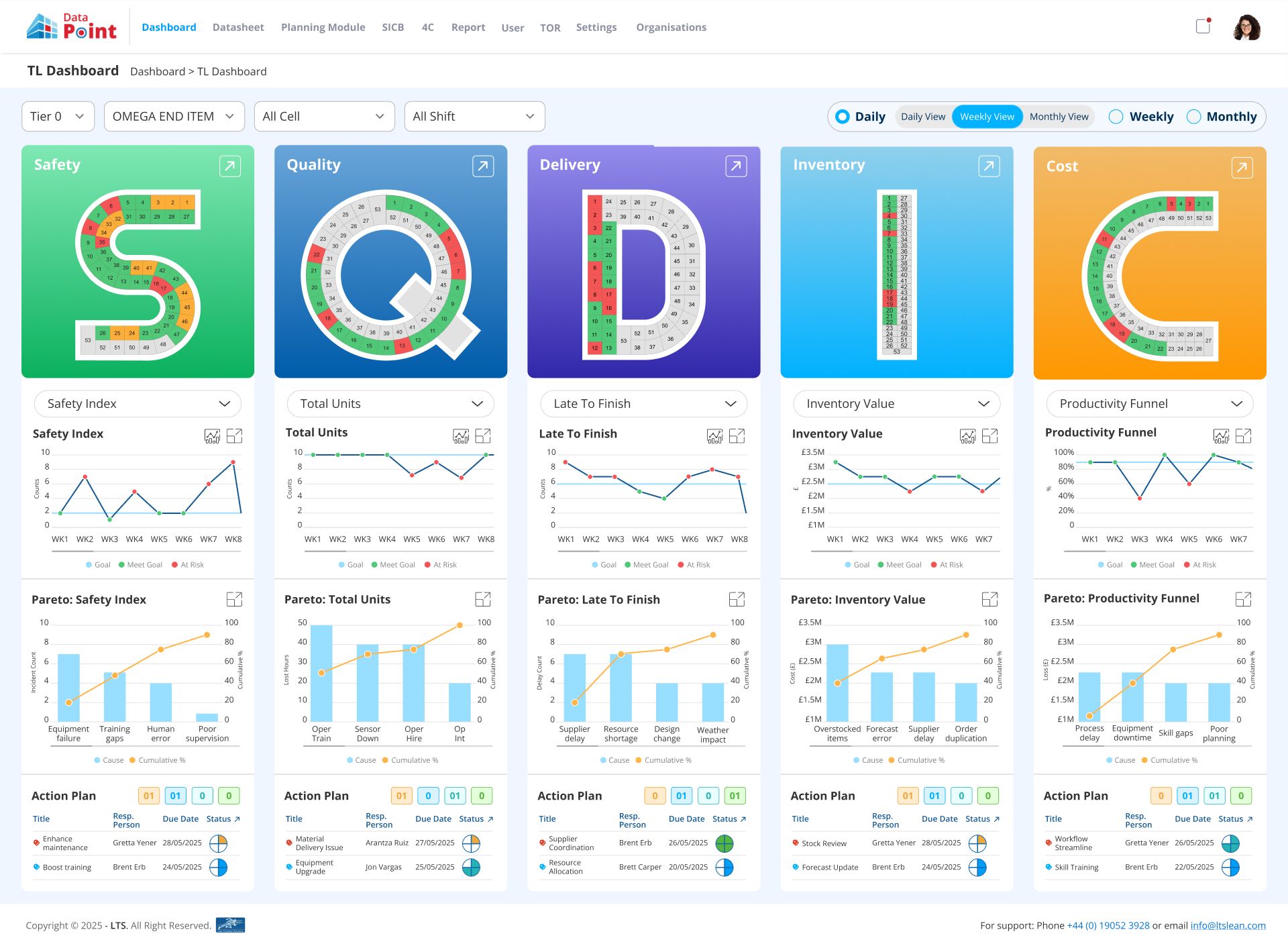
Sample of an SQDIC board
An overview of SQDIC framework: How does it work?
SQDCI originated from the SQDC framework, which is a core element of Lean manufacturing. Over time, Inventory was added as a fifth pillar to mirror growing challenges around stock visibility, cash flow, and supply chain stability – evolving SQDC into SQDCI for modern operational environments.
See SQDIC in action with LTS Data Point
Quick guide: SQDIC vs. SQDIP
What are SQDIC shopfloor metrics?
SQDIC metrics are daily, operational indicators used on the shopfloor to monitor performance, spot issues early, and support rapid decision-making during huddles and reviews.
Below are commonly tracked examples for each SQDIC pillar:
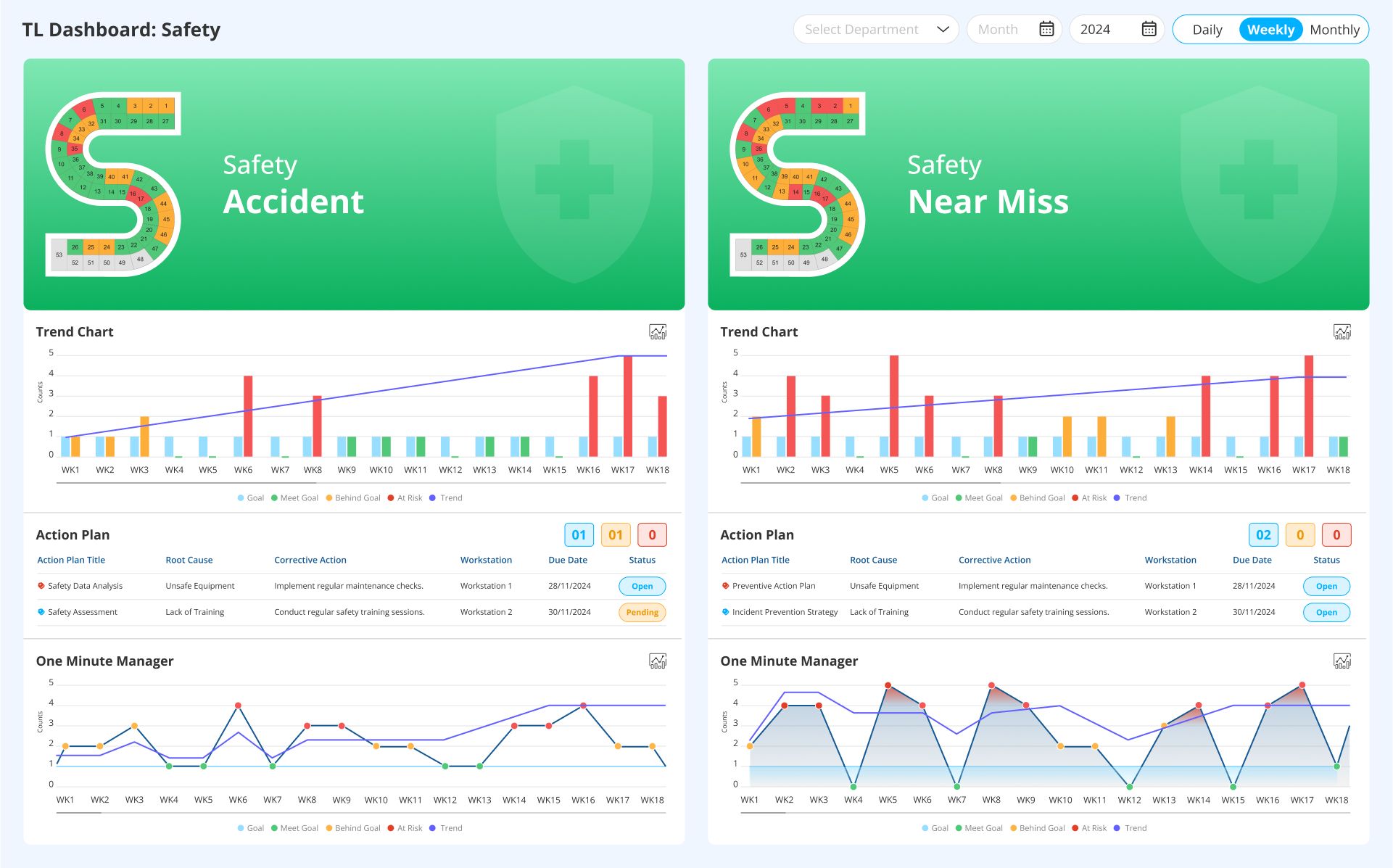
Safety
- Recordable incidents
- Near-miss reports
- Unsafe acts observed
- Unsafe conditions logged
- Days since last incident
- First-aid cases
- Lost Time Injury Frequency Rate (LTIFR)
- Safety audit findings
- PPE non-compliance incidents
- Toolbox talk completion
- Hazard reports raised
- Safety corrective actions overdue
Quality
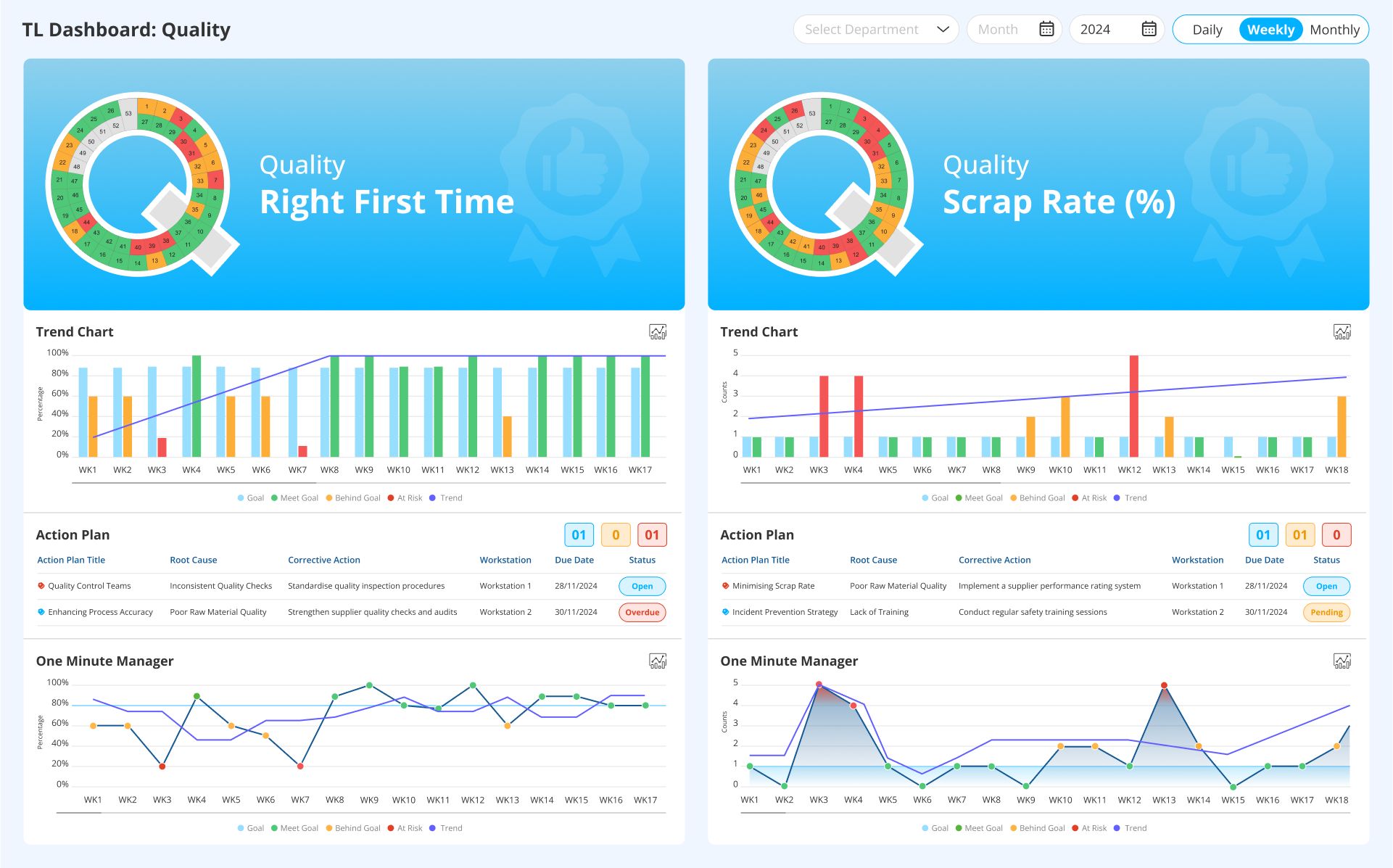
- Defect rate
- First Pass Yield (FPY)
- Scrap quantity
- Rework hours
- Customer complaints
- Internal quality alerts
- Right-first-time percentage
- Process deviations
- Quality audit findings
- Non-conformance count
- Cost of poor quality (COPQ)
- Returned goods
Delivery
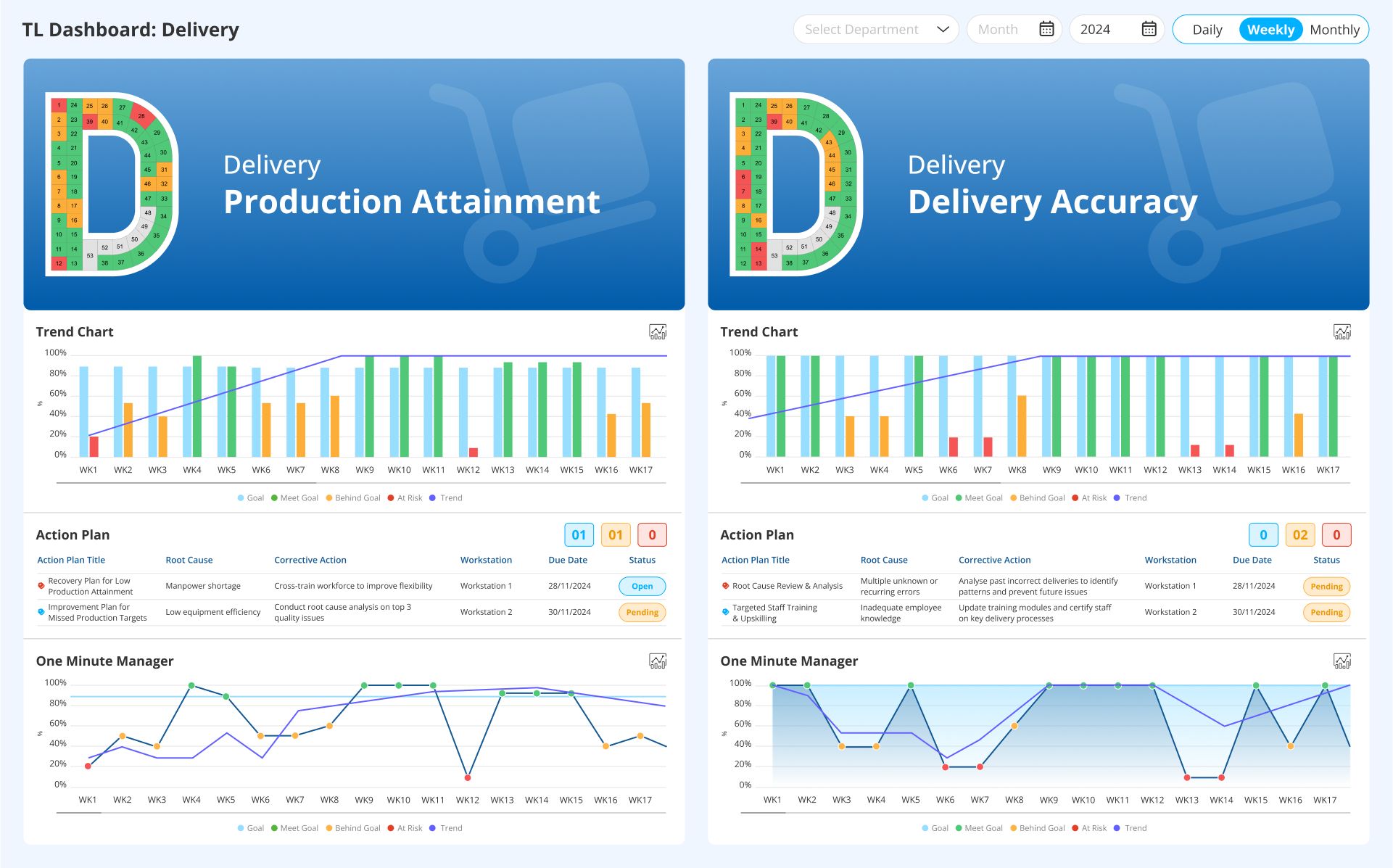
- On-time delivery (OTD)
- Schedule adherence
- Missed orders
- Backlog count
- Throughput vs plan
- Order fulfilment rate
- Late dispatches
- Cycle time variance
- Expedite requests
- Customer service level
- Production plan attainment
- Lead time performance
Inventory
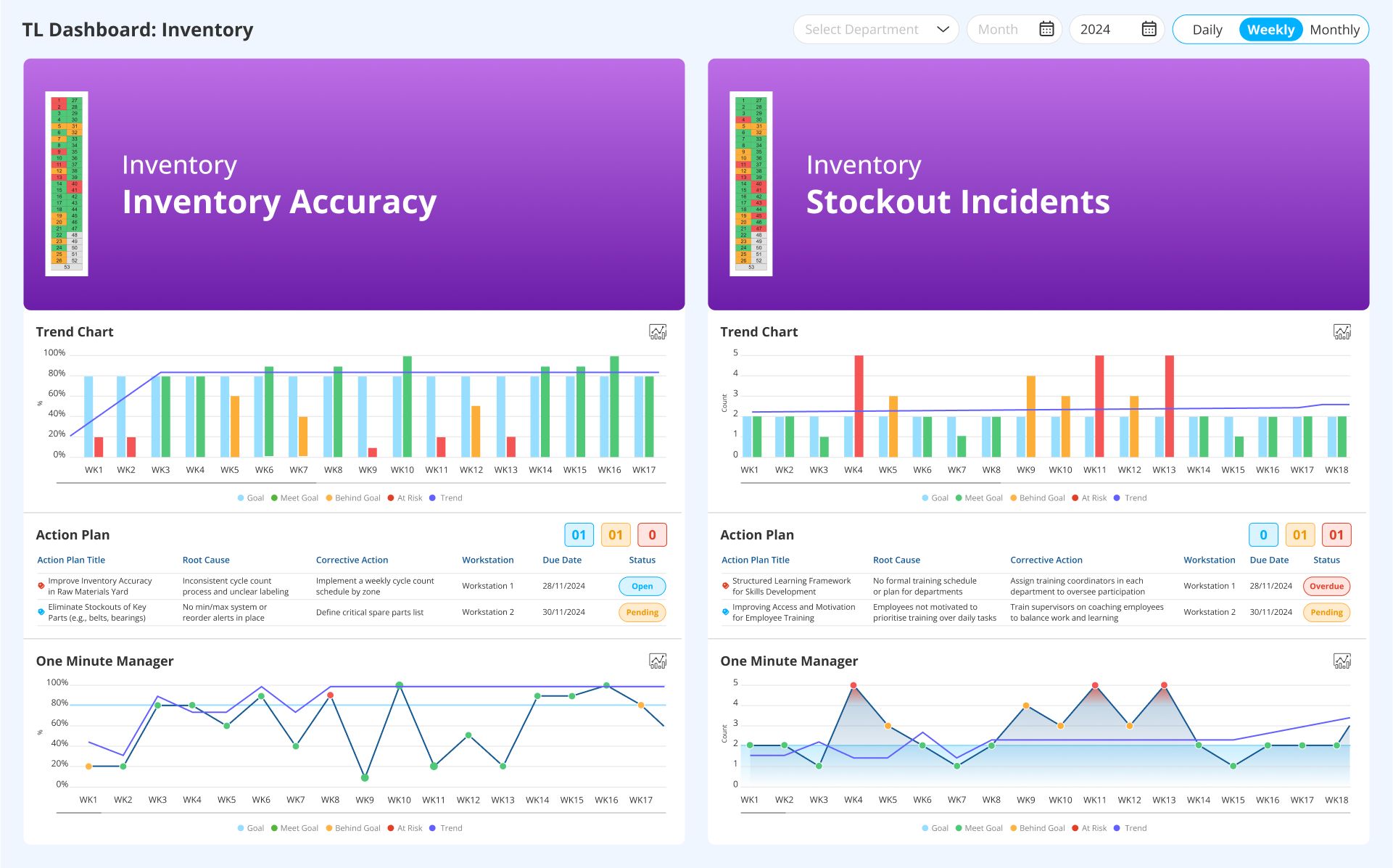
- Inventory turns
- Days of inventory on hand
- Stock-outs
- Excess inventory
- Obsolete inventory
- Work-in-progress (WIP) levels
- Finished goods inventory
- Inventory accuracy
- Slow-moving items
- Stock ageing
- Buffer stock breaches
- Material availability rate
Cost
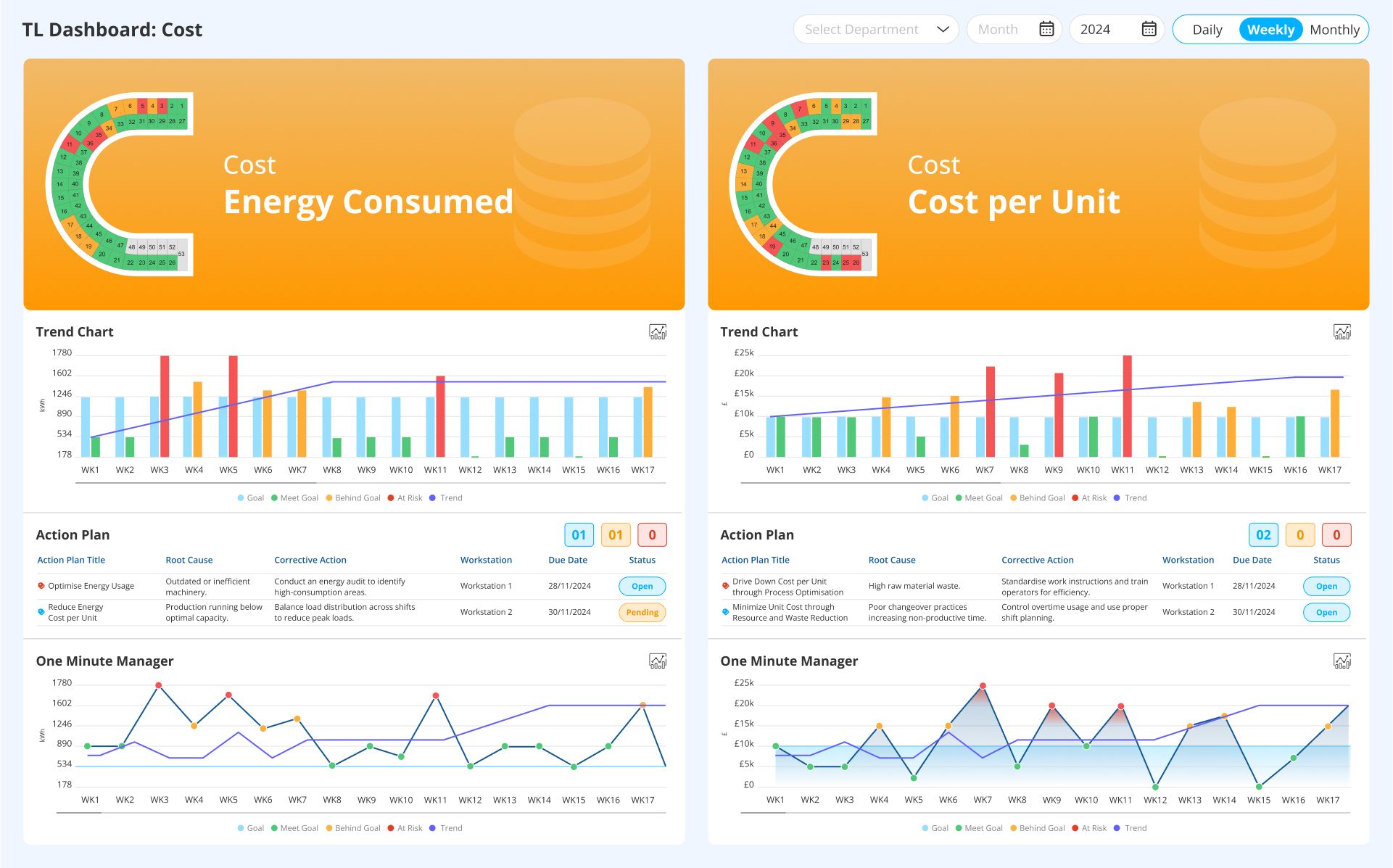
- Scrap cost
- Rework cost
- Overtime hours
- Downtime losses
- Cost variance vs plan
- Labour efficiency
- Energy consumption variance
- Material waste cost
- Maintenance cost overruns
- Productivity loss cost
- Cost of delays
- Conversion cost per unit
Solve your SQDIC visibility gaps with LTS Data Point
SQDIC in lean daily management
SQDIC is used a lean daily management framework to assess performance, detect problems early, and drive timely action at the shopfloor and leadership levels.
In practice, teams evaluate SQDIC metrics during daily huddles or production meetings, typically covering:
- Yesterday's performance against targets
- Today’s risks and priorities
- Open issues, actions, and owners
- Escalations where targets are missed
The framework makes sure discussions follow a consistent, structured flow – beginning with safety and quality before moving onto delivery, inventory, and cost. This aids teams concentrate on root causes rather than symptoms and assists faster decision-making.
SQDIC is commonly applied across tiered meetings, permitting alignment from operators to supervisors and senior leadership through a shared set of performance indicators.
What is an SQDIC board?
An SQDIC board is a visual management tool used to monitor and review Safety, Quality, Delivery, Inventory, and Cost metrics at both shopfloor and operational levels. It offers teams with a clear, shared view of daily performance, assisting them quickly identify problems, prioritise actions, and drive continuous improvement.
SQDCI boards are commonly used in daily huddles, production meetings, and tiered management reviews, allowing quicker decision-making and consistent performance tracking across teams.
Challenges and limitations in traditional paper-based SQDIC
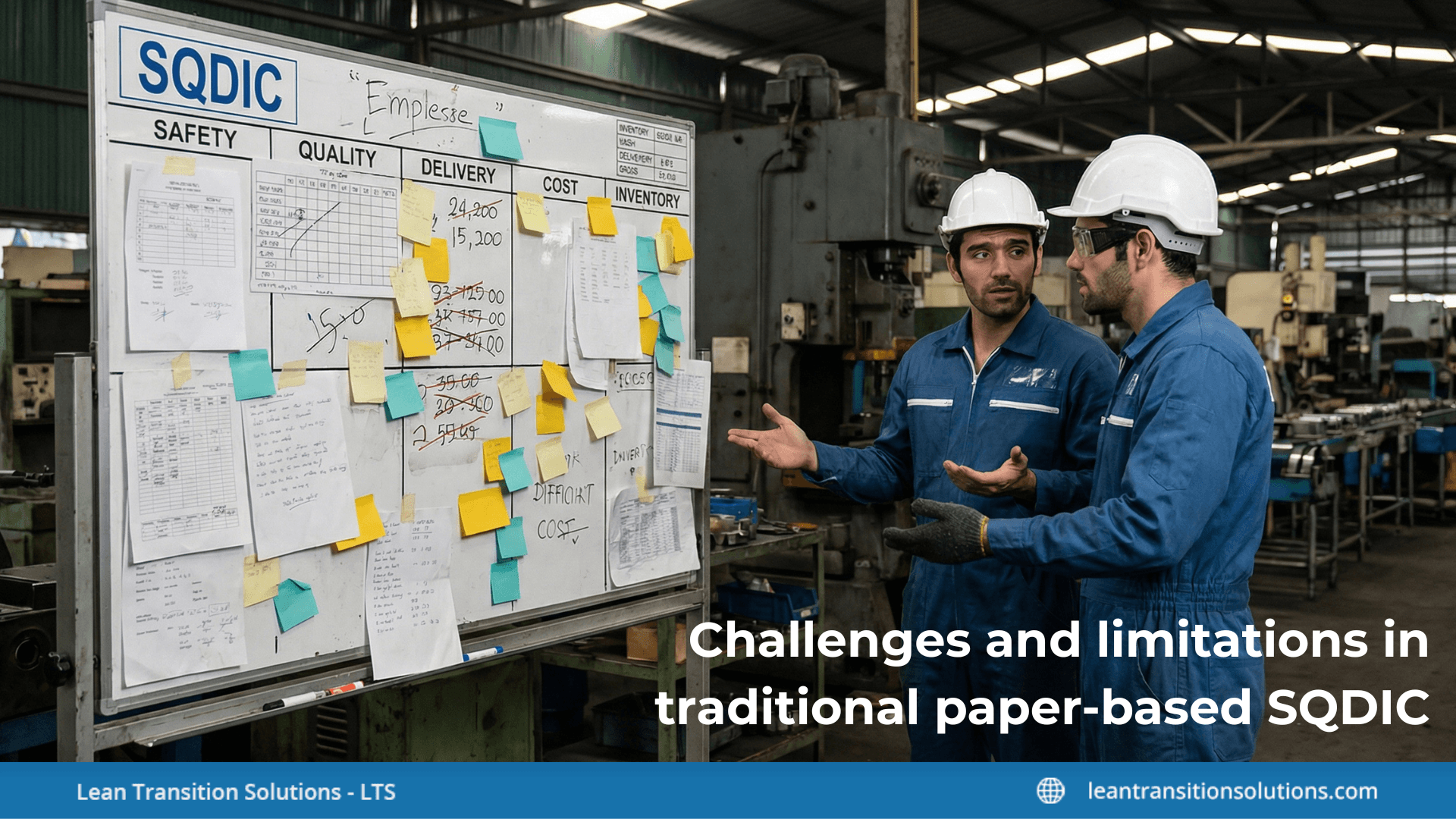
Traditional SQDIC tracking using whiteboards, spreadsheets, or paper charts creates several operational challenges and limitations.
Let's explore them one-by-one.
Challenges of paper-based SQDIC boards
- Manual data updates: SQDCI metrics often depend on manual entry, making updates time-consuming and prone to errors.
- Delayed visibility: Performance issues are identified after the fact rather than in real time, limiting timely corrective action.
- Inconsistent data across teams: Different teams may monitor metrics differently, leading to misalignment and confusion during reviews.
- Limited historical tracking: Paper-based systems make it difficult to examine trends, patterns, or repeating issues over time.
- Poor escalation of issues: Problems spotted at the shopfloor level are not always visible to supervisors or leadership quickly enough.
Limitations of paper-based SQDIC boards
- Lack of live updates: Information quickly becomes outdated between meetings.
- Restricted accessibility: Data is only visible where the board is physically located.
- No integration with systems: Metrics cannot be automatically pulled from MES, ERP, or production systems.
- Scalability challenges: Managing SQDCI across multiple lines, plants, or sites become difficult.
- Higher risk of data loss: Physical boards and sheets can be erased, damaged, or misplaced.
Visualise your SQDIC performance digitally with LTS Data Point
What is a digital SQDIC board?
A digital SQDIC board is an electronic version of a traditional SQDCI board used to track its core metrics in real time.
Instead of manual updates, electronic SQDIC boards automatically pull data from systems, standardise KPIs across teams, and give instant visibility into performance. This is what modern KPI tracking looks like in practice - live, standardised, and visible the moment something shifts, rather than waiting for the next scheduled review. They are commonly used in daily huddles, tiered meetings, and operational reviews to support faster decision-making and systematic problem escalation.
Digital SQDCI boards enhance precision, consistency, and accountability while allowing teams to respond quickly to problems as they arise.
Benefits of digital SQDIC boards

A digital SQDIC board refines how teams observe, review, and act on performance by replacing manual, static updates with live visibility.
Key benefits include:
- Live data visibility across Safety, Quality, Delivery, Inventory, and Cost
- Faster spotting and escalation of issues during daily huddles
- Standardised KPIs across teams, lines, and sites
- Reduced manual effort compared to paper boards and spreadsheets
- Better decision-making through trends, history, and performance insights
Which industries can make use of digital SQDIC boards?
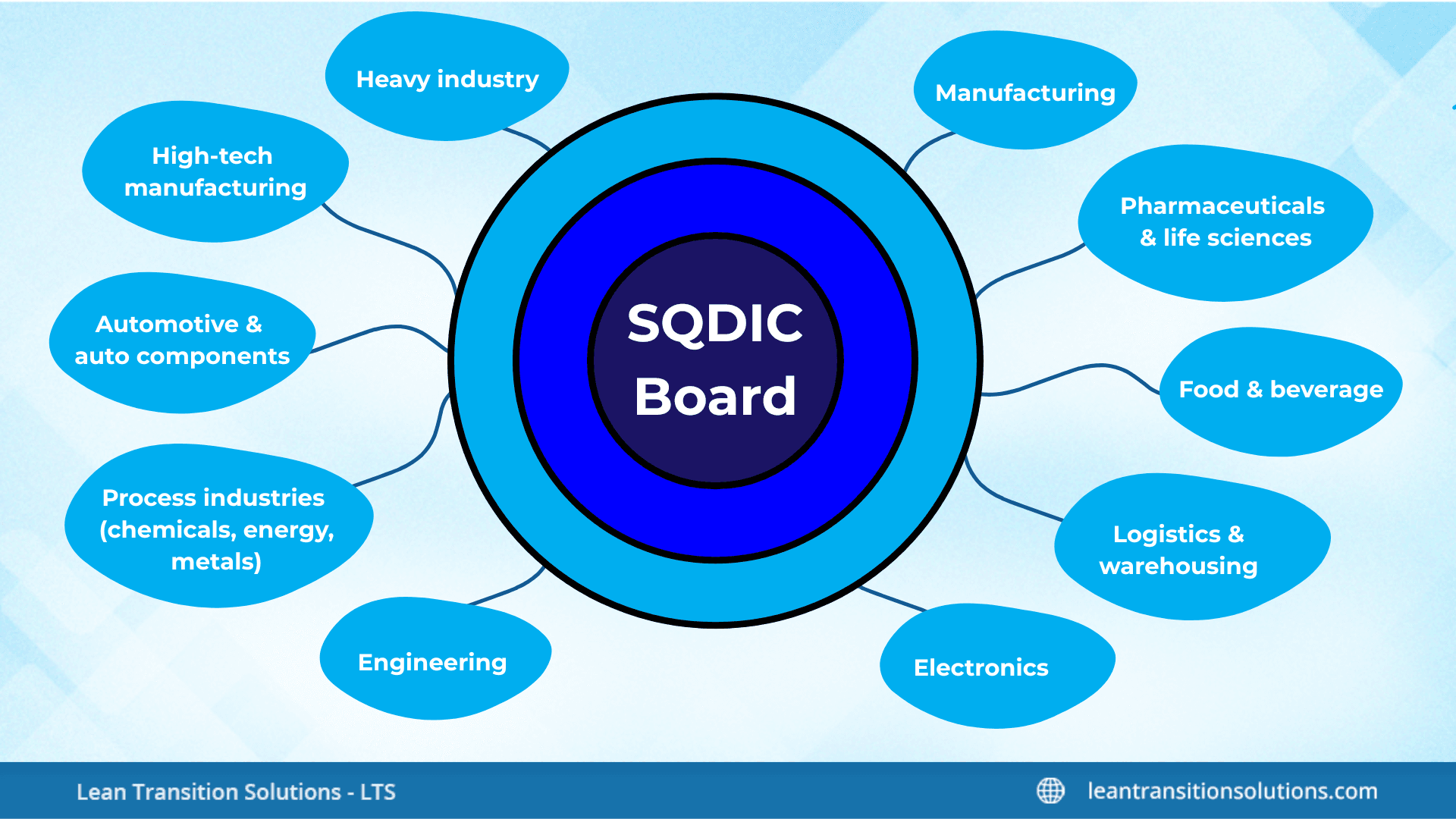
Digital SQDIC boards are used across organisations where daily performance visibility, operational control, and continuous improvement are crucial.
They are especially effective in environments with:
- Multiple KPIs to track daily
- Shift-based of frontline teams
- A need for live visibility and escalation
Let's look at some common industries who can benefit from using digital SQDIC boards:
- Manufacturing: Used to monitor shopfloor safety, quality defects, production delivery, cost losses, and inventory levels across lines and plants.
- Automotive & auto components: Supports high-volume, high-precision operations with strong focus on safety, quality, delivery adherence, and inventory flow.
- Pharmaceuticals & life sciences: Helps track quality compliance, production schedules, deviation management, controlled inventory environments.
- Food & beverage: Permits daily monitoring of safety incidents, quality checks, throughput, wastage, and stock freshness.
- Logistics & warehousing: Used to manage delivery performance, inventory accuracy, handling safety, equipment quality, and delivery milestones.
- Engineering & heavy industry: Supports complex operations with strong focus on safety performance, equipment quality, and delivery milestones.
- Electronics & high-tech manufacturing: Aids in controlling defect rates, delivery timelines, cost efficiency, and component inventory.
- Process industries (chemicals, energy, metals): Used to maintain operational stability, safety compliance, and inventory balance in continuous operations.
Get expert advice on daily SQDIC management
Why SQDIC is a powerful visual management framework
SQDIC brings structure and visibility to daily performance management by organising critical metrics into clear, prioritised framework. By showing Safety, Quality, Delivery, Inventory, and Cost in one place, teams can quickly spot gaps, align on priorities, and take action before problems escalate.
Used consistently, SQDIC supports faster decision-making, stronger accountability tracking, and a shared understanding of performance across all functional levels.
Key features of the SQDIC framework
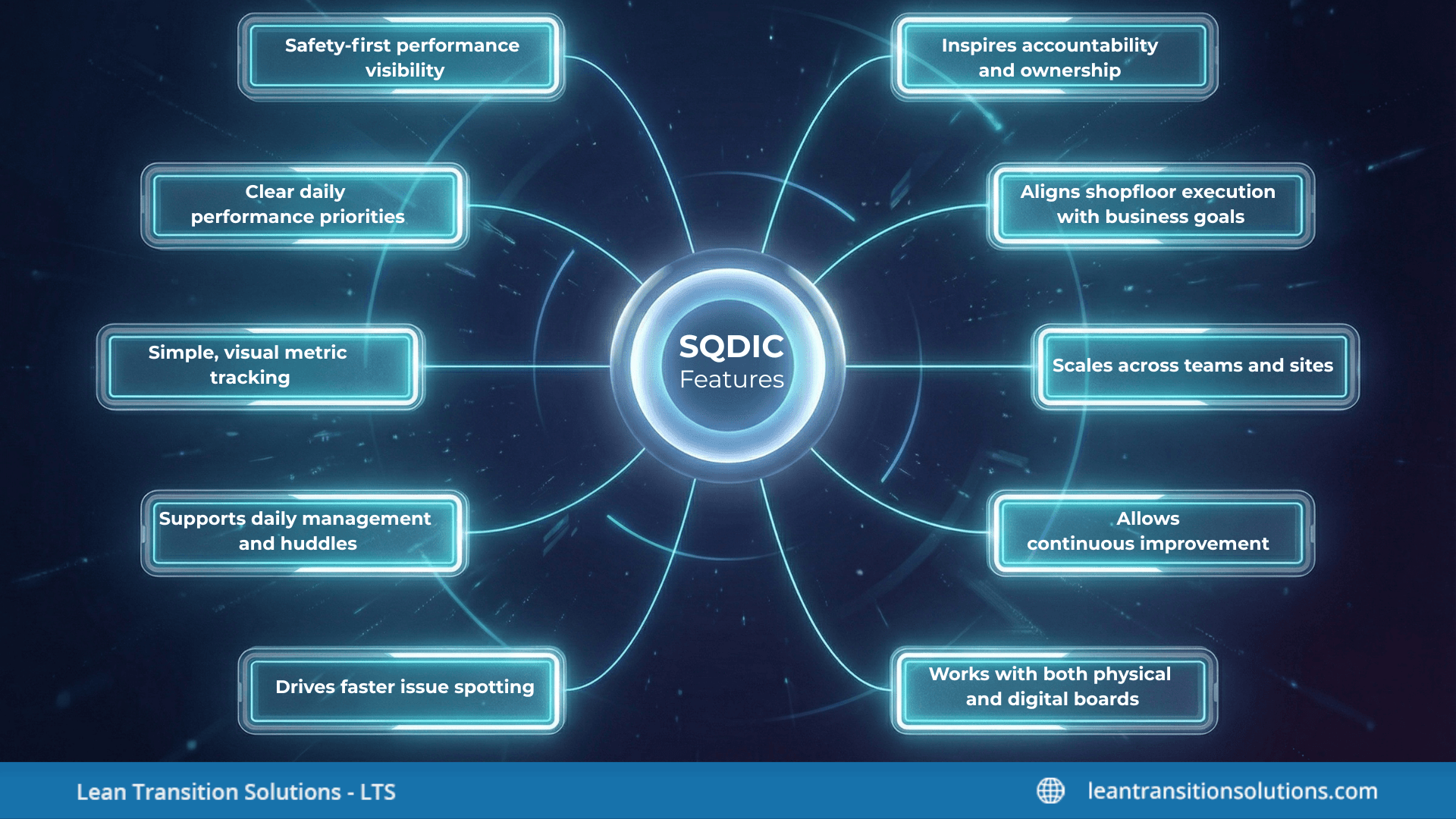
- Safety-first performance visibility: Ensures safety is always assessed before operational KPIs, reinforcing people-first culture.
- Clear daily performance priorities: Organises what teams review every day, minimising noise and emphasising on what matters most.
- Simple, visual metric tracking: Uses clear, visual indicators that are easy to understand at all industrial levels.
- Supports daily management and huddles: Fits naturally into daily production meetings and tiered reviews.
- Drives faster issue spotting: Makes deviations visible early, enabling quicker response and escalation.
- Inspires accountability and ownership: Assigns clear responsibility for metrics and actions.
- Aligns shopfloor execution with business goals: Links frontline performance to delivery, cost, and inventory outcomes.
- Scales across teams and sites: Can be standardised across lines, departments, and locations.
- Allows continuous improvement: Offers a structured foundation for problem-solving and Kaizen activities.
- Works with both physical and digital boards: Flexible enough to start simple and evolve into a digital system.
How SQDIC enhances operational performance
- Creates daily performance visibility: Teams can quickly see where targets are met or missed across all five dimensions.
- Allows faster issue detection: Deviations are spotted early, before they escalate into larger operational problems.
- Supports systematic problem-solving: Issues identified through SQDIC can be logged, tracked, and resolved systematically.
- Aligns teams around shared priorities: Everyone works from the same performance framework, minimising silos and confusion.
- Balances efficiency with stability: Developments in cost or inventory are made without compromising safety or quality.
- Inspires data-driven decisions: Decisions are based on actual performance data rather than assumptions or gut feeling.
SQDIC management: How to implement SQDIC effectively
Implementing SQDCI is not about adding more KPIs – it's about building a simple, recurring daily management rhythm that teams actually use.
Define clear objectives for SQDIC
Start by clarifying why you are using SQDCI. Decide whether the focus is on enhancing safety visibility, stabilising delivery, minimising costs, or controlling inventory. Clear intent makes sure the framework supports real operational priorities, not just reporting.
Choose relevant metrics for each SQDIC pillar
Select a small number of meaningful metrics under Safety, Quality, Delivery, Inventory, and Cost.
Metrics should be:
- Easy to understand
- Relevant to daily operations
- Practical at team level
Avoid overloading the board with too many KPIs.
Assign ownership and accountability
Each SQDIC metric should have a clear owner.
Ownership verifies:
- Data is updated consistently
- Issues are acknowledged quickly
- Actions are followed through
Without ownership, SQDCI becomes a passive dashboard.
Integrate SQDIC into daily meetings
SQDIC works best when assessed during:
- Daily production meetings
- Shift handovers
- Tier 1 and Tier 2 huddles
Teams should evaluate yesterday’s performance, today’s risks, and open actions, rather than historical trends alone.
Establish escalation and action routines
Define what happens when a metric is off target.
This includes:
- Recording issues
- Assigning corrective actions
- Escalating unresolved problems to the nest tier
SQDCI should drive problem-solving, not just visibility.
Standardise and continuously improve
Once the SQDIC structure is stable:
- Standardise definitions across teams
- Review metrics periodically
- Refine based on operational maturity
SQDIC should evolve as functions and focus change.
Get guidance on implementing SQDIC effectively with LTS Data Point
How to track and customise SQDIC metrics using a digital system
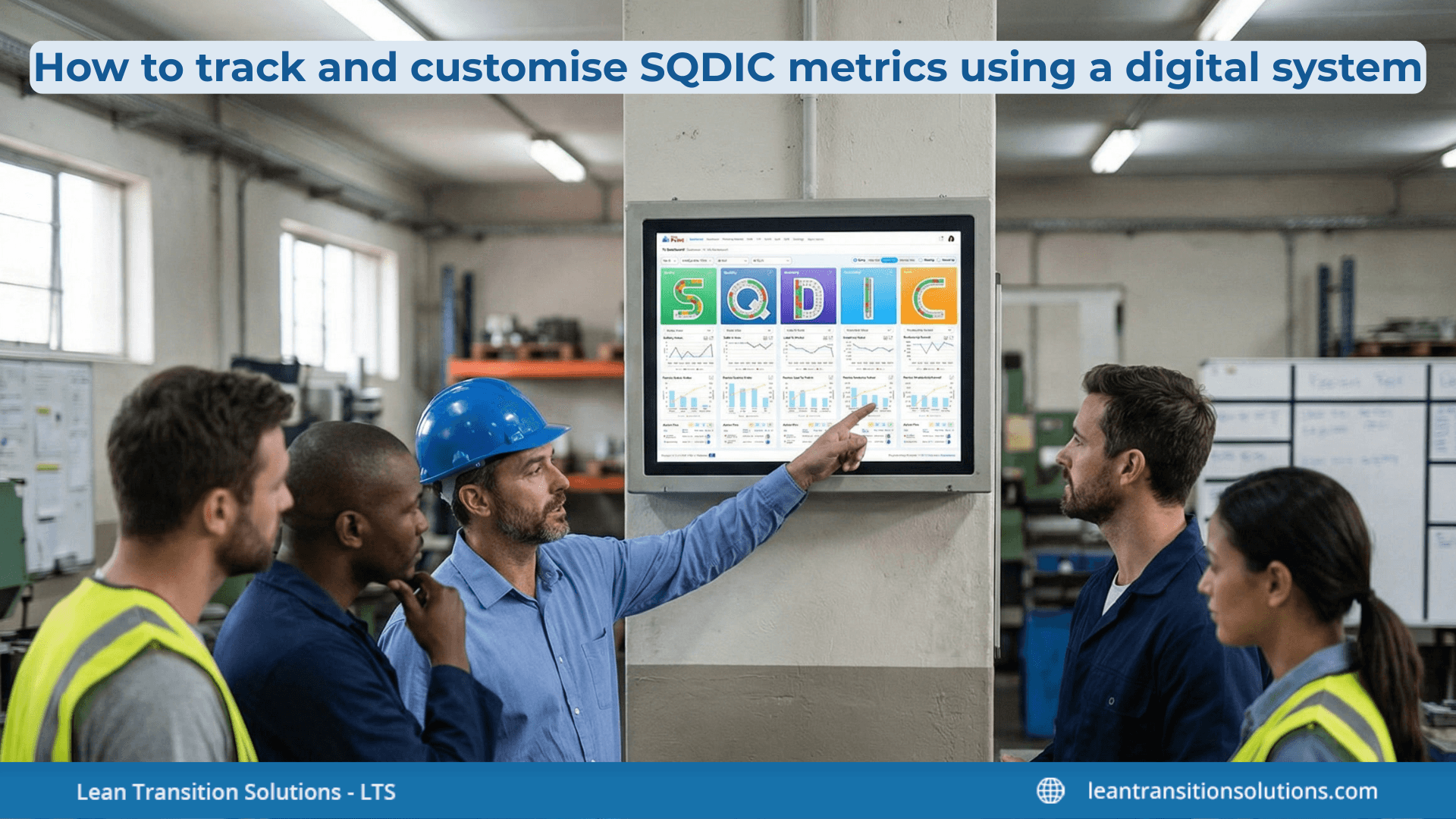
A digital SQDIC system allows teams to monitor Safety, Quality, Delivery, Inventory, and Cost metrics live, replacing manual updates and disconnected spreadsheets.
With digital monitoring, data can be:
- Captured automatically from operational systems or entered at source
- Updated in real time across teams and shifts
- Standardised to verify consistent metric definitions
- Visualised clearly for daily evaluations and escalation
Customisation enables companies to:
- Choose relevant SQDIC metrics based on role, function, or tier
- Mould thresholds, targets, and alerts for quick issue detection
- Tailor dashboards for operators, supervisors, and leadership
- Align visual layouts with existing daily management routines
This combination of live tracking and flexible customisation ensures SQDIC remains actionable, scalable, and aligned with how teams actually work.
Tier-based use of SQDIC
SQDCI is commonly used in a tiered daily management structure, making sure problems are evaluated at the right level and escalated quickly when needed.
Tier 1 – Team or Shopfloor level
Used by operators and frontline teams during daily huddles.
- Reviews live SQDIC metrics for the day or shift
- Spotlights immediate safety risks, quality issues, or delivery blockers
- Priorities short-term actions within the team’s control
- Escalates unresolved issues to Tier 2
Tier 2 – Department or area level
Used by supervisors and middle management.
- Reviews escalated problems from Tier 1
- Spots cross-team dependencies and trends
- Assigns resources or corrective actions
- Verifies alignment between teams and preferences
Tier 3 – Leadership or site level
Used by plant leaders and senior management.
- Evaluates aggregated SQDIC performance
- Focuses on systematic problems and long-term improvements
- Aligns operational performance with business goals
- Drives strategic decisions and continuous improvement initiatives
Tier-based SQDIC confirms visibility, accountability, and structured escalation, helping industries move from daily firefighting to proactive performance management.
See how teams track SQDIC effortlessly with LTS Data Point
Digital SQDIC boards customised for your needs by LTS Data Point
Digital SQDIC boards by LTS Data Point assist industries move beyond static reporting to live, action-driven performance management. Designed for daily use on the shopfloor and at leadership levels, the platform makes SQDCI visible, consistent, easy to act on.
How LTS Data Point reinforces SQDIC execution
- Live SQDIC dashboards: Automatically monitor Safety, Quality, Delivery, Inventory, and Cost metrics without manual updates or spreadsheets.
- Single source of truth: Standardised SQDIC definitions and KPIs across teams, lines, and sites confirm alignment and clarity.
- Action-focused daily management: Record problems, allot ownership, monitor actions, and follow up directly from SQDIC boards.
- Tier-based visibility: Endlessly roll up SQDIC performance from Tier 1 teams to Tier 2 and Tier 3 leadership reviews.
- Customisable to your operation: Create SQDIC metrics, thresholds, and visuals to match your processes and priorities.
- Faster escalation, better decisions: Missed targets and risks are instantly visible, allowing quicker response and problem-solving.
With LTS Data Point, SQDIC becomes more than a framework – it becomes a daily habit that drives accountability, transparency, and continuous improvement.
Case study: How SQDIC drives real results in different sectors
Let's look at real life examples of industries using LTS Data Point SQDIC boards to transform their operations.
Food and Beverage operations
A food and beverage manufacturer struggled with missed hygiene checks and delayed issue escalation across fast-moving production lines. Safety and quality problems were recorded manually, often evaluated too late, resulting in compliance risks, rework, and occasional delivery delays during peak demand periods.
By introducing LTS Data Point digital SQDIC board, the company centralised safety, quality, delivery, inventory, and cost monitoring into day-to-day SQDCI reviews. Live visibility helped teams surface hygiene deviations early, assign actions immediately, and stabilise inventory flow – enhancing compliance and on-time delivery without increasing operational overhead.
Pharmaceutical operations
A pharmaceutical manufacturer faced challenges with quality deviations being detected at the shopfloor but escalated too slowly to leadership. Fragmented monitoring across spreadsheets caused delays in corrective actions, increasing the risk of batch holds and production interruptions.
Using LTS Data Point tier-based SQDIC framework, the industry linked Tier 1 shopfloor issues directly to Tier 2 and Tier 3 evaluations through digital dashboards. This allowed quicker escalation of quality and safety risks, clearer accountability, and stronger governance – assisting maintain compliance while improving delivery reliability and inventory control.

Amer Jumah, Senior Lean Consultant
Amer is co-founder of Agile Solutions and a certified Six Sigma Black Belt, Lean Black Belt, and PMP, with over nine years of experience implementing Lean, Six Sigma, and Agile principles across diverse industries. He specialises in process optimisation, waste elimination, and delivering cost savings through organisational change.