Balanced Scorecard in organisations: A practical guide to performance management
Last updated on : January 22, 2026
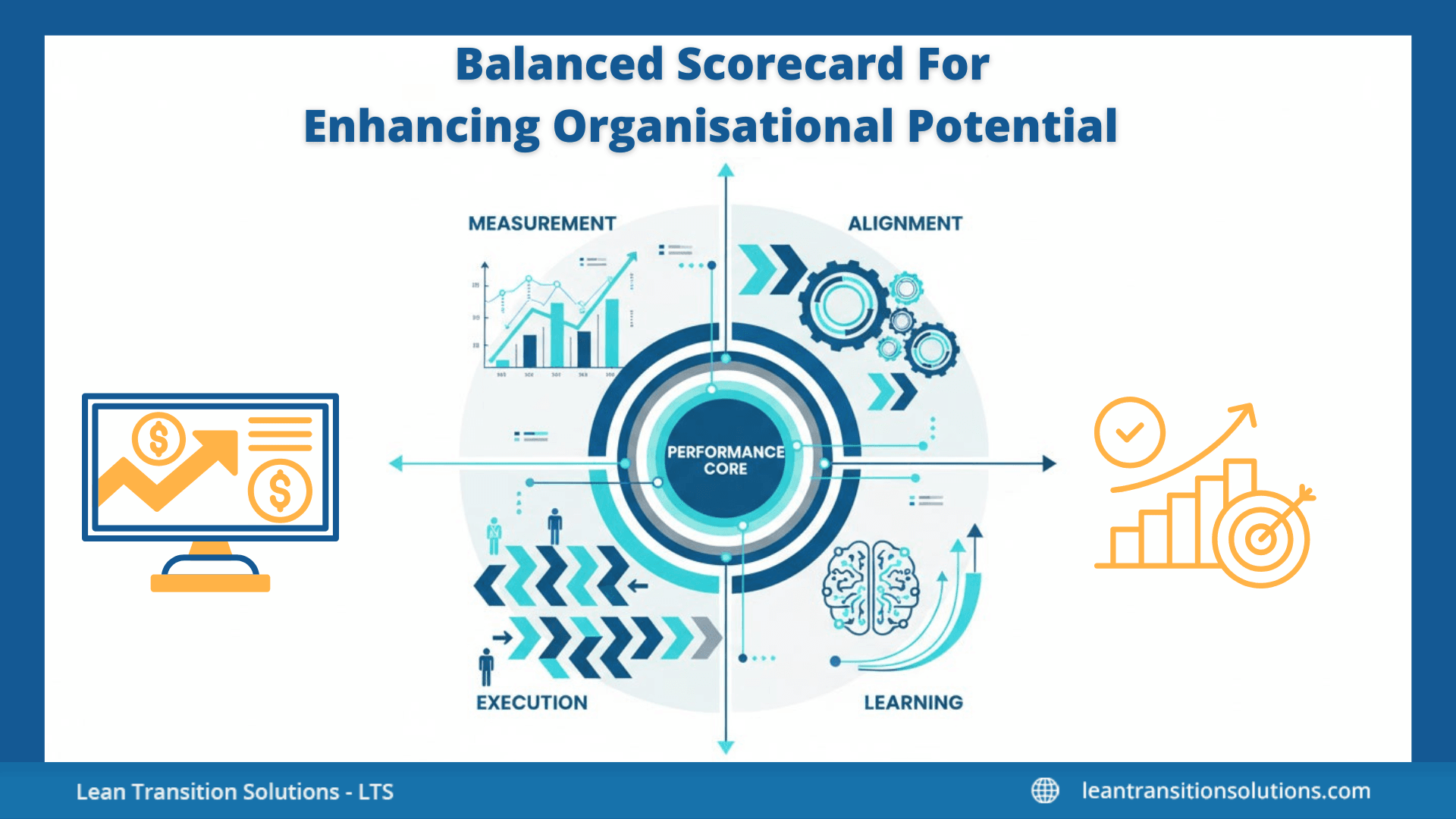
A Balanced Scorecard in organisations is more than a performance measurement tool. When implemented correctly, it becomes a strategic management system that connects vision to execution, aligns teams around shared priorities, and enables leaders to track what truly drives long-term success.
Despite its widespread adoption, many organisations struggle to realise the full value of the Balanced Scorecard. Common reasons include poor strategy translation, overreliance on lagging KPIs, manual tracking methods, and weak review discipline. This guide explains what a Balanced Scorecard is, how it works in real organisations, why implementations fail, and how modern digital approaches help organisations execute strategy more effectively.
What is a Balanced Scorecard in an organisation?
A Balanced Scorecard (BSC) is a strategic performance management framework that helps organisations translate their vision and strategy into a coherent set of measurable objectives.
Unlike traditional KPI systems that focus heavily on financial results, a Balanced Scorecard provides a balanced view of organisational performance by combining financial and non-financial measures. It ensures that short-term operational activities are aligned with long-term strategic goals.
A Balanced Scorecard in management acts as:
- A strategy translation tool
- A communication framework
- A performance monitoring system
- A foundation for continuous improvement
Why organisations need a Balanced Scorecard today
Many organisations face a familiar challenge: leadership defines strategy, but execution breaks down at operational levels. Employees remain busy, yet strategic outcomes are missed.
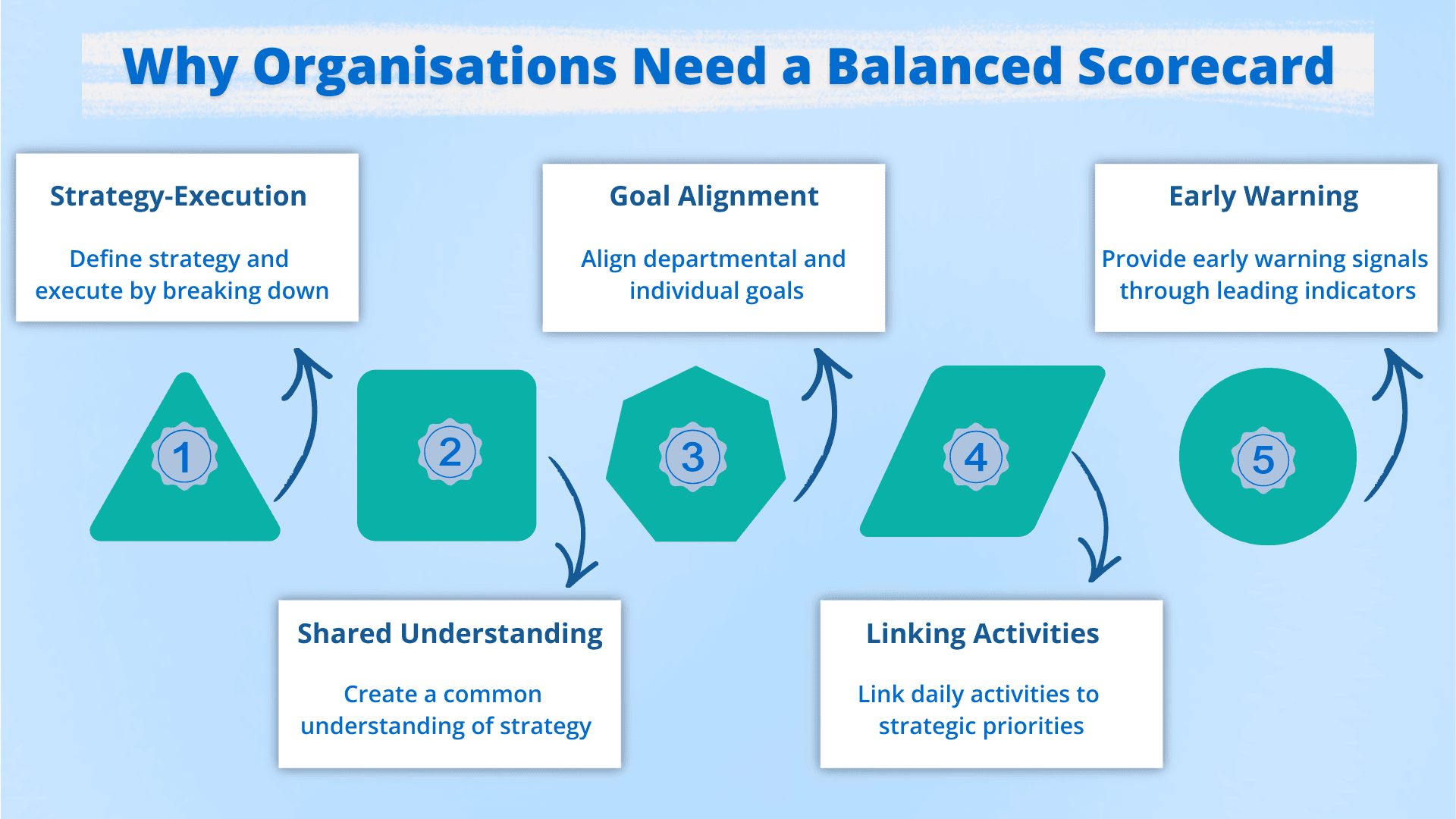
A Balanced Scorecard helps organisations address this gap by:
- Creating a shared understanding of strategy
- Aligning departmental and individual goals
- Linking daily activities to strategic priorities
- Providing early warning signals through leading indicators
In complex, multi-department or multi-site organisations, the Balanced Scorecard in organisation becomes essential for maintaining alignment, accountability, and focus.
What is balanced in the Balanced Scorecard approach and how it benefits organisation?
The Balanced Scorecard framework is called “balanced” because it deliberately avoids focusing on a single dimension of performance.
It creates balance by:
- Measuring financial and non-financial performance together
- Aligning internal processes with customer and stakeholder expectations
- Comparing leading indicators (drivers of future performance) with lagging indicators (results)
- Connecting short-term actions with long-term strategic objectives
This balance ensures organisations do not optimise one area at the expense of another.
The four perspectives of an organisational scorecard
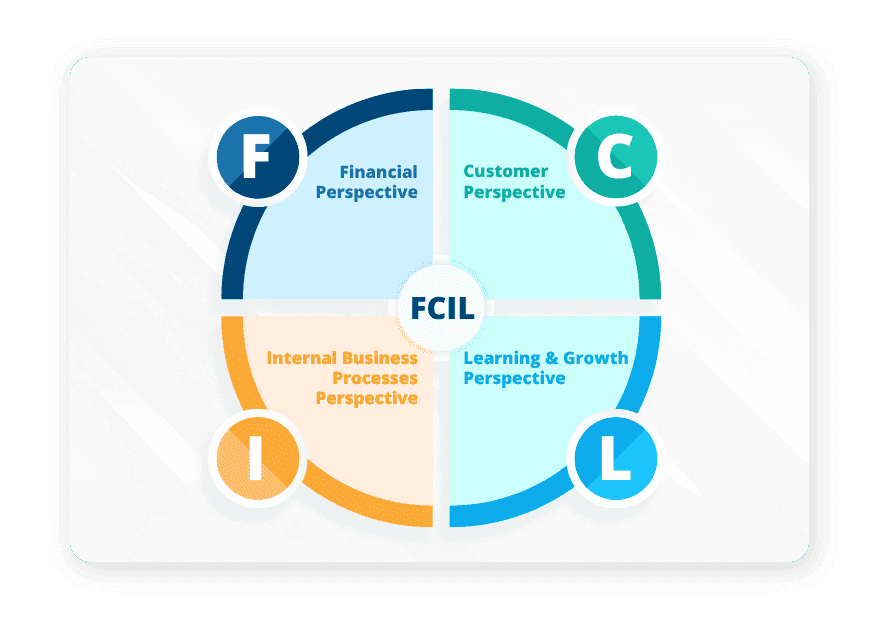
Most organisations structure their organisational scorecard around four core perspectives, which is called as the four perspectives of Balanced Scorecard:
Financial perspective
Tracks outcomes such as revenue growth, cost control, profitability, or budget utilisation.
Customer / Stakeholder perspective
Measures customer satisfaction, service quality, retention, or stakeholder trust—critical for businesses, government, and non-profits.
Internal process perspective
Focuses on operational efficiency, quality, delivery, compliance, and process effectiveness.
Learning and growth perspective
Covers people capability, skills development, engagement, innovation, and culture.
Together, these perspectives provide a complete picture of organisational performance.
A simple organisational scorecard example
To make this concrete, consider a basic organisational scorecard example:
Strategic Objective: Improve service reliability
- Financial Metric: Reduce operational rework costs by 10%
- Customer Metric: Increase customer satisfaction score from 78 to 85
- Process Metric: Reduce average service resolution time by 20%
- People Metric: Train 90% of employees on standard operating procedures
This example shows how one strategic goal is measured by Balanced Scorecard in organisation across multiple dimensions, rather than relying on a single KPI. Beyond tracking KPIs, the Balanced Scorecard is widely used to measuring strategic execution success.
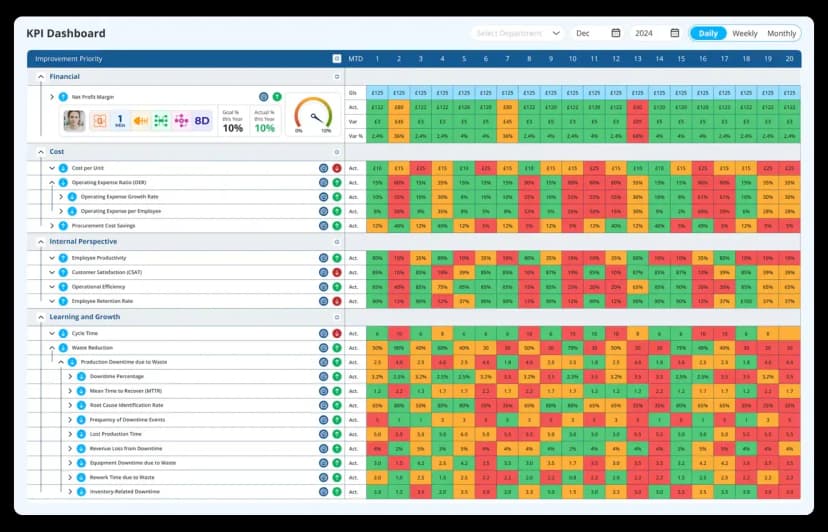
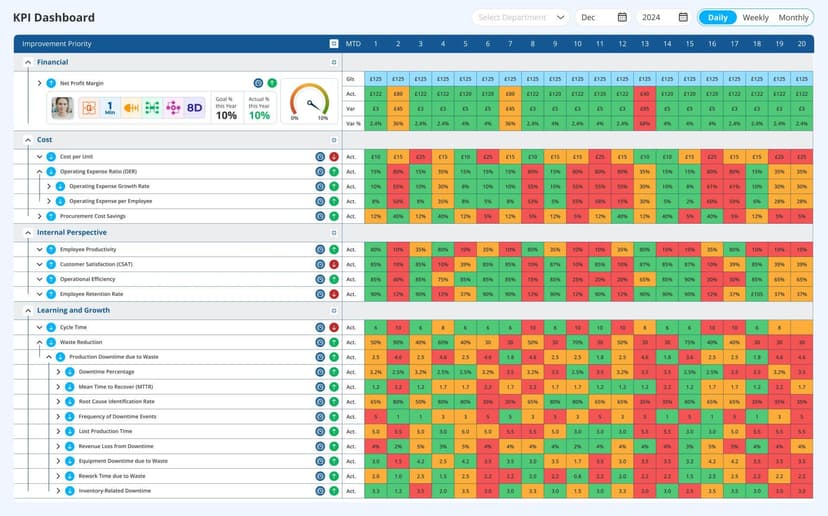
LTS Data Point Balanced Scorecard software combines strategy planning, KPI tracking, and performance visibility
How a Balanced Scorecard works in real organisations
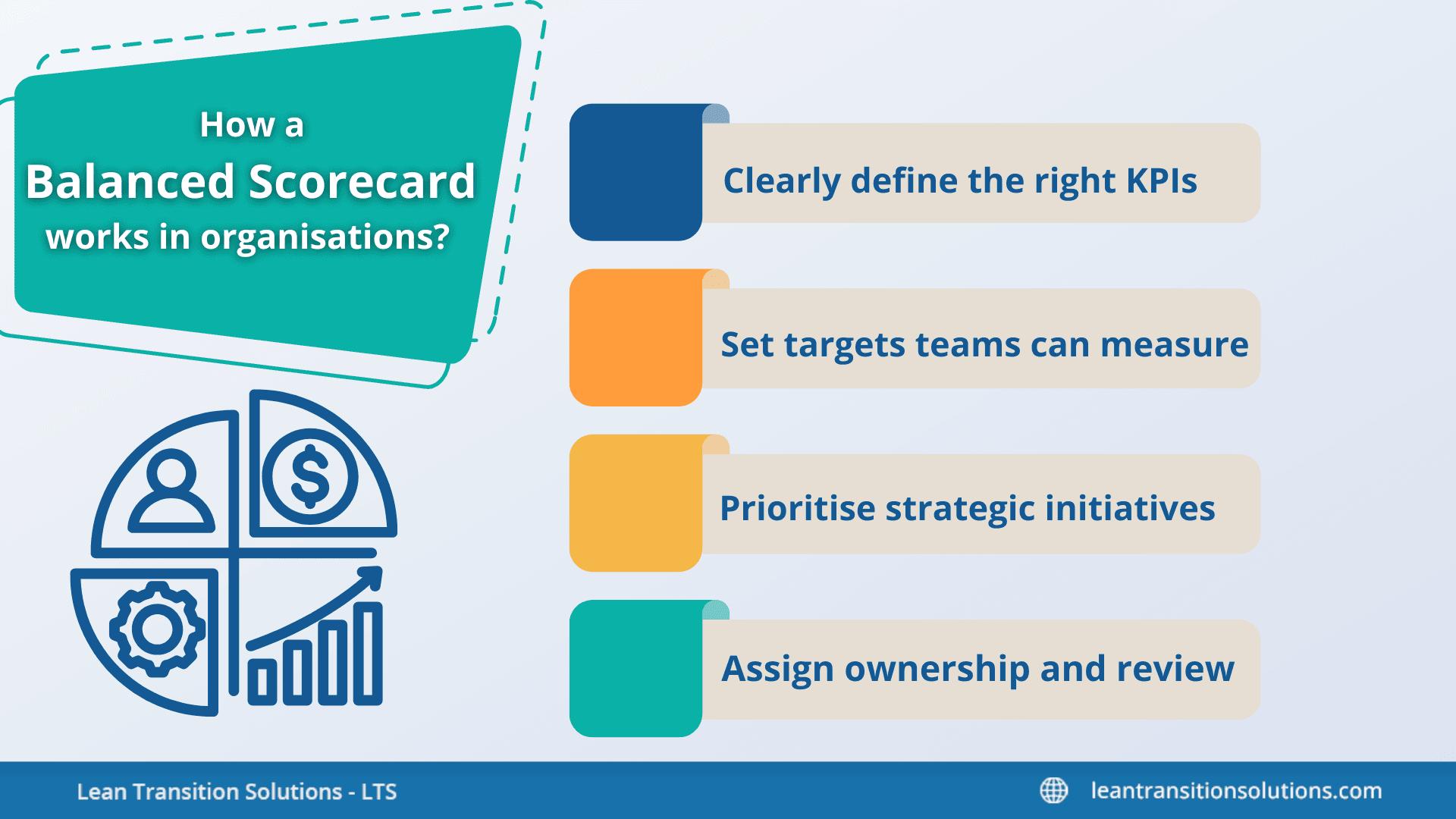
In practice, a Balanced Scorecard operates through a cause-and-effect logic:
Learning & Growth → Internal Processes → Customer Outcomes → Financial Results
Organisations define strategic objectives under each perspective and link them through strategy maps by cascading strategy. Each objective is supported by:
- Clearly defined KPIs
- Targets
- Strategic initiatives
- Ownership and review cadence
This structure ensures that improvement efforts are intentional, measurable, and aligned with strategy.
When should an organisation use a Balanced Scorecard?
A Balanced Scorecard is especially useful when organisations experience:
- Misalignment between leadership strategy and workforce priorities
- Unclear or inconsistent definitions of success
- Too many KPIs with no clear strategic linkage
- Strong activity levels but limited impact on results
- Difficulty prioritising work across departments or teams
In these situations, the Balanced Scorecard provides structure, focus, and clarity. For more insights read how strategy execution fails in organisation.
Benefits of using a Balanced Scorecard for organisations
Organisations that implement a Balanced Scorecard effectively gain several advantages:
- Clear visibility into strategy execution
- Better alignment between organisational, departmental, and individual goals
- Improved accountability through defined ownership of measures
- Faster, data-backed decision-making
- A foundation for continuous improvement and strategy evaluation
Because of these benefits, Balanced Scorecards for business are widely used across sectors. It is used for multiple purposes including mid- year or year-end strategy evaluation or for annual strategy planning.
Balanced Scorecard vs traditional KPI tracking
Many organisations track KPIs but still fail to execute strategy. The difference lies in structure and intent.
A Balanced Scorecard in organisations transforms KPIs from passive measurements into active drivers of performance.
How to implement a Balanced Scorecard in an organisation?
Successful Balanced Scorecard implementation follows a structured approach.
Clarify vision and strategy
Define clear strategic priorities and outcomes. Ambiguous strategy leads to ineffective scorecards.
Develop strategic objectives
Translate strategy into objectives across the four perspectives.
Build a strategy map
Visualise cause-and-effect relationships between objectives to show how value is created.
Define KPIs and targets
Select meaningful indicators, balancing leading and lagging measures.
Align the organisation
Cascade objectives and KPIs to departments, teams, and individuals.
Establish review and learning cycles
Use structured review meetings to track progress, address gaps, and adapt strategy.
Balanced Scorecard for different types of organisations
The Balanced Scorecard framework is flexible and can be applied across different organisational contexts while maintaining a consistent focus on strategy alignment, performance measurement, and accountability.
Balanced Scorecard for business
In business organisations, a Balanced Scorecard is used to align growth, profitability, customer value, and operational excellence. It helps leadership prioritise strategic objectives and ensure that financial results are supported by customer outcomes, efficient processes, and workforce capability. Learn more from business improvement strategies with Balanced Scorecard.
Example: A manufacturing company reviews its manufacturing balanced scorecard monthly to decide whether to invest in new capacity or fix delivery delays before pushing sales growth.
Balanced Scorecard for non-profit organisations
For non-profit organisations, a Balanced Scorecard focuses less on profit and more on mission impact, donor accountability, and service effectiveness. A balanced scorecard for non-profits may track beneficiary outcomes, funding stability, program efficiency, and the organisation’s ability to sustain long-term impact.
Example: A non-profit uses its balanced scorecard during quarterly board reviews to decide which programs to scale based on beneficiary outcomes and funding stability.
Balanced Scorecard for government
A balanced scorecard for government supports transparency, service delivery, compliance, and public value creation. It enables agencies to evaluate policy execution, monitor service quality, and balance operational efficiency with citizen outcomes.
Example: A government department uses a balanced scorecard in performance reviews to identify why citizen service targets are being missed despite budget adherence.
Balanced Scorecard for IT
IT teams use Balanced Scorecards to align technology initiatives with business strategy. Typical measures include system reliability, delivery timelines, cybersecurity readiness, and capability development, helping IT teams demonstrate strategic contribution rather than just operational activity.
Example: An IT team uses its balanced scorecard in planning meetings to prioritise system reliability issues over new feature requests that don’t support strategic goals.
Balanced Scorecard for individual performance and employees
A Balanced Scorecard for employees or individual performance connects personal objectives with organisational goals. This approach supports clearer role expectations, fair performance evaluation, and ongoing development by showing how individual contributions influence broader results.
Example: Managers use employee balanced scorecards in appraisal discussions to link daily work, improvement actions, and skill development to organisational priorities.
Balanced scorecard for boards of directors
At the leadership level, a balanced scorecard for boards of directors provides visibility into strategic progress, risk exposure, and long-term sustainability. Boards use scorecards to support strategy evaluation and governance without becoming involved in day-to-day operational management.
Example: A board reviews a high-level balanced scorecard each quarter to assess whether strategic initiatives are progressing as planned or need course correction.
Why Balanced Scorecards fail in many organisations?
Despite good intentions, many organisational Balanced Scorecard initiatives fail due to:
- Treating the scorecard as a reporting tool, not a management system
- Overloading the scorecard with too many KPIs
- Poor data quality and manual tracking
- Lack of ownership and accountability
- Infrequent or ineffective performance reviews
These failures are usually execution-related, not framework-related.
From manual to digital Balanced Scorecards
Digital Balanced Scorecard platforms overcome traditional manual methods limitations by enabling live dashboards, automated reporting, and organisation-wide alignment. It enables:
- Real-time data visibility
- Centralised access and version control
- Advanced analysis, filtering, and reporting
- Cross-team collaboration
How organisations use digital Balanced Scorecards successfully
High-performing organisations use digital Balanced Scorecards to:
- Visualise strategy maps and objectives
- Align organisational, departmental, and individual goals
- Integrate KPIs from operational systems
- Support structured review meetings
- Enable continuous improvement and faster decision-making
Rather than replacing strategy, digital platforms act as enablers of disciplined execution.
Companies that use Balanced Scorecards
Balanced Scorecards are used by organisations of all sizes, including:
- Global enterprises managing complex strategies
- Government agencies focused on accountability
- Non-profits tracking mission outcomes
- Mid-sized organisations improving operational discipline
Their widespread adoption reflects the framework’s adaptability and long-term relevance.
Drive better organisational performance with LTS Data Point Balanced Scorecard
FAQs
1. What is the main purpose of a Balanced Scorecard in organisations?
The primary purpose is to translate strategy into measurable objectives and align the entire organisation around shared goals.
2. Is the Balanced Scorecard suitable for all types of organisations?
Yes. The framework is used by manufacturing, service, public sector, and non-profit organisations, with customisation based on strategic context.
3. How many KPIs should a Balanced Scorecard include?
Most organisations perform best with a focused set of 15–25 KPIs linked directly to strategic objectives.
4. Can a Balanced Scorecard work without digital tools?
It can, but manual methods limit visibility, scalability, and effectiveness as organisations grow.
5. How often should a Balanced Scorecard be reviewed?
High-performing organisations review scorecards monthly at leadership level, with more frequent operational reviews.
6. Can a Balanced Scorecard be used for non-profits and government?
Yes. Balanced Scorecards are commonly used for non-profits, government agencies, and public sector organisations.
7. How is a Balanced Scorecard different from KPI tracking?
KPI tracking focuses on metrics, while a Balanced Scorecard connects those metrics directly to strategy and objectives.
Final thoughts
A Balanced Scorecard in organisations is not a one-time initiative or a reporting exercise. It is a living management system that enables alignment, focus, and execution.
Organisations that succeed with the Balanced Scorecard combine:
- Clear strategy
- Disciplined execution
- The right performance measures
- Modern digital enablement
When these elements work together, the Balanced Scorecard becomes a powerful driver of sustainable organisational success.

Amer Jumah, Senior Lean Consultant
Amer is co-founder of Agile Solutions and a certified Six Sigma Black Belt, Lean Black Belt, and PMP, with over nine years of experience implementing Lean, Six Sigma, and Agile principles across diverse industries. He specialises in process optimisation, waste elimination, and delivering cost savings through organisational change.