Balanced scorecard strategy: Your complete guide to strategic planning and execution
Last updated on : January 27, 2026
The balanced scorecard strategy addresses one of business's most persistent challenges: turning strategic vision into measurable results. Created by Robert Kaplan and David Norton in 1992, this framework emerged from research showing that nine out of ten organisations fail to execute their strategies effectively.
A balanced scorecard is a tool for strategy that extends beyond traditional financial metrics. Rather than focusing solely on profit and revenue, the balanced scorecard approach to strategic planning considers multiple dimensions that drive sustainable success. It translates an organisation's vision and strategic objectives into actionable performance indicators across four interconnected perspectives: financial, customer, internal processes and learning and growth.
In summary: Balanced scorecard strategy creates a clear line of sight from your organisation's vision to daily operations through measurable objectives that balance short-term results with long-term capability building.
Why balanced scorecard strategy is important?

Despite newer frameworks like OKRs and agile methodologies, balanced scorecard strategy remains uniquely relevant because it provides comprehensive strategic context. Organisations using this framework report 12-36% improvement in overall performance within the first two years.
The balanced scorecard framework helps organisations:
- Align departments around unified strategic goals
- Bridge execution gaps between high-level vision and operational reality
- Balance competing priorities across different time horizons
- Create transparency through visual strategy communication
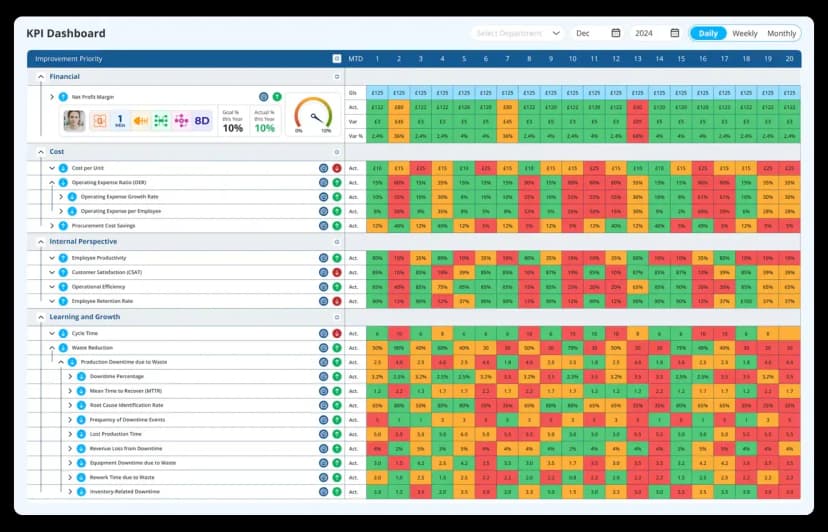
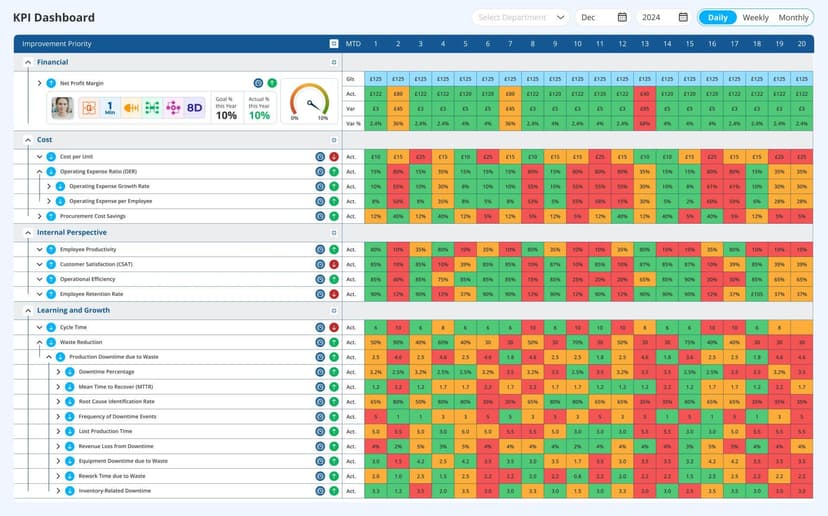
- Enable data-driven decisions with real-time performance tracking
How strategy maps work in the Balanced Scorecard framework
What is strategy mapping in balanced scorecard? A strategy map is a visual diagram that demonstrates how your organisation creates value by connecting strategic objectives through cause-and-effect relationships. It's one of the most powerful elements in balanced scorecard strategic planning because it transforms abstract strategy into communicable action.
A strategy map in the balanced scorecard framework is essentially a one-page visual that displays strategic objectives as interconnected elements organised by the four perspectives of balanced scorecard. The diagram flows from bottom to top, telling your strategy story: foundational investments in learning and growth enable internal process improvements, which deliver customer value, which generates financial results.
Most strategy maps contain between 12-18 strategic objectives distributed across the four perspectives. For-profit organisations typically place the financial perspective at the top since economic value creation is their ultimate goal. Non-profits might place customer or stakeholder perspective at the top instead.
Balanced scorecard strategy map example
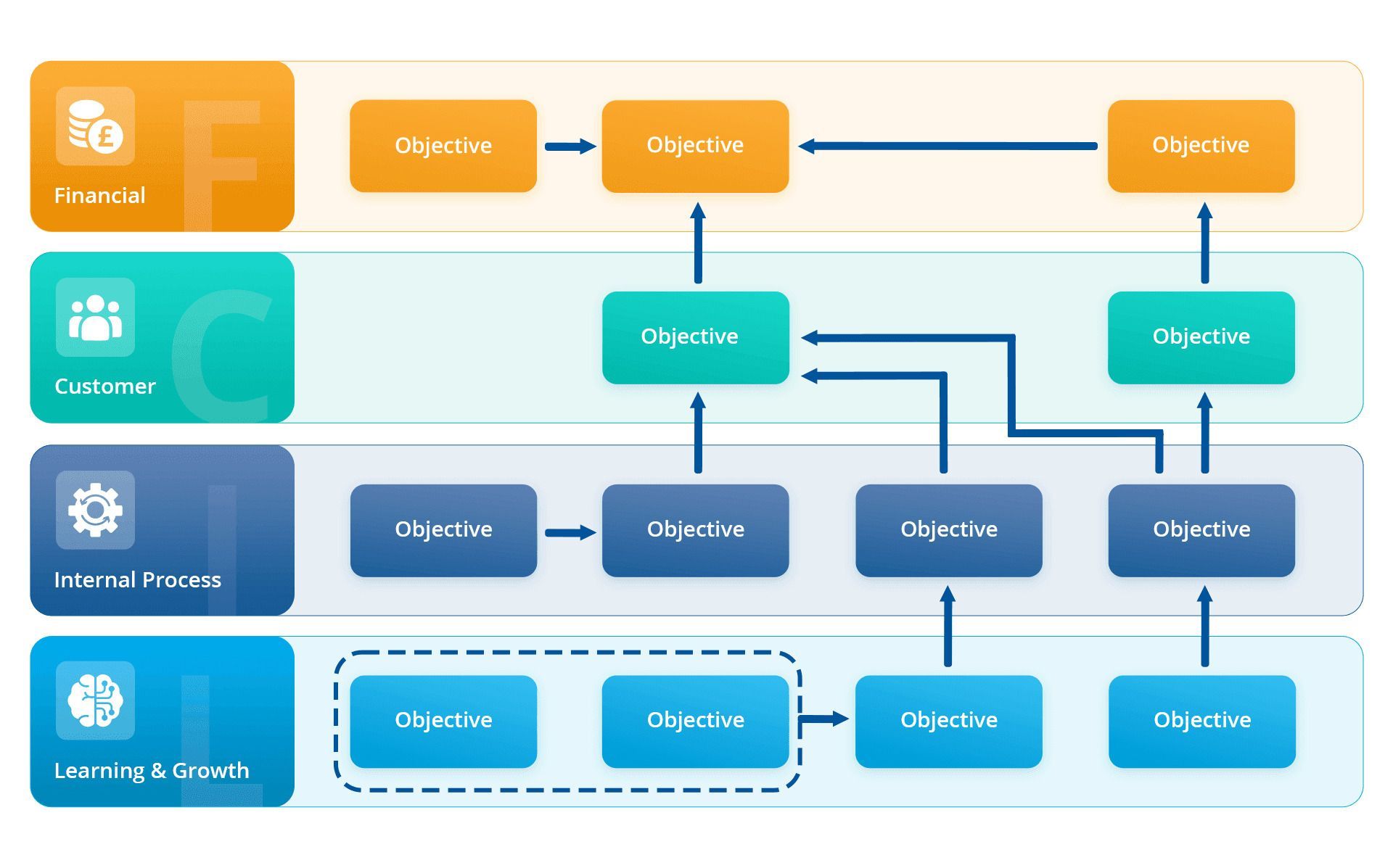
Consider a simplified balanced scorecard strategy map example for a technology services company:
Learning & Growth (Foundation):
- Develop technical certification programme
- Implement knowledge management system
Internal Process:
- Reduce project delivery time by 30%
- Achieve 99% quality standards
Customer:
- Increase client satisfaction to 90%+
- Grow contract renewal rate to 85%
Financial (Outcome):
- Achieve 25% revenue growth
- Improve profit margins to 18%
You can find more detailed examples in our guide on strategy maps for operational excellence.
Benefits of strategy mapping
- Visual clarity: Strategy maps communicate in minutes what written documents take hours to explain, making strategy accessible to everyone in the organisation.
- Alignment: When employees see how their work contributes to organisational objectives, engagement and performance improve significantly.
- Focus: By limiting objectives to 12-18 items, strategy maps force prioritisation on what truly matters strategically.
- Testing assumptions: The cause-and-effect arrows make strategic assumptions explicit, allowing teams to validate their strategy through performance data.
- Who this is best for: Organisations struggling with strategic alignment, companies with multiple departments needing coordination, and businesses where cross-functional initiatives drive success.
Balanced Scorecard strategy implementation explained
Implementing a balanced scorecard strategy successfully requires systematic planning, stakeholder engagement and commitment to change management. Here's your practical implementation roadmap.
Phase 1: Foundation (Weeks 1-4)
- Clarify vision and purpose Before creating any balanced scorecard strategy template, establish crystal-clear vision and purpose statements.
- Identify strategic priorities What are the 3-5 strategic themes that will drive your organisation forward? These might include growth, innovation, operational excellence or customer intimacy.
- Form a strategy team Assemble a cross-functional team with representatives from major departments. This diversity ensures multiple perspectives inform strategy and builds buy-in for execution.
Phase 2: Design (Weeks 5-10)
- Define strategic objectives For each perspective, brainstorm potential strategic objectives. Effective strategic objectives are action-oriented, specific enough to guide decisions, measurable through clear indicators, controllable by your organisation and genuinely strategic rather than merely operational. Aim for 3-5 objectives per perspective, totalling 12-18 objectives overall.
- Create your strategy map Arrange objectives by perspective and draw arrows showing cause-and-effect relationships. This visual becomes your primary strategy communication tool. Include this in your balanced scorecard software or strategy map template Excel for easy updates.
- Select performance measures For each strategic objective, identify 1-2 key performance indicators (KPIs). Research shows organisations tracking fewer than 20 total measures achieve better results than those monitoring 30+ metrics.
- Set targets and initiatives Establish specific, time-bound targets for each measure. Then identify strategic initiatives (projects) required to achieve these targets. Learn more about effective strategic planning approaches.
Phase 3: Cascade (Weeks 11-14)
- Cascade the scorecard Translate organisational-level objectives into department and team scorecards. By cascading strategy each level becomes more operational and specific while maintaining alignment with overall strategy. Proper strategic implementation depends on this cascading process.
- Assign ownership Every objective, measure and initiative needs a clear owner accountable for results.
Phase 4: Execute (Ongoing)
- Integrate into management rhythm Embed balanced scorecard reviews into regular management meetings. Monthly reviews examine KPI performance and identify issues. Quarterly sessions provide deep dives on strategic initiatives and tactical adjustments. Annual reviews refresh strategy, update objectives and set new targets. This rhythm ensures balanced scorecard strategy implementation stays dynamic rather than static.
- Communicate relentlessly Share strategy maps throughout the organisation using dashboards, town halls and team meetings. A balanced scorecard visual management system keeps strategy visible and top-of-mind for all employees.
- Learn and adapt Treat your strategy as a hypothesis. When performance doesn't match expectations, investigate whether execution failed or the strategy needs refinement. Understanding why strategy execution fails helps you avoid common pitfalls.
Where Balanced Scorecard strategy implementations often fail
- Treating it as a project: Balanced scorecard strategy requires continuous management, not just initial setup.
- Too many measures: More than 2 measures per objective creates confusion and diffuses focus.
- Lack of executive commitment: Without visible leadership support, initiatives stall quickly.
- Poor data quality: If measures can't be tracked reliably, the scorecard loses credibility fast.
- Insufficient cascading: When scorecards exist only at executive level, frontline employees don't understand how their work connects to strategy.
Using the Balanced Scorecard for strategic planning
The balanced scorecard approach to strategic planning produces living documents that drive daily decisions rather than lengthy plans that gather dust. This framework transforms the strategic planning balanced scorecard template into an active management tool.
How balanced scorecard enhances strategic planning
- Forces clarity The discipline of creating a strategy map with limited objectives forces leadership teams to make hard choices about priorities. You can't pursue everything, so what matters most?
- Tests strategic logic By making cause-and-effect relationships explicit through strategy map connections, teams must articulate and validate their assumptions about how the business creates value.
- Balances time horizons Traditional planning often overweights short-term financial results. The balanced scorecard strategic planning process ensures equal attention to long-term foundational investments and medium-term capability building.
- Creates accountability Unlike vague strategic plans, balanced scorecards assign specific ownership for every objective and measure, making accountability clear and measurable.
Annual strategy planning cycle
Most organisations follow an annual cycle for balanced scorecard strategic planning:
Integrating with other frameworks
- Balanced scorecard + OKRs: Use balanced scorecard for annual strategic direction and OKRs for quarterly execution. The balanced scorecard sets strategic objectives; OKRs break them into 90-day sprints with stretch goals.
- Balanced scorecard + Lean: The balanced scorecard identifies strategic improvement areas; Lean tools deliver the process improvements needed to achieve targets.
- Balanced scorecard + Agile: Balanced scorecard provides strategic context and priorities; Agile enables rapid iteration in execution.
Balanced scorecard in strategic management process
The balanced scorecard in strategic management process transforms how organisations manage strategy planning, strategy implementation and evaluation phases.
Strategy formulation with balanced scorecard
During strategy formulation, the balanced scorecard framework structures environmental analysis (both external opportunities and threats, and internal capabilities and constraints), strategic choice (which objectives create most value and how they interconnect) and resource allocation (which initiatives get funded across the four perspectives).
The balanced scorecard strategic analysis process makes these decisions more rigorous by requiring explicit connections between choices and expected outcomes.
Strategy implementation through balanced scorecard
Once strategy is formulated, the balanced scorecard in strategic management template becomes the implementation engine:
- Communication: Strategy maps provide universal language for discussing strategy at all organisational levels.
- Alignment: Cascading scorecards ensure every level works toward the same strategic objectives.
- Resource management: The balanced scorecard links budgets to strategy, making impact on strategic objectives the primary budget decision criterion.
- Performance management: Individual and team performance reviews reference balanced scorecard objectives and measures, linking personal success to organisational success. Our approach to strategic execution demonstrates these connections in practice.
Strategy evaluation using balanced scorecard
The balanced scorecard for strategy evaluation enables systematic learning:
- Performance monitoring: Real-time dashboards show which measures are on track, at risk or off track, enabling proactive intervention.
- Hypothesis testing: Your strategy map represents hypotheses about cause-and-effect relationships. When you improve learning and growth metrics but don't see expected internal process improvements, you learn valuable insights about how your business operates.
- Strategic reviews: Quarterly reviews examine performance achievement, execution quality versus strategy quality, necessary adjustments and new opportunities or threats. This creates a feedback loop where performance data informs strategic adjustments, which drive new initiatives, which generate new performance insights.
Effective strategic management depends on this continuous evaluation cycle.
What are the common challenges and solutions when using the Balanced Scorecard for strategy?
Even with careful planning, organisations encounter predictable challenges when implementing balanced scorecard strategy. Here's how to address them.
Challenge 1: Resistance to change
Symptom: Managers view balanced scorecard as extra work rather than value-adding.
Solution: Start with a pilot in one business unit to demonstrate value through quick wins like improved clarity and better decisions. Involve sceptics in the design process to build ownership. Show how balanced scorecard reduces rather than increases work by focusing effort on strategic priorities.
Challenge 2: Measure overload
Symptom: Scorecards balloon to 50+ measures, creating information paralysis.
Solution: Apply the "rule of 2": maximum 2 measures per objective. Ask of each measure: "Will this drive different decisions?" Distinguish strategic measures (on scorecard) from operational measures (in reports). Review and prune measures annually.
Challenge 3: Weak causal logic
- Symptom: Strategy map shows disconnected objectives rather than coherent strategy.
- Solution: Test each arrow: "If we achieve this objective, will it truly drive that outcome?" Look for missing links between foundation and outcomes. Use data to validate relationships over time. Be willing to revise the map as you learn how your business actually creates value.
Challenge 4: Static strategy
- Symptom: Scorecard becomes stale, disconnected from current business realities.
- Solution: Schedule annual strategy refresh as non-negotiable. Empower leadership to adjust between annual cycles when needed. Monitor environmental changes that might require strategic pivots. Create a culture where strategy evolution is expected, not avoided.
When to choose this approach: Your organisation struggles with strategy execution, competing priorities create confusion, you need to balance short-term results with long-term capability building, cross-functional alignment is weak, or you want to create a performance-driven culture with clear accountability.
Challenge 5: Traditional manual methods limiting scalability
Symptom: Excel spreadsheets and PowerPoint presentations make scorecard updates time-consuming, data becomes outdated quickly, and cascading scorecards across departments is cumbersome.
Solution: Implement digital balanced scorecard software that automates data collection, provides real-time dashboards and enables seamless cascading across organisational levels. Modern platforms integrate with existing data sources, reducing manual data entry by up to 80% and ensuring stakeholders always access current performance information.
How LTS Data Point supports your balanced scorecard journey
LTS Data Point digital Balanced Scorecard, specialise in helping organisations transform strategic vision into measurable results through balanced scorecard implementation. Our approach combines proven methodology with practical, hands-on support tailored to your unique business context.
This software provide comprehensive balanced scorecard services including strategy workshop facilitation, custom scorecard design, strategy map development and implementation support. It streamlines the entire strategic management process, providing real-time dashboards, automated data integration and collaborative features that make strategy execution more efficient.
Access our comprehensive organisational strategy kit to accelerate your implementation with templates, examples and expert guidance.
Optimise Your Organisational Strategy with LTS Data Point Integrated Balanced Scorecard Strategy Platform
FAQs
1. What is a balanced scorecard strategy?
A balanced scorecard strategy is a strategic management framework that translates an organisation's vision and strategic objectives into measurable performance indicators across four balanced perspectives.
2. How does a strategy map work in the balanced scorecard framework?
A strategy map in the balanced scorecard framework is a visual diagram that displays strategic objectives as connected elements organised by perspective.
3. How long does balanced scorecard implementation take?
Typical balanced scorecard implementation takes 12-16 weeks from initial planning to full deployment.
4. What's the difference between balanced scorecard and OKRs?
Balanced scorecard provides comprehensive strategic framework across four perspectives with annual time horizons, focusing on how all business aspects connect to create value. OKRs (objectives and key results) are shorter-term (quarterly) goal-setting tools with ambitious targets to drive rapid progress.
5. How many strategic objectives should a balanced scorecard have?
A well-designed balanced scorecard typically contains 12-18 strategic objectives distributed across the four perspectives, with 3-5 objectives per perspective.
6. Can small businesses use balanced scorecard strategy?
Yes, balanced scorecard strategy scales effectively for small businesses. Smaller organisations actually benefit from simplified implementation: fewer stakeholders to align, faster decision-making and more direct line of sight between strategy and execution.
7. What makes a good strategic objective for balanced scorecard?
Good strategic objectives are action-oriented (start with verbs like improve, increase, develop), specific enough to guide decisions but not so detailed they become operational tasks, measurable through clear KPIs, controllable by your organisation
8. How often should balanced scorecards be updated?
Performance data in balanced scorecards should be updated monthly for most KPIs, with some leading indicators updated weekly or even daily. Strategic objectives and measures should be reviewed and potentially revised quarterly, with comprehensive annual updates aligning with the strategic planning cycle.
9. What software is best for balanced scorecard management?
LTS Data Point digital Balanced Scorecard is one of the leading Balanced scorecard software that offer strategy mapping, KPI tracking, cascading, dashboards and integrations with data sources.