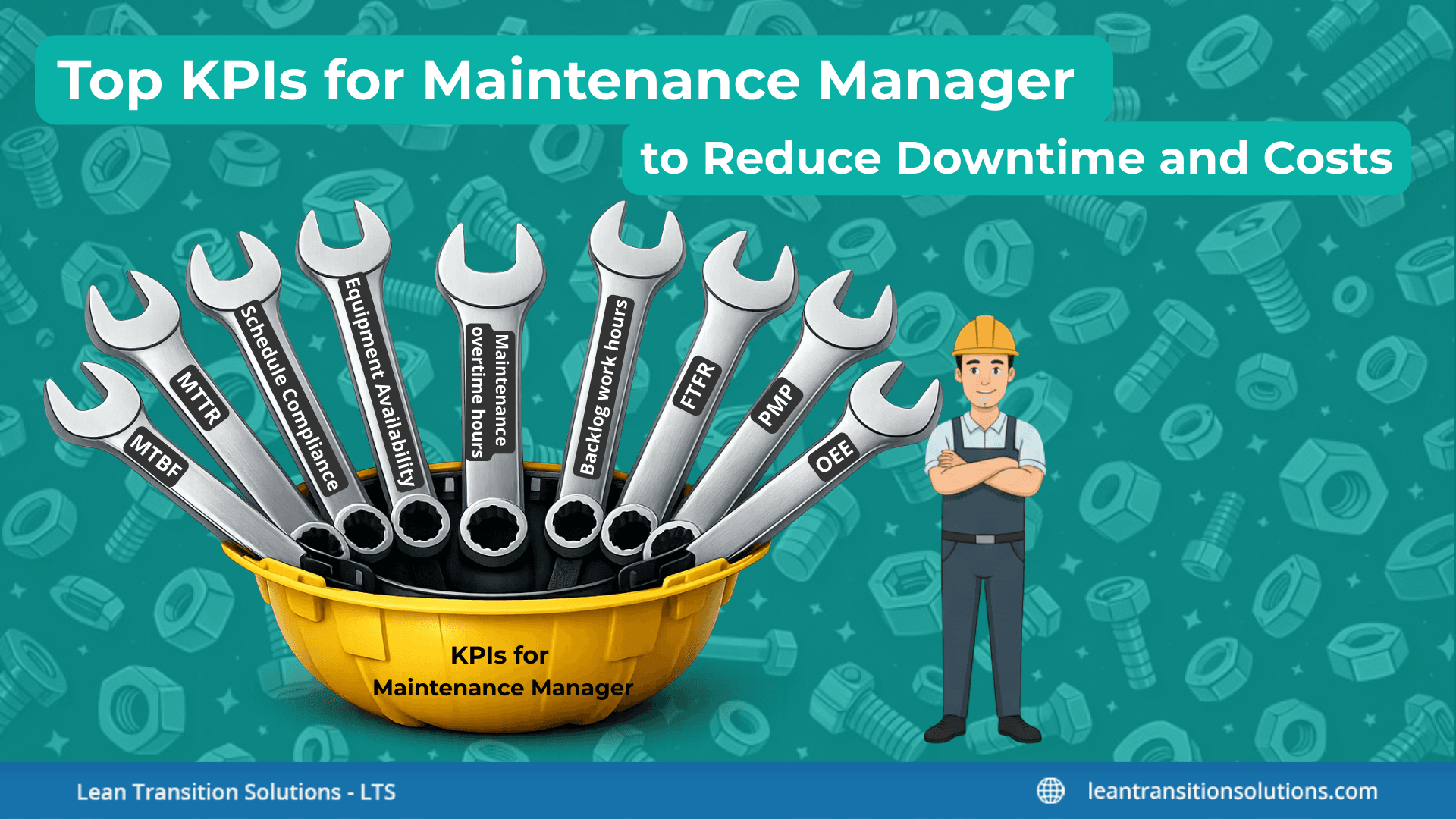
Top KPIs for Maintenance Manager to Reduce Downtime and Costs
Last updated on : January 7, 2026
Every maintenance manager knows the pressure of keeping operations running without a hitch. When unexpected breakdowns hit, production halts, costs spiral, and the blame often lands squarely on your shoulders. It’s not just about fixing machines – it's about preventing failures before they happen, managing tight budgets, and proving the value of your team’s work. The truth is, without clear performance metrics, it’s easy to feel like you’re fighting fires in the dark. That’s why KPIs for Maintenance Manager are more than numbers – they're your roadmap to reliability, efficiency, and peace of mind. In this blog, we’ll look into why maintenance managers need KPIs, common challenges in maintenance management and solutions, top 10 KPIs for maintenance managers, difference between preventive and predictive maintenance, tools and techniques to track KPIs effectively, how to set realistic KPI targets and link them to cost reduction and ROI, common mistakes to avoid when using KPIs, and how to turn data into continuous improvement with LTS Data Point.
Want to know more about LTS Data Point tools?
Why maintenance managers need KPIs
Key Performance Indicators (KPIs) are vital tools for maintenance managers because they turn operational data into productive insights, assisting teams work smarter, faster, and more efficiently.
Here's how KPIs help maintenance managers:
- Reducing downtime: KPIs such as Mean Time Between Failures (MTBF) and Mean Time to Repair (MTTR) underlines how often equipment fails and how quickly it can be fixed. By monitoring these metrics, maintenance managers can spot patterns, schedule preventive maintenance, and minimise unexpected breakdowns. This results in more reliable operations and less costly downtime.
- Improving reliability: Reliability-focused KPIs, such as equipment availability and failure rate, aid teams in understanding which assets are underperforming. Tracking these indicators assures that maintenance efforts target the right equipment at the right time, boosting overall plant trustworthiness and extending the life of critical machinery.
- Aligning with business objectives: Maintenance KPIs aren’t just machines – they link maintenance work directly to business outcomes. For example, monitoring maintenance costs against manufacturing targets or customer delivery timelines ensures that maintenance activities support organisational goals. This alignment helps maintenance managers justify budgets, optimise resource allocation, and demonstrate the value of their maintenance strategy to leadership.
KPIs give maintenance managers a clear picture of performance, reveal opportunities for improvement, and makes sure maintenance activities contribute to the company’s broader goals. They transform maintenance from a reactive necessity into a proactive, strategic function.
Common challenges in maintenance management and solutions
1. Too much reactive maintenance
- Challenge: Teams spend too much time repairing breakdowns instead of preventing them.
- Solution: Shift toward a preventive or predictive maintenance strategy using KPIs like MTBF or MTTR. Implement planned inspections and use digital tools to monitor asset health in real time.
2. Budget constraints
- Challenge: Limited budgets make it harder to uphold new tools, spare parts, or staffing.
- Solution: Use cost-related KPIs – maintenance cost per unit, cost of downtime – to build data-backed business cases. Prioritise high-impact assets to maximise return on investment.
3. Lack of visibility across assets and work orders
- Challenge: Maintenance managers can’t see what’s occurring across machines, teams, or shifts, leading to lags and inefficiencies.
- Solution: Adopt a digital maintenance dashboard or CMMS. Live tracking enhances transparency, highlights bottlenecks, and assists with quicker decision-making.
4. Unplanned downtime
- Challenge: Sudden failures disrupt production arrangement and increase operational cost.
- Solution: Use downtime-related KPIs and root cause analysis to spot repeating problems. Implement preventive schedules and assure critical spares are readily available.
5. Skill gaps in the maintenance teams
- Challenge: Lack of training, outdated skill sets, or uneven skill distribution across shifts.
- Solution: Maintain a digital skill matrix to allot tasks to the right technicians. Invest in regular training aligned with new technologies and equipment.
6. Inefficient work planning and scheduling
- Challenge: Poor planning results in delays, repeated work, or technicians waiting for instructions or tools.
- Solution: Use a centralised scheduling system (like digital TCard or CMMS planner). Plan jobs based on priority, technician availability, and asset criticality.
7. Poor spare parts management
- Challenge: Stockouts or overstocked inventory cause delays and connect capital unnecessarily.
- Solution: Monitor KPIs, maintain minimum stock levels for critical parts, and use digital inventory management for live updates.
8. Inconsistent documentation and reporting
- Challenge: Paper-based records lead to errors, missing documents, or lack of traceability.
- Solution: Switch to digital work orders and automated reporting. This verifies precise history, better compliance, and simplified audits.
9. Difficulty proving maintenance value to leadership
- Challenge: Maintenance is often seen as a cost centre instead of productivity enabler.
- Solution: Show KPI-driven insights – reduced downtime, enhanced OEE, higher reliability – to demonstrate impact on manufacturing objectives and cost savings.
Get a clear idea on how LTS Data Point help solve challenges
Top 10 KPIs for maintenance manager to track
KPI tracking is never an easy job. It requires a skilled maintenance manager to identify priorities and choose which KPIs are relevant for a particular task to be done quickly.
Let's see which KPIs are important for a maintenance manager.
Mean Time Between Failures (MTBF)
- Why it matters: Shows how dependable an asset is by calculating average uptime between failures.
- How to measure: MTBF = Total uptime / Number of failures
Mean Time to Repair (MTTR)
- Why it matters: Reflects how quickly your team can respond to and repair equipment issues. Lower MTTR = faster recovery.
- How to measure: MTTR = Total repair time / Number of repairs
Overall Equipment Effectiveness (OEE)
- Why it matters: Computes how effectively equipment is used by integrating availability, performance, and quality.
- How to measure: OEE = Availability x Performance x Quality
Planned Maintenance Percentage (PMP)
- Why it matters: Indicates how much of your maintenance work is scheduled vs reactive. Higher PMP = more control.
- How to measure: PMP = (Planned maintenance hours / Total maintenance hours) x 100
Maintenance cost as percentage of Replacement Asset Value (RAV)
- Why it matters: Aids gauge maintenance spending against asset worth. Good for budgeting and cost control.
- How to measure: Maintenance cost % of RAV = (Annual maintenance cost / RAV) x 100
Equipment availability
- Why it matters: Shows how often equipment is ready for production when needed.
- How to measure: Availability = (Uptime / (Uptime + Downtime)) x 100
Schedule compliance
- Why it matters: Reflects how effectively maintenance tasks are completed as planned.
- How to measure: Schedule compliance = (Completed planned tasks / Total planned tasks) x 100
Backlog work hours
- Why it matters: Reveals how much work is pending. High backlog shows understaffing or inefficiency.
- How to measure: Backlog work hours = Total estimated hours for pending work orders
Maintenance overtime hours
- Why it matters: Shows workload imbalance, staffing problems, or frequent unplanned work.
- How to measure: Overtime % = (Overtime hours / Total labour hours) x 100
First-Time Fix Rate (FTFR)
- Why it matters: Indicates how often technicians fix problems on the first attempt – important for efficiency and customer satisfaction (both internal and external).
- How to measure: FTFR = (Number of first-time fixes / Total service calls) x 100
Preventive vs predictive maintenance: Which KPIs apply?
Let's break these KPIs into which they are – predictive or preventive KPIs. Let's also look into why they belong where they belong where they belong.
Preventive maintenance KPIs
These KPIs support time-based or schedule-based maintenance activities. They aim on consistency, planning, and minimising unexpected failures.
- Planned Maintenance Percentage (PMP): It depends heavily on arranged tasks. A higher PMP shows teams are proactively maintaining equipment.
- Schedule compliance: Shows how well the team sticks to the maintenance plan. Preventive maintenance is effective only if planned tasks are implemented on time.
- Maintenance backlog: Monitoring backlog assures preventive tasks aren’t piling up. It helps staying ahead of failures.
- Maintenance cost tracking: Keeping an eye on cost trends helps ensure if preventive work is lowering breakdown. Costs can be controlled by scheduled care.
- Equipment availability: Availability shows if preventive actions are working. This keeps the equipment healthy reducing downtime.
Predictive maintenance KPIs
These KPIs are perfect for condition-based and data-driven maintenance strategies. They concentrate on real-time tracking and predicting failures before they happen.
- Mean Time Between Failures (MTBF): Increase the time between failures as issues are caught early.
- Unplanned downtime: Lower unplanned downtime reflects the predictive model is detecting issues early.
- Maintenance lead time: Monitoring lead time displays how much notice technicians get before problems occur.
- Condition tracking metrics: Assists early warning signs related to conditions of equipment such as vibration, temperature, pressure trends etc.
KPIs that act as both
Some metrics support any maintenance strategy – all it takes is how you approach.
- Mean Time to Repair (MTTR): Relevant for both, but in preventive maintenance, it reflects response preparedness, while in predictive maintenance it indicates how early detection enhances repair efficiency.
- Overall Equipment Effectiveness (OEE): Used across maintenance types to mirror how maintenance practices impact production performance.
Learn how to track KPIs effectively with LTS Data Point tools
Tools and techniques to track KPIs effectively
- Software integration: Use systems like MES (Manufacturing Execution Systems), ERP (Enterprise Resource Planning), and Balanced Scorecard platforms to centralise data, automate tracking, and align KPIs with operational and strategic goals.
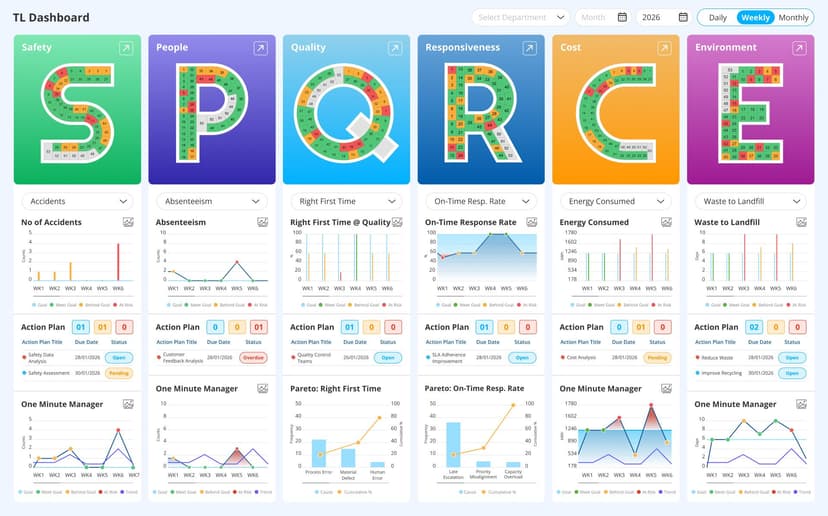
- Dashboards and visualisation tools: Interactive dashboards simplify data interpretation through charts, colour-coded indicators, and trend analysis, allowing faster decision-making. Purpose-built KPI tracking software brings these dashboards together with automated alerts and root cause tools in one system.
- Real-time data and alerts: Continuous monitoring with live updates and automated alerts assures quick responses to deviations, helping teams maintain performance and prevent issues before they escalate.
KPIs for maintenance manager: How to set realistic KPI targets and link them to cost reduction and ROI
Setting KPI targets isn’t just about selecting numbers; it’s about aligning maintenance performance with industrial objectives and exhibiting clear financial impact. A structured, fact-based approach assures KPI targets are achievable, meaningful, and directly tied to cost reduction and Return on Investment (ROI).
1. Start with benchmarking to understand what “good” looks like:
Before setting targets, compare your performance with industry standards, OEM recommendations, or internal historical reports. Benchmarking aids determine whether your latest MTBF, downtime, or maintenance costs are above or below typical performance levels. This gives you a base for setting targets that are realistic, not random.
2. Align KPIs with organisational and operational objectives:
Maintenance KPIs must support broader business goals like productivity, on-time delivery, safety, or cost optimisation.
- If the organisational goal is higher output, aim on KPIs like availability, OEE, and preventive maintenance compliance.
- If the focus is cost control, prioritise KPIs linked to labour, spare parts, and asset life. This alignment assures maintenance efforts contribute directly to strategic outcomes instead of working in isolation.
3. Translate benchmarked targets into actionable, asset-level goals:
Break down high-level KPI targets into productive goals for individual assets, teams, and technicians. For example, lowering downtime by 10% may require improving preventive scheduling, increasing planner compliance, or upgrading condition tracking on critical machines. This level of clarity drives daily behaviour.
4. Connect KPIs directly to cost reduction:
Every maintenance KPI should have a financial story behind it -
- Higher MTBF means fewer breakdowns, less manufacturing loss, and lower repair cost.
- Lower MTTR reduces overtime, spares usage, and production lags.
- Better schedule compliance minimises emergency work, which is usually 2-5x more expensive than planned work. By showing how KPI improvements lower waste, maintenance leaders can prove investments in tools, training, or automation.
5. Highlight ROI through data visibility and trend tracking:
Once targets are set and driving action, monitor improvements over time and convert them into financial outcomes. For example:
- A drop in unplanned downtime directly boosts manufacturing capacity – an immediate ROI.
- Enhanced asset dependability extends equipment life, delaying large capital expenses.
- Efficient spare parts usage lowers inventory carrying costs. When KPI trends are linked to real savings, leadership clearly notices the ROI of maintenance initiatives.
6. Review and adjust targets regularly:
As functions evolve, KPI targets shouldn’t remain static. Study them quarterly or semi-annually to verify they mirror ongoing asset conditions, business priorities, and new technologies. Continuous recalibration keeps targets realistic and aligned with financial objectives.
Common mistakes to avoid when using KPIs
To be a skilled maintenance manager is not to be one who does not make mistakes, but one who avoids it at all costs. Being a human, you’ll always be prone to manual errors which may cause great complications in your business. A wise maintenance manager sees these possibilities beforehand and finds solutions before it ever happens.
For this, one must know what common mistakes are usually made and how to avoid them if in case, you too happen to face.
- Tracking too many metrics: When teams monitor dozens of KPIs, nothing stands out. Overloading dashboards leads to confusion and reduces focus.
Avoid it by: Prioritising 3-6 KPIs that directly impacts reliability, downtime and cost.
- Selecting KPIs that don’t align with goals: A KPI is useless if it doesn’t support what the business is trying to attain – whether it’s uptime, quality, or cost reduction.
Avoid it by: Securing every KPI clearly connects to a strategic or operational goal.
- Ignoring the story behind numbers: KPIs alone don’t fix issues. If teams look at numbers but skip inspecting why they’re trending up or down, improvements stall.
Avoid it by: Pairing KPIs with root cause analysis, daily review meetings, and action plans.
- Focusing only on lagging KPIs: Metrics like downtime and cost displays what has already happened. Relying only on lagging indicators means issues are discovered too late.
Avoid it by: Balancing lagging KPIs with leading ones such as preventive compliance or condition monitoring data.
- Setting unrealistic targets: Targets that are too complicated demotivate teams and lead to inconsistent performance.
Avoid it by: Using benchmarking and past performance trends to set achievable, meaningful goals.
- Not reviewing KPIs regularly: Stagnant KPIs become irrelevant as equipment ages or business priorities change.
Avoid it by: Reviewing KPI relevance quarterly or bi-annually and adjusting based on operational shifts.
- Treating KPIs as reporting tools: Several industries gather data just for reporting – but without action, KPIs offer no value.
Avoid it by: Linking each KPI to corrective actions, performance huddles, and continuous improvement initiatives.
- Poor data quality or inconsistent logging: Inaccurate information leads to wrong decisions and distrust in the KPI system.
Avoid it by: Standardising data entry, using digital systems, and assuring that teams understand KPI definitions.
For more details, pay a visit: How to Measure KPIs: All you need to know
Enhance KPI tracking with LTS Data Point now
KPIs for Maintenance Manager: Turning Data into Continuous Improvement with LTS Data Point
As maintenance goes deeper into Industry 4.0 era, organisations are demanding faster insights, smarter decision-making, and more connected workflows. LTS Data Point can aid maintenance managers achieve this efficiency in various industries as per needs.
1. Real-time dashboards for instant visibility: LTS Data Point offers tools that make sure maintenance teams don't have to wait for weekly or monthly reports – they act instantly.
- Live KPI dashboards
- One-minute manager views
- Role-based scorecards
2. Predictive decision-making through trends and early warning signs:
Provides solutions that empowers maintenance teams to detect patterns early and prevent failures before they escalate.
- Trend charts for MTBF, downtime, backlog, and schedule compliance
- Deviation alerts and threshold warnings
- Historical performance comparison
3. Integrated root cause and corrective action tracking: Supports solutions that ensures KPI deviations convert into concrete actions – not just documents.
- Built-in root cause analysis (RCA)
- Corrective and preventive action (CAPA) monitoring
- Closed-loop follow-up and verification
4. End-to-end maintenance visibility across teams and assets: Supports system-wide transparency through various tools verifying everyone sees the same truth and works toward the same goals. Those tools include:
- Asset-level KPIs
- Team, shift, and department scorecards
- Cross-functional visibility for processes, maintenance, and quality
5. Turning KPIs into continuous improvement cycle: Keeps KPIs alive creating a consistent loop of calculating, analysing, improving, and sustaining gains – exactly what continuous improvement requires. This is done through:
- Daily management routines
- Action-triggering alerts
- Automated escalations
- Audit-ready performance logs
Keeping your plant running smoothly isn’t easy, and we get that. Between juggling budgets, tackling unexpected breakdowns, and proving the value of your team, it can feel like a never-ending battle. That’s why focusing on the right KPIs for Maintenance Manager makes all the difference. These metrics aren’t just numbers – they're your guide to smarter decisions, fewer surprises, and better results. Start small, track what matters, and let data lead the way. With tools like LTS Data Point, turning KPIs into real improvements becomes second nature. After all, maintenance isn’t just about fixing – it's about building reliability for the future.
Grow your business journey with LTS Data Point
FAQs
1. What’s the biggest mistake maintenance managers make with KPIs?
Focusing on too many metrics at once. Stick to 6–10 KPIs that directly impact reliability and cost.
2. How often should KPIs for maintenance managers be reviewed?
Ideally every quarter. Regular reviews ensure KPIs stay aligned with changing business goals and asset conditions.
3. Can KPIs help justify maintenance budgets?
Yes. Data-backed KPIs like cost per downtime hour or MTBF show clear ROI and help secure leadership buy-in.
4. Do predictive maintenance KPIs require expensive tools?
Not always. Many CMMS platforms and IoT sensors offer affordable options for condition monitoring and KPI tracking.
5. What’s the best way to start using KPIs for maintenance managers?
Begin with simple metrics like MTTR and PMP, then gradually add predictive KPIs as your data and tools mature.

Geandra Queiroz, Operations Management Consultant
Geandra is an Operations Management Consultant at Lean Transition Solutions, specialising in Lean philosophy, Lean Six Sigma, and strategic planning across manufacturing and healthcare. She is currently completing her PhD in Industrial Engineering at the Federal University of São Carlos, researching the integration of Operations Strategy, Lean, and Green Manufacturing.