6 Pillars of Strategy Execution: How to Turn Vision into Action
Last updated on : January 20, 2026
You know the drill – you set a bold strategy, share the vision, and then… things slow down. Priorities clash, teams lose focus, and progress feels like wading through mud. It’s frustrating because the idea was solid, but execution? That’s where most plans fall apart. The good news? It doesn’t have to be that way. The 6 pillars of strategy execution give you a practical, proven way to cut through the chaos, keep everyone aligned, and turn big goals into real results. No buzzwords, no endless meetings – just clarity, accountability, and action.
This blog focuses on what the six pillars of strategy execution are, why most companies fail without these six pillars, how to implement them, common challenges in implementing and how to solve those, real-world example, and leadership guide and quick-start roadmap fuelled by LTS Data Point.
Explore how to turn your vision into action with LTS Data Point
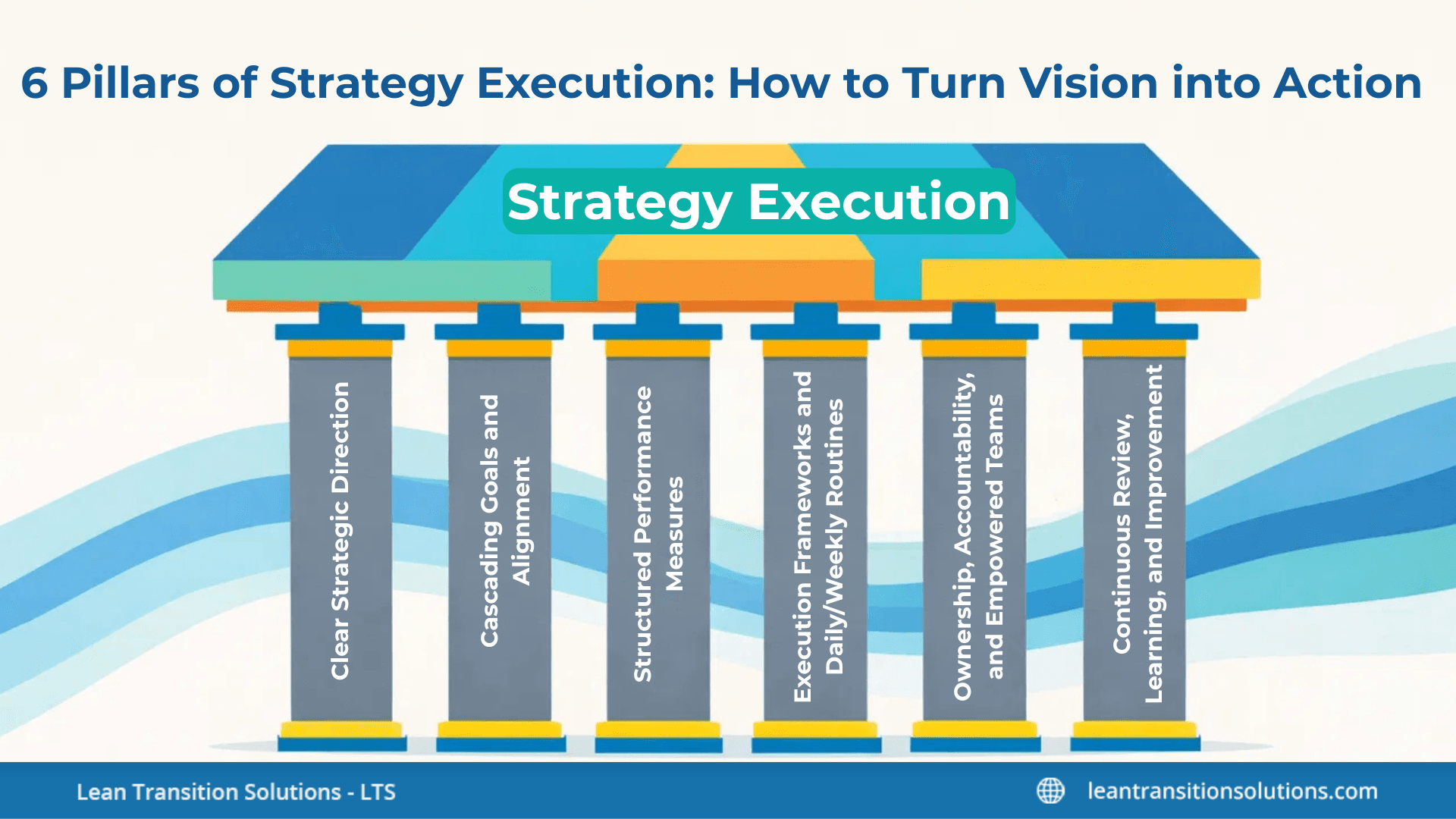
What are the 6 pillars of strategy execution?
The term strategy execution must have become quite familiar for you by now. But where you aware of the six pillars of strategy execution? Do you know why these pillars exist and in what order?
Let's put them under a microscope and see what those are.
1. Clear strategic direction: This includes a well-defined vision, mission, and set of strategic objectives that sketch where the industry is heading and why.
Why it matters:
- Prevents ambiguity and scattered priorities.
- Provides employees a compass to align their work.
- Verifies all functions operate with the same long-term intent.
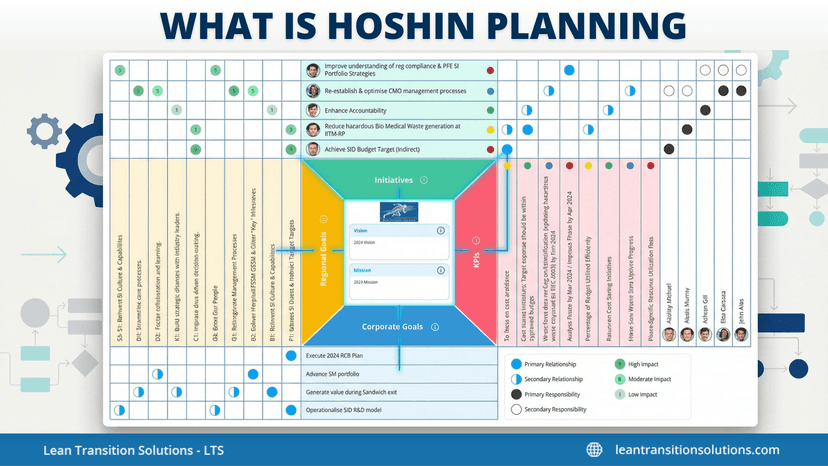
2. Cascading goals and alignment: This refers to the breaking down of high-level organisational goals into departmental, team, and individual targets. Tools like Hoshin Kanri X Matrix and Balanced Scorecard (BSC) support this.
Why it matters:
- Assures every layer contributes to strategy.
- Eliminates silos by linking daily tasks to big-picture goals.
- Assists staff understand how their work impacts outcomes.
3. Structured performance measures: Recognising the right set of KPIs, OKRs, or performance metrics that monitor progress, underlines gaps, and guide decisions.
Why it matters:
- Enables leaders to track real performance – not guesswork.
- Aids early inspection of issues through leading indicators.
- Creates accountability and data-driven decision-making.
4. Execution frameworks and daily/weekly routines: This includes operational systems like daily huddles, SQDCP boards, Gemba walks, project scorecards, and standard review cycles that reinforce consistent action.
Why it matters:
- Converts goals into consistent behaviours.
- Allows quick problem-solving and course correction.
- Makes sure everyone stays focused on priorities despite daily pressures.
5. Ownership, accountability, and empowered teams: Focuses on clear role ownership for each aim, Key Performance Indicator (KPI), or initiative – combined with the autonomy to make decisions.
Why it matters:
- Avoids confusion about who is responsible for what.
- Motivates proactive behaviour instead of escalations.
- Creates engagement because people feel connected to results.
6. Continuous review, learning and improvement: Indicates strategy assessments – monthly, quarterly, and annual – to examine progress, learn from performance, adapt tactics, and refine targets.
Why it matters:
- Keeps strategy relevant in changing conditions.
- Prevents stagnation and secures ongoing alignments.
- Encourages a culture of learning, not blaming.
Why most companies fail without the 6 pillars of strategy execution
Most industries don’t fail because their strategy is faulty – they fail because their execution is faulty. Without these six pillars, the teams struggle with unclear direction, fragmented priorities, and inconsistent follow-through resulting in the crumbling down of your business.
Here are the most common pain points and how the pillars address them:
1. Lack of alignment across teams
- The problem: Departments end up working individually, their priorities end up clashing, and daily work doesn’t mirror strategic goals.
- The solution: Clear strategic direction + Cascading alignment = everyone moves in the same direction with shared priorities.
2. Unclear priorities
- The problem: Teams try to do everything at once, causing delays, overload, and diluted focus.
- The solution: Goal alignment + KPI frameworks = refined focus to the few crucial goals that create the greatest impact.
3. No reliable way to monitor progress
- The problem: Managers depend on outdated records, inconsistent information, or subjective judgement.
- The solution: Structured KPIs + Leading indicators = live visibility so decisions are fact-based, not assumptions.
4. Weak accountability and ownership
- The problem: Duties fall through the cracks because people don’t know who owns what – or guess someone else does.
- The solution: Defined ownership + Empowered teams = clarity, responsibility, and momentum.
5. Poor execution discipline
- The problem: Strategy is examined once a year and forgotten in daily functions.
- The solution: Daily + Weekly execution routines = embed strategy into daily behaviour.
6. No learning loop or adaptation
- The problem: Organisations repeat the same mistakes because they don’t review, reflect, or adjust.
- The solution: Continuous review + improvement = make strategy dynamic, assuring it remains relevant and responsive.
The six pillars of strategy execution form a practical framework that turns ambition into measurable business results. Alignment ensures every department works toward shared priorities, such as cascading strategic goals into team-level objectives. Leadership commitment provides visible sponsorship, resource allocation, and consistent follow-through – without which execution collapses. Metrics bring clarity and focus by using KPIs and leading indicators to track progress and guide decisions. Agility enables faster adaptation through weekly huddles, live dashboards, and fast course correction. Talent development builds the skills and problem-solving capabilities required to execute effectively. And continuous improvement keeps execution sharp through A3s, CAPA, retrospectives, and regular strategy reviews.
Together, these pillars drive tangible business growth. Aligned teams deliver faster, leadership commitment reduces friction, and clear metrics improve accountability and performance. Agility boosts responsiveness to customer needs and market shifts, while strong talent and continuous improvement increase efficiency, minimise waste, and strengthen competitiveness. Industries that master these six pillars consistently achieve higher productivity, better financial results, stronger customer satisfaction, and a durable competitive advantage.
Implement the 6 pillars of strategic execution with LTS Data Point
Implementing the 6 pillars of strategy execution in your organisation
Putting the six pillars into practice requires structure, discipline, and the right tools. Below is a practical guide leaders can follow to place each pillar into daily operations and drive consistent execution.
1. Alignment
How to implement:
- Begin by clarifying vision, strategic priorities, and annual breakthrough goals.
- Cascade objectives from the top down using tools like Balanced Scorecard or Hoshin Kanri X Matrix.
- Hold cross functional alignment workshops to eliminate conflicting priorities.
Best practices: Keep targets simple, visible, and bound directly to team responsibilities.
Tools: Strategy deployment templates, balanced scorecards, digital goal-alignment dashboards.
2. Leadership commitment
How to implement:
- Verify leaders take a proactive part in reviews, huddles, and problem-solving – not just planning.
- Assign clear owners to strategic initiatives and qualify them with decision-making authority.
- Communicate progress throughout the organisation clearly.
Best practices: Supervisors model behaviours – if they don’t show commitment, the industry won’t either.
Tools: Leadership review calendars, RACI matrices, and visibility dashboards.
3. Metrics and performance monitoring
How to implement:
- Define a balanced set of KPIs along with both leading and lagging indicators.
- Set aims, thresholds, and actions needed when performance drifts.
- Review metrics frequently – daily, weekly, and monthly – depending on the KPI.
Best practices: Focus on the vital metrics that influence strategic outcomes.
Tools: KPI dashboards, OKR trackers, digital SQDCP boards, automated alerts.
4. Agility and fast decision-making
How to implement:
- Establish a rhythm of daily huddles, weekly execution meetings, and monthly strategy reviews.
- Authorise teams to make quick decisions within their scope without constant escalation.
- Use live data to adjust priorities quickly.
Best practices: Short, focused meetings -> faster actions -> fewer delays.
Tools: Lean daily management systems (LDMS), workflow trackers, and live dashboards.
5. Talent development
How to implement:
- Train teams in problem-solving, KPI ownership, A3 thinking, and data interpretation.
- Build leadership capabilities around communication, coaching, and execution discipline.
- Develop a skill matrix to spot gaps and create targeted development plans.
Best practices: Invest consistently – strategy execution enhances only when people grow.
Tools: Training frameworks, competency matrices, coaching dashboards.
How to implement:
- Introduce structured improvement cycles (PDCA, A3, 5 Why, CAPA).
- Review strategic initiatives quarterly and refine actions based on results.
- Encourage teams to raise problems early and solve them at the root.
Best practices: Think small steps, tested frequently, rather than big annual overhauls.
Tools: A3 templates, digital CAPA systems, PDCA trackers, monthly review boards.
Benefits of following the 6 pillars of strategy execution
- Clear direction and focus: Everyone understands the strategic priorities, minimising confusion and conflicting efforts.
- Stronger alignment: Teams and departments work toward shared goals instead of operating in silos.
- Higher accountability: Clear ownership of KPIs and initiatives make sure tasks don’t fall through the cracks.
- Quicker decision-making: Swift routines and real-time reports allow faster more confident decisions.
- Enhanced performance visibility: Metrics and dashboards make progress clear and problems easy to detect early.
- Greater employee engagement: Empowered teams feel responsible for outcomes and contribute proactively.
- Better utilisation of talent: Continuous development strengthens problem-solving skills and leadership capacity.
- Consistent continuous improvement: Frequent assessments and organised improvement tools help sustain results.
- Operational efficiency: Minimised waste, lesser delays, and strict execution refine productivity.
- Stronger business results: Better execution leads to higher revenue growth, profitability, customer satisfaction, and competitive advantage.
Find more about the right tools and techniques with LTS Data Point
Common challenges in implementing 6 pillars of strategy execution and how to solve them
Even with the most efficient frameworks, industries often struggle to put the six pillars into practice. The biggest obstacles usually stem from people, culture, and outdated ways of working.
Here are the most common challenges and how to overcome them:
1. Resistance to change
The challenge: Staff may feel pressurised by new routines, metrics, or accountability structures.
How to overcome: Communicate why it is necessary, involve teams early, and show quick wins. Use coaching and change champions to build trust and lessen fear.
2. Siloed teams and poor cross-functional collaboration
The challenge: Departments protect their own priorities, making alignment and shared metrics difficult.
How to overcome: Use cascading aims, aligned KPIs, and cross-functional huddles. Motivate joined problem-solving instead of isolated decision-making.
3. Leadership not fully committed
The challenge: When leaders don’t constantly take part in assessments or model behaviours, the initiative loses the pace.
How to overcome: Create a leadership rhythm – monthly reviews, visible sponsorship, and clear ownership. Hold leaders accountable for both outcomes and engagement.
4. Too many priorities and lack of confidence
The challenge: Teams tend to get overwhelmed when everything feels important, leading to poor execution.
How to overcome: Limit strategic priorities to the vital few. Use goal tracking tools like prioritisation matrices or Hoshin Kanri.
5. Weak metrics or poor data quality
The challenge: Inconsistent data, unclear KPIs, or outdated reporting make execution unreliable.
How to overcome: Define the right KPIs, standardise data sources, and utilise live dashboards to secure precision and visibility.
6. Slow decision-making and low agility
The challenge: Long approval chains and traditional meeting systems make it difficult to adapt quickly.
How to overcome: Introduce fast, structured routines – daily huddles, weekly execution reviews, and qualified teams with clear boundaries for decision-making.
7. Skill gaps and underdeveloped talents
The challenge: Teams may lack the analytical, problem-solving, or leadership skills required to execute strategy.
How to overcome: Invest in organised learning – A3 problem-solving, KPI ownership training, coaching, and capability development plans.
8. Lack of continuous improvement discipline
The challenge: Industries jump from one initiative to another without closing the loop or learning from outcomes.
How to overcome: Plant PDCA cycles, CAPA, A3s, and scheduled retrospectives to assure learning becomes part of the culture.
The bottom line is, most challenges in applying the six pillars are predictable – and solvable. With clear communication, focused priorities, strong leadership, reliable data, and a culture of continuous improvement, organisations can overcome resistance, break down silos, and build a high-performance execution system that delivers results consistently.
Uplift your company to the height with LTS Data Point
6 pillars of strategy execution: Real-world example
A mid-sized manufacturing company was struggling with missed targets, siloed teams, and constant firefighting – nobody was aligned, priorities kept shifting, and decisions took too long to make. Leadership realised strategy execution was failing, so they rebuilt their approach around the six pillars. They began by clarifying strategic priorities and cascading them across departments, so every team finally worked toward the same goals. Leaders committed to a monthly review cadence and daily engagement on the shop floor, which immediately minimised bottlenecks. Clear KPIs and leading indicators replaced guesswork, giving everyone real-time visibility into performance. Daily huddles and live dashboards brought flexibility to decision-making, enabling teams to adjust quickly instead of waiting for approvals. They invested in talent development – training teams in A3 thinking, problem-solving, and KPI ownership – which boosted confidence and capability. Finally, they embedded continuous improvement through PDCA and CAPA routines, turning problem-solving into a habit rather than a reaction. Within months, on-time delivery improved, waste reduced, and engagement increased. By applying all six pillars together, the company transformed chaos into disciplined execution and achieved consistent, measurable business growth.
Leadership guide and quick-start roadmap: Maximising the 6 pillars of strategy execution with LTS Data Point
Senior leaders who want to embed the 6 Pillars deeply and systematically can leverage LTS Data Point’s built-in templates, dashboards, and lean management tools. The ideas below draw on how real companies have used the system to improve alignment, accountability, agility, and continuous improvement.
What LTS Data Point offers you as leader-tools
- Digital Balanced Scorecard and strategy maps: Instead of static spreadsheets, you get a live, visual strategic map where long-term aims, annual goals, and high-level priorities are bound to clear metrics.
- Hoshin Kanri X Matrix template: This allows you to cascade strategy into practical initiatives and metrics, aligning teams across departments with the big-picture vision.
- Custom KPI and SQDCP (or SQDC/SQDCL/ESQDCP) dashboards: For processes and strategy alike, you can keep an eye on Safety, Quality, Delivery, Cost, People (and optionally Lean, Environment, etc.) – across daily, weekly, monthly horizons.
- Digital daily management or huddle boards: Instead of whiteboards or spreadsheets, teams get visually updated boards to record performance vs target, underline deviations, and initiate corrective actions.
- Automated reporting and live data integration: Data Point integrates with ERP, MES, or other systems so information flows into dashboards automatically; to manual consolidation or delays.
- Continuous improvement and project-tracking tools: With built-in support for lean problem-solving (root cause analysis, CAPA, A3, improvement project tracking), leaders can turn problems into structured learning and improvement loops.
Step-by-step quick-start roadmap for leaders using LTS Data Point
Define strategic priorities and vision
- Use the Balanced Scorecard module to map long-term vision, mission, and strategic goals.
- Build a strategy map to see cause-effect relationships (e.g., how sales growth depends on quality, delivery, cost, etc.).
Cascade goals across the industry
- Use the Hoshin Kanri X Matrix template to break high-level strategy into annual targets, priorities, and bound KPIs – then allocate them to departments or teams.
- Make sure each KPI is clearly assigned to an owner using Data Point accountability boards.
Configure custom KPI and operational dashboards
- Set up SQDCP/SQDC/ESQDCP dashboards (or customise according to your needs) to keep an eye on key metrics – not only financial, but also safety, quality, delivery, cost, people, environment as required.
- Define reporting frequency (daily, weekly, monthly) and make sure thresholds or targets are set.
Implement daily and weekly execution routines
- Launch daily digital daily management (huddle) boards – teams update progress, note deviations, spotlight issues, and monitor actions.
- Leadership participates in periodic reviews (weekly/monthly) - removes bottlenecks, tracks risks, and confirms continuous alignment.
Integrate data systems for live visibility
- Link Data Point to existing ERP, MES or production/quality systems for automated data capture – eliminates manual reporting lags and inconsistencies.
- Make sure dashboards mirror real-time data, allowing faster decisions and early issue detection.
Rollout continuous improvement and problem-solving frameworks
- Use built-in lean tools – root cause analysis, A3, CAPA templates – to look into variances, incidents, or opportunity areas captured via dashboards or huddle boards.
- Monitor improvement projects and corrective actions directly in the system for traceability and learning.
Nurture a culture of transparency, accountability and learning
- Inspire open communication through dashboards that are visible to all relevant levels; performance metrics, aims, and responsibilities shared.
- Recognise achievements and improvements publicly – reinforce that fact-based execution and continuous improvement are valued.
- Periodically examine the strategy map and KPIs to upgrade objectives based on evolving business conditions.
Leadership insights: What senior managers should watch out
- Lead by example: Use the dashboards, attend huddles, assess KPI trends – when leadership visibly engages, teams make it seriously.
- Simplify and prioritise: Don’t overload with too many KPIs or initiatives. Focus on the relevant ones that truly drive strategic objectives.
- Encourage ownership and accountability: Assign clear owners for metrics and initiatives. Use Data Point to keep an eye on responsibility and follow-up actions.
- Embed continuous improvement as habit: Use lean tools, root cause analysis, and improvement logs so that learning and enhancing happens routinely.
- Keep strategy alive: Refresh targets, assess dashboards, and re-align quarterly or as required, not just annually.
Getting strategy right is only half the battle – making it happen is where the real work begins. The six pillars aren’t just theory; they’re practical habits that keep everyone pulling in the same direction, focused on what matters most. When you nail alignment, accountability, and continuous improvement, you turn big ideas into real results without the usual chaos. Start small, keep it visible, and build the rhythm – because strong execution isn’t a one-off project, it’s a way of working that pays off every single day.
Secure your business success with LTS Data Point
FAQs
1. What's the difference between strategy execution and strategic planning?
Strategic planning sets the direction; strategy execution makes it happen. Planning defines goals, while execution ensures those goals are embedded into daily actions and monitored for progress.
2. Why do most strategies fail during execution?
They fail because organisations lack alignment, clear metrics, and consistent routines. Without these, priorities clash, accountability weakens, and progress stalls.
3. How can technology improve strategy execution?
Digital tools like KPI dashboards, huddle boards, and automated reporting provide real-time visibility, reduce manual errors, and speed up decision-making.
4. What industries benefit most from strong strategy execution?
Every industry benefit, but sectors with complex operations—like manufacturing, healthcare, and aerospace—see the biggest gains in efficiency and agility.
5. How do you measure successful strategy execution?
Success is measured through clear KPIs, leading indicators, and regular reviews that show progress toward strategic goals and adaptability to changes.
6. Can remote teams apply the 6 pillars effectively?
Yes. Virtual dashboards, online huddles, and digital collaboration tools make it possible to maintain alignment, accountability, and continuous improvement remotely.