Mastering Corporate Strategy for SMEs: A Complete Guide
Last updated on : January 21, 2026
Ever feel like you’re running your business on a shoestring while trying to keep up with giants? You’re not alone. Most SMEs struggle with limited resources, constant competition, and the pressure to grow fast without burning out. The good news? A clear corporate strategy can turn that chaos into a plan that actually works for you. In this guide, we’ll show you what corporate strategy for SMEs means and why it matters, common challenges SMEs face and solutions, steps to build corporate strategy for SMEs, budget-friendly ways to implement corporate strategy, common SME strategy mistakes and how to avoid them, and practical tools and frameworks for planning corporate strategy and with LTS Data Point.
Discover how LTS Data Point can transform your SME strategy
What is corporate strategy for SMEs and why it matters
A corporate strategy is the top-level plan a business makes use of to determine where it is going and how it will grow profitably. For small and medium sized enterprises (SMEs), it’s not much of a complex theory, but a sensible roadmap that aids owners and teams make consistent decisions, assign resources wisely, and remain competitive in fast-changing markets.
What corporate strategy for SMEs look like
For SMEs, corporate strategy prioritises:
- Setting a clear direction for the business – vision, long-term goals, growth priorities.
- Choosing where to compete – which markets, customer segments, and products to focus on.
- Determining how to win – unique strengths, capabilities, and value propositions.
- Allotting resources efficiently – time, people, budgets, technology.
- Reducing uncertainty with organised decision-making.
No matter how small, the right corporate strategy helps it act with clarity instead of reacting to daily pressures.
Why corporate strategy for SMEs matters so much
A solid strategy is not something that is “nice to have” – it is vital for survival and scale. It assists SMEs:
- Stay focused on what really matters: Avoid distraction and make sure teams understand priorities.
- Use limited resources wisely: SMEs can’t afford waste. Strategy ensures money, people, and tools are used where they create the most impact.
- Respond faster to market changes: With clear targets and performance measures, SMEs can adapt quickly to new customer needs, competitors, and technologies.
- Improve decision quality: A strategy behaves as a filter helping owners say yes to the right opportunities and no to the wrong ones.
- Build a sustainable competitive advantage: Whether it’s speed, quality, service, or innovation, strategy clarifies what makes the business unique and better.
- Align the entire industry: Teams work better when everyone knows the direction, targets, and expectations.
- Allow measurable growth: Strategic planning links daily actions to long-lasting aims – making growth predictable and traceable.
Common challenges SMEs face without clear strategy and solutions
SMEs often run head-first into challenges out of which majority are avoidable if there’s a clear corporate strategy. These challenges end up consuming them wholly, draining them out of resources and energy. This is exactly why every SME should be aware of the most common challenges and practical solutions.
1. Unclear direction and priorities
- Challenge: Teams work hard but not always on the right things, leading to confusion and inconsistent progress.
- Solution: Define a clear vision, long-term goals, and strategic priorities so everyone understands what matters most and why.
2. Wasted resources and inefficient decisions
- Challenge: Time, money, and manpower get exhausted on low-impact activities because there is no strategic filter.
- Solution: Design a systematic decision-making framework that guides investment, resource allocation, and project selection.
3. Reactive instead of proactive working
- Challenge: The business constantly reacts to day-to-day problems instead of planning for growth and improvement.
- Solution: Adopt a simple strategic planning cycle – weekly, monthly, quarterly – to anticipate challenges and act ahead of competitors.
4. Poor alignment across teams
- Challenge: Departments or individuals typically work in silos, resulting in duplication, delays, and miscommunication.
- Solution: Establish shared goals, cross-functional Key Performance Indicators (KPIs), and frequent alignment meetings to create a unified path.
5. Difficulty adapting to market changes
- Challenge: Without strategic awareness, SMEs struggle to respond to new customer trends, competitor moves, or technology shifts.
- Solution: Use continuous market scanning, customer feedback loops, and scenario planning to remain swift and adjust quickly.
6. Lack of quantifiable performance
- Challenge: Progress is based on guesswork rather than facts, making it hard to monitor improvement or spot issues early.
- Solution: Implement clear KPIs, best digital dashboard tools, and performance reviews so decisions are driven by evidence – not assumptions.
7. Limited competitive advantage
- Challenge: SMEs merge with competitors because they lack a defined value proposition or strategic focus.
- Solution: Clarify what makes the business different – quality, speed, service, innovation – and build strategy around those strengths.
8. Slow or stagnant growth
- Challenge: Without direction, SMEs struggle to scale, enter new markets, or innovate effectively.
- Solution: Design a growth roadmap with defined milestones, potential needed, or initiatives to unlock new opportunities.
Want a smarter way to plan?
Proven steps to build corporate strategy for SMEs and align vision, mission, and goals for growth
Building a strong corporate strategy begins with clarity – knowing who you are as a business, where you want to go, and how you plan to go there. For SMEs, this alignment becomes the base for sustainable growth and consistent decision-making. Following steps help build a future-ready strategy while making sure your vision, mission, and goals work together flawlessly.
Clarify your strategic foundation (vision, mission, values)
- Vision: Define the future you want to build.
- Mission: Explain how you’ll get there and whom you serve.
- Values: Recognise principles that guide behaviour and decisions.
- Outcome: A clear identity that aligns your team and sets long-term path.
Assess your current position
- Analyse your strengths, weaknesses, market opportunities, and competitive threats.
- Make use of tools like SWOT, customer analysis, operational reviews, and competitor benchmarking.
- Outcome: A realistic understanding of where you stand and what must change.
Set strategic goals that drive growth
- Translate your vision and mission into computable, practical aims.
- Prioritise objectives related to revenue, customer experience, market expansion, efficiency, and innovation.
- Outcome: Clear preferences that lead day-to-day actions and long-run plans.
Choose the right strategic initiatives
- Identify projects, improvements, and investments that will help you hit your targets.
- Examples: Digital evolution, new product development, market penetration, or capability building.
- Outcome: A focused portfolio of initiatives with maximum impact.
Allocate resources to what matters most
- Determine how to invest time, people, and budget.
- Avoid spreading resources too thin – prioritise high-value activities.
- Outcome: Efficient execution with minimal waste.
Design a reasonable execution plan
- Define owners, KPIs, timelines, milestones, and success measures.
- Use quarterly plans to make strategy manageable for SMEs.
- Outcome: A roadmap for your whole team to follow.
Align teams through communication and collaboration
- Share the vision, mission, goals, and initiatives across the organisation.
- Motivate cross-functional teamwork and accountability.
- Outcome: A united industry working toward shared success.
Monitor, review, and adjust regularly
- Keep an eye on progress using KPIs, live electronic dashboards, and weekly or monthly reviews.
- Adapt plans based on performance and market changes.
- Outcome: An agile strategy that remains relevant and effective.
Budget-friendly ways to implement corporate strategy in SMEs and quantify success
Accomplishing a corporate strategy doesn’t have to drain your resources. SMEs can achieve a meaningful growth with smart planning, disciplined execution, and simple computing practices. Below are few cost-effective methods to kickstart your strategy – along with the key metrics you should observe to remain on course.
1. Start small and prioritise high-impact actions
Prioritise few strategic initiatives that deliver the most value instead of trying to change everything at once.
Low-cost win: Optimise one process, upgrade one system, or enhance one customer touchpoint.
2. Use free or affordable digital tools
Leverage budget-friendly platforms for task management, performance tracking, communication, and collaboration.
Low-cost win: Replace manual spreadsheets with simple dashboards or workflow tools.
3. Involve your team early
Tap into your staff’s knowledge for ideas, improvements, and feedback. Team involvement decreases resistance and cuts training costs.
Low-cost win: Run short weekly huddles or problem-solving sessions.
4. Chart clear roles and responsibilities
Clarity improves efficiency and prevents duplication of work – saving both time and money.
Low-cost win: Use simple RACI charts or responsibility matrices.
5. Divide strategy into quarterly action plans
Cascading strategy into short planning cycles aid SMEs stay swift and avoid long, expensive execution delays.
Low-cost win: Set 90-day targets and assess the frequently.
6. Measure what truly matters – key metrics for SME corporate strategy
Monitoring performance doesn’t demand expensive systems – just the right metrics. Track a mix of financial, functional, customer, and people indicators such as:
- Revenue growth rate – Are we expanding sustainably?
- Customer acquisition and retention – Are we gaining and keeping the right customers?
- Operational efficiency – Are we minimising waste, delays, or errors?
- Profit margins – Is the business becoming stronger financially?
- Employee productivity and engagement – Are teams aligned and performing well?
- Project completion rate – Are strategic initiatives progressing on time?
- Customer satisfaction (NPS/CSAT) - Are we consistently meeting expectations?
Low-cost win: Track these metrics in monthly reviews to remain focused and agile.
7. Review, learn and adjust continuously
A flexible improvement cycle helps strategy remain relevant without unnecessary spending.
Low-cost win: Conduct monthly reflection sessions – what worked, what didn’t, what needs to change?
Got questions? Data Point experts are just a call away.
Common SME strategy mistakes and how to avoid them
Designing an effective corporate strategy is vital for SME growth – but many firms unintentionally fall into invisible traps that are actually avoidable. Identifying these mistakes early on helps you create a stronger, clearer, and more attainable strategy. Below is what to avoid – and a simple action plan to begin building your SME corporate strategy today.
1. Jumping into projects without a clear direction
- Fault: SMEs often begin initiatives without defining the vision or goals.
- Fix: Start with a strong foundation – clarify your vision, mission, and long-tern goals.
2. Trying to do everything at once
- Fault: Spreading limited resources too thin leads to poor execution.
- Fix: Concentrate on high-impact initiatives and break them into manageable stages.
3. Neglecting data and depending on gut feeling
- Fault: Decisions made without evidence lead to misalignment and wasted resources.
- Fix: Utilise simple metrics, dashboards, and customer feedback to usher choices.
4. Not involving team early
- Fault: Keeping strategy at the leadership level creates resistance and miscommunication.
- Fix: Incorporate employees in brainstorming, improvement discussions, and goal assessments.
5. Setting goals without clear KPIs
- Fault: Without computable aims, strategy becomes vague and untraceable.
- Fix: Define KPIs for each goal – financial, customer, operational, and people-related.
6. Treating strategy as a one-time event
- Fault: Strategy is usually created once and forgotten.
- Fix: Adopt a continuous review cycle – monthly, quarterly, and annually.
Stop guessing, start growing!
Practical tools and frameworks for planning corporate strategy for SMEs and the future of SME corporate strategy with LTS Data Point
Small and medium sized enterprises often end up battling to translate strategy into execution as they lack systematic tools, clear frameworks, and live data visibility. LTS Data Point fills this gap with a sensible, end-to-end strategic planning ecosystem designed specifically for SME realities – limited resources, fast-changing markets, and a need for simple yet powerful execution methods.
Let's look at them one-by-one:
1. Strategic planning templates and blueprints
LTS Data Point gives a full suite of ready-made templates that assist SMEs move from scattered ideas to a structured, practical plan. These include:
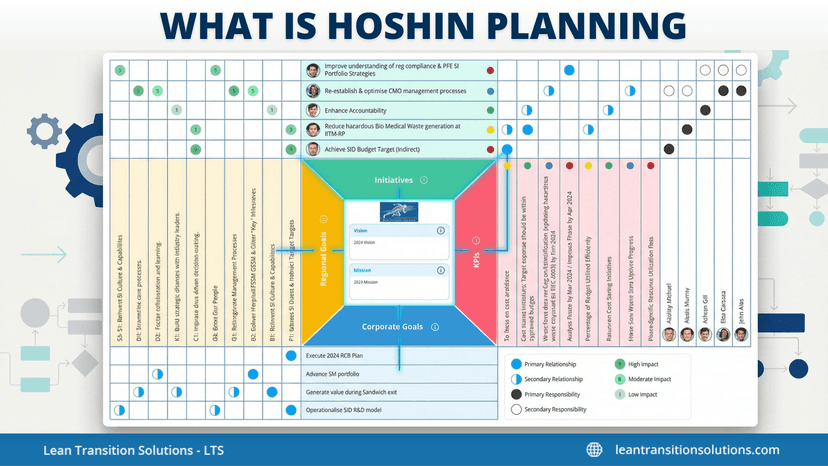
- Hoshin Kanri: Allows goal alignment from top-level strategy to daily actions. Visual Hoshin Kanri X Matrix, catch ball communication, and deployment maps help SMEs translate long-term vision into tactical plans.
- Vision-mission-goal template: Ready-to-use template digital templates for defining purpose, strategic anchors, and SMARTER goals.
- A3 strategy and A3 problem-solving: Digital A3 sheets structure thinking, from defining problems to planning countermeasures, allowing strategic and operational clarity.
- SWOT, PESTLE and VRIO: Interactive templates to analyse internal and external environments for smarter decision-making.
- Mind mapping tool: Assists teams visually brainstorm strategy ideas, break down goals, and explore improvement opportunities in a systematic intuitive flow.
- Fishbone diagram (Ishikawa): Root cause analysis tool for addressing strategic bottlenecks, quality issues, or capability gaps.
These templates verify SMEs can begin strategic planning without expensive consultants or complicated models.
2. Goal setting, KPI mapping, and OKR frameworks
LTS Data Point performance frameworks help SMEs convert strategy into computable targets:
- OKR builder and templates: An interactive process to design Objectives and Key Results that cascade from leadership to teams.
- KPI library for SMEs: Industry-ready KPI suggestions for operations, customer experience, finance, productivity, and innovation.
- Live KPI dashboards: Role-based dashboards that provide teams instant visibility into growth, bottlenecks, and resource utilisation.
- Balanced Scorecards and KPI templates: Guarantee targets remain measurable and consistently reviewed.
These tools make strategy quantifiable, trackable, and visible across teams.
3. Strategy execution framework
Strategy execution fails in the absence of proper visual tool. To help SMEs go beyond planning and move into action, LTS Data Point offers a proven execution rhythm:
- Gemba walk boards: Digital Gemba boards help leaders monitor operations, capture improvement opportunities, and bind findings to strategic goals.
- Risk register and mitigation planner: Spots risks, allocate owners, examine impact, and monitor mitigation process.
- Digital huddle boards: Team boards for daily or weekly alignment, KPI updates, blockers, and action assignments.
- Initiative tracker and milestone heatmaps: Visual management tools that show where execution is strong, where it’s delayed, and where support is needed.
This makes sure SMEs stay on target and avoid the common failure point – execution drift.
4. Capability development skills and skill matrix integration
A unique strength of LTS Data Point is the integration between strategy and people capability:
- Skill matrix integration: Link strategic initiatives to needed skills, showing whether the workforce is ready – or where training is required.
- Capability gap analysis tool: Charts current capacities vs the potential the future demands.
- Training and upskilling templates: Offers guided development plans based on potential gaps.
This assists SMEs create the workforce needed to execute future strategies, not just plan them.
5. Operational excellence and continuous improvement tools
SMEs often struggle to balance strategy with daily operations. LTS Data Point bridges this gap with:
- Daily management dashboards: Custom dashboards like SQDC or SQDCP assists firms monitor Safety, Quality, Delivery, Cost, People, and Productivity KPIs each day.
- Digital Gemba walk boards: Enable leaders to track live performance at the source, spot issues, capture improvement opportunities, and allot actions during the walk.
- Problem-solving and root cause analysis tools: Structured templates like 5 Why tools and fishbone tools for root cause analysis help resolve recurring issues that block strategic growth.
- Value stream mapping tool (VSM): visual mapping of process flows, waste identification, and optimisation planning.
- PDCA cycles and standard work templates: Strengthen structured improvement loops and operational stability.
By integrating Lean and strategy, SMEs accomplish quicker, more predictable performance improvements.
Future trends in SME corporate strategy with LTS Data Point
LTS Data Point is already aligned with the emerging future of corporate strategy for SMEs. Here's how we position businesses ahead of the curve:
1. Data-driven strategy: Strategy is shifting from annual planning to real-time adaptation with live insights.
LTS Data Point dashboards live KPI tracking, and heatmaps allow immediate course correction instead of waiting months.
2. Continuous strategy cycles: SMEs are moving from “strategy once a year” to “strategy every quarter.”
LTS Data Point 90-day execution framework supports this shift with systematic planning and review cycles.
3. Capability-based strategy: Future competitiveness depends on skills, not size.
Through its skill matrix and potential-mapping tools, LTS Data Point integrates people development directly to strategy.
4. Integrated operational and strategic views: SMEs require both daily operational clarity and long-term direction.
The SQDC/SQDCP templates and strategic KPIs sit on a unified platform – something traditional strategy tools don’t give.
5. AI-assisted decision support: The future of SME corporate strategy involves AI-driven insights and predictive analytics.
LTS Data Point structured data architecture already allows future AI layers for predicting, risk alerts, and goal optimisation.
6. Collaborative, cross-team strategy execution: Modern SME strategy needs transparent communication and shared accountability. Every company, despite its size, needs to follow the six pillars of strategy execution.
LTS Data Point role-based dashboards, initiative trackers, and team alignment tools design a seamless environment for collaboration.
If there’s one thing to take away, it’s this – strategy isn’t just for big corporations. SMEs need it even more to stay focused and make the most of what they’ve got. You don’t need fancy consultants or endless meetings; just a clear plan, a few smart priorities, and the discipline to keep checking in. This is where organisational strategy kit by LTS Data Point comes in handy. Start small, keep it simple, and build from there. The sooner you put a strategy in place, the sooner you’ll feel in control and ready for whatever comes next.
Your growth deserves expert support
FAQs
1. How is corporate strategy different for SMEs compared to large companies?
SMEs need simpler, cost-effective strategies that prioritise agility and resource efficiency, while large firms often use complex, multi-layered plans.
2. Can SMEs implement corporate strategy on a tight budget?
Yes. Focus on high-impact actions, use affordable digital tools, and involve your team early. Small, consistent steps can deliver big results.
3. How often should SMEs review their corporate strategy?
At least quarterly. Regular reviews help SMEs stay agile and adapt to market changes quickly without losing sight of long-term goals.
4. What tools can help SMEs with corporate strategy planning?
Templates like SWOT, OKRs, KPI dashboards, and digital planning tools make strategy easier to design, track, and adjust without heavy costs.
5. Is corporate strategy only for growing SMEs?
No. Even stable SMEs need a strategy to stay competitive, manage resources effectively, and prepare for future challenges.

Geandra Queiroz, Operations Management Consultant
Geandra is an Operations Management Consultant at Lean Transition Solutions, specialising in Lean philosophy, Lean Six Sigma, and strategic planning across manufacturing and healthcare. She is currently completing her PhD in Industrial Engineering at the Federal University of São Carlos, researching the integration of Operations Strategy, Lean, and Green Manufacturing.