Strategic KPIs for Quality Managers: Boosting Performance in Manufacturing
Last updated on : January 14, 2026
At a growing food manufacturing company, the quality manager was doing everything by the book – daily checks, audits, and reports. Yet, customer complaints kept rising and internal issues went unnoticed until they became serious. The problem wasn’t effort – it was focus. The KPIs being tracked didn’t reflect the real challenges. Without the right metrics, even the most committed quality teams can struggle to improve. In this blog, we’ll explore why KPIs matter to a quality manager, characteristics of effective KPI, various strategic KPIs for quality managers, tools and techniques to monitor KPI, and how often quality managers should keep track on quality KPIs.
Explore real-time KPI tracking tools with LTS Data Point
Why do KPIs matter for a quality manager?
Key Performance Indicators (KPIs) are numbers that show how well an organisation is meeting its goals – both long-term and day-to-day. For quality managers, these metrics are especially important, as they help track product standards, reduce errors, and improve processes.
KPIs play a key role in helping industries grow and succeed. They give quality managers the tools to make smart decisions based on facts, monitor progress towards targets, and make sure everyday tasks support the company’s bigger goals. By using KPIs, quality managers can avoid guesswork, spot problems early, and take timely action to improve how things run. This leads to better results, smoother operations, and more confidence in decision-making.
Characteristics of an effective KPI
So, what makes a KPI truly valuable from a quality manager’s perspective?
There’s a simple rule to keep in mind: while every KPI is a metric, not every metric is a KPI. KPIs are specific, measurable indicators chosen based on what matters most to your organisation’s quality goals. They aren’t universal. For instance, Right First Time (RFT) might be a valuable KPI for pharmaceutical or biopharmaceutical companies, but it may not be the best fit for a textile manufacturer or an electronics assembly unit. Similarly, customer complaint rate might be critical in a consumer goods company, while internal audit findings could be more relevant in a regulated industry.
Choosing KPIs just because they’re popular in other sectors can lead to poor focus and missed opportunities. As a quality manager, your KPIs should reflect your company’s unique processes, challenges, and improvement goals. Whether it’s tracking defect rates, supplier quality, or process capability, the right KPIs help you measure what truly matters to your role and your organisation.
Let’s take a closer look at what makes a KPI effective and how to choose the ones that will help you lead quality improvements with confidence.
Characteristics of an effective KPI includes:
- Measurable: Can be calculated numerically or monitored objectively.
- Actionable: Offers insights that urge data-driven decision-making or corrective action.
- Relevant: Directly connected to business goals and preferences.
- Time-bound: Tracked over a defined period to monitor progress effectively.
For more details on KPIs and how to track them, pay a visit to our latest blog: How to Measure KPIs: All you need to know
See why LTS Data Point is the best real-time KPI tracking software
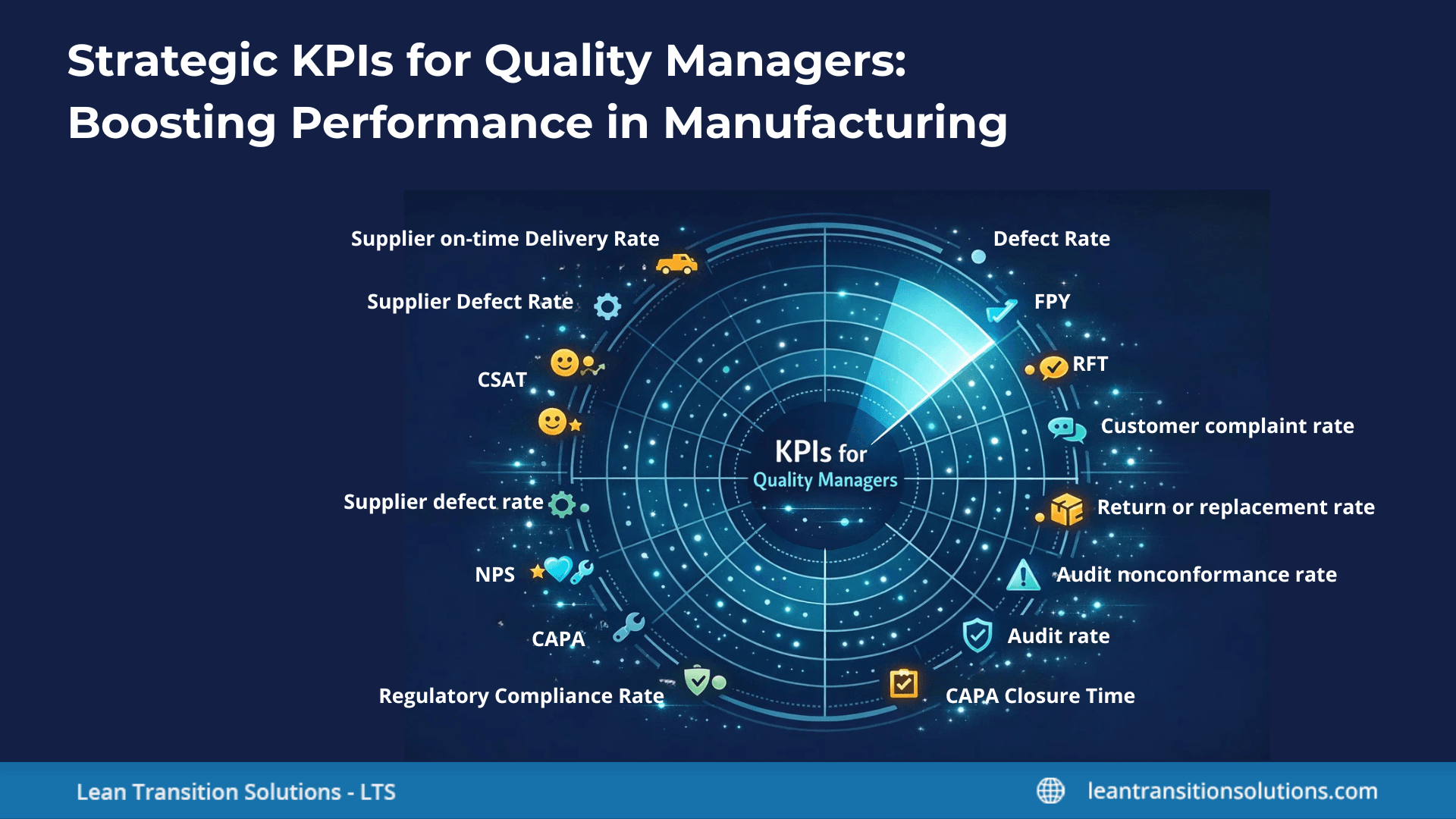
Strategic KPIs for quality managers: What makes your company a hero?
Focusing on the right quality KPIs helps you keep an eye on issues and spot them immediately before they escalate. This helps in the smooth running of your company and helps it stay above challenges that the industry keeps facing.
Let's look at some of the clever KPIs for quality managers.
Defect rate
Defect rate (DR) calculates the percentage of products or units that fail to fulfil the defined quality standards during inspection or testing.
- Why it matters: Shows incompetence, poor operational control, or problems with raw materials. Tracking it helps spot root causes, minimise waste, and enhance product consistency.
- How to measure: DR % = (Number of defective units / Total units produced) x 100
First pass yield
First pass yield (FPY) measures the proportion of products that satisfy quality standards without any rework or repair.
- Why it matters: Indicates operational efficiency and production quality. High FPY means fewer resources are wasted on rework and higher throughput is attained.
- How to measure: FPY % = (Number of units passing without rework / Total units produced) x 100
Customer complaint rate
Customer complaint rate measures the number of customer complaints received compared to the total units shipped or customers served.
- Why it matters: Directly reflects the customer satisfaction and perceived product quality. Monitoring this KPI helps identify repeating quality issues and improve customer trust.
- How to measure:
Customer complaint rate % = (Number of complaints / Total units shipped) x 100 (by units).
Customer complaint rate % = (Number of complaints / Total customers served) x 100 (by customers)
Audit nonconformance rate
This KPI tracks the number of nonconformances (NCRs) or findings detected during internal or external quality audits compared to total audits conducted.
- Why it matters: Measures the potential of quality systems and compliance with standards (e.g., ISO 9001, GMP). A rise shows systemic issues needing corrective actions.
- How to measure: Audit nonconformance rate % = (Number of nonconformances found / Total audit items or audit conducts) x 100
Corrective and preventive action closure time
Corrective and preventive action (CAPA) closure time measures the average time taken to resolve and close quality issues from identification to verification.
- Why it matters: It indicates how effectively the industry addresses root causes of quality problems. Shorter closure times mean faster risk reduction and stronger quality culture. Tracking this closure time effectively usually means running each CAPA as a formal KPI action plan, with an owner, a deadline, and a documented outcome, rather than an open-ended to-do.
- How to measure: Average CAPA closure time (days) = Total days to close all CAPAs / Number of CAPAs closed
Customer satisfaction score
Customer satisfaction score (CSAT) computes how satisfied customers are with a product, service, or interaction – typically collected through surveys asking users to rate their satisfaction on a scale (e.g., 1-5).
- Why it matters: Offers direct feedback on how customers see quality and performance. A low CSAT score suggests quality or service issues that may affect customer retention and brand reputation.
- How to measure: CSAT % = (Number of satisfied customers (4 or 5 rating) / Total survey responses) x 100
Net promoter score
The net promoter score (NPS) calculates customer loyalty and their likelihood to recommend your product or service to others, based on a 0-10 rating scale.
Promoters: 9-10, Passives: 7-8, Detractors: 0-6
- Why it matters: High NPS suggests strong customer relationships and future growth potential; low NPS alerts dissatisfaction or reputational risk.
- How to measure: NPS = Promoter % - Detractor%
Want to know more on how to track these quality KPIs with LTS Data Point?
Return or replacement rate
The return or replacement rate measures the percentage of sold products that customers return or request replacement for due to defects, malfunctions, or dissatisfaction.
- Why it matters: Highlights the efficiency of product quality and post-sales functions. A high rate points to design flaws, production issues, or unmet customer expectations – impacting costs and brand image.
- How to measure: Return/replacement rate % = (Number of products returned or replaced / Total units sold) x 100
Right first time
Right first time (RFT) calculates the percentage of operations completed correctly on the first attempt, without needing correction.
- Why it matters: Underlines the effectiveness of manufacturing and quality assurance processes. Higher RFT leads to reduced rework, lower costs, and faster cycle times.
- How to measure: RFT % = (Number of units passing without rework / Total units produced) x 100
Regulatory compliance rate
The regulatory compliance rate measures the percentage of operations, processes, or products that fully comply with industry regulations and legal quality requirements (e.g., ISO, FDA, GMP).
- Why it matters: Shows how well an organisation sticks to mandatory standards, minimising risk of penalties, recalls, or reputational damage. High compliance ensures trust, certification retention, and smooth audits.
- How to measure: Regulatory compliance rate % = (Compliant processes or operations / Total processes or operations audited) x 100
Audit pass rate
The audit pass rate calculates the percentage of internal or external audits that are successfully completed without major nonconformance or findings.
- Why it matters: Reflects the strength of the industry’s quality systems and readiness for certification or regulatory review. A high pass rate shows strong process control and adherence to standards.
- How to measure: Audit pass rate % = (Audits passed without major findings / Total audits conducted) x 100
Supplier defect rate
Supplier defect rate monitors the percentage of incoming materials or components from suppliers that fail to meet quality specifications.
- Why it matters: Assists in assessing supplier reliability and the impact on supplier quality on production performance. Tracking this KPI encourages accountability and promotes supplier improvement.
- How to measure: Supplier defect rate % = (Defective supplier parts / Total parts received) x 100
Supplier on-time delivery rate
Supplier on-time delivery rate computes the percentage of supplier deliveries that arrive on or before the agreed delivery rate.
- Why it matters: Ensures smooth production flow, prevents downtime, and supports lean inventory management.
- How to measure: Supplier on-time delivery rate % = (Deliveries received on time / Total deliveries) x 100
In the end, choosing the right KPIs isn’t just a technical task – it's a strategic responsibility. Choosing KPIs for quality managers means selecting metrics that truly reflect the organisation’s quality goals, adapting them as the business evolves, and ensuring they continue to drive meaningful improvements. By focusing on KPIs that matter, and regularly reviewing their relevance, quality managers can lead with clarity, respond to challenges with confidence, and contribute to long-term success.
Tools and techniques to track KPIs effectively
- Software integration: Use systems like MES (Manufacturing Execution Systems), ERP (Enterprise Resource Planning), and Balanced Scorecard platforms to centralise data, automate tracking, and align KPIs with operational and strategic goals.
- Dashboards and visualisation tools: Interactive dashboards simplify data interpretation through charts, colour-coded indicators, and trend analysis, allowing faster decision-making.
- Real-time data and alerts: Continuous monitoring with live updates and automated alerts assures quick responses to deviations, helping teams maintain performance and prevent issues before they escalate.
To see what mistakes to avoid while tracking KPIs, check out our blog: Mastering KPIs for Operations Managers: What to Track and What to Skip
Find the best tools for KPI tracking with LTS Data Point
How often does a quality manager track KPIs?
1. Daily tracking (Operational KPIs): Used for real-time visibility and quick corrective actions.
- Examples: Defect rate, first pass yield, rework and scrap rate, right first time, and supplier on time delivery rate.
- Why: These KPIs are sensitive to process changes and can help detect issues before they escalate.
2. Weekly tracking (Tactical KPIs): Used for short-term performance review and team-level enhancement.
- Examples: Audit nonconformance rate, CAPA closure progress, return/replacement rate, customer complaint rate, and training hours.
- Why: Weekly tracking supports quick trend analysis without data overload.
3. Monthly tracking (Strategic-operational KPIs): Used to examine broader process trends and departmental performance.
- Examples: Supplier defect rate, regulatory compliance rate, and audit pass rate.
- Why: These metrics require sufficient data volume for meaningful insights and typically align with monthly quality review meetings.
4. Quarterly tracking (Strategic KPIs): Used for management reporting, strategic analysis, and continuous improvement assessment.
- Examples: Customer satisfaction score and net promoter score.
- Why: These are long-term indicators that don’t fluctuate daily but reveal the impact of sustained quality initiatives.
5. Annual review (Performance and planning KPIs): Used for long-term trend analysis, goal setting, and management review.
- Examples: Overall quality system performance, long-term supplier performance, and employee competency.
- Why: Annual reviews ensure continuous improvement alignment with business objectives and quality strategy.
LTS Data Point: Efficiently and easily tracking KPIs for quality manager
LTS Data Point enables quality managers to track, analyse, and act on KPIs seamlessly through its integrated digital performance management platform. With real-time dashboards, automated data capture from MES/ERP systems, and colour-coded indicators, it simplifies monitoring across key quality areas such as defect rates, audit findings, CAPA closure times, and customer complaints.
The platform’s customisable Balanced Scorecards and SQCDP dashboards provide instant visibility into trends, deviations, and areas needing improvement. Automated alerts and action-tracking tools ensure timely responses to quality issues, helping teams move beyond reactive reporting to proactive quality management.
By replacing manual reports with interactive visual tools, LTS Data Point empowers quality managers to make faster, data-driven decisions, align quality initiatives with strategic goals, and build a culture of continuous improvement and operational excellence.
Make your business fly with LTS Data Point
FAQs
1. What are the most important KPIs for quality managers in manufacturing?
The most relevant KPIs include defect rate, first pass yield, customer complaint rate, audit nonconformance rate, CAPA closure time, and regulatory compliance rate. These help track product quality, operational efficiency, and customer satisfaction.
2. How often should quality managers review their KPIs?
KPIs should be reviewed regularly – daily for operational metrics like defect rate, weekly for tactical indicators such as CAPA progress, and monthly or quarterly for strategic KPIs like customer satisfaction and compliance rates.
3. Can KPIs vary between industries or departments?
Yes, KPIs should be customised to the specific needs of your organisation and industry. For example, RFT maybe critical in pharmaceuticals but less relevant in electronics. Always choose KPIs that reflect your company’s unique goals and challenges.
4. What makes a KPI effective for quality management?
An effective KPI is measurable, actionable, relevant to business goals, and time bound. It should offer clear insights that support decision-making and continuous improvement.
5. Why is it important to revise existing KPIs?
As your organisation evolves, some KPIs may become outdated or less important. Regularly reviewing and updating KPIs make sure they continue to reflect current objectives and drive meaningful improvements.
6. How can digital tools help in tracking quality KPIs?
Platforms like LTS Data Point provide real-time dashboards, automated data capture, and visual scorecards that simplify KPI tracking, minimise manual effort, and support faster, data-driven decisions.