Continuous Improvement Charter: Drive sustainable excellence
Transform your production processes with data-driven insights and a structured approach to ongoing improvement.
Supercharge Continuous Improvement: Accelerate operational excellence & cultivate sustainable growth
The Continuous Improvement Charter offers a structured framework to foster ongoing development and operational excellence. By harnessing data-driven insights, it empowers organisations to identify inefficiencies, optimise workflows, and embed a culture of continuous improvement for long-term growth.
- Standardise Improvements: Establish clear protocols for ongoing process enhancements.
- Data-Driven Insights: Leverage real-time data to identify and resolve inefficiencies.
- Sustainable Growth: Drive long-term success with continuous performance optimisation.
- Empowered Teams: Cultivate a culture that encourages proactive problem-solving.
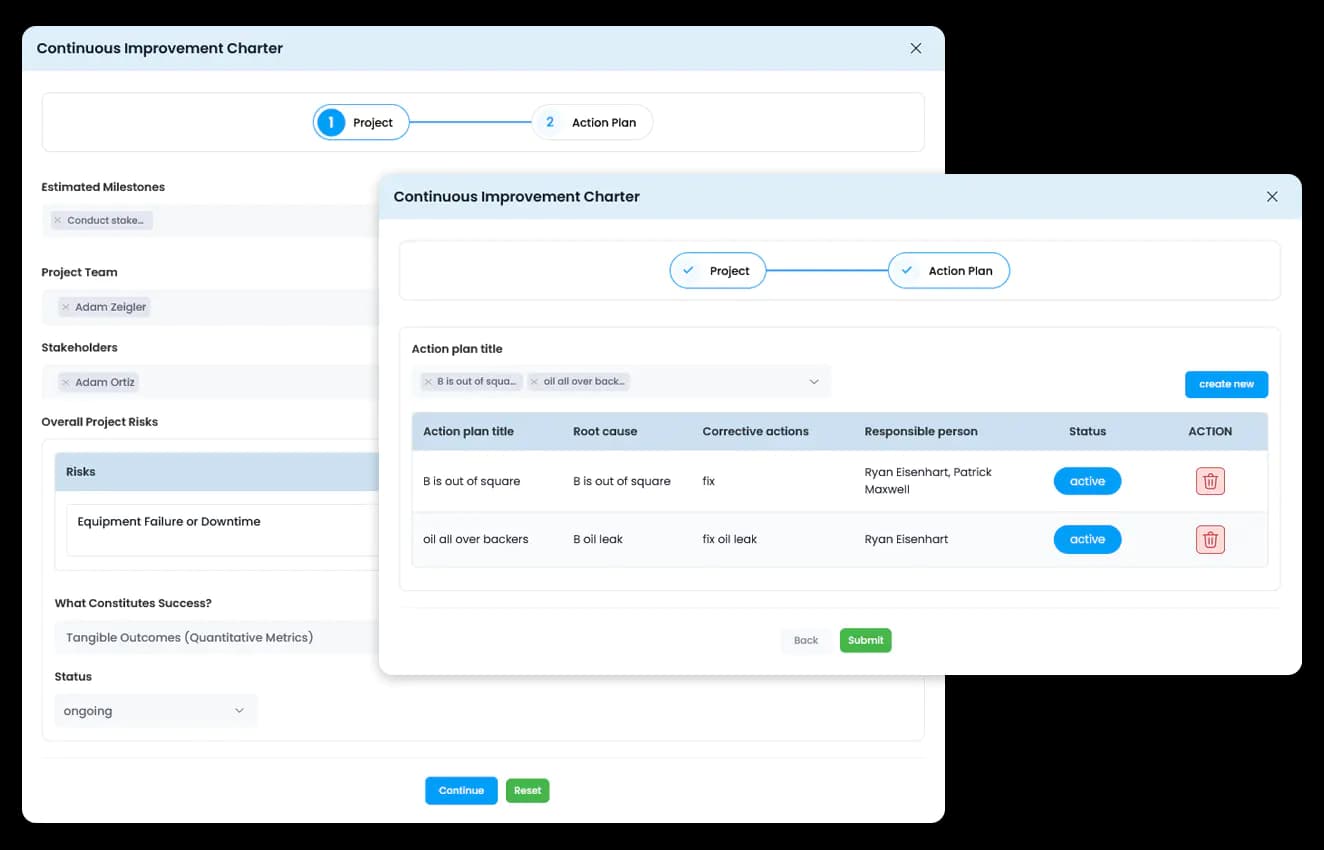
Discover how Data Point CI charter can transform your production processes.
Unlock the Keys to Continuous Excellence with Data Point

Performance dashboards
Visualise key metrics to track progress at a glance.

Insightful analytics
Generate actionable insights from real-time production data.

Customisable templates
Tailor improvement plans to your unique operational needs.

Seamless integration
Effortlessly connect with your existing production systems.

Automated reporting
Log outcomes and progress automatically for clear visibility.

Actionable recommendations
Receive clear, step-by-step guidance for process enhancements.
Continuous Improvement Charter Software: The Complete Guide to Managing, Tracking and Sustaining Improvement Initiatives
Learn how Continuous Improvement Charter software helps teams define, track, verify, and sustain improvement initiatives with structured workflows, performance dashboards, audit trails, and seamless integration with operational data.
How does a continuous improvement charter differ from a standard project brief?
A project brief defines scope and deliverables. A charter does more. It defines scope, but it also defines the audit trail that proves the improvement actually delivered what it promised. Most CI initiatives stall not because the idea was wrong, but because nobody can demonstrate afterward whether the projected savings or performance gains materialised.
A structured charter built into the platform connects the initial scope directly to an implementation tracker and a verification process. The charter is not a document that gets filed once approved. It stays live through execution, tracks against the original commitment, and feeds into an audit step that confirms whether the cost savings or efficiency gains claimed at the outset were actually realised. That closing step is what more spreadsheet-based CI programmes skip entirely.
How do performance dashboards within the charter keep an initiative accountable during execution?
A charter approved and then left alone until the next steering committee review is a commitment with no ongoing visibility. Months pass. Priorities shift. By the time anyone checks in, the initiative has either drifted from its original scope or quietly stalled.
Performance dashboards tied to the charter keep the initiative visible throughout execution, not just at sign-off and at completion. Tracking key metrics continuously means deviation from the projected improvement curve is visible early, while there is still time to intervene. For multi-shift operations running several improvement initiatives in parallel, this also means leadership can see which charters are progressing and which are stalling without requesting a status update from each project owner individually.
How does the audit process confirm whether a completed improvement actually delivered the projected savings?
The most common gap in continuous improvement reporting is the difference between projected impact and verified impact. A charter might project a cost saving of a specific amount. The initiative is marked complete. Whether that saving actually materialised is rarely checked with the same rigour that went into the original projection.
An audit process built into the charter workflow closes that gap. Once an initiative is marked complete, the actual performance data is checked against the original projection rather than taking the completion status at face value. This creates accountability that extends past the point where most CI programmes consider the work finished. It also builds a more honest picture over time of which types of initiatives reliably deliver against their projections and which consistently fall short, which is valuable input for prioritising future improvement activity.
How does seamless integration with existing production systems keep the charter grounded in actual performance data?
A charter that tracks progress based on manually updated status reports is only as current as the last time someone remembered to update it. The risk that the charter becomes a narrative document, reflecting what the project owner believes is happening rather than what the production data shows.
Integration with existing production systems means the performance dashboards within the charter are populated by the same data the rest of the operation runs on, not a separate manual input. If the initiative is targeting a specific KPI improvement, the dashboard reflects that KPI’s actual movement, sourced from the same system tracking it everywhere else. This removes the gap between what is reported and what is real, and it means the audit step at completion is comparing against data that was never manually adjusted along the way.
How does the charter workflow connect to A3 problem solving once an initiative moves into execution?
A charter defines what is being improved and why. A3 problem solving defines how the improvement actually gets investigated and resolved. Most organisations treat these as separate documents in separate systems, which means the link between the original business case and the working investigation has to be manually maintained.
When a charter feeds directly into the A3 stage, the initiative carries its context forward. The problem statement, the scope boundaries, and the projected impact defined at charter stage are still attached when the team moves into root cause analysis and corrective action planning. Nothing has to be re-explained or re-justified at the start of the A3. The investigation starts from where the charter left off, not from a blank template.
How does the implementation tracker structure the path from approved charter to verified outcome?
Approving an improvement initiative and completing it are separated by a long middle stage where most of the risk sits. Resources get reallocated elsewhere. The original owner moves to a different priority. The initiative is technically still open but practically dormant.
An implementation tracker structures that middle stage so it cannot quietly disappear. Each phase of the initiative has a defined status, and the tracker shows where the initiative actually is against where it was planned to be. Document uploads tied to the tracker mean evidence of progress, whether that is a test result, a process change record, or a sign-off, sits alongside the status update rather than being scattered across emails. The tracker is what turns a charter from an approved idea into a managed initiative with a visible path to completion.
How do customisable templates support consistency across different types of improvement initiatives?
A quality improvement initiative, a cost reduction project, and a safety improvement programme have different scopes, different stakeholders, and different success metrics. Forcing all three through an identical template either over-complicates the simple ones or under-specifies the complex ones.
Customisable templates allow the charter structure to flex for the type of initiative while maintaining the same underlying discipline: defined scope, tracked implementation, and audited outcome. This matters most in organisations running multiple categories of improvement work simultaneously. A standardised but adaptable charter format means every initiative, regardless of category, is held to the same standard of accountability without forcing irrelevant fields onto projects that do not need them.
How does the charter framework support multi-shift operations maintaining consistency across improvement initiatives?
Improvement initiatives in a multi-shift operation face a specific challenge: the team that scoped the charter may not be the team executing it on every shift. A change implemented on day shift needs to carry through to night shift with the same discipline, or the gains made in one shift get undone in another.
A charter framework built for multi-shift consistency keeps the initiative’s scope, tracker, and dashboard visible to every shift working on it, not just the team that initiated it. This matters particularly for initiatives that depend on a behavioural or process change being sustained around the clock. Without a shared reference point, a change that one shift quietly reverts to old habits on is the most common way a continuous improvement gain erodes within a few months of being declared complete.
Hear it from our customers

MARC ROBINSON
Director, Global Operational Excellence

“By providing a central location to input, analyse and share our KPIs, 'Data Point' enables site management to more easily focus on the entire business as a team. Its ability to allow automated data entry and trend analysis gives us more time for improvement rather than just reporting numbers. Combined with a disciplined approach within our SQDC meeting process, I believe 'Data Point' will help us continually focus on key issues and drive business excellence in all areas.”
Start your journey toward continuous operational excellence
Unlock the full potential of your production environment with Data Point’s Continuous Improvement Charter. This structured, data-driven framework helps you standardise improvements, drive sustainable growth, and empower teams for long-term success.
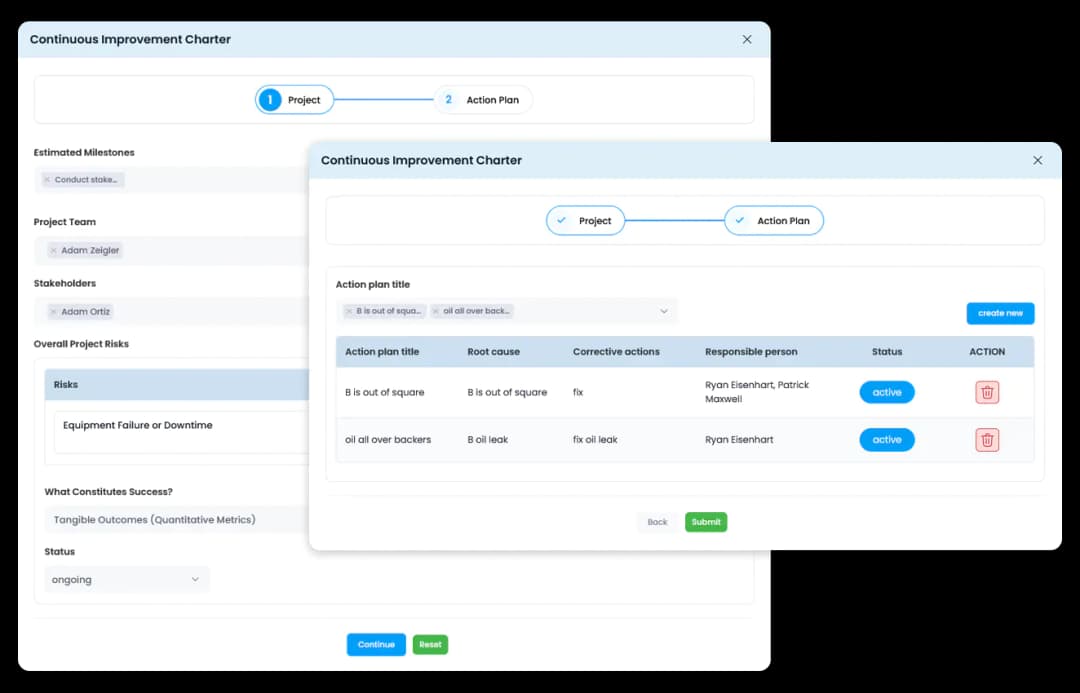
Get Started
Your Questions, Answered!
How does the Continuous Improvement Charter work?
- Track Performance: Continuously monitor key production metrics through integrated dashboards.
- Analyse Trends: Use data analytics to identify trends and pinpoint process inefficiencies.
- Implement Changes: Apply structured recommendations to drive immediate improvements.
- Review & Refine: Continuously review outcomes and adjust strategies for optimal performance.
What production environments benefit from this charter?
- Lean Manufacturing: Systematically eliminate waste and improve process flow.
- Multi-Shift Operations: Maintain consistency and efficiency across all shifts.
- Quality Management: Enhance product quality through continuous process refinement.
How does the system deliver actionable insights?
Why choose Data Point’s Continuous Improvement Charter?
- Holistic Process Optimisation: Address multiple facets of production for comprehensive improvement.
- Scalable Solutions: Adaptable for small-scale operations to large enterprises.
- Actionable Data: Empower your teams with clear, data-backed insights for decision-making.
- Future-Ready Framework: Build a culture of continuous improvement that evolves with your business.