Agentic AI for Operational Excellence: Why Manufacturing AI Needs to Act, Not Just Alert
Last updated on : July 14, 2026
In the era of AIs, only 2% of manufacturing sector has adopted agentic AI for operational excellence. The concept of agentic AI still remains clouded and the mistrust on a generic AI handling the daily operations is what prevents most manufacturing companies from adopting them.
What if the AI misreads the data and provides me with faulty conclusion? Can't risk it.
But agentic AIs go a little beyond than generic AIs. It does not simply surface an issue and wait for someone to act. It decides, and it acts.
See how LTS Data Point's escalation, ownership, and audit trail structure is already built for the leap to agentic AI
What "Agentic" actually means (and why most AI in manufacturing isn't it)
Most of what runs on a shopfloor today gets called AI, but very little of it is agentic AI in manufacturing. The difference is not a matter of sophistication. It is architectural. A chatbot is a single LLM call producing one response. An agent repeatedly reasons about a task, takes an action, observes the result, and decides what to do next, continuing until the task is complete or a stopping condition is met. That is the difference between something that talks and something that works.
Most manufacturing AI today sits somewhere on a short ladder. Dashboards show the data, nothing more. Alerts flag a deviation and wait for a person. AI assistants answer when asked, with no memory of what happened last time. Copilots suggest a next step, still waiting for a human to act on it. Agentic AI decides and acts too, but it keeps a human in the loop where it counts, surfacing the right recommendation and the right person for the job, with a human finalising before it closes.
Unlike generative AI, which produces an output in response to a single prompt, agentic systems pair large language models with external tools, memory, and orchestration layers to complete long-running, multi-step workflows end to end, with minimal human intervention at each step. That is what separates a system that reports from one that runs.
Most of what gets called AI in a plant today sits on the left of that ladder. Agentic AI sits close to the far right, deciding and acting, with a person still closing the loop.
Agentic AI vs Generative AI: Why the difference matters on the shopfloor
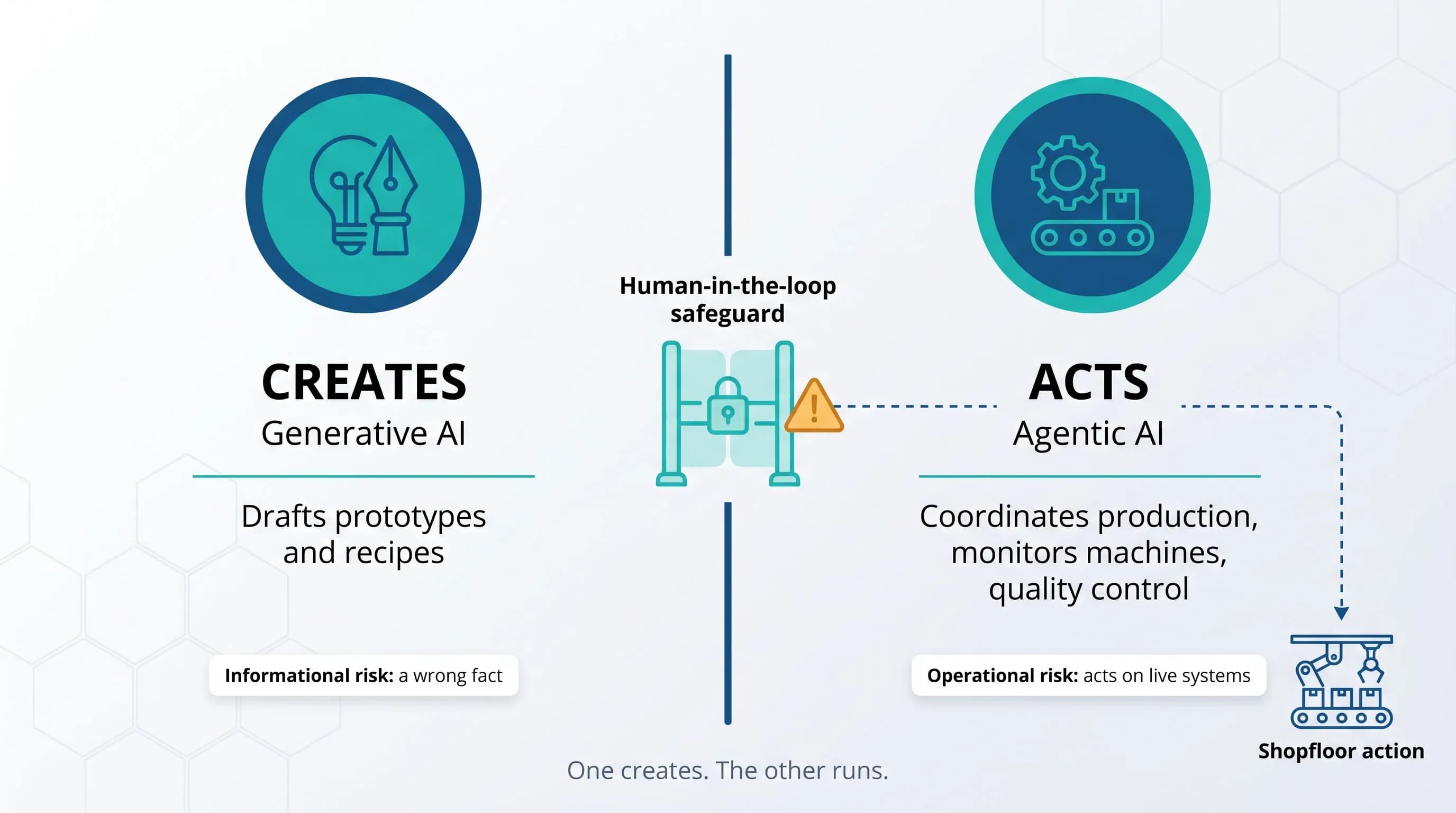
Agentic AI and generative AI both use large language models, but they are not interchangeable and mixing them up costs more on a shopfloor than anywhere else. In a manufacturing context, generative AI is suited to designing a new prototype or drafting a recipe. Agentic AI coordinates production, monitors machines, and ensures quality control. One creates. The other runs.
That difference is not just technical. Generative AI poses informational risk. It can hallucinate or get a fact wrong, and the cost is a bad paragraph. Agentic AI poses operational risk. It acts on live systems, which is why it needs human-in-the-loop thresholds, a record of what it did, and strict limits on what it is allowed to touch, built in from day one, not bolted on after something goes wrong.
Mistake the two for the same technology, and you either underuse a system built to act, or hand real operational authority to something built only to talk.
The pattern hiding in plain sight across your operations
Look closely at how most manufacturers actually run continuous improvement, decision-making, and tier escalation, and a pattern shows up. Each one is solving the same underlying problem from a different angle: what happens after a signal arrives. Each does it alone.
A quality issue gets a root-cause investigation.
A forecast miss gets a planning correction.
A missed KPI gets escalated up a tier.
Three teams, three tools, three versions of the same question: now that we know something is wrong, who acts on it.
That is not a technology failure. It is a design gap. Nobody built the layer that connects the three.
Agentic AI is that layer. Not a fourth initiative sitting alongside continuous improvement, decision-making, and escalation. The thing that finally ties them together, so a deviation gets noticed once and acted on once, instead of three teams discovering the same problem three separate ways.
How agentic AI extends the operational excellence disciplines you already run
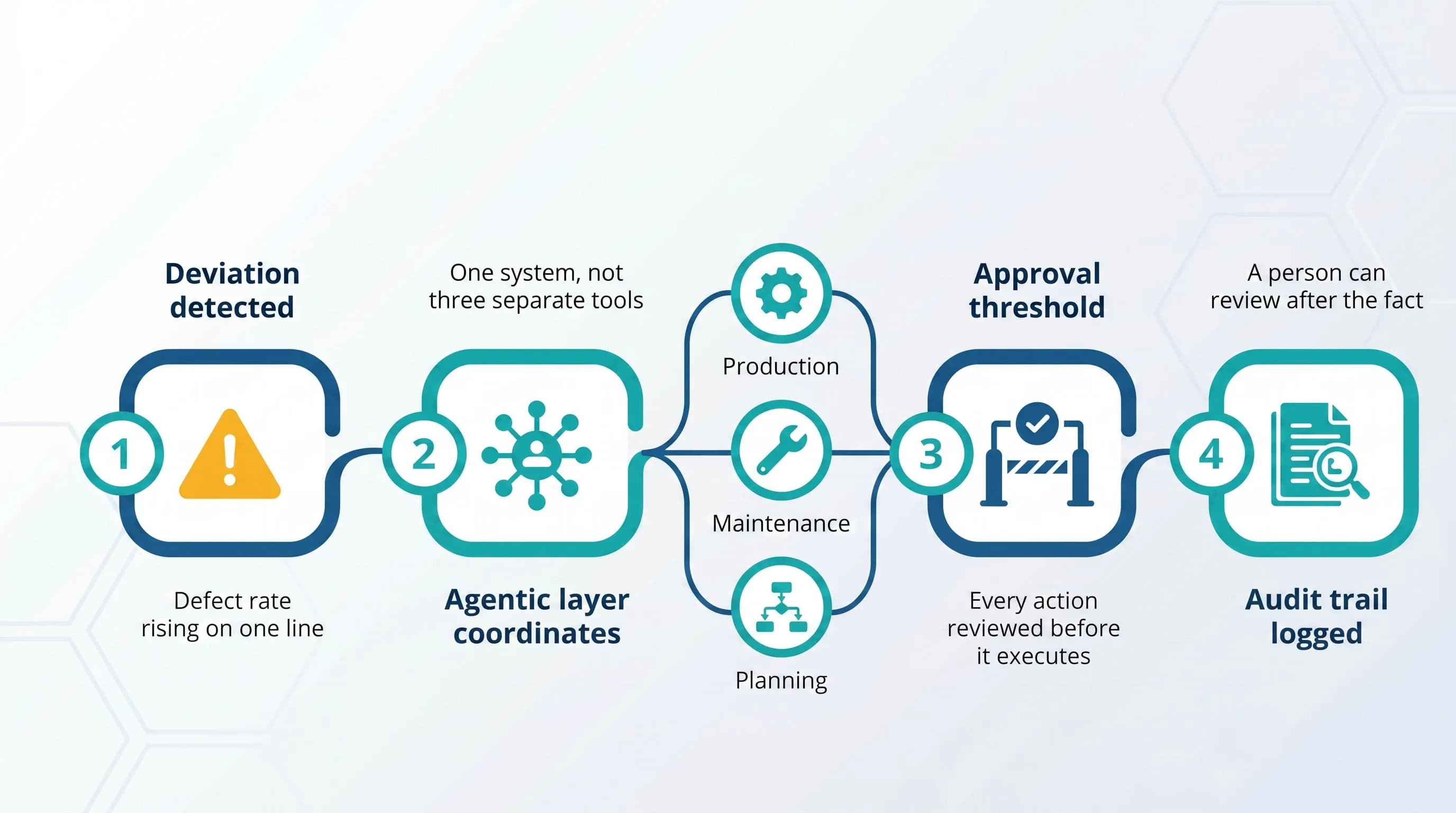
Continuous improvement, decision ownership, and tiered escalation are not separate disciplines that agentic AI replaces. They are the disciplines it runs inside of. A quality deviation still gets flagged. It still gets an owner, a deadline, an escalation path if it is not resolved in time.
What changes is that the system coordinating that response is no longer three people checking three separate tools. It is one layer that already knows who owns what, what has already been tried, and who else needs to be pulled in.
Picture a defect rate ticking up on one line. Today, that becomes a quality alert, a separate maintenance ticket if a machine is implicated, and a planning adjustment if output has to shift, each raised and chased by a different person in a different system. An agentic layer sitting across all three sees the same deviation once and coordinates the response across production, maintenance, and planning, instead of three people discovering the same problem three separate ways.
None of this means the AI decides alone. Every action it proposes still runs through an approval threshold before it executes, and every action it does take leaves an audit trail a person can review after the fact. Agentic does not mean unsupervised. It means the coordination finally has an owner, even when that owner is a system checking in with a person before it moves.
LTS Data Point: Built for the leap to agentic AI
Everything the previous sections describe as missing from most manufacturing AI is already structurally present in Data Point.
- Every KPI is already linked to an owner, a deadline, and a corrective action, not a raw number on screen.
- Every deviation already runs through 4C problem solving, Concern, Cause, Countermeasure, Confirmed, with full traceability from the moment it is raised to the moment it is closed.
- Every action already carries a complete audit trail, timestamped and attached to a named owner, renewable long after the fact.
- The system already supports MES-ERP integration and connects to CRM, and BI platforms too, so a deviation on one system does not sit isolated from the context that explains it.
None of that is generic dashboard territory; it’s what AI agents in manufacturing actually need to act. It is the exact structure agentic AI needs to act on: named ownership, a defined escalation path, and a system of record that already knows what happened last time. Most platforms would need to build that foundation before agentic AI could mean anything on top of it. Data Point already has it.
That is the difference between bolting AI onto a reporting tool and building on a system that was already designed to close loops, one action, one owner, one audit trail at a time.
Most manufacturing AI still stops at the alert. Agentic AI decides, acts, and keeps a person in the loop where it counts. Continuous improvement, decision-making, and escalation have each been solving pieces of this alone. Agentic AI is the layer that finally connects them. Data Point was already built for that leap, one owner, one audit trail at a time.
Most operations aren't as far from agentic AI as they assume. An LTS Data Point expert can tell you exactly how close.
FAQs
1. How do you measure whether agentic AI is actually improving operational excellence?
The right measure isn’t how many alerts the system generates, it’s how much faster a deviation moves from being flagged to being resolved, and how often the same root cause reappears. If mean time to resolution keeps falling and repeat deviations keep dropping, the agentic layer is doing its job. If alert volume rises but resolution speed doesn’t move, the AI is still stuck at the reporting stage, whatever it’s being marketed as.
2. What data does a manufacturer need before agentic AI is worth attempting?
Agentic AI acts on a decision loop, so it needs the same three things that loop needs, a KPI tied to a named owner, a defined escalation path if the deadline is missed, and a record of what was tried last time the same issue came up. Without those three, there is nothing for the AI to reason over except a raw number, which is closer to a dashboard problem than an agentic one.
3. Does introducing agentic AI change what shopfloor teams do day to day?
The daily rhythm, huddles, tier reviews, escalation, stays the same. What changes is who is chasing the paperwork behind it. A supervisor spends less time manually routing a deviation to the right person and more time actually addressing what the deviation was about, since the routing and initial coordination is handled before the meeting starts.
4. What's the most common reason agentic AI implementations stall in manufacturing?
It's rarely the AI itself. It's inconsistent data across sites or shifts, so the system is reasoning over a partial picture and either acts too cautiously to be useful or acts on incomplete information. Operational excellence disciplines that already enforce consistent KPI definitions and ownership tend to avoid this, since the AI inherits structure that already exists rather than having to impose it.
5. Is agentic AI a one-time implementation, or does it need ongoing adjustment?
It needs ongoing adjustment, the same way any escalation discipline does. Thresholds, ownership rules, and approval limits should be revisited as a plant’s operations mature, the same way a tier board or an action-tracking system gets refined over time rather than set once and left alone.
6. How does agentic AI handle a situation it hasn’t seen before?
It escalates to a person rather than guessing. The defined stopping condition in an agentic system exists precisely for this, when a situation falls outside what it’s been set up to act on, the safe default is raising it for human judgment, not taking an unfamiliar action autonomously.