4C Problem Solving in Lean Six Sigma: From Concern to Countermeasure Without the Chaos
The 4C Problem Solving Framework transforms operational challenges into validated countermeasures. Discover how Lean manufacturers use LTS Data Point to identify root causes, implement effective solutions, and improve KPI performance.
Contents
- Most Teams Are Solving Problems. They're Just Not Closing Them.
- What Is the 4C Problem Solving Framework? (And Why It's Not Just Another Lean Acronym)
- The 4 C’s Explained
- Countermeasure: The Difference Between a Fix and a Guess
- An Example for 4C in Action: A Short Manufacturing Scenario
- 3C vs 4C: Why the Missing Step Is Costing You Repeat Problems
- 4C vs PDCA vs A3 vs 8D: When to Use Which Framework
- Where 4C Lives in Your Daily Management Cadence
- What Happens When Each C Is Skipped: The Real Operational Cost
- How to Run a 4C Review That Actually Sticks
- How Data Point Turns 4C From a Paper Framework Into an Operational Intelligence Loop
Last updated on : September 30, 2026

The 4C problem solving framework is a structured lean methodology guiding manufacturing teams through four sequential steps: Concern, Cause, Countermeasure, and Check. Applied within Lean Six Sigma daily management, it provides a repeatable, disciplined process for identifying, resolving, and verifying operational problems at the point they occur: from shopfloor to leadership tier.
Most Teams Are Solving Problems. They're Just Not Closing Them.
Here is a situation most plant managers recognise. A quality defect surfaces in the morning huddle. Someone takes ownership. An action gets logged. Three weeks later, the same defect is back on the board.
The team was not lazy. They were not incompetent. They simply had no structured process to take a concern from identification to verified closure.
This is the core failure in manufacturing problem solving. Not the absence of effort. The absence of method.
Effective manufacturing process improvement does not begin with the right tools. It begins with a framework that every team member, from the line operator to the shift supervisor, can follow consistently. The 4C problem solving framework was built for exactly that.
What Is the 4C Problem Solving Framework? (And Why It's Not Just Another Lean Acronym)

The 4C framework has its roots in the Toyota Production System. Its premise is straightforward: before you fix anything, understand it. That sounds obvious. In practice, it is where most problem-solving collapses.
Unlike heavier lean tools built for specialists, 4C was designed for the shopfloor. Daily use. Frontline teams. No specialist training required.
C4 Card vs C4 Worksheet: Two Formats, One Discipline
Two practical formats exist in lean environments:
- The C4 Card
A physical or digital form that captures all four steps in a single structured document. Completed during or after daily SQCDP reviews. Quick, visible, and accessible to frontline teams without facilitation.
- The C4 Worksheet
Used for more complex problems, often completed as a team exercise. Closer in structure to the A3 approach. More detailed cause analysis, more formal countermeasure tracking.
Both formats share one non-negotiable rule: no countermeasure gets logged until a cause has been confirmed.
The Three Rules Every 4C Cycle Must Follow
Regardless of format, the same discipline applies across every 4C cycle:
- No concern is acted on until it is precisely defined with data
- No countermeasure is assigned until a root cause is identified
- No concern is closed until the Check step confirms the fix worked
Skip any one of these and the framework breaks. The problem either returns or gets buried.
The Lean Thinking Behind 4C: Genchi Genbutsu and Jidoka
4C reflects two foundational lean principles:
- Genchi genbutsu: Go and see the problem where it actually occurs, which is the guiding principle behind Gemba walk. The Concern step is not a second-hand report. It is a first-hand, data-backed description of a deviation observed at the point it happened.
- Jidoka at team level: Stop and fix rather than pushing a defective output downstream. Lean teams are expected to raise concerns at the point of occurrence and work through the 4C cycle before the issue compounds.
These are not abstract principles. They are the operating logic behind how 4C is meant to run on the shopfloor every single day.
Why 4C Works Best as a Habit, not a Procedure
The goal is not compliance with a form. It is a culture in which every deviation automatically triggers the cycle.
A team running 4C as a checklist will close some problems. A team running 4C as a habit will stop seeing the same problems reappear. That shift, from procedural to habitual, is what separates a lean tool from a lean culture.
4C scales because of the shared language it creates. When a team leader asks "what is the C?", whether it is the concern, the cause, the countermeasure, or the check, every person in the room understands the process. That shared language is what allows 4C to work from a single production cell all the way to a multi-plant operation.
The 4 C’s Explained
Concern: Define the Problem Before You Try to Fix It

The first step sounds obvious. It rarely is.
A concern is not "the line went down." That is an event. A concern is a precise description of what happened, where, when, how often, and what the measurable gap from standard actually is.
Teams that rush this step spend the next three steps solving the wrong problem. The concern statement sets the direction for everything that follows. Get it wrong and the countermeasure will miss too.
Cause: What's Actually Driving the Issue?

This is where most teams rush. Pressure to act is real. So teams jump from concern to countermeasure, skipping the uncomfortable work of understanding why the problem happened.
The Cause step requires discipline. It means using structured tools, including the 5 Whys root cause technique, Ishikawa fishbone diagrams, fault tree analysis, or Pareto charts, to find the actual root cause before anyone changes a process. Understanding root cause analysis vs gap analysis matters more than most teams realise.
If the countermeasure does not address the actual root cause, the problem returns. Every time.
Countermeasure: The Difference Between a Fix and a Guess

Note the word. Not "solution." Countermeasure.
In lean thinking, a countermeasure is an action taken against a specific identified cause. It may be temporary (a containment measure) or permanent, once the root cause is fully confirmed. Either way, it is directly tied to what the Cause step revealed.
This distinction matters. A "solution" can be anything. A countermeasure must be traceable to a specific cause. That traceability is what makes the Check step possible.
Check: The Step Every Team Skips (And Why That's the Real Problem)

This is where 4C earns its value. And where most teams fall down.
The Check step asks one question: did the countermeasure actually work? Not "we think it worked." Not "nothing has been flagged since." Actual data. Baseline versus post-fix comparison. A confirmed result.
Without Check, you do not have a closed problem. You have a paused one.
The future of lean problem solving is a connected operational intelligence platform that makes every C impossible to skip
An Example for 4C in Action: A Short Manufacturing Scenario

Here is what a complete 4C cycle looks like in a real production environment. The process is fast. The discipline is what makes it effective.
Scenario: Automotive Components Plant, Morning SQCDP Review
- Concern: Reject rate on Component K has risen from 0.4% to 2.1% overnight on Line 3. Target is below 0.5%. 47 components rejected in 8 hours. The issue is concentrated on the night shift.
- Cause: The team runs a 5 Whys. Surface finish is out of tolerance. Why? The cutting tool is leaving micro-burrs. Why? Tooling was changed during the night shift PM. Why? The replacement tool carries a slightly different coating specification. Root cause: incorrect tooling specification applied during planned maintenance.
- Countermeasure: Halt use of the new tooling immediately (containment). Raise a tooling specification review with the procurement team. Assign to the Engineering Lead, due by end of day. Success criterion: reject rate back below 0.5% within 24 hours.
- Check: Scheduled for the following morning's review. Reject rate at 0.3%. Countermeasure confirmed effective. Action closed. Total time for the full 4C cycle: 12 minutes in the morning meeting, 24 hours to verify.
The same cycle runs across every manufacturing sector. A rejected batch in pharma. A delivery miss in automotive. A safety near-miss on the shop floor. The names of the problems change. The 4C discipline stays the same.
What if your countermeasures were tracked, verified, and time-stamped automatically across every shift?
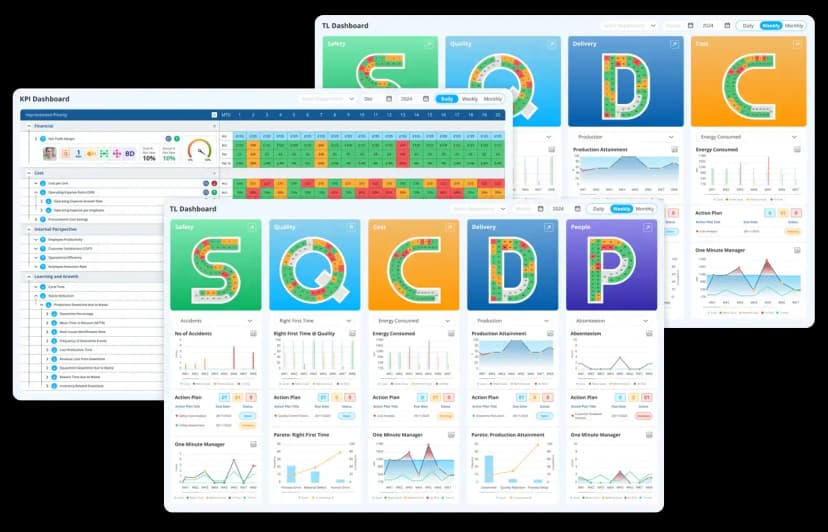
Data Point's SQCDP board surfaces concerns in real-time during daily reviews. Teams do not just log problems. They trigger a connected 4C cycle. The One Minute Manager board gives supervisors an instant status view of open actions across the shift. The Quad Chart maps concern trends across safety, quality, delivery, and cost, so patterns are visible before they become systemic.
The Check step stops being a manual follow-up. It becomes part of the daily rhythm.
3C vs 4C: Why the Missing Step Is Costing You Repeat Problems

Most lean teams are running 3C without realising it. Concern. Cause. Countermeasure. And then back to the board on Monday morning, where the same issue appears again.
The Check step is not optional. It is the mechanism that converts a temporary fix into a permanent improvement. Without it, continuous improvement metrics look healthy on a dashboard but tell a different story on the floor.
The difference between a team running 3C and a team running 4C is simple: one keeps seeing the same problems. The other does not.
4C vs PDCA vs A3 vs 8D: When to Use Which Framework
These frameworks are not competitors. They serve different purposes at different problem scales.
The Lean Six Sigma methodology encompasses all of these. But 4C is the daily-cadence tool: the one that runs every day, at every tier, before escalation to A3 or 8D becomes necessary.
Think of it this way: if the 4C process is working well, teams will need 8D far less often.
The process improvement techniques that drive sustained performance are not always the most complex ones. They are the ones that get used consistently.
Still seeing the same problems week after week? Let us show you how Data Point changes that.
Where 4C Lives in Your Daily Management Cadence
The 4C framework does not exist in isolation. It is most effective when embedded into the daily management system: specifically, the Tier meeting structure. That embedding often starts with a continuous improvement charter, which formally scopes the initiative and assigns ownership before 4C becomes the daily mechanism for running it.
In UK automotive plants including Jaguar Land Rover and Nissan Sunderland, and across US discrete manufacturers, the highest-performing facilities do not treat problem solving as an event. They treat it as a daily discipline. That discipline lives in the tiered meeting structure.
Tier 1: The Shopfloor Concern
Frontline operators raise the Concern. The team leader documents it on the SQCDP board. Duration: five minutes. Outcome: concern captured, owner assigned.
This is where the SQCDP board for daily performance carries its heaviest load. Without a structured visual tool, concerns get lost. Or they get fixed without passing through the full 4C cycle.
Tier 2: The Cause Conversation
The shift manager or area lead reviews open 4C actions from Tier 1. Causes are challenged. Are they root causes or symptoms? Is the countermeasure addressing the right driver?
This is also the point where patterns are identified. Three separate concerns, three separate shifts, same root cause. That is a systemic issue requiring a different level of response.
Tier 3: Countermeasure Ownership and Check Accountability
Plant leadership reviews escalated issues. Countermeasures are assigned owners with due dates and success criteria. The Check step is scheduled. Not assumed.
This is where Tier 1, Tier 2 and Tier 3 meetings become the accountability engine for the entire 4C cycle. Without this structure, the Check step evaporates. With it, closed problems stay closed.
The lean daily management tools that support this cadence do not need to be complicated. They need to be visible, consistent, and connected.
What Happens When Each C Is Skipped: The Real Operational Cost
Each missed step has a predictable consequence.
- Skip Concern (poor problem definition): Teams address the wrong issue. The real problem continues. Time and resource are spent on a countermeasure that was never relevant.
- Skip Cause: The countermeasure addresses the symptom. The root cause stays untouched. The problem recurs, often worse, because the team assumes it was already resolved.
- Skip Countermeasure (vague action, no owner): Nobody acts. Nothing changes. The concern stays on the board until it quietly disappears.
- Skip Check: The problem may or may not be resolved. Nobody knows. Next month, it is back. The cycle begins again.
This is not hypothetical. It is the daily reality in facilities that treat problem solving as an occasional activity rather than an embedded discipline.
How to Run a 4C Review That Actually Sticks

Here is a practical sequence for embedding 4C into daily operations:
Standardise the Concern statement.
Train every team leader to capture what happened, where, when, how often, and the gap from standard. One sentence. No ambiguity.
Mandate the Cause step before any action.
No countermeasure is logged until a root cause has been identified. Use the 5 Whys root cause technique as the default starting point. Escalate to fishbone or Pareto analysis where the cause is not immediately clear.
Assign countermeasures with owners and due dates.
Every action raised through KPI action plans should carry a named person, a deadline, and a success criterion. An action without an owner is a wish.
Schedule the Check.
Before implementation, agree on when and how the countermeasure will be verified. What data? What target? Agree it upfront, not afterwards.
Use manufacturing KPI dashboards to make the Check visible.
Post-fix data should sit alongside baseline figures, visible to the team rather than buried in a spreadsheet.
Close or escalate.
A 4C that has passed Check gets closed. One that has not gets escalated to A3 or 8D. Either outcome is progress.
In India's fast-growing pharma manufacturing sector and across German precision engineering facilities, this cadence is embedded in high-performing plants. In UK and US manufacturing, where shopfloor accountability structures vary, consistent application of this sequence is the difference between a lean programme that delivers and one that stalls.
How Data Point Turns 4C From a Paper Framework Into an Operational Intelligence Loop

Kineco, an aerospace manufacturer, deployed shopfloor performance tracking through Data Point. Before implementation, problem identification was largely informal: concerns raised verbally, causes assumed, countermeasures unverified. With Data Point, structured 4C cycles became embedded in daily SQCDP reviews. Repeat concerns reduced significantly. Countermeasure closure rates improved measurably. The Check step, previously absent from daily practice, became a standard part of every review meeting.
That result is not unique to aerospace. It is what happens when a structured framework is backed by a connected platform.
Here is what that looks like across each 4C step:
Concern: Data Point's SQCDP board captures concerns in real-time at Tier 1. The One Minute Manager board gives supervisors an instant view of open action status across the shift. The Quad Chart maps concern trends across safety, quality, delivery, and cost, so patterns that would take weeks to spot manually become visible within days.
Cause: Data Point AI Intelligence analyses recurring concerns across shifts and plants, identifying patterns before they escalate into systemic failures. Teams run structured cause analysis using the built-in Ishikawa fishbone diagram and Pareto Chart directly within the platform. This is an AI that understands the full lean and operational context of the business. Not a generic assistant. Countermeasure: KPI action plans are created at the point of cause confirmation, with an assigned owner, due date, and priority level. Corrective and preventive actions (CAPA) are logged and tracked formally where the concern warrants it: particularly relevant in pharma, aerospace, and regulated manufacturing environments where traceability is required. Check: KPI tracking software provides the before-and-after performance comparison automatically. The accountability board for shopfloor excellence keeps every open and closed action visible across the organisation. The SQDIP, SQDCM, and SQCDDP framework variants within Data Point carry this structure across different operational contexts: from safety-led environments to delivery-focused production floors. This is what operational intelligence means in practice. Not a dashboard that reports what happened. A connected platform that ensures something gets done about it. And that the doing is verified. Data Point connects every layer of the organisation: from a frontline team raising a concern at Tier 1 to a leadership team reviewing closure rates on a global dashboard. That is the complete 4C loop, running continuously, without paper and without gaps.

Amer Jumah, Senior Lean Consultant
Amer is co-founder of Agile Solutions and a certified Six Sigma Black Belt, Lean Black Belt, and PMP, with over nine years of experience implementing Lean, Six Sigma, and Agile principles across diverse industries. He specialises in process optimisation, waste elimination, and delivering cost savings through organisational change.