AI Demand Forecasting: What Lean Manufacturing Teams Lose Every Week the Number Is Wrong and How AI Fixes It at Source

Last updated on : June 18, 2026
The lean base – checked.
Proper lean knowledge transfer – checked.
AI reading every signal – checked.
AI giving customised suggestions based on industry and department – checked.
Accuracy of the signals read by AI – ???
What does this incomplete checklist mean?
The answer is brutal. Every lean decision downstream – how much to produce, how much to hold, how to schedule the line – is being made on a number that no one trusts.
Research shows that the gap between top performers and average performers on forecast accuracy is 23%. That gap has a cost.
AI demand forecasting helps you close that gap and complete the checklist.
See how LTS Data Point gives your lean team the operational foundation to act on demand signals before the waste runs
How an inaccurate demand forecast generates waste before production begins
Most lean improvement programmes begin from the floor. But in reality, that is the wrong point to begin with.
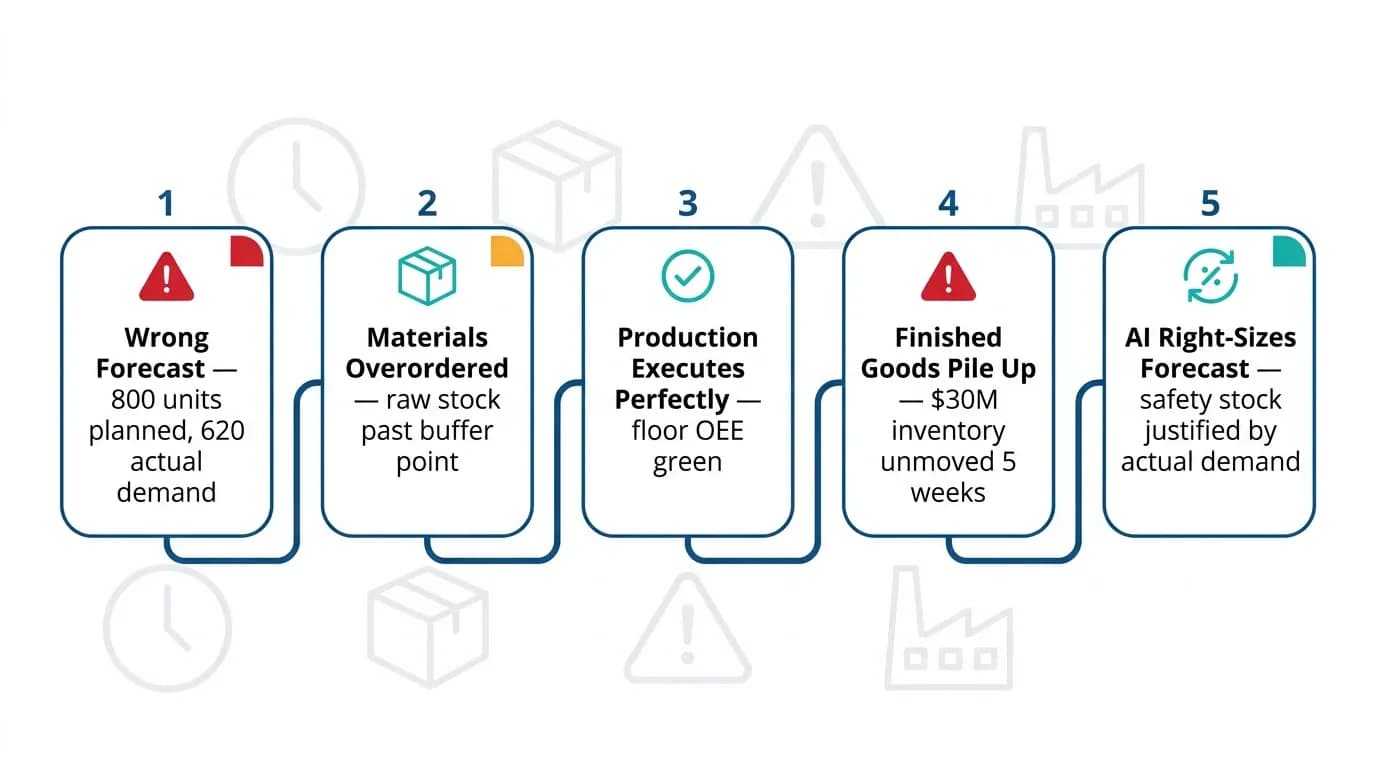
Overproduction of materials doesn’t begin when the line runs too fast. It starts with the wrong forecast, which says produce 800 units, but the actual demand was just 620. The floor executed perfectly, but the waste was already written into the plan before the production even began.
This is not a rare case scenario. Unfortunately, it is more common than rare.
The margin does not disappear between planning and production. It appears as:
- finished goods nobody is pulling
- raw materials sitting past their buffer point
- scheduling team replanning mid-week because the original numbers no longer match the shopfloor
Consider a lean manufacturing team that runs a $500 million supply chain. Floor waste is low. OEE tracker is showing improvement. The tier meetings are running on time. But the inventory holding report says a different story. A separate $30 million remains in the safety stock that hasn’t moved in over five weeks. The safety stock was built not because lean failed. It existed because the forecast was unreliable enough that the team needed insurance.
That is where AI inventory forecasting closes the gap, not by eliminating safety stock entirely, but by right-sizing it to what demand actually justifies. That insurance now remains in the warehouse, tying up working capital. The improvement programme, in the meanwhile, takes credit for waste it never actually eliminated.
In short, when the forecasting goes wrong, the lean system does not absorb that error. It produces it.
Why traditional forecasting keeps lean teams one step behind
Old methods of forecasting were not built for lean. They were built for stability.
The traditional models that most teams relied on such as the historical averages, fixed planning cycles, spreadsheet-based consensus were designed for supply chains where demand moved slowly and predictably. But that is not the case for most companies nowadays. Demand changes mid-week. Promotions spike consumption overnight. A single supply disruption rewrites the schedule. None of these are assumed in traditional forecasting.
Timing problem is the result. Lean operations need a demand signal they can act on today. Traditional forecasting gives them last month’s average, updated once a week if the team is disciplined. Top-performing planning teams have identified this. They update forecasts weekly, specifically because the speed of update is now as critical as accuracy.
What makes this worse is the data issue. Every department sits in separate systems. Most demand forecasting tools still rely on manually compiled inputs pulled from separate systems. Nearly a third of companies identified data silos as a primary barrier to reliable analytics. A forecast built on fragmented inputs is not a plan. It is an informed guess with a confidence issue.
Lean teams compensate the only way they can. They build buffer. They over plan. They leave margin in the schedule. Not because lean tells them to. But because the forecast does not give them enough confidence to do anything else.
What AI demand forecasting actually does differently inside a lean system
The difference is not just accuracy. It is what the system reads and how fast it updates.
What traditional forecasting does is that it reads just one input like historical sales and updates it on a fixed cycle. AI demand forecasting reads hundreds of signals simultaneously – point-of-sale data, supplier lead times, production telemetry, economic indicators, and weather.
The next immediate difference is the cycle speed change. Traditional forecasting gives lean teams a weekly number to plan from. On the other hand, AI updates continuously. When demand shifts on Tuesday morning, the forecast mirrors it by afternoon on the same day. The lean system is no longer planning from last week’s signal. It is planning from now.
The result? The outcome generated by the AI becomes a number they can trust and can act on without building insurance around it. AI-driven forecasting reduces forecast errors by 20-50%. That translates directly into fewer stockouts, lower warehousing costs, and a lean schedule that does not need a buffer margin written into it to survive contact with reality.
A reliable forecast is the input. AI decision making is what determines the output.
Carrying a buffer was never a lean decision. It was the result of running on a forecast they cannot fully trust.
Three lean decisions that improve when you can trust the forecast
When the forecast is faulty, lean teams make conservative decisions. When it is reliable, those same decisions tighten.
When AI demand planning enhances restocking accuracy, by predicting when to reorder and by how much, the safety stock shrinks. This was not because the team decided to play brave and become leaner out of the blue. It is simply because the numbers finally justified it.
Kanban sizing follows. When restocking triggers are aligned to actual consumption rather than worst-case assumptions, the excess margin built into every kanban level comes out. The team is no longer padding to survive a forecast they do not trust.
The most visible change is the production schedule. AI production planning is what keeps the schedule synchronised with actual demand rather than reacting to surprises mid-week. Manufacturers that make this shift achieve 1.5x faster turnaround times and reduce operational costs by up to 22%.
The decisions never changed. The confidence just grew.
And when confidence grows, the continuous improvement metrics that matter most finally start to move.
The forecast is where lean waste starts. AI demand forecasting fixes it at source. The floor improvements lean teams work for every week are only as strong as the number feeding them.
But when the number is right and the waste still appears, where does the investigation begin?
Not sure where inaccurate forecasting is hitting your operation hardest?
FAQs
1. What is the difference between AI demand forecasting and traditional demand planning?
Traditional demand planning uses historical averages and fixed cycles to produce a static number updated weekly or monthly. AI demand forecasting reads multiple variables simultaneously and updates continuously, giving lean teams a signal that reflects what demand is doing now, not what it did last month.
2. How does AI demand forecasting reduce overproduction in lean manufacturing?
Overproduction starts with a forecast that is too high. AI demand forecasting narrows the gap between forecast and actual demand, which means production schedules are built on a more reliable number and the excess that drives overproduction is reduced before the line runs.
3. Does AI demand forecasting work with existing ERP systems?
Yes. AI demand forecasting tools connect to existing ERP data including sales, inventory, and production records. The forecast improves because it draws from integrated real-time inputs rather than manually compiled historical data.
4. How quickly do lean decisions improve after AI demand forecasting is implemented?
Kanban sizing and buffer stock decisions typically tighten first, within weeks of implementation, because these are directly driven by forecast confidence. Production scheduling improvements follow as the system accumulates data and the forecast becomes more precise over time.
5. Is AI demand forecasting only relevant for large manufacturers?
No. Forecast inaccuracy creates waste regardless of operation size. Small and mid-sized manufacturers carrying excess buffer stock or replanning schedules mid-week face the same upstream problem. AI demand forecasting tools are increasingly accessible to operations outside enterprise scale.

Geandra Queiroz, Operations Management Consultant
Geandra is an Operations Management Consultant at Lean Transition Solutions, specialising in Lean philosophy, Lean Six Sigma, and strategic planning across manufacturing and healthcare. She is currently completing her PhD in Industrial Engineering at the Federal University of São Carlos, researching the integration of Operations Strategy, Lean, and Green Manufacturing.