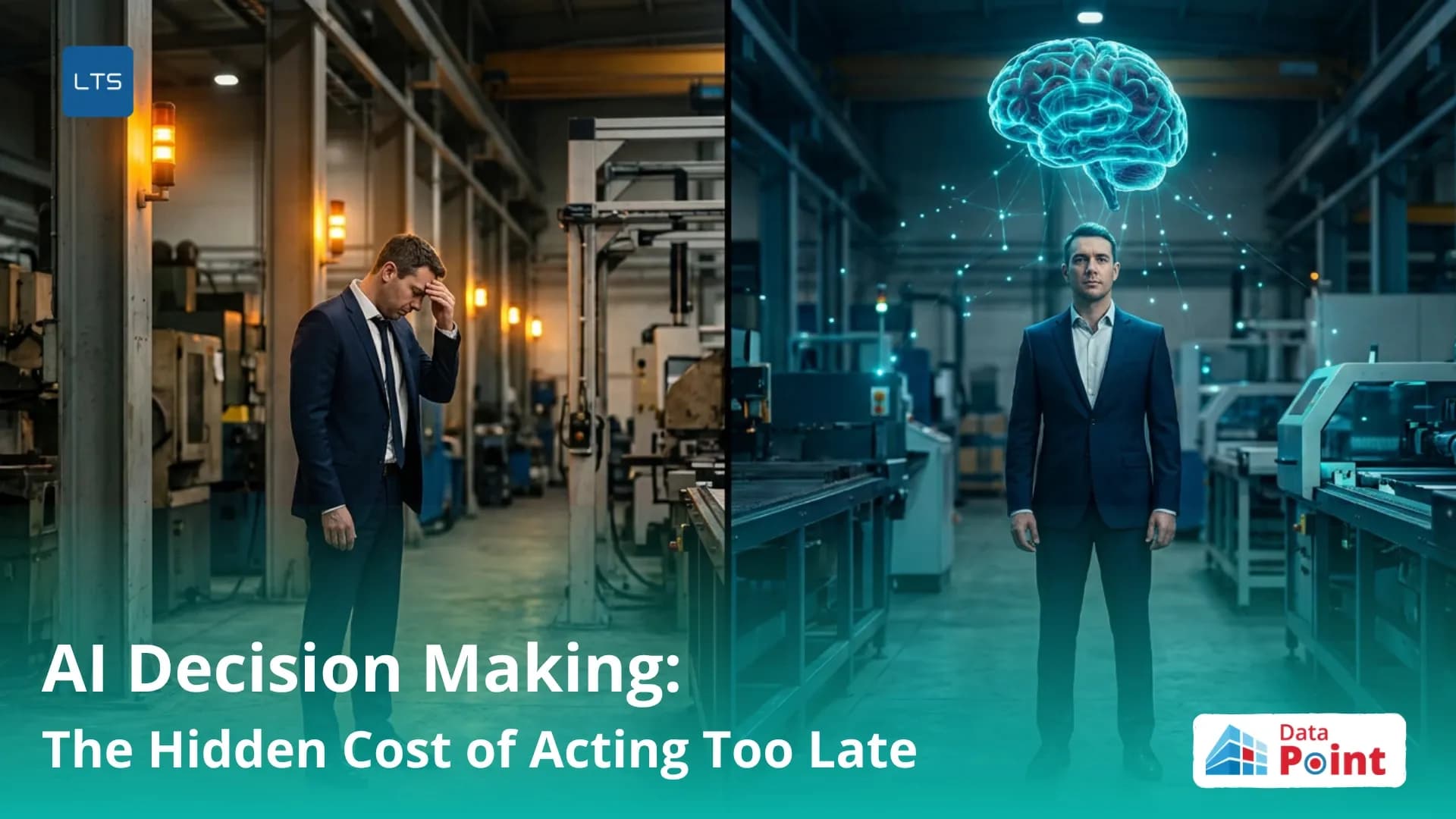
AI Decision Making: What It Still Costs When the Right Call Arrives Too Late
Last updated on : May 27, 2026
Implemented the AI, fed it the actual lean knowledge, promoted continuous improvement. All the boxes ticked. Still no progress. Lean AI is a scam.
Actually, no.
Having AI flag the problem is not the same as solving it. The gap between signalling and solving is where most of the cost lives.
The danger? Decision lag is rarely seen as a formal KPI that is monitored regularly. But the effects are very real. When response speed becomes unreliable, organisations begin compensating with more stock. Service begins to erode and what began as a manageable disruption becomes a missed customer commitment as the response window shrinks.
What lean teams need is not a pile of data that they cannot get to in time. What they need is faster decisions making.
Your AI is flagging the problems. LTS Data Point makes sure your team acts on them
Why AI-supported decisions still delay
Feeding the actual lean knowledge and training the AI is not the end. It's just the beginning. Creating a lean foundation will equip the AI and makes it a lean guide in the absence of a lean expert in the room.
But once the alert is triggered, who picks it up? Which tier owns it? How fast do they move? The chain of questions still remains unanswered. The organisations who answer them quickly and strategically spend less time compared to the ones who don’t.
78% of manufacturers have still automated less than half of their critical data transfers. Only 40% have automated exception handling. This is not a failure. This is being wise.
So, why should I spend too much in implementing a Lean AI that does nothing?
Actually, it does plenty more. Lean AI accelerates the information flow between tiers helping you reach your decision much quicker than you used to.
But this is where you know you asked the wrong question. The right question looks more like this:
Are we ready to act on what the AI tells us?
What slow decision making actually costs
AI decision making becomes faster when the information reaches you quicker along with proper lean guidance.
But why speed up the decision-making process? What do I have to lose?
Let's break this down into three – the processes most affected by delayed decision-making process:
- Quality: The defect signal fired. But the RCA did not start until the next shift clocked in. Meanwhile, the same defect kept running. Hours gone. Same problem. No owner. Engineers already spend the majority of their time collecting and cleaning data before analysis even begins. Add a tier handover delay on top of that and a problem that should have closed in one shift runs into three.
- Delivery: The miss did not come out of nowhere. The delivery KPIs flagged it early enough to act. The response window just closed before anyone moved. What gets recorded as a disruption was really a delay. A manageable situation escalates to a problem out of control.
- Escalation: The alert fired. Ownership was unclear. The problem moved up one tier, sat, moved to another. Each level waiting for the next to take it. When escalation thresholds are not defined clearly enough, the AI flags the issue and the problem still bounces. The system worked. The structure around it did not. The AI did its job, but the cost ran anyway.
Real-time decision making is not about the speed of the alert. It is about the speed of the response.
Decision delay does not show up where KPIs fail to capture it. It shows up in scrap, in late orders, and in problems that should have closed in one shift but ran into three.
Why the response breaks down and what actually closes the gap
The knowledge lives in the system. The methodology is also there. The alert is fired. And the team is still waiting for the next review meeting to decide what to do.
That is where the response breaks down. Not in the AI, but in the structure around it.
So, what actually needs to change?
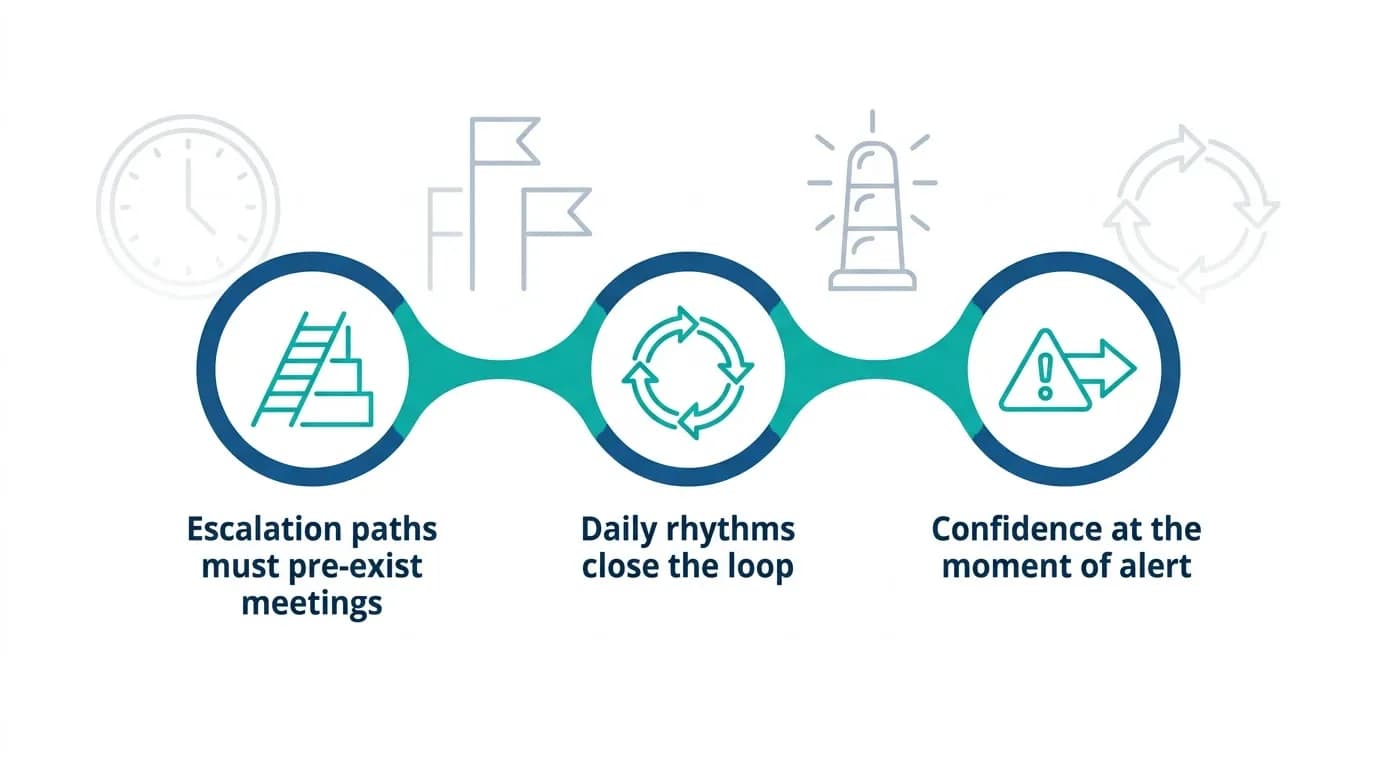
- Escalation paths need to be defined clearly enough to act without a meeting. When they are not, the alert becomes a notification. The tier receives it, reads it, and waits for someone above to move first.
- Lean daily management rhythms only hold when every tier acts on what the system surfaces, not just receives it. When those rhythms slip, the compounding loop stalls. The system stops improving. The floor keeps running.
- What changes when methodology is available at the moment the alert is triggered is not the speed of the signal. It is the confidence of the person receiving it. Root cause attached. Next step visible. Escalation path clear. That is what same-shift resolution requires.
A problem closed in one shift and one that runs into three rarely differ in the alert. They differ in what the team did in the thirty minutes after it was flagged. That is what operational decision speed actually looks like — not faster alerts, but faster structured action.
The decision gap is not a technology problem. AI is in place. The knowledge is embedded in the system. The reds are flagged immediately. But the cost is still rising. This is not because the technology failed. It was because the response structure around it was never built to match it. The cost of a slow decision is visible, but the cost of a decision not having to be made is not. And so, another question pops up:
What if you could eliminate the signal entirely because the system already acted before the problem appeared?
Still losing time between the signal and the fix?
FAQs
1. Does having AI in place guarantee faster decisions?
No. AI accelerates the information; it does not make the decision. Speed depends on how clearly the response structure is defined at each tier once the signal arrives.
2. Does decision lag affect all tiers equally?
No. Tier 1 feels it first. The problem runs while ownership is being established. By the time it reaches Tier 2, the recovery options have already narrowed.
3. What is the difference between an escalation delay and a decision delay?
An escalation delay is a problem sitting at the wrong tier. A decision delay is a problem sitting at the right tier with no one moving. Both cost money. Only one is a structure problem.
4. How do you measure decision latency in a lean operation?
Track the time between when an alert fires and when a corrective action is owned and assigned. That gap, not the alert itself, is where the cost lives.
5. Is decision lag only a problem on night shifts?
No. It is more visible on night shifts because the lean expert is not in the room. But the same gap exists on any shift where escalation paths are unclear, and methodology knowledge is not available at the point of decision.

Amer Jumah, Senior Lean Consultant
Amer is co-founder of Agile Solutions and a certified Six Sigma Black Belt, Lean Black Belt, and PMP, with over nine years of experience implementing Lean, Six Sigma, and Agile principles across diverse industries. He specialises in process optimisation, waste elimination, and delivering cost savings through organisational change.