Alert Overload in Manufacturing: Fixing Alarm Fatigue, Bad Thresholds, and Alerts Nobody Owns
Last updated on : September 30, 2026
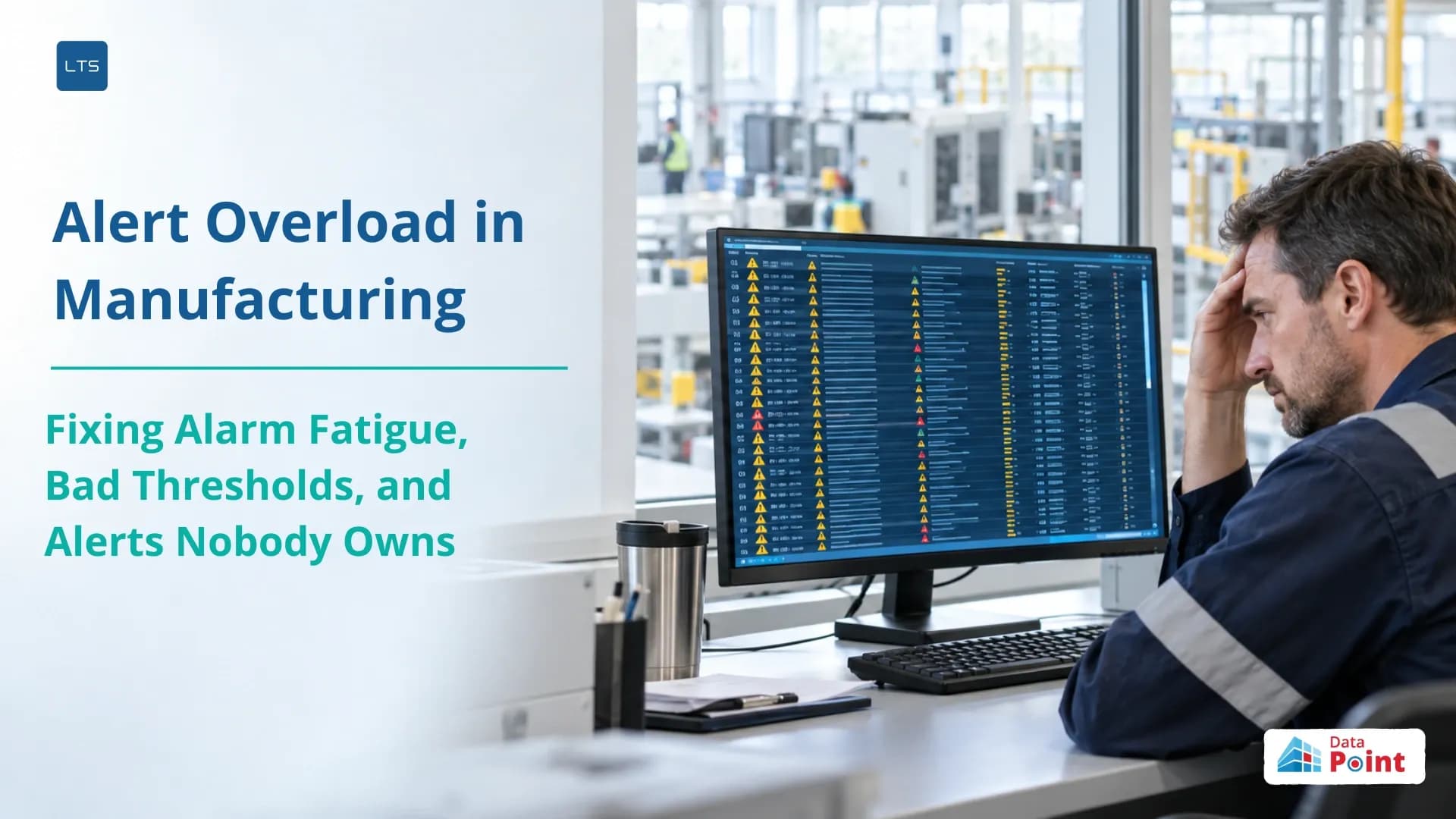
Alert overload in manufacturing starts when more live monitoring produces more notifications than teams can act on. Past a point, more alerts don't mean faster response. They mean tuned-out operators and missed critical conditions. More visibility had not made the problem clearer. It had buried it in noise.
The same pattern drives alarm fatigue in manufacturing. Repeated alerts, poorly set thresholds, and unclear ownership train teams to tune notifications out. The problem isn't too many alarms, but too many reaching the wrong people without a defined response. Preventing critical alerts from being missed requires tiered, role-based visibility, so the right person gets the right signal early enough to act.
See how LTS Data Point can organise KPI visibility by role, threshold and operating tier so critical signals reach the people responsible for acting
When monitoring outpaces response
A connected factory can detect more than any team could manage a decade ago. Machine conditions missed production targets, quality failures, downtime events, KPI breaches. Detection capacity has grown faster than response capacity. Alert overload doesn't start because someone deliberately creates too many alarms. It starts because every connected system is now capable of raising one.
Each alert still needs someone to:
- Notice it
- Understand what changed
- Judge how urgent it is
- Decide what action it needs
- Act before the condition worsens
Systems can raise ten alerts in the time it takes a person to read one. Operators and managers work through them in sequence while still running the operation. The gap widens fastest during disruption, when several connected measures react to the same underlying fault and fire together.
This isn't a subjective complaint. EEMUA 191 and ISA-18.2, the standards most alarm-heavy industries design against, define an alarm flood as more than ten alarms in ten minutes on a single operator position, tracked through flood duration, alarm count within the flood, and peak alarm rate. A plant can look manageable across an average shift and still overwhelm its operators in short, sharp bursts. Averages hide exactly the moments response capacity is under the most pressure. HSE guidance goes further. Alarm systems must account for human capability and limitation and must leave operators enough time to respond before conditions escalate.
The limit was never what the system could detect. It's what the person receiving the alert can understand and act on in time. Once notification volume crosses that line, more visibility becomes more noise.
How alarm fatigue trains teams to tune out
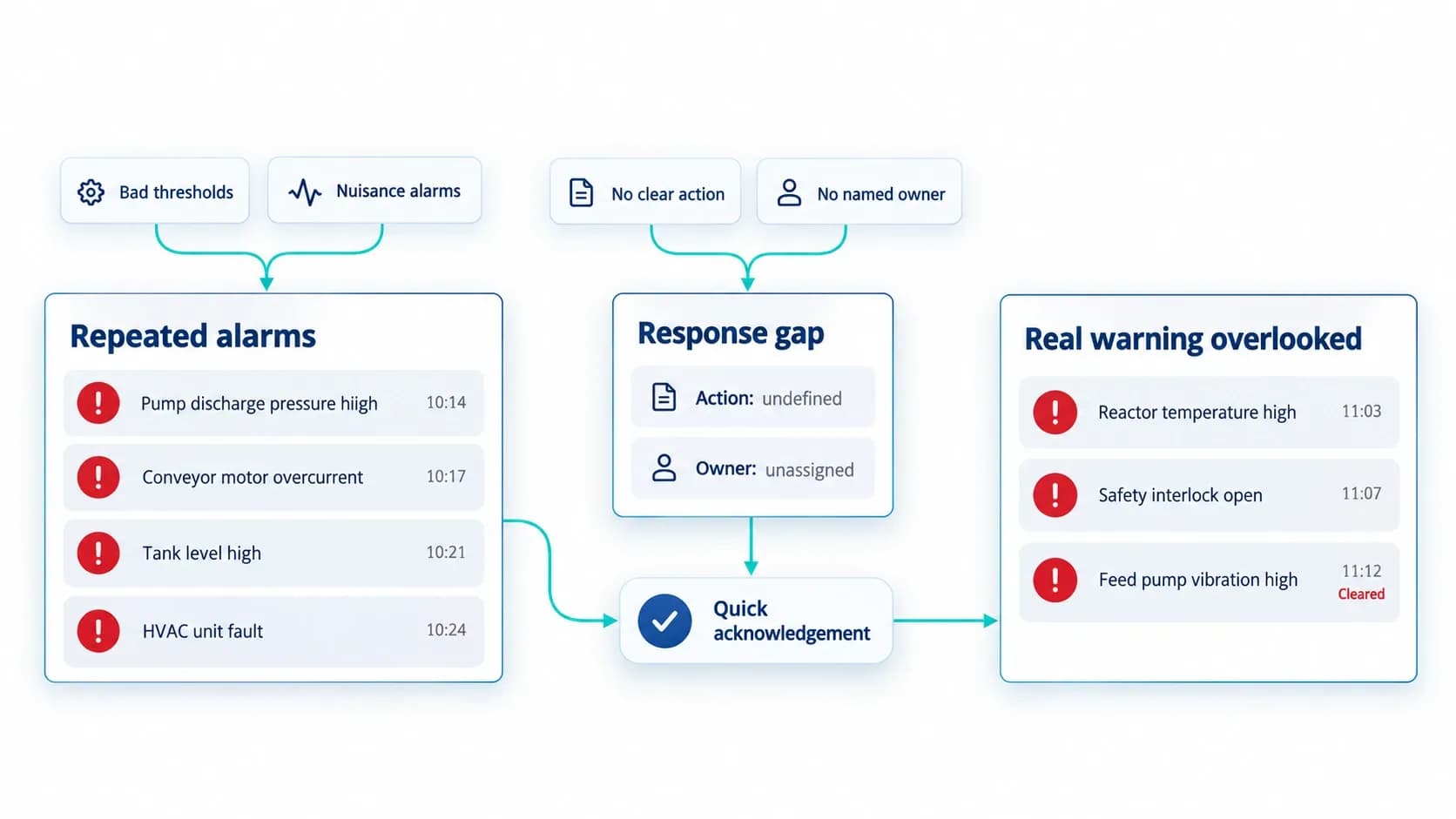
Alarm fatigue in manufacturing rarely starts with a decision to ignore a warning. It builds through repetition. When the same condition fires again and again without needing a real response, teams learn that an alert can look urgent without being useful.
Four things tend to be responsible:
- Poorly set alert thresholds, where normal process variation crosses a limit that was never tied to a real intervention point
- Nuisance alarms, where the same warning fires during expected conditions or maintenance that need no action
- Non-actionable alerts, where a notification reports a change but gives no clear next step
- Unclear alert ownership, where several people receive the same warning and nobody is responsible for closing it
Each unneeded alert weakens the one after it. A federal chemical safety investigation into a US manufacturing incident found that a history of false alarms had already trained operators to treat a particular alarm as a nuisance. When it fired again during an actual incident, it went unaddressed. Not because the system failed. Because the people using it had learned, correctly by their own experience, that it usually didn't mean anything.
That is alert desensitisation. Teams do not stop watching the system. They start making faster assumptions about what to dismiss. Acknowledging an alert becomes clearing a screen, not starting a response.
Poor KPI alert thresholds make this worse. If every small movement triggers the same warning, urgency stops meaning anything. And if that alert has no expected action and no named owner, the safest assumption becomes someone else will deal with it.
HSE guidance is blunt on this point. Every alarm should be relevant to the operator and carry a defined response. Without that, repeated alerts train teams in exactly the wrong habit. Not faster reaction. Faster dismissal.
What gets missed when every alert reaches everyone
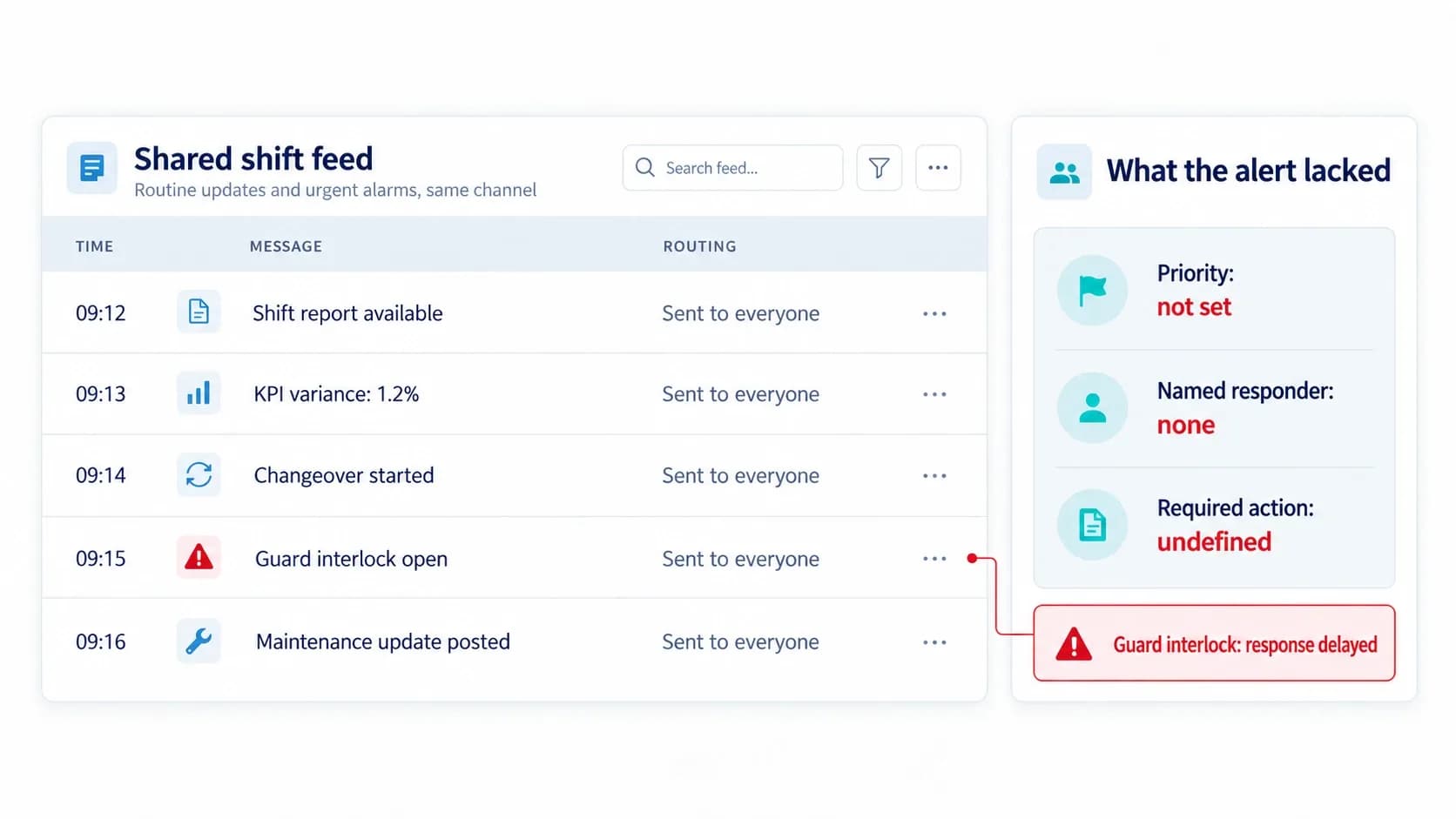
When every alert reaches everyone, visibility stops meaning clarity. A minor KPI movement, an expected status change, a condition needing immediate intervention. All land in the same field of attention, at the same time, through the same channel.
Every signal is technically visible. The signal-to-noise ratio in manufacturing KPIs has still collapsed. Not because information is missing. Because nothing has been marked as more urgent than anything else.
The system asks people to sort urgency after the alert arrives, not before it's sent. That's the design failure.
Routine information competes with critical manufacturing alerts for the same screen space and the same response window. Everything ends up looking equally first.
An alarm, properly defined, is an indication of an abnormal condition requiring a timely response. A status change that needs no action isn't that. It's information. When non-actionable alerts get treated as alarms anyway, they consume attention without producing a decision.
The scale of the problem shows up starkly in the record. A federal investigation into a fatal US refinery incident found more than 3,700 alarms had gone off in twelve hours before the event. The flood overwhelmed the operators on shift. It directly contributed to delays and errors in responding to the alarms that actually mattered.
Detection wasn't the failure there. Distinction was. Critical alerts getting missed in manufacturing rarely happens because the system failed to raise them. It happens because too many other things were raised at the same volume.
A bigger stream of alerts can carry less usable information than a smaller, deliberately prioritised one. Every routine notification a team must open and dismiss is time it isn't spending finding the one that affects safety, quality or delivery.
Alert prioritisation in manufacturing isn't about hiding information from people. It's about protecting what urgency is supposed to mean.
The most effective system isn't the one that sends the most alerts. It's the one that separates information from intervention and reserves immediate attention for actionable alerts. That means deciding who needs to see a given signal before it's ever sent, which is where tiered, role-based visibility comes in.
Fixing alert overload with tiered, role-based visibility
Reducing alert overload in manufacturing doesn't mean reducing visibility. It means structuring visibility around who can act on a signal, what decision they own, and when intervention is actually needed. LTS Data Point supports this through KPI management that connects each KPI with its operational level, target, threshold and accountable owner.
Four things make this work:
- Set meaningful KPI alert thresholds. Define the point where action is genuinely required, not every minor movement.
- Match visibility to the operating tier. Operators see line-or-machine-level detail. Site leaders see wider patterns. Senior leaders see enterprise-level exceptions.
- Use role-based alerts and dashboards. Scope measures and visibility to each person’s responsibility, so the same notification doesn’t reach everyone regardless of relevance.
- Attach ownership to the signal. Connect each deviation to a KPI action plan with an accountable owner, priority, due date and action record, so an alert starts a response instead of ending as a notification.
This builds tiered performance visibility without adding another monitoring layer. The underlying data stays connected. Each tier just sees the detail it needs to decide. A deviation gets handled close to the process. Persistent or higher-impact issues stay visible at the level that needs to see them.
The KPI, threshold, owner and action stay in the same operational context throughout. That's what strengthens manufacturing alert management. Teams aren't moving from a dashboard notification into disconnected emails or spreadsheets before responsibility becomes clear.
In a QC operations deployment, role-based dashboards and KPI-linked action ownership supported faster intervention and closed-loop resolution. Not more alerts. Clearer ones, reaching the right people.
The fix for alert overload was never fewer alerts or more monitoring. It's making sure every real-time performance alert has a relevant audience, a meaningful threshold and a clear owner. Get that right, and the right signal reaches the right decision level without everything reaching everyone.
Alert overload in manufacturing is not solved by switching off real-time monitoring. It is solved by making every notification earn attention. Meaningful thresholds, role-based visibility and clear ownership separate actionable signals from background noise. When the right alert reaches the right person early enough to act, greater visibility can support faster response without creating greater noise.
Talk through where alert volume, unclear ownership or poorly set thresholds may be weakening response across your operations
FAQs
1. What is the difference between an alarm flood and alert fatigue?
An alarm flood is a short period in which alerts arrive faster than operators can assess them. Alert fatigue is the longer-term reduction in attention and trust caused by repeated, irrelevant or excessive notifications.
2. How often should manufacturing alert thresholds be reviewed?
Review thresholds whenever processes, equipment, products or operating conditions change. They should also be checked periodically using alert frequency, response time, false-positive rates and recurring-alert data.
3. Which metrics can manufacturers use to measure alert-system performance?
Useful measures include alerts per shift, peak alert rate, recurring alarms, standing alarms, acknowledgement time, response time, percentage of non-actionable alerts and the number or alerts without an assigned owner.
4. Does acknowledging an alert mean it has been resolved?
No. Acknowledgement only confirms that someone has seen the alert. Resolution requires the condition to be assessed, the appropriate action completed and the result verified.
5. Should maintenance and production teams receive the same alerts?
Not automatically. Production teams may need immediate process deviations, while maintenance teams need equipment conditions requiring technical intervention. Shared alerts are appropriate only when both functions have a defined role in the response.
6. Can alert priorities change during start-up or shutdown?
Yes. Equipment start-up, shutdown, changeover and maintenance can create conditions that are abnormal during steady production but expected during a transition. Alert logic should account for the current operating state.
7. Who should own manufacturing alert governance?
Ownership usually spans operations, engineering, maintenance, quality and IT or OT teams. One accountable role should govern alert definitions, thresholds, priorities and review routines, while operational owners remain responsible for individual responses.
8. Can operator training solve alert overload?
Training helps teams interpret alerts and follow the correct response, but it cannot compensate for a poorly designed system. Excessive, duplicated or non-actionable alerts must be removed or reconfigured at source.

Amer Jumah, Senior Lean Consultant
Amer is co-founder of Agile Solutions and a certified Six Sigma Black Belt, Lean Black Belt, and PMP, with over nine years of experience implementing Lean, Six Sigma, and Agile principles across diverse industries. He specialises in process optimisation, waste elimination, and delivering cost savings through organisational change.