Transforming Your Organisation: 12 Strategy Frameworks That Work
Last updated on : March 6, 2026
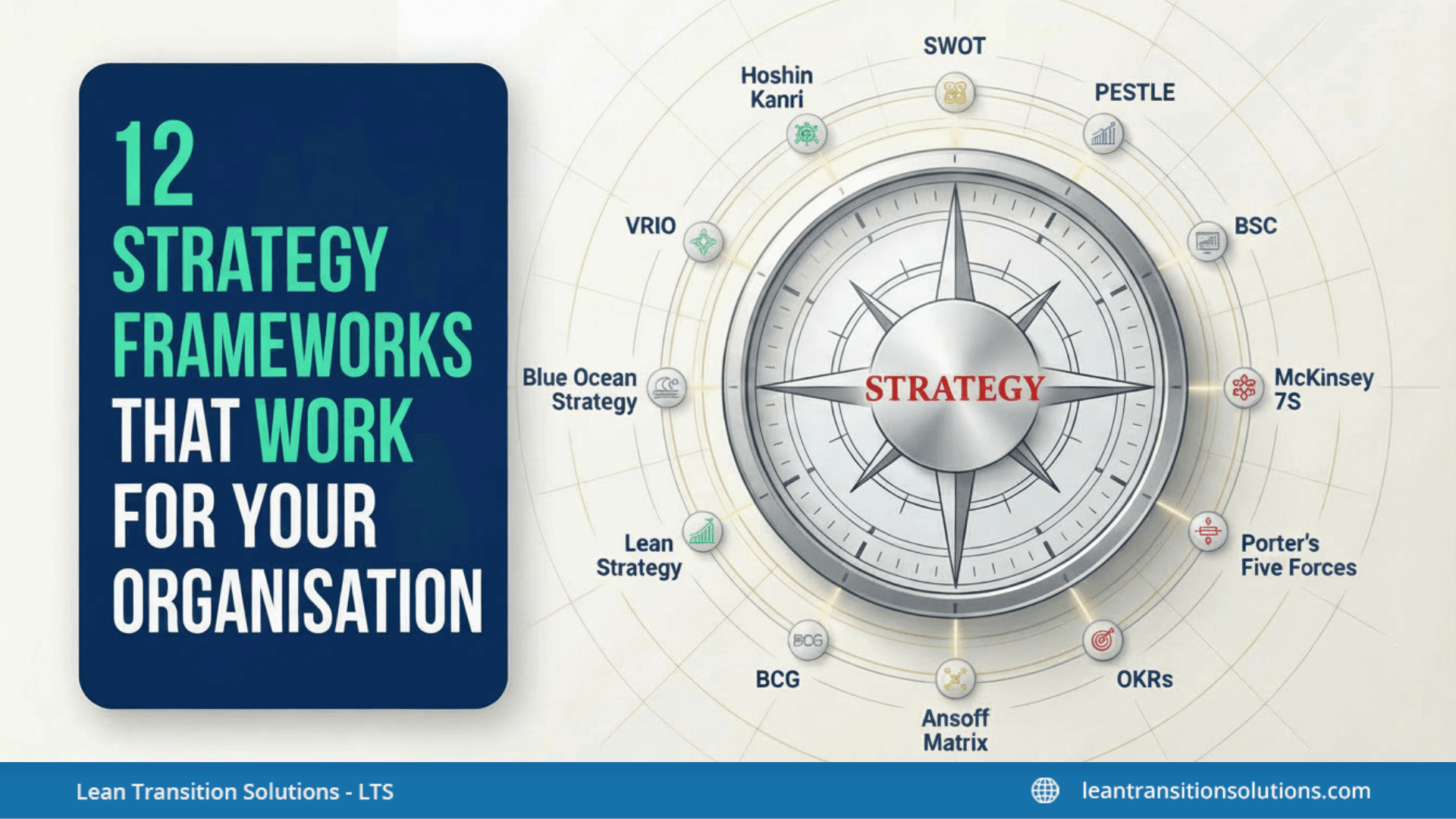
When it comes to driving success in your organisation, choosing the right strategy framework is key – but with so many options, it’s easy to feel overwhelmed. That’s why we’ve rounded up 12 proven frameworks to help you focus, align your teams, and make confident decisions. Whether you're running a start-up or a large enterprise, this guide explains what strategy frameworks are, why they matter, how to pick the right one for your goals, and why the Balanced Scorecard is often seen as the most effective.
Explore the best strategy framework for your company with LTS Data Point
What are strategy frameworks and why do they matter?
Strategy frameworks are more like models designed to pilot how an industry defines its direction, makes decisions, and calculates progress toward long-term goals. They offer a clear and structured approach for understanding internal capabilities, analysing external challenges, and harmonising every level of the organisation around a shared vision.
At their core, strategic frameworks assist in modifying business objectives into functional strategies. Whether it’s improving market competitiveness, driving innovation, or assuring operational excellence, these frameworks provide a blueprint for planning, execution, and continuous improvement.
But why do they matter?
Strategy frameworks matter because they bring about clarity, alignment, and accountability to organisational planning. In complex and fast-paced business environments, industries often struggle to stay focused or link daily activities with strategic goals. Frameworks such as the Balanced Scorecard, SWOT Analysis, or Porter’s Five Forces bridge this gap by connecting strategy to quantifiable outcomes.
By using a strategic framework, organisations can:
- Align teams around common objectives and priorities.
- Analyse performance objectively through defined metrics and KPIs.
- Detect risks and opportunities using data-driven insights.
- Ensure quickness by adapting strategies to market or regulatory changes.
- Drive long-term success through organised, continuous improvement.
In essence, strategic frameworks provide the foundation for disciplined strategic thinking and execution, verifying that every decision contributes meaningfully to the industry’s mission and performance goals.
12 strategy frameworks: All you need to know
It's true that awareness about your business and its challenges will help you choose the right strategy framework. But is that all? Not really. You should also be aware of various types of strategy frameworks and for what purpose they’re used for. This knowledge gives you a headstart when choosing the right one for your business.
Let's explore those strategy frameworks right away.
1. SWOT Analysis: It is a fundamental strategic tool that examines an industry’s internal Strengths and Weaknesses, along with external Opportunities and Threats, to guide data-driven decision-making and strategic planning.
- Use when: You need a quick, intuitive overview of internal strengths and weaknesses, and external opportunities and threats – ideal for start-ups or early-stage planning.
- Fails when: You need measurable, data-driven insights; it can be too subjective and lacks depth.
2. PESTLE Analysis: It evaluates Political, Economic, Social, Technological, Legal, and Environmental factors that design macro-environment impacting business performance.
- Use when: You're entering a new market or assessing external risks like regulations, politics, or economic shifts.
- Fails when: Internal factors are more critical; it doesn’t help with operational or team-level strategy.
3. Balanced Scorecard (BSC): It links organisational vision with quantifiable goals across Financial, Customer, Internal Process, and Learning and growth perspectives.
- Use when: You want to align strategy with measurable goals across departments – great for mature organisations.
- Fails when: KPIs are poorly defined or not tracked consistently; implementation can be complex.
4. McKinsey 7S Framework: It is a diagnostic tool that examines seven interconnected elements – Strategy, Structure, Systems, Shared values, Skills, Style, and Staff – to secure organisational clarity.
- Use when: You’re undergoing organisational change, restructuring, or cultural transformation.
- Fails when: You need quantitative metrics; it’s more diagnostic than performance focused.
5. Porter’s Five Forces: It analyses the competitive environment through five forces – industry rivalry, newcomers, substitutes, supplier power, buyer power – to establish industry attractiveness.
- Use when: You’re evaluating market competitiveness or planning strategic positioning.
- Fails when: The market is fast-changing or highly innovative; it doesn’t account for disruption.
6. OKRs (Objectives and Key Results): It is a goal setting framework that connects determined Objectives to computable Key Results, synchronising teams toward transparent, traceable outcomes.
- Use when: You want to set clear, measurable goals and track progress – ideal for agile teams and tech firms.
- Fails when: Goals are too ambitious or not reviewed regularly; qualitative outcomes may be overlooked.
7. Ansoff Matrix: It is a progress planning framework that defines four strategies – market penetration, market development, product development, diversification – to balance risk and reward.
- Use when: You’re planning growth through new markets or products and want to assess risk.
- Fails when: Competitive reactions or market dynamics are unpredictable; it’s a high-level tool.
8. BCG (Boston Consulting Group) Matrix: It classifies products as stars, cash cows, question marks, or dogs based on their market share and growth rate.
- Use when: You need to manage a product portfolio and decide where to invest or divest.
- Fails when: Market conditions change rapidly; it oversimplifies complex realities.
9. Lean Strategy: It is based on Lean principles and aims on maximising customer value while minimising waste and inefficiencies throughout operations.
- Use when: You aim to maximise value and reduce waste – ideal for operational efficiency.
- Fails when: The organisation lacks a Lean culture or commitment; it may feel rigid.
10. Blue Ocean Strategy: It motivates companies to create blue oceans (new, uncontested markets) instead of locking horns with saturated red oceans.
- Use when: You want to innovate and create new markets rather than compete in saturated ones.
- Fails when: The new market doesn’t materialise, or competitors quickly copy your idea.
11. VRIO Framework: Examines resources and capabilities based on Value, Rarity, Imitability, and Organisation to see if they can maintain competitive advantage.
- Use when: You’re assessing internal resources for sustainable competitive advantage.
- Fails when: Resources are intangible or hard to measure; it’s not ideal for external analysis.
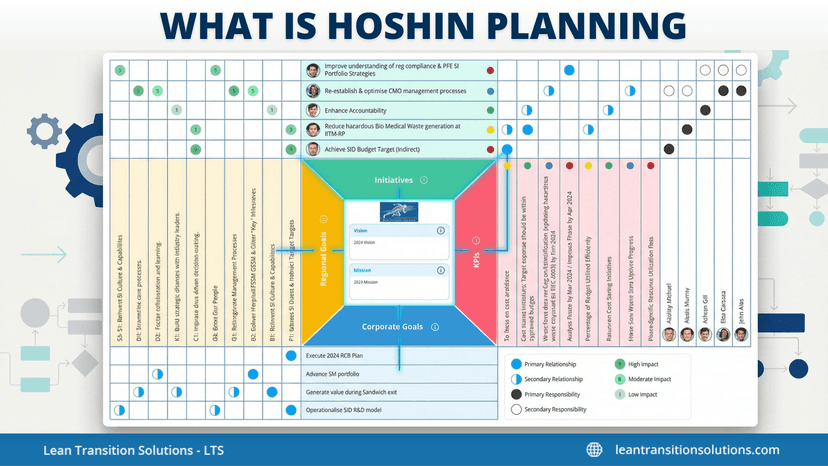
12. Hoshin Kanri: It is a Japanese management system that aligns strategic goals with daily operations using continuous improvement (Kaizen) and policy setup principles.
- Use when: You want to align strategic goals with daily operations – especially in continuous improvement cultures.
- Fails when: Communication is poor or leadership isn’t committed; implementation can be slow.
Different strategy frameworks fulfil different purposes. It is important to make sure which is apt to tackle your business challenges.
You got to know about 12 different kinds of strategy frameworks, now it’s time to know how to choose which is best for your needs.
How can you choose the right strategy framework for your business?
Hand-picking the right strategy framework depends on your industry’s goals, context, and current challenges. Different frameworks serve different purposes – some are framed for market analysis, others for goal alignments, performance management, or growth planning. The trick is to identify which framework fits better to the strategic journey of your business.
1. Start with your business objectives: Begin by describing what you want to achieve.
- For assessing your market position, use frameworks like Porter’s Five Forces or PESTEL.
- To set measurable goals and monitor progress, choose Balanced Scorecard or OKR frameworks.
- For growth and diversification, use Ansoff Matrix or BCG Matrix.
2. Consider your industry and competitive environment: Different organisations face different dynamics.
- Manufacturing and pharma sectors often utilise Balanced Scorecards (BSC) framework to bridge operational KPIs with strategic objectives.
- Tech or innovation-driven businesses may choose Blue Ocean Strategy or OKRs to encourage creativity and agility.
- Highly controlled industries benefit from frameworks that highlights compliance, risk management, and performance tracking.
3. Examine your organisation’s maturity: Your company’s growing stage affects the effectiveness of the framework greatly.
- Startups or SMEs may find SWOT analysis or OKRs much simple and more flexible.
- Established enterprises often need integrated models like the Balanced Scorecard or McKinsey 7S framework for aligning complex functions and teams.
4. Aim on your strategic challenges: Recognise the core problems you are trying to tackle.
- Facing stiff competition? Use Porter’s Five Forces to revise positioning.
- Struggling with alignment and execution? Establish a Balanced Scorecard or OKR model.
- Unsure where to invest? Apply the BCG Matrix or GE-McKinsey Matrix to prioritise opportunities.
5. Integrate frameworks when needed: Most industries combine frameworks for a more complete view as no single model can be perfect.
- Use SWOT for internal analysing, PESTEL for external scanning, and Balanced Scorecard for performance monitoring.
- Blend Ansoff Matrix with Blue Ocean Strategy to plan innovative market moves.
6. Verify quantifiability and integration: Select a framework that enables clear metrics, KPIs, and monitoring mechanisms. Combining with performance software can digitise strategy execution, offering live insights, dashboards, and accountability.
Having a clear knowledge on which stage your company is in, what its challenges are, how you want to tackle them – all these helps in choosing the right strategy framework.
Balanced Scorecard: Overall performer in a team of strategy frameworks
Several choices exist when it comes to choosing the ideal strategy framework for your company. This may overwhelm you and drain you in the process which might tempt you to give up. That's one reason why you need to always remember this – there is no ideal strategy framework that satisfies all the requirements of your business.
But there’s no harm in finding more about a strategy framework that comes very close to being ideal. Let's see why Balanced Scorecard (BSC) is seen as one of the best strategy frameworks by many industries.
1. Translates strategy into action: Instead of remaining stuck at the conceptual level like other strategy frameworks, the BSC transforms an organisation’s vision and strategy into specific, measurable goals and KPIs. This assures that every department and individual can see how their work directly contributes to strategic goals.
2. Ensures a balanced view of performance: The BSC goes beyond financial metrics by analysing performance across four perspectives (FCIL):
- Financial – How the company looks in the shareholder’s eyes.
- Customer – How customers recognise value and satisfaction.
- Internal processes – How efficiently functions and discoveries are managed.
- Learning and growth – How well people, systems, and culture help in future success.
This balance hinders industries from focusing too narrowly on short-term profits or a single angle of success.
3. Drives alignment across organisations: The BSC connects corporate strategy to departmental objectives, KPIs, and individual performance. This alignment makes sure that everyone – from top managers to front-line teams – works toward the same strategic goals.
4. Encourages continuous improvement and feedback: As the BSC includes regular performance reviews, it aids informed decision-making and continuous improvement. Leaders can spot gaps easily, monitor progress, and revise strategies over time.
5. Integrates well with other frameworks: It can complement other models – SWOT, PESTLE, or OKRs – by offering the calculating system to track their outcomes. It serves as the heart that holds together different strategic insights into a compatible performance management system.
These features make Balanced Scorecard the most effective framework. It bridges the gap between strategy formulation and execution, providing a balanced, quantifiable, and actionable approach to attaining long-term operational success.
Find why LTS Data Point Balanced Scorecard is the best choice for your company
LTS Data Point: Your clever choice for a Balanced Scorecard
LTS Data Point Balanced Scorecard has its own features that makes it popular in the field of SaaS companies. This is because it transforms the traditional scorecard into a digital, data-driven system that supports continuous improvement.
Let's see some of those features that make LTS Data Point stand out.
- Real-time KPI tracking and visibility: Offers live dashboards that monitor key performance metrics across financial, functional, quality, and compliance areas. This live visibility enables leaders to identify performance trends immediately, allowing faster informed decision-making and proactive issue resolution – something static spreadsheets or manual scorecards fail to provide.
- Seamless integration with existing systems: The platform integrates smoothly with MES, ERP, LIMS, and QMS systems, verifying that data flows automatically from major business applications. This puts an end to manual data entry, minimises errors, and creates a single source of truth for performance management.
- Designed for operational excellence across industries: The Balanced Scorecard is built to support organisations in tracking key performance indicators (KPIs), ensuring strategic goals are aligned with day-to-day operations. It helps maintain compliance, monitor progress, and stay audit-ready – whether you're in manufacturing, healthcare, finance, or tech. By offering structured performance insights, it empowers teams to stay focused, accountable, and continuously improve in line with industry standards and strategic objectives.
- Customisable dashboards for strategic focus: Enables industries to edit scorecards by department, site, or function. Supervisors can concentrate on what matters most – whether it is RFT rate, equipment utilisation, expense – linking each KPI directly to strategic goals.
- Supports continuous improvement and Lean thinking: Since LTS Data Point is built with Lean and Six Sigma principles, it motivates a data-driven culture of continuous improvement. The scorecard does not simply monitor but also helps spot root causes, prioritise improvement projects, and observe results over time.
- Allows enterprise-wide alignment: It verifies that every team works toward the same goals by linking strategy, KPIs, and operational execution. It harmonises strategy with daily performance, reinforcing accountability and transparency across the industry.
Choosing the right strategy framework doesn’t have to be complicated. Whether you're just starting out or managing a large organisation, having the right tools in place can make all the difference. From SWOT to Balanced Scorecard, each framework offers something unique – so it’s all about finding what fits your goals and challenges best. And if you're looking for a smarter, more connected way to manage strategy, the LTS Data Point Balanced Scorecard might just be the game-changer you need.
FAQs
1. What is a strategy framework?
A strategic framework is a structured model that helps organisations define goals, make decisions, and measure progress effectively.
2. Why should you use a strategy framework for your business?
It brings clarity, alignment, and accountability to your planning process, helping you link daily actions to long-term goals.
3. How can you choose the right strategy framework?
Start by identifying your business goals, challenges, and industry context. Then match those with the strengths of each framework.
4. Is it possible to use more than one strategy framework?
Yes, many organisations combine frameworks to get a more complete view—for example, using SWOT for internal analysis and Balanced Scorecard for performance tracking.
5. What makes the Balanced Scorecard so effective?
It translates strategy into measurable goals across financial, customer, internal process, and learning perspectives, ensuring alignment and continuous improvement.
6. Which strategy framework best suits start-ups or SMEs?
Start-ups and SMEs often benefit from simpler frameworks like SWOT or OKRs, which are flexible and easy to implement.

Geandra Queiroz, Operations Management Consultant
Geandra is an Operations Management Consultant at Lean Transition Solutions, specialising in Lean philosophy, Lean Six Sigma, and strategic planning across manufacturing and healthcare. She is currently completing her PhD in Industrial Engineering at the Federal University of São Carlos, researching the integration of Operations Strategy, Lean, and Green Manufacturing.