How an Advanced Materials Manufacturer Gained Real-Time SQDIP Visibility with LTS Data Point
With LTS Data Point, the manufacturer unified SQDIP performance tracking across all production cells, connecting daily shopfloor data to strategic reviews for the first time. Real-time dashboards replaced fragmented reporting, so that when the morning review began, the supervisor, the manager, and the team leader were all looking at the same dashboard, not three different versions of last week's work.
Customer overview
- Industry: Advanced Materials Manufacturing
- Location: United Kingdom
- Specialisation: Precision materials processing for industrial and technical applications
A UK-based advanced materials manufacturer specialises in precision-driven manufacturing processes. The organisation focuses on improving equipment utilisation, maintaining consistent quality standards, and strengthening visibility across shopfloor operations and leadership decision-making.
Executive Summary
The advanced materials manufacturer had no structured way to track SQDIP performance across daily operations before implementing LTS Data Point. Safety incidents were logged on paper, rarely reaching the supervisor before the shift began. The shopfloor and leadership were working from different information – and there was no system connecting the two.
Getting teams to trust live data over familiar routines took time. But once the dashboards were embedded into daily meetings, the shift was clear. LTS Data Point connected directly to SAP – so plan data and actuals were visible in the same place. A structured escalation path meant issues raised on the shopfloor reached the right level of management the same day.
Within weeks, the morning review stopped starting with a debate about which numbers were correct. Teams arrived at the meeting having already seen the same dashboard.
Challenges Before Digitalisation
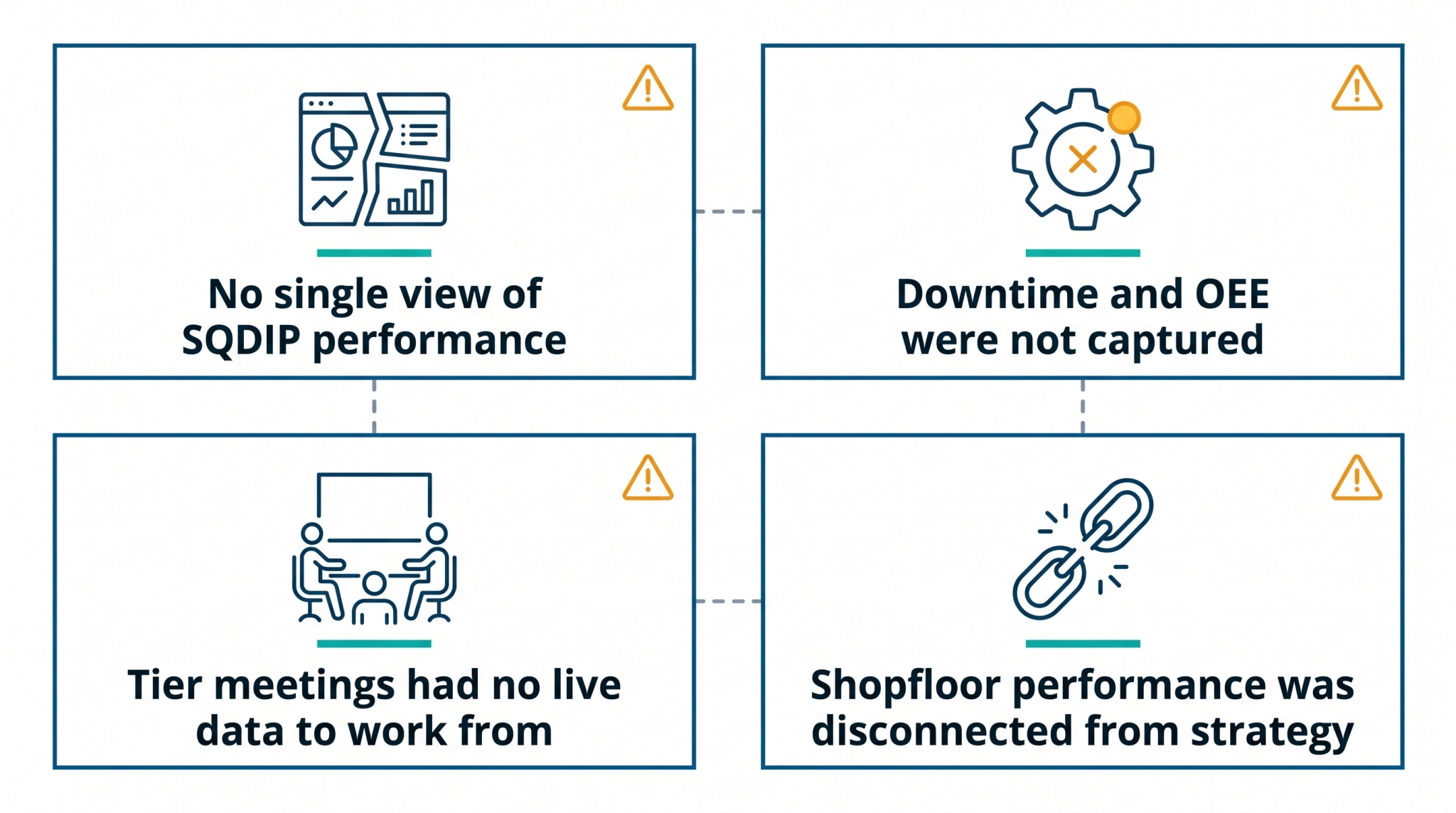
- No single view of SQDIP performance
SAP managed production orders but delivered no unified SQDIP dashboard. A quality deviation raised on Monday would not reach the production manager's weekly summary until Thursday, by which point the batch had already moved on.
- Downtime and OEE were not captured
When output fell short of plan, there was no mechanism to record why. Downtime reasons went unlogged, OEE was not tracked at machine level, and the same losses repeated shift after shift with nothing on record to drive improvement.
- Tier meetings had no live data to work from
Daily meetings ran on verbal updates and end-of-shift summaries. Without live dashboards, supervisors and managers made decisions on information that was already hours out of date. Issues raised in one meeting rarely had a structured follow-through by the next. A delivery miss discovered the morning after it happened was not unusual – by then, the window to act had already closed.
- Shopfloor performance was disconnected from strategy
The X-Matrix existed, but the SQDIP data feeding into monthly strategy reviews was incomplete and inconsistent. At the monthly strategy review, the first twenty minutes were spent agreeing on which numbers to use. By the time the discussion started, half the room had already lost confidence in the data.
The Digital Transformation
LTS Data Point was implemented as the organisation's connected SQDIP daily management system – bringing together live performance data, structured tier meetings, and a direct link between shopfloor execution and monthly strategy reviews.
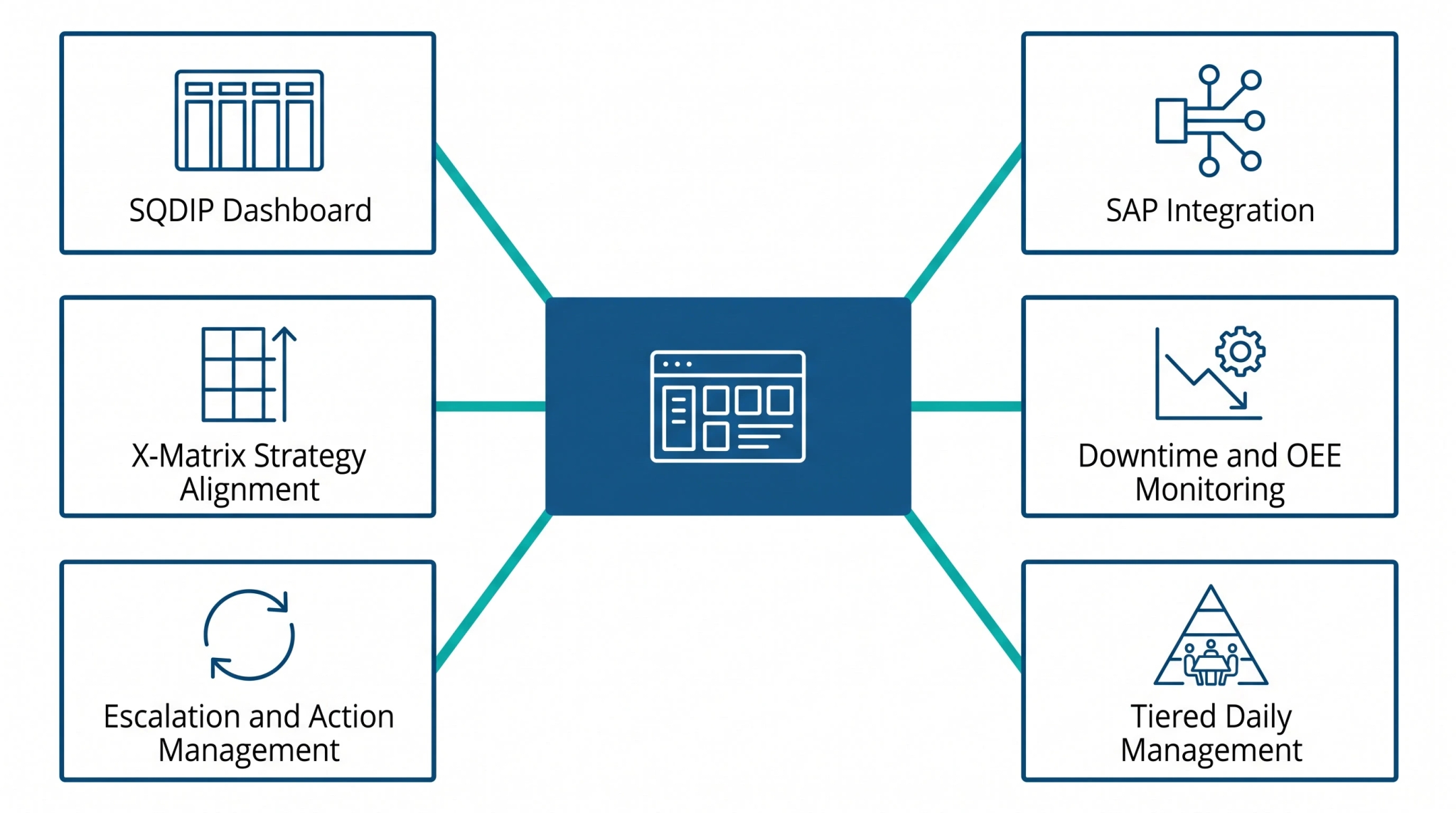

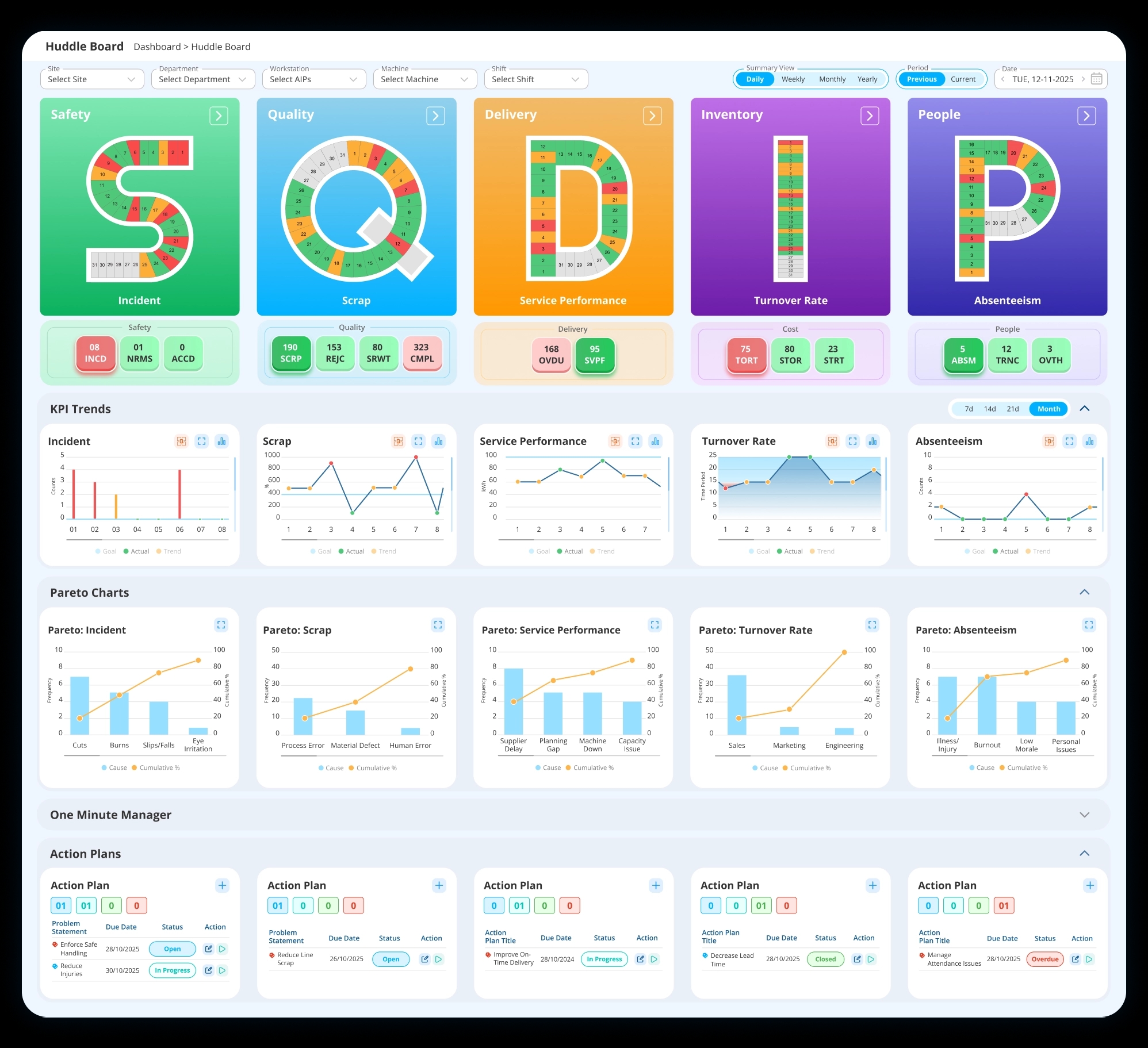
SQDIP Dashboard – Live Visibility Across All Five Pillars
- Safety incidents, near-misses, and audit compliance tracked in real time with RAG indicators showing status at a glance
- Quality deviations flagged during the shift – not after it – with drill-down into trends and Pareto analysis by defect type
- Delivery adherence, inventory status, and productivity output visible on one shared dashboard across all production cells

SAP Integration – Plan Data Connected to Live Performance
- Before the integration, operators spent the first fifteen minutes of each shift transcribing plan quantities from a printed SAP report into a separate tracking sheet – that step disappeared on day one
- Operator dashboards automatically aligned to the live production schedule at the start of every shift
- Actual versus planned output visible in real time – not retrospectively at end of shift

Downtime and OEE Monitoring – Losses Named and Tracked
- Operators log downtime reason codes directly from dashboard using a simple icon-driven interface – no paper, no delay
- Availability, Performance, and Quality calculated automatically per machine – giving full OEE picture from operator input alone
- Downtime Pareto analysis surfaces the most frequent loss reasons – turning a pattern of repeated losses into a structured improvement conversation

Tiered Daily Management – Structured Meetings at Every Level
- Tier 1 shopfloor meetings run from live SQDIP dashboards – operators and team leaders reviewing actual versus plan before the shift is an hour old
- Tier 2 management reviews draw on the same data – escalated issues visible with owner, deadline, and status already assigned
- Tier 3 leadership reviews pull from live operational data – no more verbal summaries or end-of-week collations

Structured Escalation and Closed-Loop Action Management
- Every issue identified in a SQDIP review generates an action – assigned to an owner with a deadline and a status
- The 4C workflow ensures problems are not just logged but resolved and closed
- Full audit trail maintained across every action – nothing lost between shifts, nothing unresolved without a visible reason

X-Matrix Strategy Alignment – Shopfloor to Leadership
- Monthly strategy reviews connected directly to live SQDIP performance data via the X-Matrix module
- Hoshin Kanri deployment links daily KPIs to annual objectives – closing the loop between operational execution and strategic direction
- Leadership gained a reliable line of sight from shopfloor performance to business goals for the first time
Results Achieved
The changes showed up quickly – not just in numbers. Replacing fragmented SQDIP tracking with a connected daily management system produced measurable shifts across every pillar – from how quickly safety issues were escalated to how confidently leadership could read operational performance against strategic goals.
- SQDIP visibility went from zero to real time – all five pillars visible on one dashboard across every production cell, with RAG indicators updated live during each shift rather than collated after it
- Downtime capture became a routine, not an afterthought – operators logged reason codes directly from the dashboard during the shift, giving management a Pareto of loss reasons within days of go-live; the same unrecorded losses that had repeated for months became visible and actionable
- Tier meetings became structured and data-led – supervisors and managers walked into daily reviews with a live dashboard rather than a verbal summary; decisions that previously waited until the following day were being made during the meeting
- Escalation became consistent and traceable – every issue raised in a SQDIP review generated a closed-loop action with an owner, deadline, and status; nothing left the meeting unassigned
- OEE moved from invisible to tracked – Availability, Performance, and Quality calculated automatically from operator input; production leaders had a machine-level OEE picture for the first time without costly machine integration
- Strategy reviews connected to live shopfloor data – through the Hoshin Kanri X-Matrix module, monthly leadership reviews drew directly from SQDIP performance rather than manually compiled reports; the gap between daily operations and strategic goals began to close
Conclusion
What changed was not the operation – it was the visibility. And visibility changed everything that came after it.
The shift from retrospective reporting to live SQDIP visibility enabled proactive control across the shopfloor. The one that mattered most on the shopfloor was downtime. For the first time, when a machine stopped, the reason was recorded before the next shift started – and the maintenance team had a Pareto chart to work from by Monday morning.
Tier meetings ran on live data. Escalations reached the right level of management the same day. Decisions that had previously waited until the following morning were being made during the shift.
From operators on the production floor to senior leadership, every tier now works from a shared, data-driven view of performance. The strategy review no longer started with a debate about which numbers were correct. It started with the numbers – and moved straight to what needed to change.
Hear it from our customers

MARC ROBINSON
Director, Global Operational Excellence


“By providing a central location to input, analyse and share our KPIs, 'Data Point' enables site management to more easily focus on the entire business as a team. Its ability to allow automated data entry and trend analysis gives us more time for improvement rather than just reporting numbers. Combined with a disciplined approach within our SQDC meeting process, I believe 'Data Point' will help us continually focus on key issues and drive business excellence in all areas.”