8D Problem Solving Software for Manufacturing & Quality Teams
Turn recurring issues into measurable performance improvement with a digital LTS Data Point 8D Problem Solving Software that connects root cause analysis to KPI impact, daily management, and team accountability - so issues don’t come back.
8D analysis software That Actually Drives Results - Not Just Reports
Your 8D process is working… but problems still repeat
If you’re using Excel or disconnected tools for 8D, the process often stops at documentation - issues aren’t fully resolved, actions aren’t followed through, and KPIs show little impact. LTS Data Point 8D software is the solution to close this gap- turning problem-solving into measurable performance improvement.
To make 8D problem solving effective, it must be connected to:
- KPI performance
- daily operations
- team accountability
- continuous improvement workflows
That's exactly what LTS Data Point's 8D problem solving software does.
Everything you need to run 8D Analysis effectively; without gaps

Built-in Root Cause Intelligence
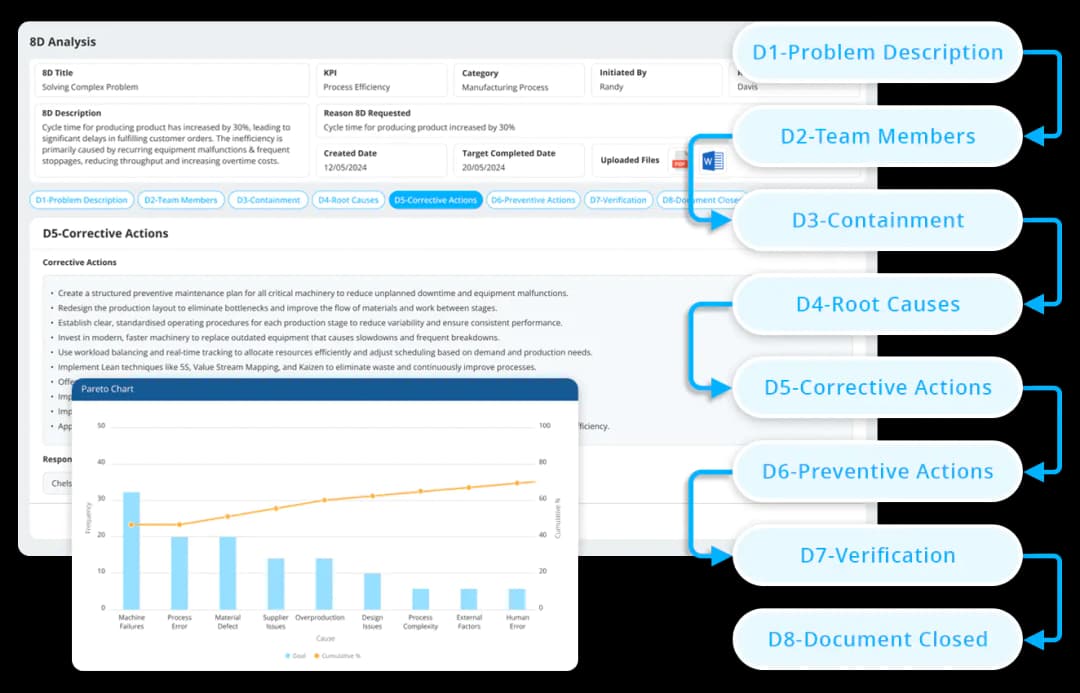
Go beyond surface-level analysis and identify what's actually driving the issue with 8D problem solving software. Use integrated tools like Fishbone and Pareto, backed by real operational data, to uncover true root causes - not assumptions. So problems are solved at their source.

Disciplined Corrective Action Execution
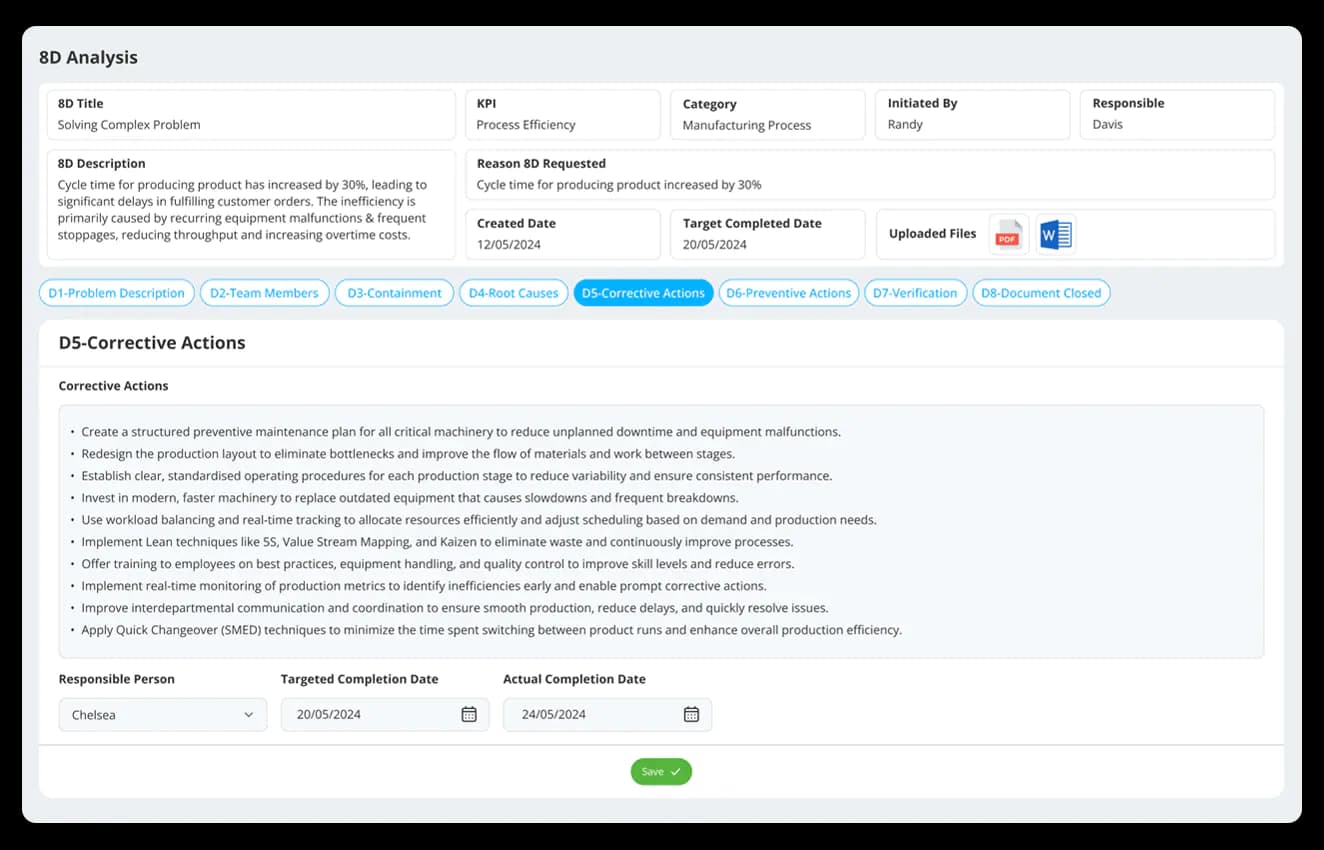
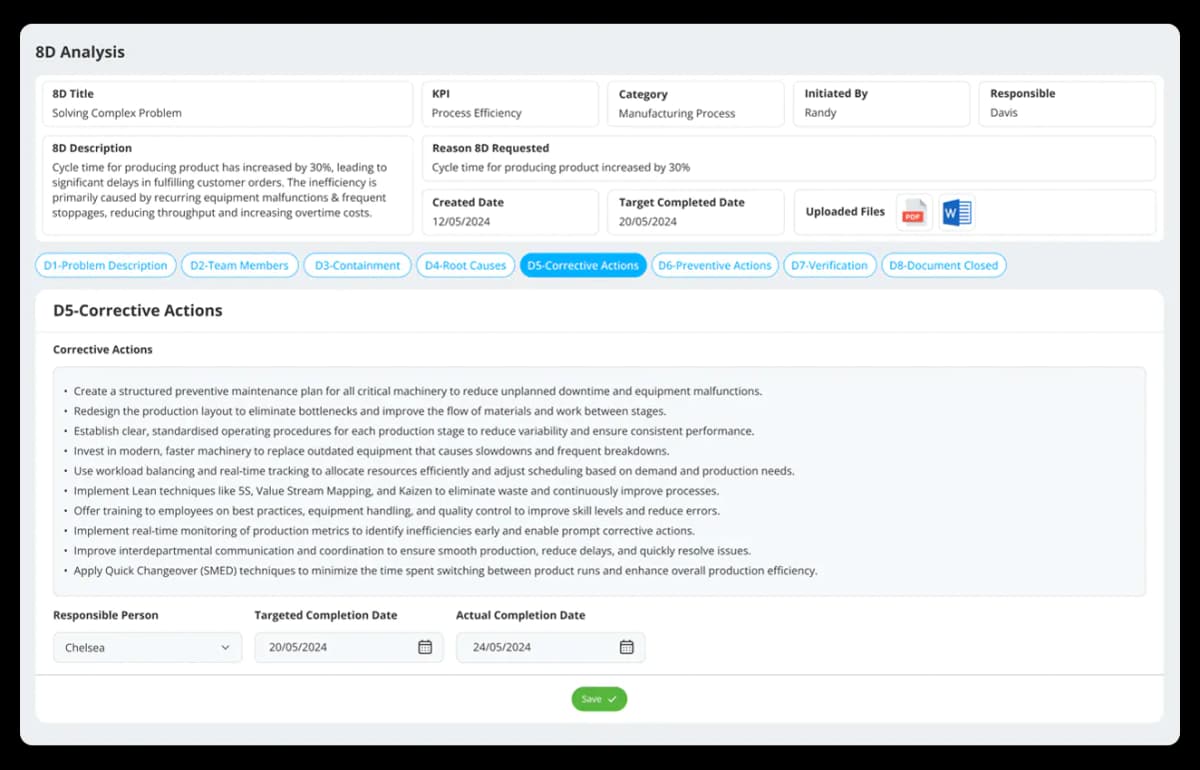
Ensure every action defined in 8D is executed, tracked, and completed. Assign owners, set deadlines, and manage corrective and preventive actions within a structured workflow, so nothing is missed, delayed, or left incomplete.

Real-Time Visibility & Control
Get complete visibility of every 8D - without chasing updates. Monitor progress, action status, and issue resolution through a live 8D problem solving dashboard, giving teams and leadership instant clarity on what's happening and what needs attention.

Traceability That Prevents Repeat Issues
Turn every 8D into long-term organisational knowledge. Maintain a complete, structured history of issues, root causes, and actions - ensuring audit readiness, learning reuse, and prevention of recurring problems.
LTS Data Point 8D Software vs Traditional 8D Tracking Approach
See how traditional 8D tracking falls short and how a modern 8D problem solving software transforms it into a connected, outcome-driven system. Compare manual methods with a digital 8D analysis software that ensures real-time visibility, action tracking, and measurable performance impact.
| Capability | Traditional 8D Tracking | LTS Data Point 8D Software |
|---|---|---|
| Issue Tracking | Outdated 8D tools | Live 8D dashboard with real-time tracking |
| Action Management | Actions assigned, rarely tracked | Owned actions with deadlines & tracking |
| Root Cause Analysis | One-time analysis, not revisited | Continuous analysis with data-backed insights |
| Visibility | Limited, siloed across teams | Centralised, real-time visibility for all stakeholders |
| Performance Link | No connection to KPIs | Direct linkage to KPI impact and outcomes |
| Problem Resolution | Issues often repeat | Built-in prevention with structured follow-through |
From 8D Reports to Real Problem Resolution - What Teams Experience

 1/3Testimonial
We had 8D reports in place, but corrective actions were not consistently followed through, and issues kept recurring on the line. With Data Point 8D problem solving software, we now assign action owners, track deadlines, and monitor every 8D through a live dashboard. The biggest change is that each 8D is now linked to our production KPIs, so we can actually see the impact of problem resolution. Repeat defects have reduced noticeably.
Plant Operations Manager
Automotive Manufacturing
2/3TestimonialIn pharma, 8D is not just about solving problems - it's about traceability and audit readiness. Earlier, our investigations were fragmented across documents. Data Point 8D problem solving software brought everything into one system, from root cause analysis using Fishbone and Pareto to CAPA tracking and full documentation history. During audits, we now have complete visibility of every step taken, which has significantly improved our compliance confidence.
Head of Quality Assurance
Pharmaceutical Manufacturing
3/3TestimonialOne of our biggest concerns was whether teams would actually use the system. Most tools feel complex on the shop floor. Data Point 8D problem solving software is different - it's intuitive, visual, and easy for operators and supervisors to update in real time. Teams quickly adapted to logging issues, updating actions, and reviewing progress without needing constant follow-up. That ease of use has made our 8D process far more consistent.
Continuous Improvement Lead
Industrial Manufacturing
Stop Repeating Problems. Start Solving Them. Bring Your 8D Under Control!
Book DemoMaster the 8D problem-solving stages with Data Point
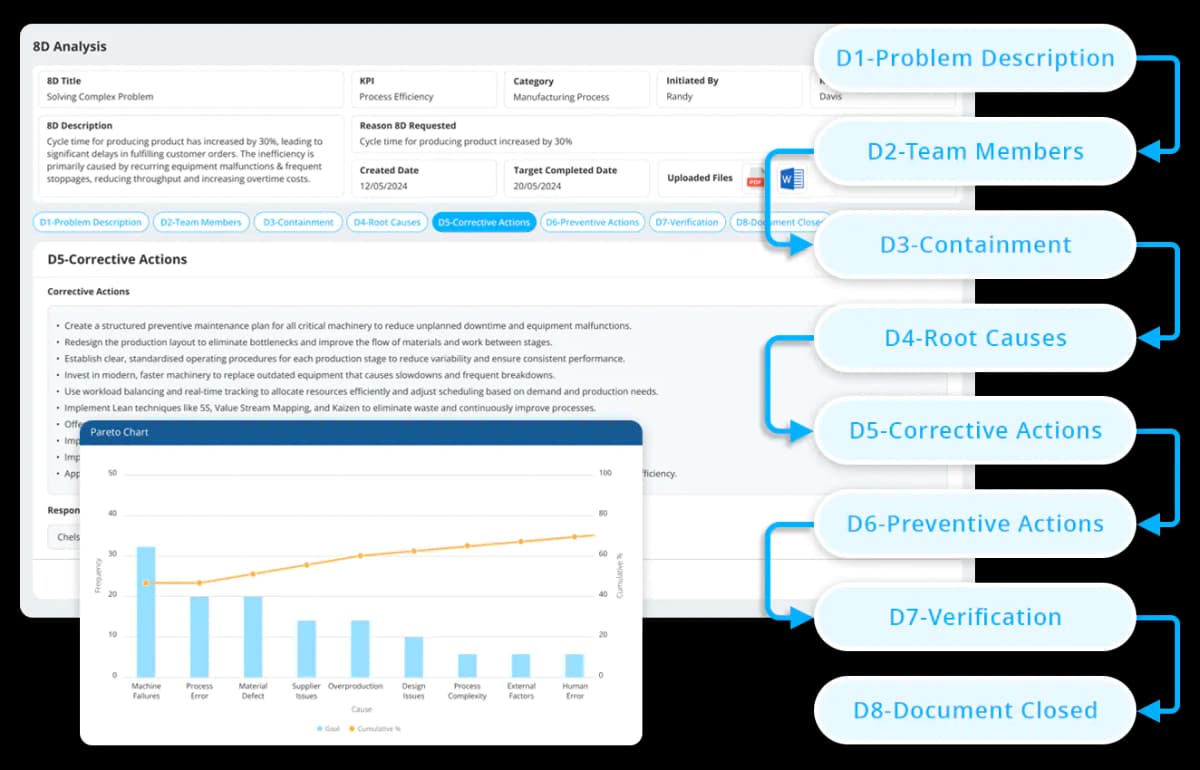
From assigning teams to tracking corrective actions, our 8D system streamlines every step for efficiency and accuracy.
Choice of industry leaders and Fortune 500 companies


















How does the 8D Analysis board elevate your problem-solving?
The 8D Analysis Dashboard replaces manual guesswork with real-time data-driven collaboration, slashing problem-solving time by aligning teams on live insights.

Seamless issue tracking
Eliminate scattered reports-monitor every step of the 8D process in a centralised dashboard, ensuring transparency and accountability.

Fact-based decision-making
Drive solutions backed by data, not assumptions. Link 8D investigations to performance metrics for impactful results.

Prevent recurrence
Go beyond quick fixes-embed preventive strategies that eliminate recurring issues and enhance operational stability.
Discover What’s Missing in Your 8D and How to Fix It
8D Problem Solving Software: The Complete Guide to Root Cause Analysis, CAPA and Quality Improvement
Learn how 8D Problem Solving Software helps teams contain issues, identify root causes, manage CAPA actions, prioritise corrective measures, track progress in real time, and build lasting quality improvements across operations.
What is the difference between 8D and A3 problem solving, and when does each fit best?
Both frameworks structure the path from problem to resolution. The difference is in depth, audience, and where they are typically used.
A3 is a lean tool built around a single-page summary. It works well for internal improvement initiatives where the team owns both the problem and the solution, the scope is contained, and a concise record is sufficient. It is a fast and visual, which makes it practical for shopfloor kaizen activity.
8D is built for a different situation. It was developed in manufacturing environments where a structured, disciplined response to a quality failure needs to be communicated clearly, often to a customer or supplier. The eight-discipline sequence separates containment from correction, requires root cause validation before corrective actions are defined, and produces documentation that can be shared across organisational boundaries. That is why it is the default framework in automotive, aerospace, and regulated manufacturing sectors where customers require documented evidence of problem resolution.
How do you define the problem statement in D1 in a way that sets the investigation up to succeed?
The problem statement sits at the head of the 8D. Everything the analysis produces is shaped by how precisely it is written. A vague statement sends the team in every direction at once.
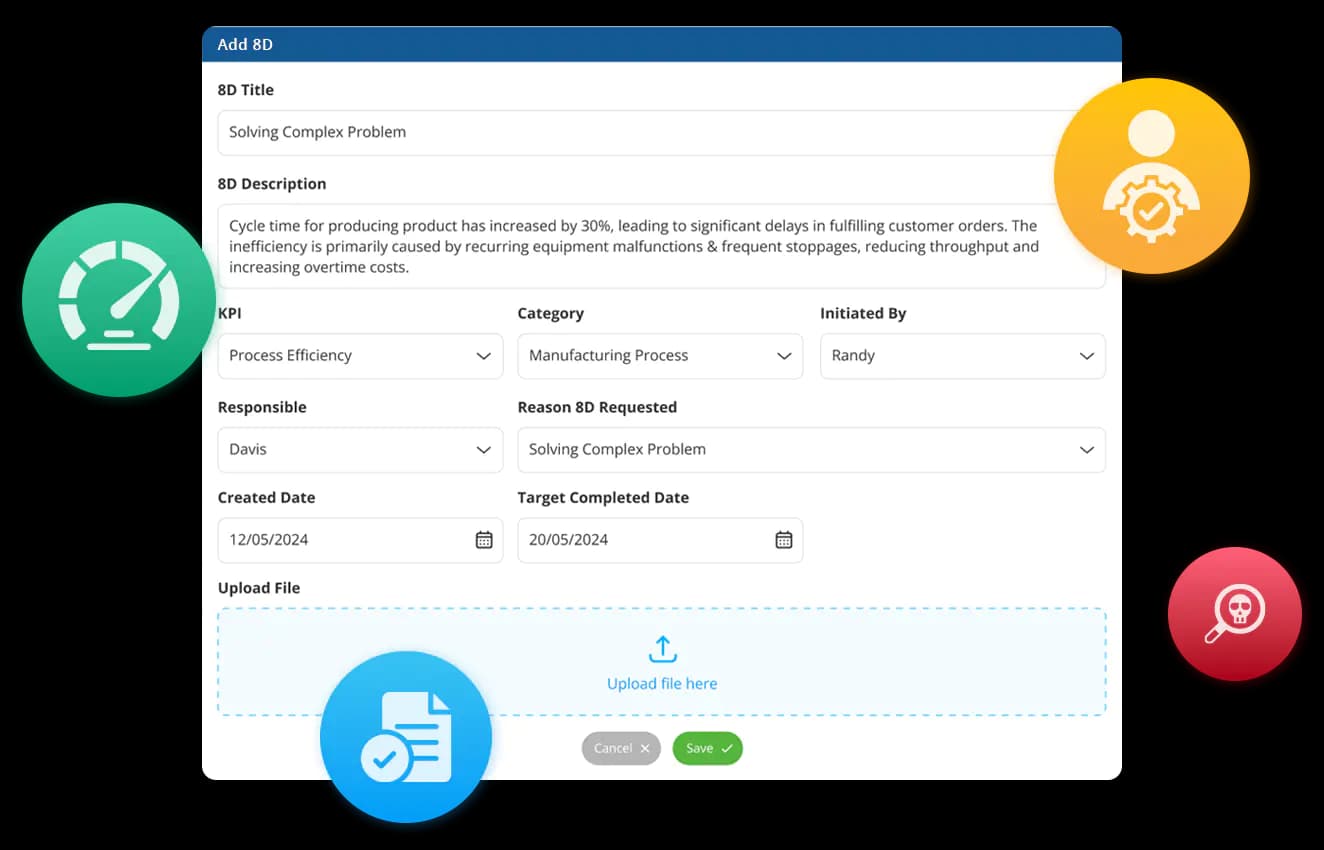
The difference is between naming a condition and defining a failure. “We have a delivery problem” is a condition. Everyone on the team will interpret it differently. A well-formed D1 statement specifies what is happening, where it is occurring, since when, and what the measurable impact is. That specificity determines which disciplines are relevant, what data needs to be pulled, and whether the team is investigating the right thing at all.
Linking the problem statement directly to KPI performance data at D1 establishes the baseline the team will measure corrective action effectiveness against at D7. Without that baseline, validation becomes a judgment call rather than a data-backed confirmation that the problem has actually been resolved.
How does Pareto analysis in D4 change the way root causes are prioritised?
D4 is where most 8D investigation either sharpen or lose focus. A brainstorm of possible root causes can generate a long list. Without a way to rank them by impact, teams either investigate everything in parallel and dilute effort or go straight to the most familiar cause without testing whether it is actually the most significant one.
Pareto analysis applied to the cause data in D4 ranks failure modes by frequency or impact, making the highest-priority investigation target visible before resource is committed.
Used alongside a fishbone diagram in D4, the two tools do different things. The fishbone maps the casual landscape. Pareto tells you where in that landscape to focus first. Together they prevent the two most common D4 failure modes: investigating too broadly without ranking or anchoring on a familiar cause without evidence is the dominant one
How does the live 8D dashboard give leadership visibility without requiring manual status updates?
The most common failure mode in 8D management is not a poor investigation. It is a good investigation that nobody is tracking. Actions are assigned. Deadlines pass. Nobody follows up because there is no single view showing what is open, what is overdue, and what has been verified.
A live 8D dashboard gives teams and leadership real-time visibility of every active 8D: action status, ownership, deadlines, and whether the corrective actions are having an impact on the linked KPI. The information does not need to be compiled or reported separately. It is visible from the same system where the investigation is being run.
For multi-team operations, this also means a quality manager overseeing several lines or locations does not need to chase updates from each team individually. The status of every open 8D is in one place, updated by the people doing the work.
How does the containment action in D3 differ from a corrective action, and why does the distinction matter?
Most teams treat containment and correction as the same thing. They are not the same and confusing them is one of the most common reasons 8D reports close without the problem actually being resolved.
A containment action is a temporary measure designed to protect the customer and the process from the impact of the problem while the investigation is still running. It does not fix anything. It holds the line. A corrective action addresses the root cause after it has been confirmed. Applying a corrective action before root cause is established means closing a problem on paper while leaving the underlying failure mode intact.
Keeping containment and correction as separate stages with separate verification means:
- D3 answers: What are we doing right now to stop the impact spreading before we know why this happened?
- D5 answers: Now that root cause is confirmed, what are we changing to eliminate it?
- Neither stage can be closed without evidence that it has achieved its specific purpose
How does 8D connect to CAPA, and what breaks when they run as separate processes?
8D is an investigation framework. CAPA is an action management system. They are designed to work together.
When they run as separate processes, the connection between the root cause confirmed in the 8D and the actions managed in CAPA is manual. Someone transfers information from one system to another. That transfer is where traceability breaks down. The CAPA record shows what action was taken. It does not show which root cause it was addressing, what containment was in place while the investigation ran, or whether the team that confirmed the root cause agreed it was the right action.
Running both within the same platform means:
- The cause-to-action link is maintained without a manual handoff
- A confirmed root cause in D4 connects directly to the corrective and preventive actions in D5 and D6
- The full chain from problem statement to verified resolution is traceable in one place
How does D6 preventive action differ from D5 corrective action, and why do most 8D reports close without completing it properly?
D5 corrects the problem that occurred. D6 prevents the same failure mode from occurring elsewhere in the process, on a different line, or in a different product family. Most 8D reports close with a strong D5 and a weak or absent D6. The result is that the specific instance is resolved, but the conditions that allowed it to occur remain in place.
The reason D6 is consistently underweighted is that it requires a different type of thinking. D5 asks: What do we change here to fix this? D6 asks: Where else in the system could this same failure mode develop, and what do we put in place before it does?
Connecting D6 to continuous improvement workflows rather than treating it as a checkbox means preventive actions are tracked and verified with the same rigour as corrective ones:
- Assigned to an owner with a deadline
- Linked to a KPI that will confirm the preventive measure is holding
- Visible in the same dashboard as the rest of the 8D, not buried in a separate report
How does closing the 8D in D8 contribute to organisational learning rather than just completing a process?
D8 is the point where most teams stop paying attention. The problem is resolved. The report closed. The knowledge generated by the investigation gets filed and rarely referenced again.
The value of D8 is not the closure. It is what gets standardised as a result. A completed 8D with documented root cause, validated corrective action, and confirmed preventive measure is a reference point for every similar failure that follows. The next team investigating the same failure mode does not start from zero.
A structured history of closed 8Ds also makes patterns visible that individual investigations cannot surface. A failure mode appearing across multiple 8Ds over different time periods is not a series of isolated problems. It is a systemic issue that individual corrective actions are not resolving. That pattern only becomes visible when investigations are stored and searchable rather than archived as standalone documents.
Hear it from our customers

MARC ROBINSON
Director, Global Operational Excellence


“By providing a central location to input, analyse and share our KPIs, 'Data Point' enables site management to more easily focus on the entire business as a team. Its ability to allow automated data entry and trend analysis gives us more time for improvement rather than just reporting numbers. Combined with a disciplined approach within our SQDC meeting process, I believe 'Data Point' will help us continually focus on key issues and drive business excellence in all areas.”
Resolve your operational issues with Data Point’s structured 8D approach
Track, analyse, and solve recurring problems by linking actions directly to KPIs—empower your teams with real-time insights and sustainable outcomes.