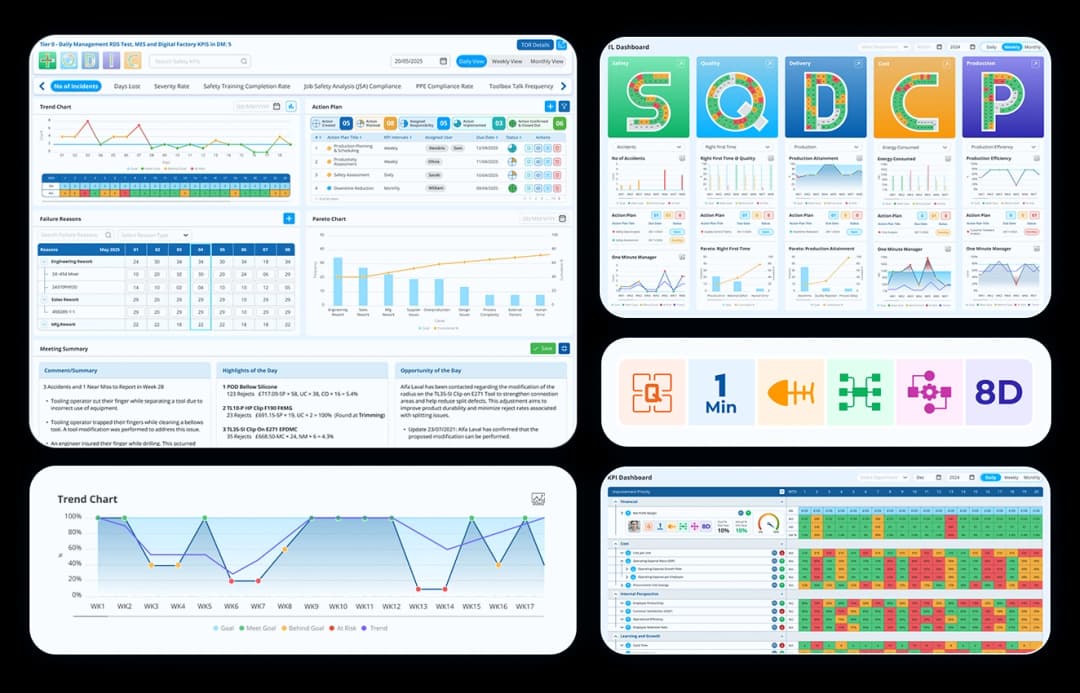
Short Interval Control Board Software for Manufacturing
Turn the production plan into live shop-floor control. Track target vs actual at short intervals, expose losses as they happen and act before the shift falls behind.
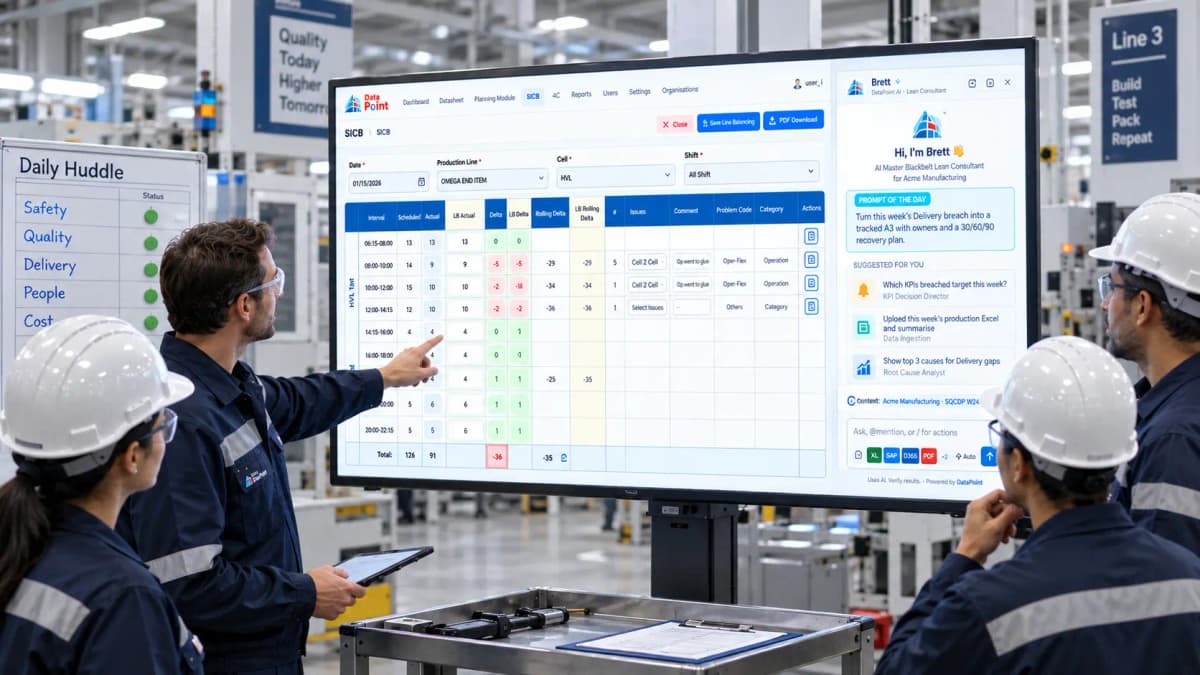
Data Point SICB Live Production View
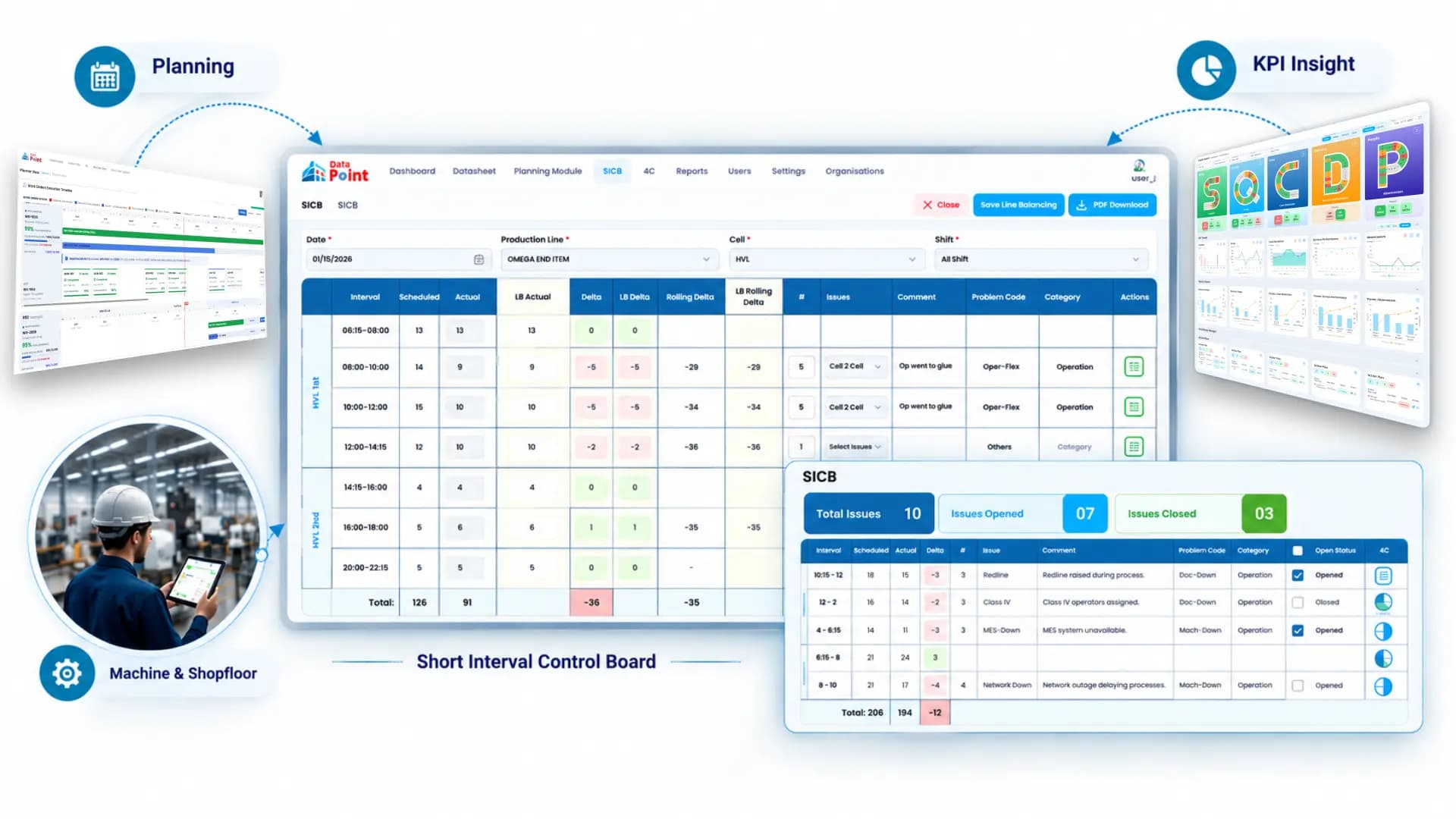
Everything You Need to Keep Production on Plan
Connect production targets, live execution, loss capture and daily management in one Short Interval Control Board software platform.
Turn the Production Plan into Short-Interval Targets
Bring the approved production plan into SICB and translate it into practical targets that operators and supervisors can manage throughout the shift.
- Connect targets to the production plan or planning environment
- Configure short intervals around your operating environment
- Track expected output by interval, shift and production context
Measurable Benefits of Short Interval Control Board
Practical gains from tighter production control, faster intervention and better use of shop-floor performance data.

More production control points in an 8-hour shift than a single end-of-shift review.

Typical short-interval windows can expose a miss while recovery time still remains.

Of off-track intervals can carry structured reason and comment context when teams use the capture workflow.

Translate quantity variance into estimated schedule impact so leaders understand the operational consequence.

Combine interval performance with cumulative or rolling delta to distinguish noise from a worsening shift.

Keep the execution baseline, actuals, reasons and comments together for review and analysis.
Traditional Production Tracking vs Digital Short Interval Control
Move from delayed reporting and disconnected production boards to live execution control.
| Traditional Production Tracking | With Data Point Short Interval Control Board Software |
|---|---|
Production performance is reviewed after the shift or next morning. | Plan vs actual performance stays visible throughout the shift |
Daily targets can hide when and where the loss actually happened. | Short intervals expose the point where production moves off plan. |
Actuals and reasons may sit across paper, spreadsheets or separate systems. | Structured execution data is captured in one SICB record. |
Supervisors manually work out whether production is ahead or behind. | Variance and adherence are calculated from plan and actual. |
Loss reasons are reconstructed from memory later. | Loss reasons and comments are captured during execution. |
Production issues wait for the next meeting or report. | Deviations can be escalated while the shift is still running. |
Huddle boards depend on manually compiled updates | SICB performance can flow into SQCDP / Huddle management. |
Recurring losses are difficult to analyse consistently across shifts. | Structured history makes repeated loss patterns easier to identify. |
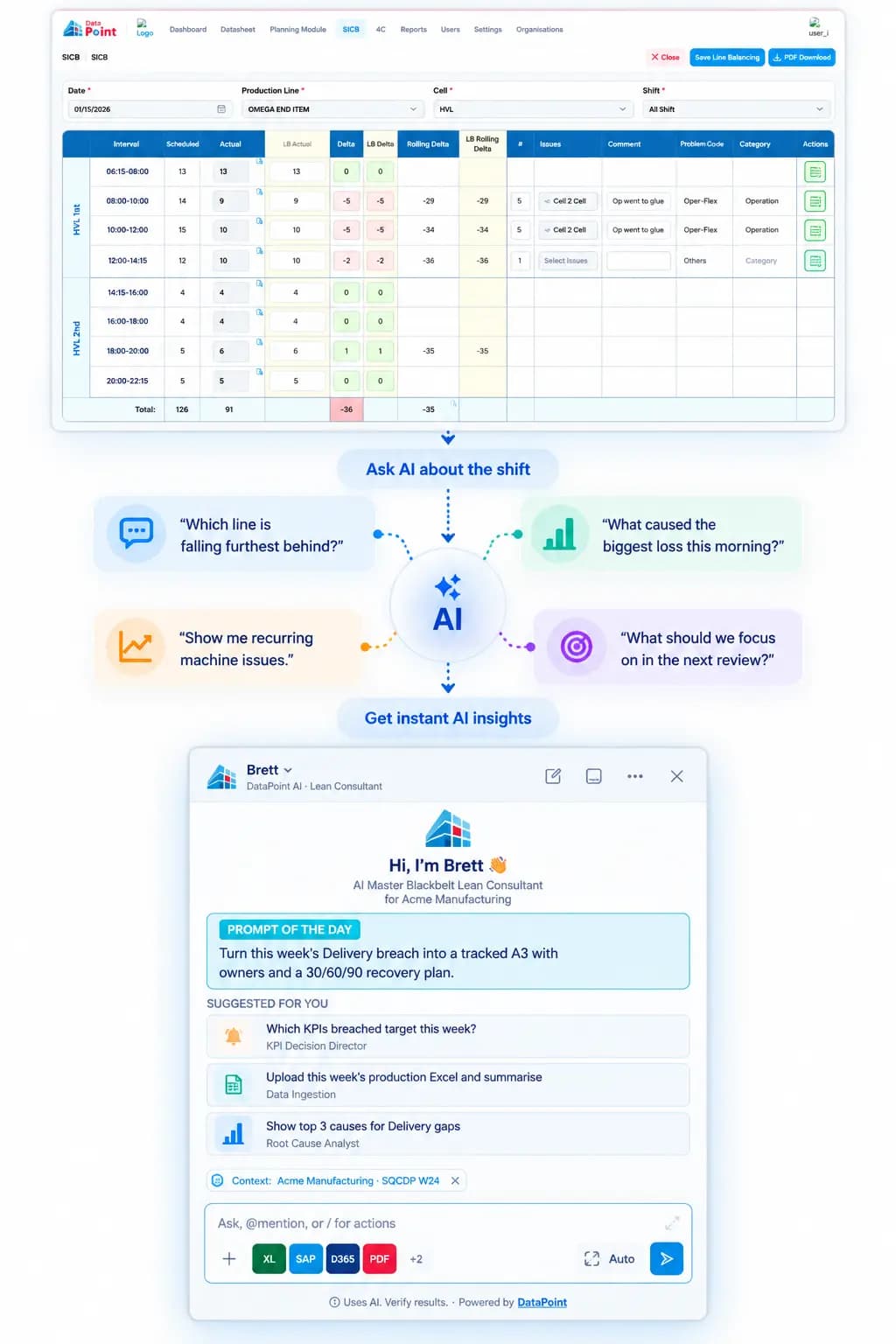
Turn Every Shift Record into Questions, Patterns and Priorities
AI works across structured SICB data to shorten the path from “what happened?” to “what should we look at next?” while the underlying production record remains visible.

Ask AI About the Shift
Use natural-language questions such as “Which line is falling furthest behind?” or “What caused the biggest loss this morning?”

Detect Worsening Performance
Use interval, cumulative and rolling signals to surface where a small miss is becoming a sustained production trend.

Find Recurring Loss Patterns
Analyse structured reasons and comments across shifts, machines or products to highlight repeated operational themes worth investigating.

Prioritise the Next Review
Summarise the highest-impact misses, recurring causes and unresolved performance risks so leaders can focus discussion on exceptions rather than reading every row.
How SICB Fits Your Production Environment
Fit SICB around the way your factory already operates. Connect the required data, configure your control model and give each team a governed interface without rebuilding the systems around it.






Connect Your Data
Bring required production data into SICB from the systems and sources your operation already uses.
Configure Operations
Set up lines, machines, shifts, intervals, thresholds and reason structures around your production process.
Govern Execution
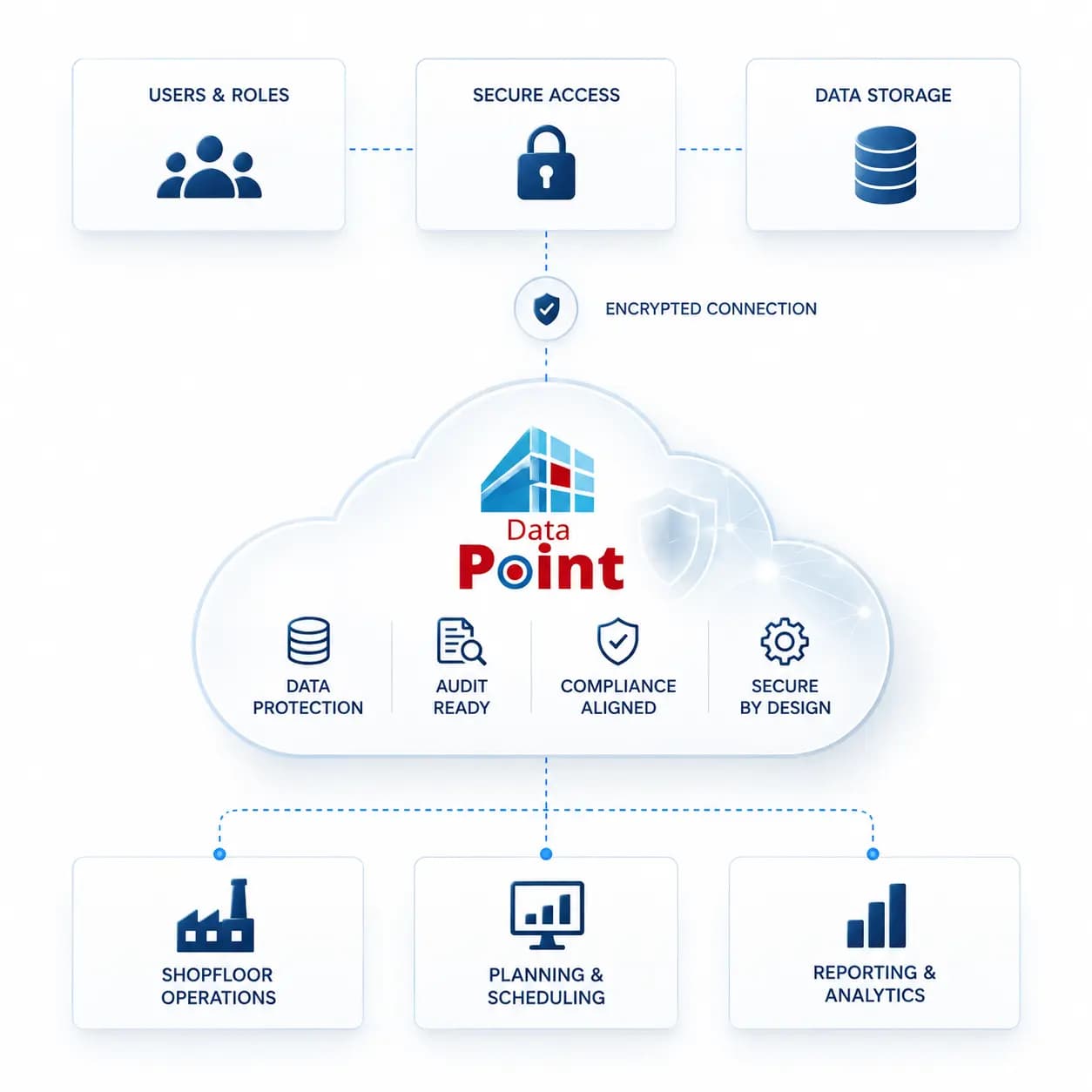
Give each role the right controls while maintaining structured production records and execution history.
Scale Across Operations
Extend the same control framework across more machines, lines, departments and sites as required.
Connect Your Data
Bring required production data into SICB from the systems and sources your operation already uses.
Configure Operations
Set up lines, machines, shifts, intervals, thresholds and reason structures around your production process.
Govern Execution
Give each role the right controls while maintaining structured production records and execution history.
Scale Across Operations
Extend the same control framework across more machines, lines, departments and sites as required.
What Manufacturing Teams Achieve with Connected Short Interval Control

 1/3Testimonial
We used to know we had missed the plan when the shift was almost over. Now with Data Point SICB the team can see where performance is drifting and respond earlier. That has made our daily production control much more disciplined.
Production Manager
Automotive Manufacturing
2/3TestimonialThe biggest change is that we no longer spend the morning reconstructing yesterday's losses. The reasons are already captured with the production record, so our review starts with what needs improving, not finding the data.
Operational Excellence Lead
Pharmaceutical Manufacturing
3/3TestimonialOur challenge wasn't collecting more data. It was knowing what deserved attention. Data Point AI helps us turn SICB history into patterns and priorities, so improvement discussions start with evidence.
CI Lead
Aerospace Manufacturing
Your production challenges. Your tailored Data Point SICB demo.
Book a DemoExpert Support. Enterprise Protection.
- Expert-guided implementation from setup to go-live
- Integration support across your production environment
- Role-based training built around how each team works
- Hands-on support for faster, smoother user adoption
- Ongoing technical and operational guidance
- Structured support for multi-line and multi-site rollout
One Live Production View. Better Decisions at Every Level.
Operator
Know the target, record actual production and capture a reason when performance falls behind.
Learn More →Operations Manager
Review adherence, recurring losses and performance patterns across shifts and lines.
Learn More →CI / OpEx Leader
Use structured execution evidence to identify chronic losses and prioritise improvement.
Learn More →Plant Leadership
Understand production status and recurring operational issues through connected daily management.
Learn More →Short Interval Control Board (SICB): The Complete Guide to Real-Time Production Monitoring and Performance Control
Learn how a Digital Short Interval Control Board helps teams monitor production in real time, identify deviations early, improve shift performance, streamline issue tracking, and integrate with MES, ERP, and production planning systems.
What is the difference between short interval control and end-of-shift reporting, and why does the gap matter?
An end-of-shift report tells you what happened. Short interval control tells you what is happening. The difference is not just timing. It is whether there is still an opportunity to act.
By the time an end-of-shift report is reviewed, the deviations it documents are history. A line that fell behind target at 10 am and was not flagged until 5 pm has spent seven hours compounding a shortfall that an early intervention could have recovered. Short interval control closes that gap by monitoring production against schedule at hourly intervals throughout the shift. A deviation that appears at 10 am is visible at 10 am. The team has the rest of the shift to respond. That difference in response window is where recovery happens or does not happen.
How does an integrated problem code system support faster troubleshooting than free-text logging?
When an operator logs a deviation using free text, the description varies every time. One operator logs “machine stopped.” Another logs “conveyor fault.” A third logs “breakdown on line 2.” These are the same category of problem described three different ways. Analysing that data for patterns requires someone to read every entry and manually group them before any frequency analysis is possible.
Standardised problem codes remove that inconsistency. Every deviation is tagged to a predefined category at the point of logging. The data is immediately comparable across shifts, lines, and time periods without a manual cleaning step. Over time, the frequency of each problem code builds a ranked picture of where recurring issues are concentrated, which is exactly the input a root cause analysis needs to prioritise where to focus first.
How does SICB connect to production planning and scheduling?
A short interval control board running against manually entered targets is only as reliable as whoever entered them. If the plan changes mid-shift and the SICB is not updated, the board is measuring performance against a target that no longer exists.
When SICB connects to the production planning module, the targets on the board reflect the current approved schedule rather than a static figure set at shift start. Shift scheduling per machine flows into the interval targets automatically. When a plan is updated, the SICB updates with it. Visual gap alerts in the scheduling layer flag where planned quantities and available capacity are misaligned before the shift begins, rather than surfacing as a deviation mid-shift after the opportunity to adjust has already passed.
How does comprehensive issue logging support shift handovers and cross-shift continuity?
A shift handover that relies on verbal communication is inconsistent by design. The outgoing shift supervisor summarises what they remember. The incoming shift receives a filtered version of what actually happened. Issues that were not considered significant enough to mention get dropped. Problems that started in one shift and need to be resolved in the next are communicated with varying levels of accuracy depending on the individuals involved.
Comprehensive issue logging in SICB captures detailed comments and data for every logged issue during the shift. Status and category indicators make the nature and severity of each issue immediately clear to the incoming team. The handover record is in the system, not in the outgoing supervisor’s memory. An issue logged at 2 pm with a status of “in progress” is visible to the incoming shift at 6 pm with full context intact, without requiring anyone to brief anyone else.
How does the dynamic interval dashboard show scheduled versus actual production in real time?
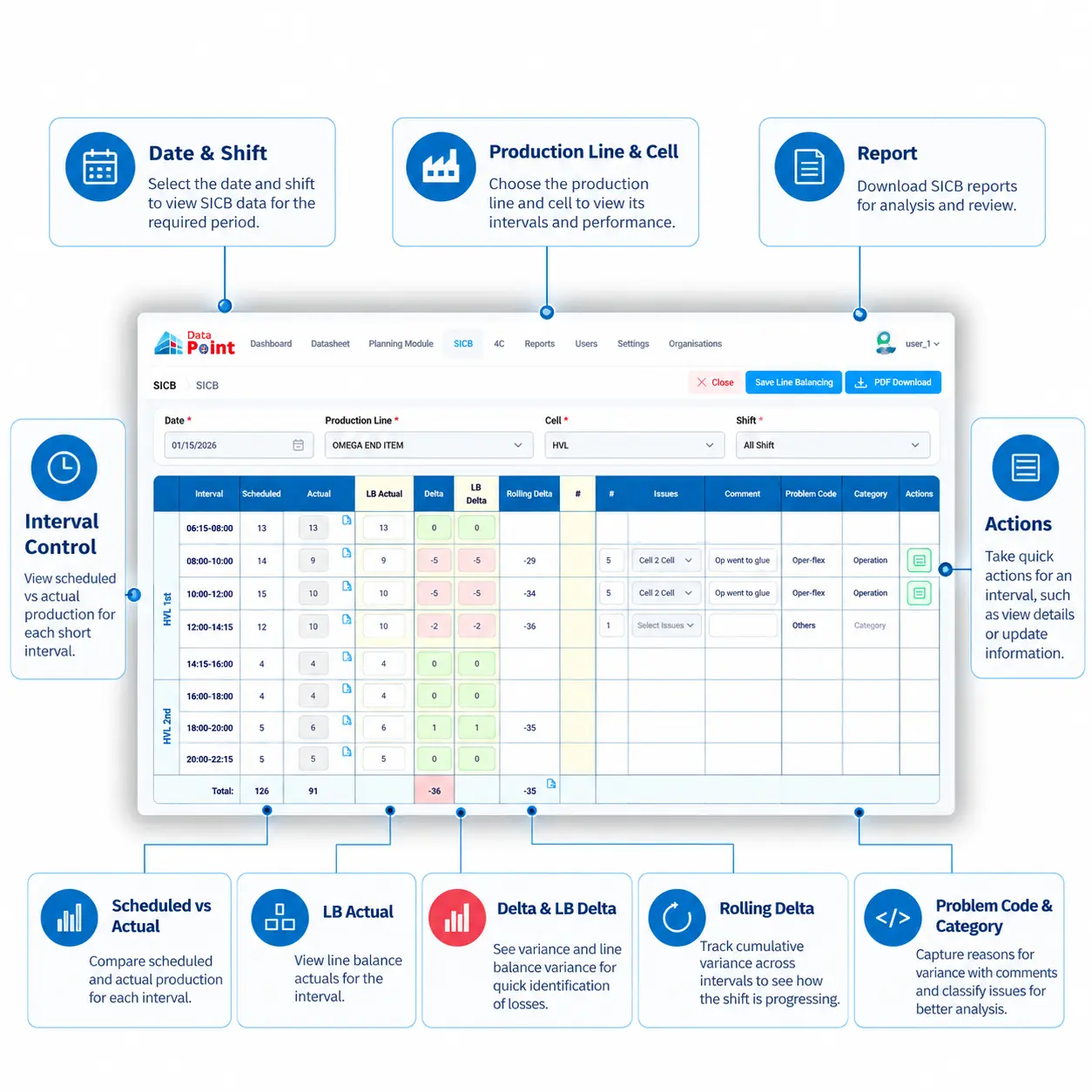
The interval dashboard shows the planned production quantity for each hourly interval alongside what was actually produced. The gap between the two is the Delta. When the Delta turns negative, the variance alert fires immediately. The team does not need to calculate whether they are on track. The board tells them.
For organisations building a broader short interval management culture, the interval dashboard is the operational anchor. It makes the discipline visible rather than relying on a supervisor to manually track pace across the shift. The colour-coded adherence monitoring means the status of each interval is readable at a glance:
- Green intervals confirm the line is running to plan
- Amber and red intervals flag deviations before they compound into a shift-level shortfall
- The cumulative picture across all intervals shows whether recovery is still achievable within the shift or whether escalation is needed
Hourly granularity is the minimum update frequency. It ensures the data on the board reflects what is actually happening on the line rather than a plan that was accurate at the start of the shift and has not been touched since.
How does operator-level data entry into SICB preserve data integrity without creating an administrative burden?
The accuracy of a short interval control board depends entirely on the quality of the data being logged. If operators are entering actuals into a system that is disconnected from the production schedule, there is no reference point to validate against. If they are copying numbers from one system into another, the transcription step introduces error and delay.
When actual production quantities are logged directly into SICB against the planned schedule for that interval, the comparison is automatic. The Delta is calculated without manual effort. Locking production orders once they have started prevents retrospective changes that would distort the performance record. The result is a board that reflects what actually happened during each interval rather than a cleaned-up version entered at the end of the shift. Where MES integration is in place, that data flows directly into the board without requiring operator input at all.
How does the actionable insights panel move the SICB from a monitoring tool to a management one?
A board that shows a deviation and stops there puts the entire burden of deciding what to do on whoever is reading it. In a busy production environment, that decision often gets deferred or missed. The actionable insights panel closes that gap by surfacing direct recommendations alongside the deviation data.
When a variance alert files, the panel provides structured guidance on how to resolve the discrepancy. The team is not starting from a blank page. They have the deviation data, the problem code, the logged comments, and a recommended response path in the same view. For supervisors managing multiple lines simultaneously, this reduces the cognitive load of switching between a monitoring view and a separate decision-making process. The response happens from the same screen where the problem was identified.
How does SICB integrate with MES and ERP systems, and what changes when that connection is in place?
A SICB running on manually entered data is better than no visibility at all. A SICB connected to MES data in real time is fundamentally different tool. The planned quantities come from the schedule. The actuals come from the production system. The Delta is calculated automatically. No operator is transcribing figures from one screen to another, and no supervisor is reconciling two different data sources at the end of the shift.
MES integration also enables real-time activity log data pipelines, where production events are captured and surfaced on the board as they occur rather than being entered retrospectively. For operations where the gap between a production event and its appearance in the management system is currently measured in hours, that reduction in latency changes what it is possible to manage in real time. Connected to KPI dashboards, the SICB data feeds directly into the performance metrics that drive daily management reviews, without a separate data preparation step between the shopfloor and the review meeting.
Hear it from our customers

MARC ROBINSON
Director, Global Operational Excellence


“By providing a central location to input, analyse and share our KPIs, 'Data Point' enables site management to more easily focus on the entire business as a team. Its ability to allow automated data entry and trend analysis gives us more time for improvement rather than just reporting numbers. Combined with a disciplined approach within our SQDC meeting process, I believe 'Data Point' will help us continually focus on key issues and drive business excellence in all areas.”
See What Your Team Could Catch Before the Shift Ends
Fill out the form to see how Data Point SICB can structure short-interval control around your production environment, make misses visible earlier and turn shift data into actionable performance evidence.