AI for Manufacturing: What Operations Teams Actually Need to Know and Why the Lean Foundation Comes First
Last updated on : May 20, 2026
I do everything manually in my shopfloor. I wish I had an AI who does it for me.
At least once, you’ve had this thought taking form in your mind. An AI who does all your work. All you have to do is overlook them. Simple. Work done. Something in your checklist you can tick off confidently.
But real life isn’t about fantasies. Expecting an AI to do all your work is still a fantasy – not because it is incapable as an AI, but it is incapable as a human being.
In today’s fast-growing world, 68% of manufacturers have already adopted AI for manufacturing in their shopfloor. But only 16% have achieved the results they were aiming for. This is because of the gap between the hype and the reality – a huge gap on what AI promises and what it actually delivers.
Let's shatter this gap, shall we?
See how LTS Data Point gives your lean operations the digital foundation AI needs.
Why most AI conversations in manufacturing miss the shopfloor entirely
Today, we have ChatGPT, Gemini, Claude, Grok and too many other AIs at our fingertips. The trend goes from asking advice on what to do in our work to what do in our life and even creating hyper-realistic photographs where the sky is the limit.
But what about AI for manufacturing operations?
The conversation around AI in manufacturing rarely starts where it should – on the shopfloor, with the people actually running it.
To deal with manufacturing operations, the AI used should deliver according to the requirements of the employee at their level. But the reality is far from simple.
Some of the reasons why implementing AI does not guarantee manufacturing excellence are as follows:
- Problems arise when implementing an AI in a manufacturing company. The focus almost always falls on the technical shortcut it provides rather than the actual people and process requirements at the shopfloor. The implementing process goes smoothly, but down the road, it stops solving the requirements the companies failed to check before implementing the AI.
- Accuracy of data can make the AI go haywire. An AI can only be as good as the data you feed it. For example, if your machines are labelled differently across shifts, your sensors are reading slightly off, or key information is simply missing, the AI will draw the wrong conclusions and guide your team wrongly.
- Even when the data is accurate, if it is recorded in silos, it will still create problems. If a machine failure is recorded in the factory floor and if it remains separate from enterprise IT systems, which in simple terms mean that it is far from AI model access, then the AI fails to get a full picture before guiding you.
- This eventually creates a trust gap. After all, the AI shows whatever data you put in. What if the data altogether is wrong? Fully depending on AI who in turns, depend on the data you put in, only creates chaos, not solve problems.
What AI actually does in an operations context
Before the table can make sense, one thing needs to be clear: artificial intelligence in manufacturing is not what most vendors describe. Here is what the gap actually looks like.
Six ways operations teams are applying AI right now
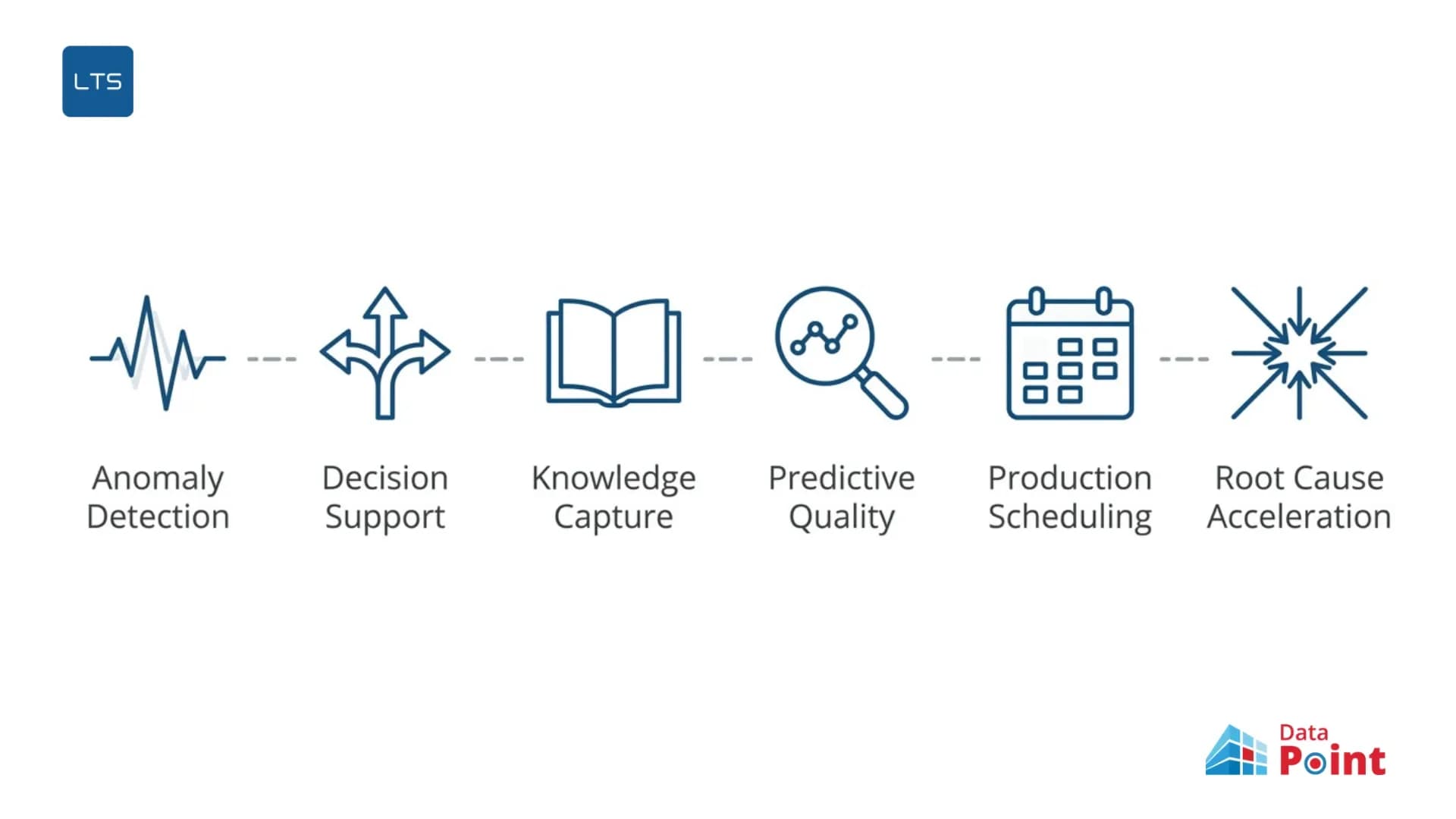
Once you erase myths about AI and focus on the reality on what AI can do, you can decide how AI can help you and where.
AI can be used by operations teams in manufacturing in the following ways:
1. Anomaly detection:
AI tracks equipment data continuously. It flags vibration, temperature, and acoustic deviations that no human operator would catch in time. After the AI has alerted the maintenance team, they can decide what to do next. Organisations that act on these flags report maintenance cost reductions of 25-35% and drop in asset downtime by 35-45%.
Teams that embed these alerts into their lean operating rhythm — rather than treating them as standalone notifications — are the ones closing the loop between signal and action. Understanding how AI fits into lean manufacturing helps clarify exactly where that loop belongs.
2. Decision support:
Traditional KPI monitoring reveals problems only after the damage is done. AI changes the speed at which the right person gets the right information and the role of AI in decision making in manufacturing goes much deeper than a single alert.
3. Knowledge capture:
Take the case of Toyota Motor Manufacturing Burnaston site alone. More than 300 technicians each carrying fault-diagnosis is nearing retirement age. Their expertise and knowledge that’s built over decades exist nowhere in any formal documentation. When they leave, it is not transferred, but relearned slowly, costing time and money.
On the other hand, an AI model trained on factory-specific data such as quality reports, SOPs, and process logs can make expertise of a high-performing site consistently available for everyone on the shopfloor. This makes the AI take up the role of a live guide rather than a replacement for the expert. How teams build that knowledge into an AI system, and keep it improving, is what lean AI is really about.
4. Predictive quality monitoring:
Implementing lean culture ensures drastic growth and keeping up with the competition. But in this age, implementing lean alone will not guarantee you that growth. 72 major MNCs still report an average of 323 hours of production downtime per year, most of it tracing back to quality issues that were visible in the data before they escalated but caught too late. This is where predictive analytics in manufacturing moves from a vendor talking point to a number your finance team can read.
5. Production scheduling and capacity:
Modern factories generate too much data on cycle time, temperature, vibration, and energy, far beyond what humans can manually track. AI can make this easier. It surfaces the demand and capacity signals that schedulers need, and the production team makes the adjustment.
6. Root cause acceleration:
AI can cross-reference with historical data, detect patterns from them and accelerate the root cause analysis. AI shortens the search, giving teams a faster starting point for the kind of AI-driven continuous improvement that used to take days of manual investigation.
Industry 5.0 and the case for AI on top of lean, not instead of it
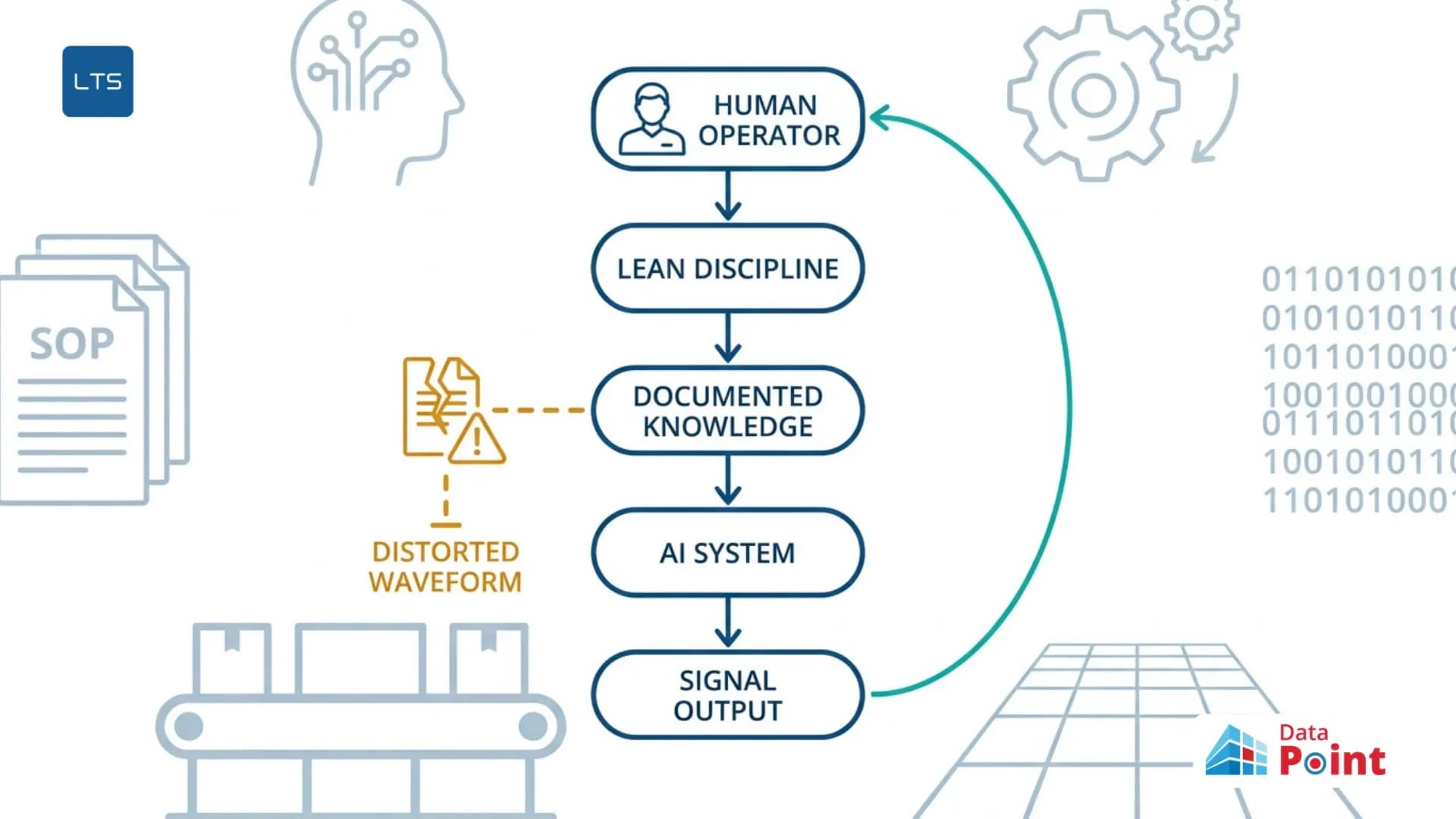
Industry 5.0 does not ask you to choose between lean and AI. It asks how you build a shopfloor where lean thinking acts as the foundation of Industry 5.0 manufacturing — the base layer from which your AI learns and your team improves.
AI provides data-driven feedback that humans can use to make decisions, while human feedback enables AI to improve their models over time. The two compound each other. But it makes it valuable only if the lean thinking driving the human feedback is consistent, documented, and transferable.
Let's take a peek at a real-world scenario.
A production team implements an AI-powered shift reporting tool across three lines. The setup takes two days. Within a week, the system is signalling a recurring quality deviation on Line 2 – same time, same pattern, every morning shift.
The operations manager investigates for three weeks. Maintenance checks the equipment. The quality team reviews the SOPs. Nothing found.
By week four, someone found out that the morning shift on Line 2 records downtime reason codes differently from the other two shifts. The AI had been learning this pattern that began long back but never corrected and reporting it as a quality deviation.
Three weeks were spent for investigation. The root cause was never on the shopfloor. It was in the data entry standard that lean discipline should have confirmed before implementing the AI.
AI can only be trained on the knowledge that has been documented. Lean expertise that lives in somebody’s brain cannot be transferred to the AI system. If the knowledge never reaches the AI, it never compounds.
AI amplifies what is underneath it. Lean discipline determines whether the amplification is an advantage or a liability.
AI for manufacturing is not a future investment. It is an operational decision your competitors are already making. The teams seeing results are not the most technologically advanced. They are the most disciplined.
The process improvement techniques that have always driven operational excellence are not being replaced — they are being given a faster engine. Lean gives AI something worth learning from. AI gives lean the scale it could never reach alone. The foundation determines everything.
Your AI can capture lean knowledge. But how do you make sure the knowledge it captures is the right knowledge, and that it keeps getting better as your team does?
Not sure where to start with AI and lean?
FAQs
1. Is AI for manufacturing only relevant for large factories?
No. AI applications in manufacturing scale down as well as up. Anomaly detection, KPI monitoring, and knowledge capture tools are available to mid-size and smaller operations. The deciding factor is not factory size but process maturity. A small site with disciplined lean processes will get more from AI than a large site without them.
2. How long does it typically take to see results from AI in manufacturing operations?
It depends on how ready your data and processes are before deployment. Teams with structured digital processes in place report meaningful signals within weeks. Teams deploying AI onto inconsistent or undocumented processes often spend the first several months troubleshooting data quality rather than acting on insights.
3. Do we need a data science team to implement AI on the shopfloor?
Not necessarily. Most operational AI tools available to manufacturers today are designed for operations teams, not data scientists. The more important capability is process discipline. Teams that understand their own data and how it is collected will get more from AI tools than teams relying on technical specialists who do not know the shopfloor.
4. What is the difference between Industry 4.0 and Industry 5.0 in manufacturing?
Industry 4.0 focused on automation, connectivity, and data integration – technology as the driver. Industry 5.0 builds on that foundation but repositions humans as the central element, with technology serving human judgment rather than replacing it. In practice, it means designing AI and automation around how your team thinks and decides, not around what the technology can do autonomously.
5. Can AI work alongside existing lean tools without replacing them?
Yes. AI does not replace value stream mapping, daily management systems, or problem-solving frameworks. It works alongside them by surfacing the signals those tools need faster than manual review can. The lean tool still drives the response. AI just gets your team to the right conversation sooner.