AI Predictive Maintenance: What Lean Manufacturing Teams Need to Know and What to Do When the Signal Fires
Last updated on : June 3, 2026
AI is booming. Is it necessary that I should consider AI for predictive maintenance in manufacturing? What benefits do I have compared to the companies who haven’t implemented AI predictive maintenance?
Several companies have already adopted digital dashboards and are already on track with their work. But that is no longer enough. Compared to competitors who have adopted AI or on the verge of adopting AI, they’re still slow.
A digital dashboard displays what your equipment is doing right now. An AI model that is trained on the same data learns what normal looks like across varying production conditions. When slight deviations appear in this pattern, it triggers an alert before any physical symptom is visible to a technician on the shopfloor.
See how LTS Data Point gives your team the visibility to act on maintenance signals before they become production losses
What AI predictive maintenance actually does and what it does not
Your predictive maintenance programme already gives your team lead time. AI explains what that lead time is based on. It moves from scheduled intervals and manual threshold checks to continuous pattern learning across every variable your equipment produces. This is the fundamental shift between preventive and predictive maintenance and AI is what makes the predictive layer intelligent rather than just scheduled.
The complaint now is not about how cluttered traditional means of collecting data is. The complaint is about how a digital dashboard detects everything. For example, if a digital dashboard detects 50 anomalies in a day, there’s a good chance that the maintenance team might ignore it as false positive.
How can AI solve this issue?
Research shows that AI multi-sensor models reduce false positive alert rates by 60-80% compared to a single parameter threshold monitoring. It produces alerts that the maintenance teams can trust and act on consistently.
An AI model acts on what rules you’ve set. In case of a machine, you’ve already set a threshold line based on historical data. A digital dashboard alerts you if the vibration of the machine crosses this line. But AI learns the trajectory across multiple variables such as vibration, thermal, and alerts you before it crosses the line. This is because AI detects them as a developing issue which is dynamic and not static.
But this is also when you’ve to check in with reality. Just because Artificial Intelligence is getting more advanced, it doesn’t mean AI is the ultimate solution.
AI has a hard limit. Roughly 15-25% of equipment failures such as sudden mechanical breakages and electronic component failures, produce no detectable precursor signal. Knowing which failures fall out of its capabilities is as important as knowing which falls under it. That gap is where lean response structure becomes the safety net.
The AI alerts earlier and on patterns which your programme would have missed to surface. But the AI stops at the signal. Teams that have already worked through the AI decision making layer know what comes next — which lean tool applies, and how fast the response needs to move.
Why unplanned downtime is a lean problem, not just a maintenance problem
Maintenance: How fast can we fix it?
Lean: How did the flow break, and what did it cost before the machine came back online?
A machine does not fail in isolation. In a lean operation that maintains a continuous flow, a breakdown at one point stops everything before and after it. That is not a maintenance problem. That is a takt time problem.
- Total Productive Maintenance (TPM) lives inside lean methodology for this exact reason. The target is not faster repair. The target is zero unplanned stops. This is mainly because a machine failure does not halt just one process, but a chain of processes before and after it. WIP accumulates upstream. Pull breaks downstream. The schedule planned by the production team no longer mirror what the floor can deliver.
- OEE availability is the production performance metric that captures this. Every unplanned stop is an availability loss. Research shows that an average manufacturing facility goes through 25 unplanned downtime incidents per month. That amounts to roughly 326 hours of lost production per year. Mean time to repair has also increased from 49 to 81 minutes. This is where AI for OEE improvement moves from a reporting function to a protection function, availability losses prevented rather than recorded.
- Fixing machines quicker than you used to does not solve the lean problem. Most plants reported fewer incidents in 2025 with higher downtime costs. The lean flow still broke. The schedule still collapsed. The cost still ran. Reactive improvement, even if quickly done, is still reactive.
- The machine performance is where the lean flow is most exposed. And this is exactly where AI predictive maintenance should target the problem before the stop occurs.
If we were to break this down into fragments, it looks a lot like this.
The maintenance team’s job is to fix machines. The lean team’s job is to protect the flow. How AI improves efficiency in a lean operation is not through speed alone. It is through protecting the conditions that allow the flow to run without interruption. AI predictive maintenance becomes the point where those two objectives finally share the same tool.
What we lean teams need in place and what changes when the signal arrives early
The technology is not what most companies get wrong. It is what happens after the alert arrives.
Before AI maintenance has anything reliable to spot, three things need to be in place:
- Sensor infrastructure on critical equipment
- At least 6-18 months of historical data including labelled failure events – this is what AI learns from
- Clear workflow on what happens when the alert fires – who triages it, who owns the response, how fast it moves
Most plants invest greatly in the first two and skip the third. They will end up being passive observers of alerts arriving, collecting false positives, and see the system quietly stop being used.
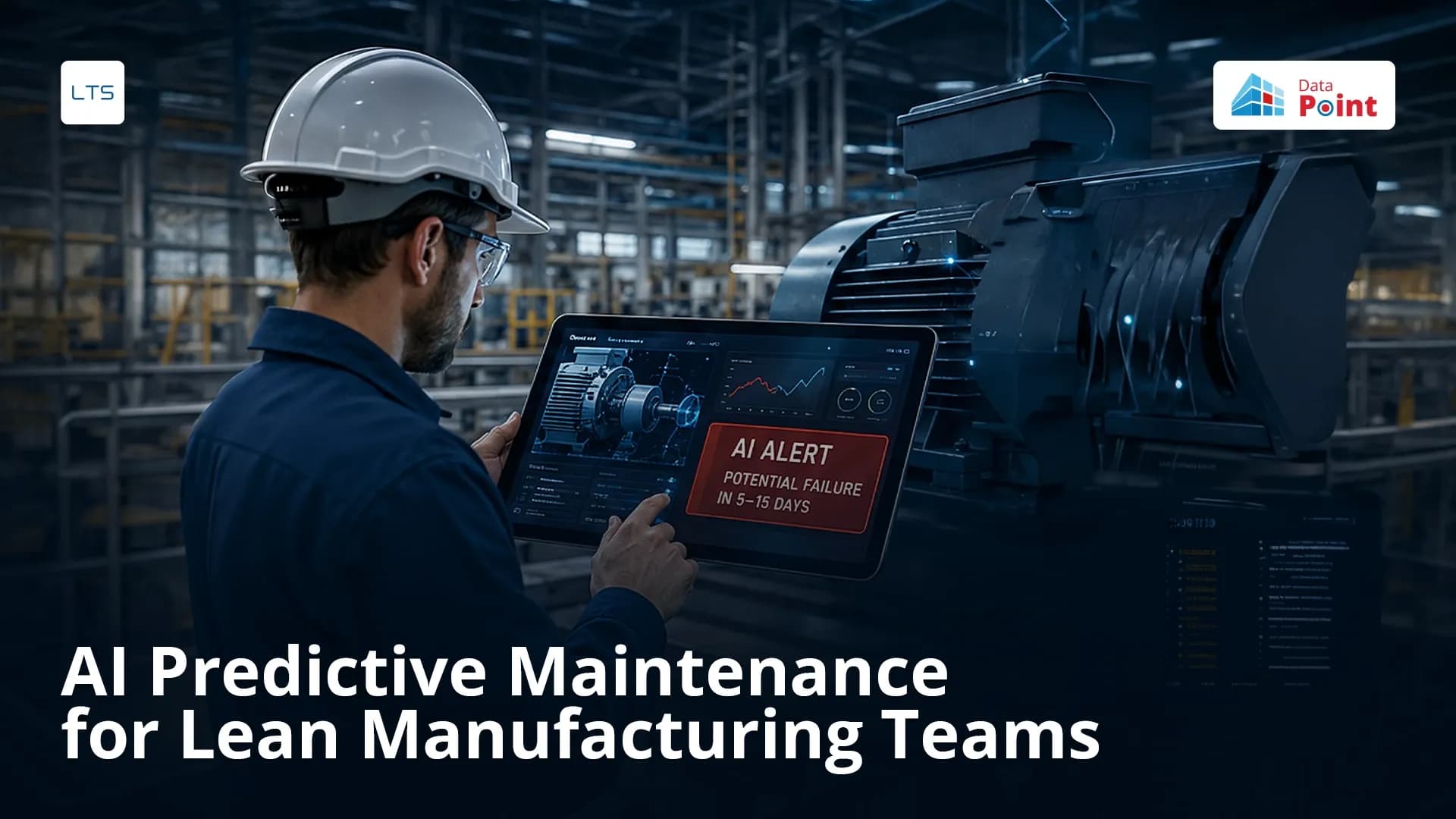
Consider a manufacturing plant where a bearing on a critical motor flagged on day three. The AI model implemented in the plant kept track and triggered an alert on a vibration pattern that was leading into a possible failure within 5-15 days. The team schedules the replacement during the weekend planned downtime. The result? The line never stops. That is not a maintenance win. That is a TPM win. The planned maintenance pillar worked. The unplanned stop never happened.
This is the exact shift AI creates in the TPM framework. Autonomous maintenance operators now have a signal to act on before the physical symptom appears. Planned maintenance teams can schedule during windows that protect lean flow instead of responding to emergencies that break it.
But what if the same pattern appears repeatedly – the same equipment, same drift signature same failure mode?
Then it is high time to understand that it is no longer a maintenance scheduling problem, but a lack of proper continuous improvement culture.
The recurring pattern becomes the data. The structured investigation is the response. AI does not run the continuous improvement event. It only surfaces the evidence that one is needed.
The lean intelligence layer that links the predictive signal to the right structured response is where AI continuous improvement closes the gap the alert alone cannot close.
AI predictive maintenance does not eliminate the need for lean discipline. It makes that discipline count earlier. The signal arrives before the machine stops, before the flow breaks, before the schedule collapses. But the signal alone is not the improvement. What the team does with it is still a lean problem. The only difference is that for the first time, the team is solving it before the cost runs.
And once the maintenance signal is no longer the problem, what else could the same intelligence prevent?
Find out if your lean operation is ready to act on the data generated by your equipment
FAQs
1. Does AI predictive maintenance work on older equipment that was not built with sensors?
Yes, in most cases. Current AI systems use non-invasive sensors such as current clamps on power feeds, vibration sensors on motor housings, that retrofit onto legacy equipment without modification. The constraint is not the age of the equipment but the availability of historical failure data to train the model on.
2. How is AI predictive maintenance different from the condition monitoring we already do manually?
Manual condition monitoring checks equipment at a point in time. AI monitors continuously across multiple variables simultaneously and learns what combinations of readings precede failure, not just which individual readings exceed a limit. The difference is not frequency. It is pattern recognition across dimensions a manual check cannot hold in view at once.
3. Who owns the predictive maintenance alert: the maintenance team or the production team?
Both, at different points. The alert is a maintenance trigger. The consequence of ignoring it is a production problem. Ownership needs to be defined at both levels before the system goes live — which tier receives it, which team triages it, and who closes it out. Undefined ownership is the most common reason AI predictive maintenance deployments stop delivering results.
4. Can AI predictive maintenance reduce spare parts costs as well as downtime?
Yes. With 5–15 days of lead time before a predicted failure, parts can be ordered and staged rather than sourced under emergency conditions. Teams with reliable lead time have reduced spare parts inventory by 15–25% by moving from emergency stock buffers to scheduled procurement.
5. At what point does a recurring predictive maintenance alert become a continuous improvement trigger?
When the same failure mode appears more than once on the same equipment under similar conditions, it is no longer a scheduling problem. The recurring pattern is the data. A structured root cause investigation, not another scheduled replacement, is the appropriate response. That is the point where predictive maintenance and continuous improvement share the same starting line.