AI Continuous Improvement: How to Keep Lean Programmes Running When the Expert Leaves
Last updated on : May 26, 2026
Imagine this: A tall building that already touches the skies. It stands strong, thanks to its strong foundation. But remove that foundation and the height becomes the risk.
Artificial Intelligence works pretty much like this.
You document your lean knowledge into the system. The system learns it. Your team interacts with it on a daily basis. The AI improves on a daily basis.
What's the foundation of an AI that tracks your daily operations?
Lean methodology, of course.
Manufacturers who already track their KPIs properly are more than twice as likely to successfully move an AI project from a test phase into full operation. Unlike continuous improvement that already drives your organisation, AI continuous improvement speeds up the process, compressing improvement cycles and cutting down cost of slow decisions.
See how LTS Data Point gives your lean operations the foundation AI continuous improvement needs
What it looks like when AI holds lean knowledge in practice
An AI that is fed lean data into it works very differently from an AI who is fed actual lean knowledge. The AI system that has genuine lean knowledge which includes not just the theory, but the practical section, cater to your requirements much more accurately.
This is what AI process optimisation looks like when it moves from theory to floor.
A quality defect appears at 2 am in the night shift, but there’s no one who knows lean methodology thoroughly. The plant had already implemented an AI system and fed it with the knowledge the lean expert had. This enabled the team leader to simply ask which problem-solving tool applies to the situation and he received a guided answer in seconds.
AI with lean knowledge looks a lot like this:
- AI holding data tells you what happened. AI holding knowledge tells you what to do next.
- Methodology knowledge means knowing which lean tool applies, why it applies, and what a good AI root cause analysis looks like from that point.
- That knowledge needs to be available at the moment the decision is being made, not retrieved later from a manual or escalated upward.
The knowledge stays in the system. But does it reach every tier, every team leader, every shift consistently?
How AI continuous improvement keeps the programme running across every tier
The absence of the expert is not the only gap. Lean methodology applies differently depending on which tier you are in.
- Tier 1 – Resolve issues locally
- Tier 2 – Coordinate cross-functional escalations
- Tier 3 – Handles what the lower tiers cannot resolve
This clearly shows the lean knowledge, and lean maturity increases as the tier increases.
To ensure smooth flow between these three tiers, each tier should know what to do with the information they have, which demands methodology knowledge along with data visibility.
But this is where things get tricky.
Not everyone in each tier might be well-versed in lean methodology. Not everyone might be experienced enough. This is where an Agentic AI for manufacturing operations that knows lean knowledge comes in handy.
- AI for manufacturing spots issues early and explains the likely root cause and the next steps in simple language. This gives every tier the investigated problem rather than each level having to interpret raw data independently.
- It shortens the time from problem seen to problem solved across every tier by acting as a thinking brain, sharpening the escalation at each level.
- Finally, it provides a single source of truth across every tier which is what AI in production management is built to deliver.
AI may not run the tier meeting for you. But it makes sure that every tier arrives at it with the right information already in the right shape.
What leaders need to do for AI continuous improvement to hold
Implementing AI before operational foundations are stable does not fix the problems, it compounds them. If five different operators perform a task in five different ways, an AI will struggle to find a common ground. The result? Automated errors at lightspeed.
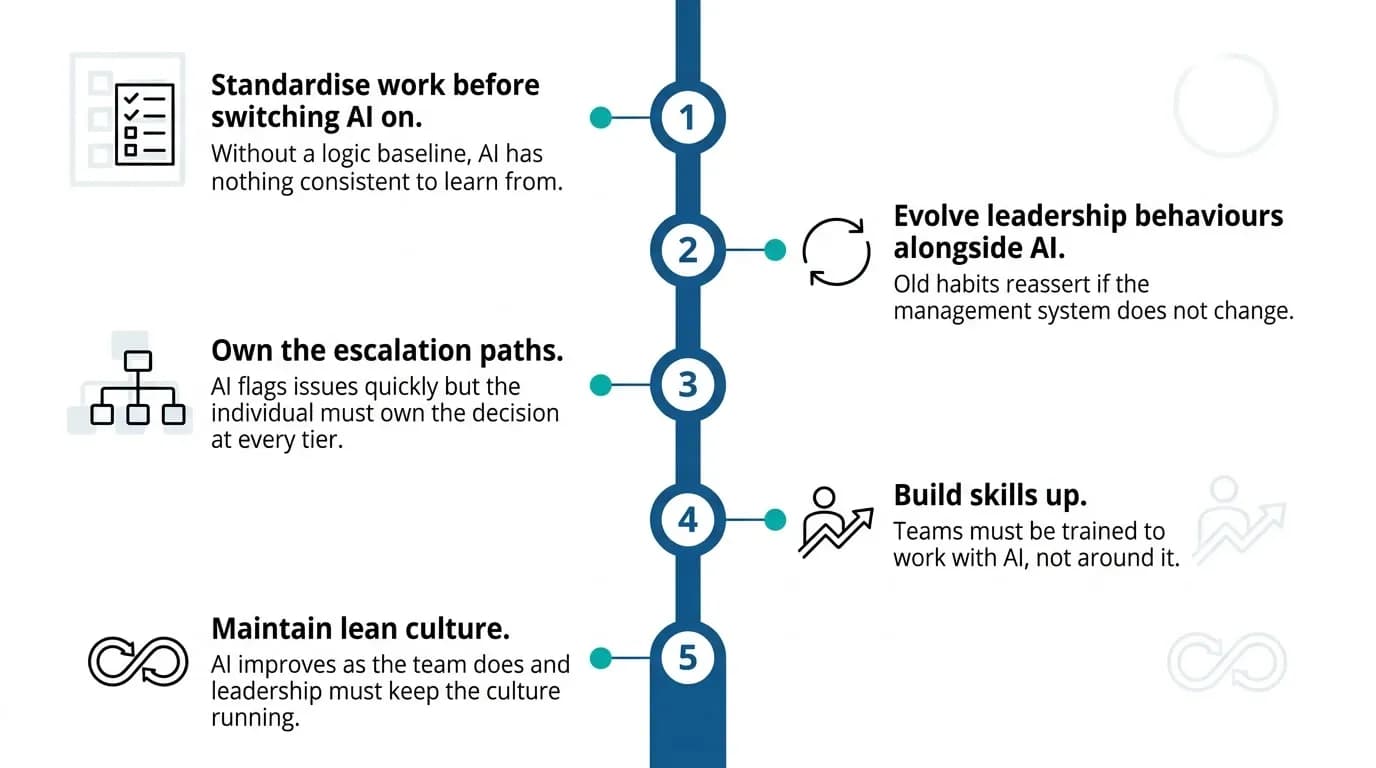
This is where leadership comes into play:
- Standardise work before switching AI on. Without a logic baseline, AI has nothing consistent to learn from.
- Evolve leadership behaviours alongside AI. Old habits reassert themselves if the management system does not change.
- Own the escalation paths. AI flags issues quickly, but it’s the individual who must own the decision at every tier.
- Build skills up. Proper training must be given to the teams to work with the AI, and not around it.
- Maintain lean culture. AI improves as the team does, and it is leadership’s job to keep the culture running.
The organisations that get this right treat AI for lean principles the same way they treat standard work.
How LTS Data Point gives your lean programme a foundation AI can actually learn from
LTS Data Point provides solid foundation that AI CI depends on.
- Replaces disconnected spreadsheets and fragmented reporting with one connected platform that aligns teams around shared KPIs from operator level to executive level.
- 4C workflow provides full traceability across every action, with assign, track, escalate, and close functionality and a complete audit trail.
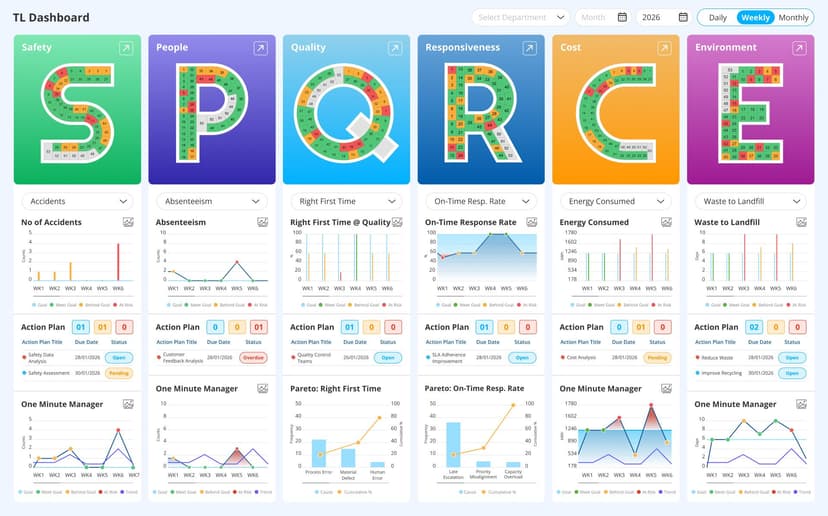
- Fishbone Diagram, Quad Chart, One Minute Manager, and PDCA are built into LTS Data Point as daily operational tools, not add-ons, embedding lean thinking at the point of decision.
- Provides 27/7 technical support, continuous improvement through regular enhancements, and one-time setup with tailored configuration, meaning the foundation it provides does not degrade after implementation.
AI CI does not make lean programmes easier to run. It makes them harder to abandon. When the right knowledge is in the system, available on every shift, at every tier, this is how AI improves efficiency – improvement becomes a function of how you operate, not who happens to be there. The foundation decides everything. But when the programme is running and the knowledge is in place, the question you end up asking will be:
What does it actually cost when AI-supported decisions still arrive too late?
Not sure if your lean foundation is ready for the next step?
FAQs
1. Is AI continuous improvement only relevant for large organisations with mature lean programmes?
No. Organisations earlier in their lean journey benefit from AI CI precisely because it embeds the right habits from the start. The earlier consistent lean knowledge enters the system, the stronger the foundation becomes regardless of organisation size.
2. What happens to AI continuous improvement if the team stops practising lean daily?
The compounding loop stalls. AI does not degrade immediately but stops improving. Over time it surfaces guidance based on how operations ran rather than how they run now, making daily lean discipline the single most important factor in keeping AI CI relevant.
3. Can AI continuous improvement work across multiple sites, not just one plant?
Yes. AI creates a single source of truth across sites — the same methodology, the same escalation logic, the same performance picture — without requiring a lean expert to be physically present at each location.
4. How is AI continuous improvement different from traditional continuous improvement software?
Traditional CI software records what happened. AI CI tells you what to do next, surfacing the right lean tool, the right escalation path, and the right response at the moment the decision needs to be made, not after the review meeting.
5. Does AI continuous improvement replace the lean expert?
No. It makes the programme less dependent on any single expert being present. The lean expert's knowledge stays in the system and remains available on every shift, but the thinking, the judgement, and the accountability remain with the team.
6. How long does it take for AI CI to start delivering consistent results?
It depends on how stable the lean foundation is before AI is deployed. Teams with disciplined daily management already in place typically see consistent signals within weeks. Teams still building that foundation will see AI improve in step with it.

Abel Jiménez, Lean Consultant
Abel is a Lean Consultant with over 30 years of expertise in operational analysis, process improvement, and organisational change across Mexican industries. Currently serving as Director of Insurance Promotions at CESCEMEX, he helps organisations leverage technology and lean practices to improve efficiency and manage change with continuity.