Digitising APQP: Why Manufacturers Are Rethinking Gate Reviews Beyond the Spreadsheet
Last updated on : August 28, 2026
An APQP gate gets signed off. Someone asks for the FMEA behind it. Nobody can find it in under ten minutes.
That's not a paperwork problem. It's a cost problem. Manufacturers running a high cost of poor quality pay five times more in scrap, rework, and recalls than the ones who've closed this gap.
The framework isn't broken. The proof is scattered across five documents that never talk to each other, and someone stitches it together after the fact.
But what happens when the gap between "signed off" and "actually ready" finally catches up with a gate?
See how LTS Data Point turns scattered FMEA, NCR, and control plan data into one auditable trail.
Why APQP gates get signed off on incomplete evidence
A gate sign-off in Advanced Product Quality Planning (APQP) draws on four documents: the DFMEA, the PFMEA, the control plan, the NCR log. It's rare for all four to actually be pulled together in one place.
Two gates in particular carry the load. Design review needs the DFMEA finished, process flows mapped, special characteristics identified. Process review, straight after, needs the PFMEA done, measurement system analysis complete, capability studies in hand. There's not much time between the two to reconcile what's actually changed.
In practice, that evidence tends to sit wherever it was last touched:
- A shared drive nobody’s cleaned since the last audit
- An engineer’s own laptop
- A QMS module that never syncs with the shopfloor system
- A paper folder marked “current” that hasn’t been opened in months
One aerospace supplier kept their NCR and hazard records in a system completely separate from their daily KPI platform. The data existed. It just couldn't be shown as auditable when someone needed it.
FMEAs tend to follow the same pattern. Most get built once, to support a PPAP process, and then sit untouched. Nobody goes back in when the process shifts or a new failure mode shows up on the line.
None of this is people cutting corners. It's what happens when two gates each demand a fresh look at the evidence, and there's no system built to actually refresh it.
The gate gets signed. The risk stays exactly where it was.
The copy-paste problem behind every "completed" gate
Nobody can actually prove a defect has happened before. That's the real gap.
At one supplier, pre-delivery inspection defects were tracked on individual desktop spreadsheets. No shared access. When a similar defect turned up in a different area, on a different day, there was no way to apply a proper root cause analysis technique or hold a proper conversation about it on the shopfloor. No way to confirm it had already happened once, let alone twice.
This is what "completed" usually means in practice:
Copy once, and the copy starts ageing the moment a new NCR gets logged somewhere else. Nobody circles back to update it. The version attached to the gate is already behind before anyone signs it.
That gap has a cost. Manufacturers running a cost of poor quality above 5% pay roughly five times more in scrap, rework, and recall costs than manufacturers who've got it near 1%. This isn't a tidiness problem. It's a five-times-the-cost problem.
The gate says complete. The evidence says otherwise.
What changes when FMEAs are live instead of filed
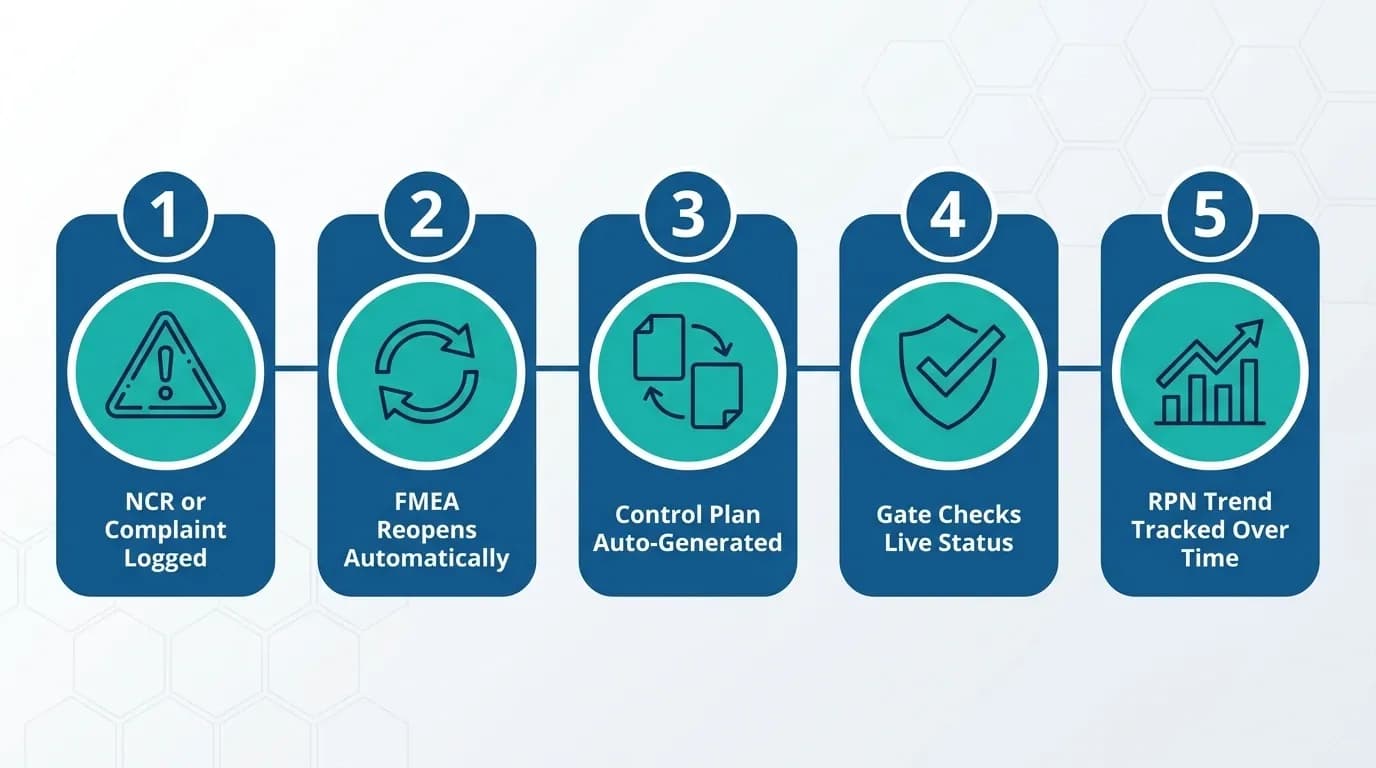
A live FMEA process works differently to a filed one. When a new complaint or NCR gets logged against a part number, the FMEA tied to that failure mode reopens on its own. It doesn't wait for someone to remember it exists.
That single change closes the gap the APQP process depends on. The evidence at a gate reflects what's actually known right now, not what was known whenever the document was last opened.
The same logic applies to control plans. Instead of an engineer manually copying FMEA outputs into a separate document, the control plan gets generated directly from the FMEA. One less place for the data to drift out of sync. One less manual step where something gets missed or mistyped.
At gate review, this matters more than it does day to day. A gate isn't asking whether the FMEA was ever completed. It's asking whether it's still true. A live FMEA can actually answer that question. A filed one can only confirm it existed at some point in the past.
There's a further benefit past the individual gate. A live FMEA builds a running RPN trend for each failure mode over time, which shows whether the corrective actions taken are actually reducing risk, not just whether someone signed off once and moved on.
How LTS Data Point connects gate evidence in one system
None of this requires a new framework. It requires the evidence to stop living in five different places.
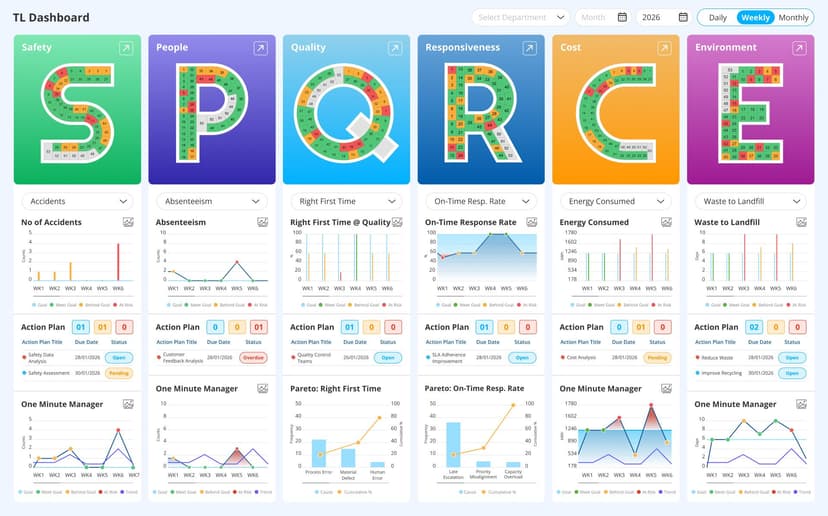
Data Point quality management dashboard already links action plans to specific KPIs, not just to a generic to-do list. Each one gets an owner. Each one needs an accept or decline before it counts as active. That creates a trail - who approved it, when, against what metric.
Apply that same logic to a gate:
- An FMEA finding becomes an action plan through CAPA software, not a note in a separate file
- The owner and sign-off status are visible before the gate, not assembled the morning of
- The audit trail already exists, because the accept or decline step created it
A quality team walking into an APQP gate review with this in place isn't pulling four documents together the night before. They're opening one system that already shows what's been actioned, what's pending, and who's accountable for each.
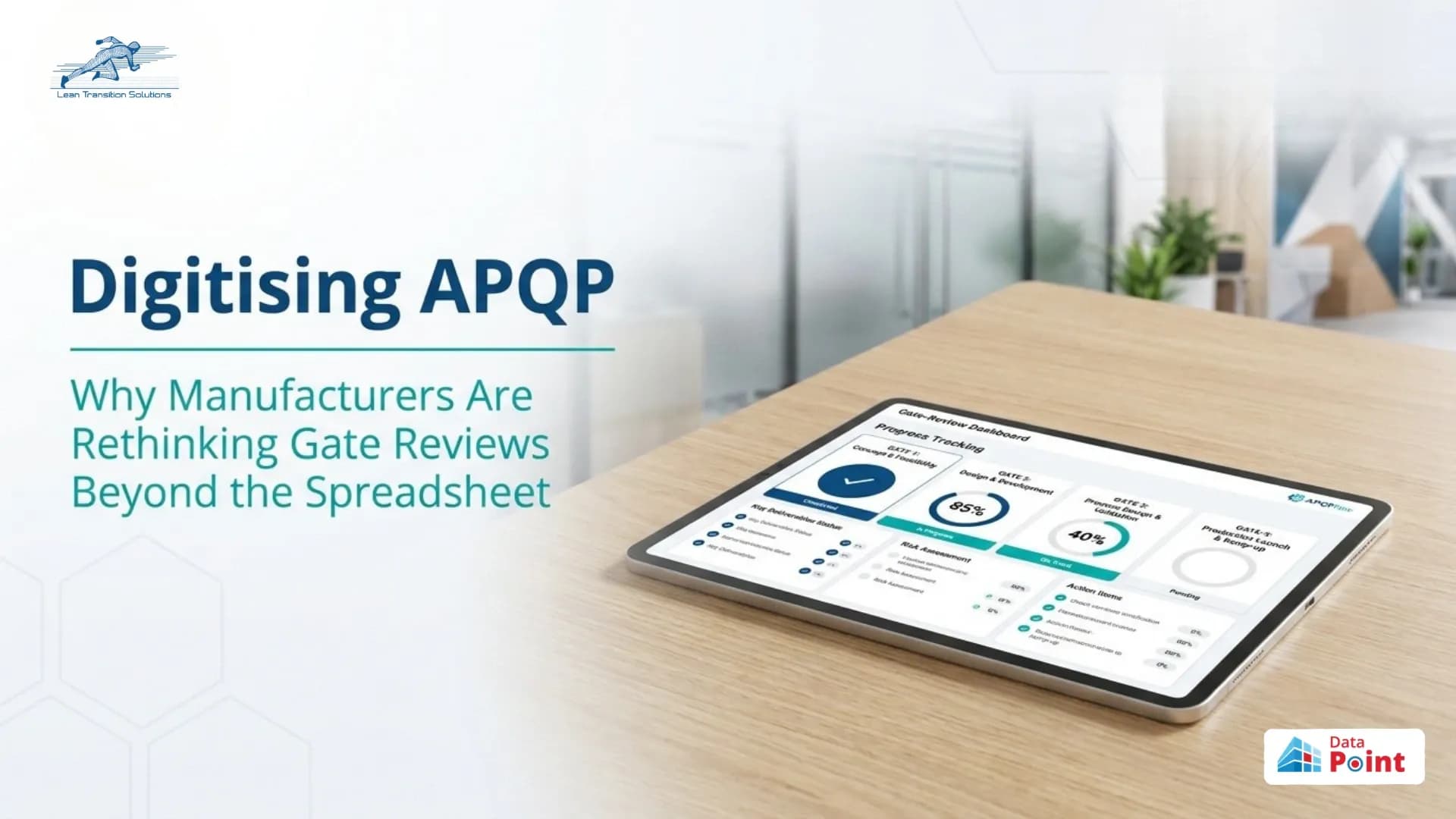
That's the difference between showing a gate was signed and showing it should have been. In practice, this is what a digital APQP gate dashboard delivers.
A signed gate used to mean the paperwork was done. It should mean the evidence behind it is still true, right now, not whenever someone last opened the file.
That's the real shift. Not a new framework, not more forms to fill in. Just evidence sitting in one place, already current, instead of five folders stitched together the night before someone asks for proof.
Your APQP evidence breaks down somewhere before the gate does. An LTS Data Point expert can help you find exactly where.
FAQs
1. How many gates does the APQP process have?
APQP typically runs through five phases – planning, product design and development, process design and development, product and process validation, and production/feedback - with formal gate reviews at the end of each stage before the next can begin.
2. What's the difference between APQP and PPAP?
APQP is the full planning process from concept through production validation. PPAP is the evidence package (the documents, data, and physical parts) that proves APQP was actually carried out, and the part is ready for production.
3. Who is responsible for signing off an APQP gate?
Sign-off typically involves a cross-functional team – design, quality, and manufacturing engineering – presenting evidence and risk mitigation, with management granting approval to move to the next phase.
4. Is APQP only used in the automotive industry?
No. While APQP originated in automotive under AIAG, aerospace and rail suppliers increasingly apply the same phase-gated approach, often adapting it to their own standards such as AS9145.
5. How is a live FMEA different from a standard FMEA?
A standard FMEA is typically completed once, often to support a PPAP submission, and then left as a static document. A live FMEA automatically reopens or flags for review when a related complaint, NCR, or defect is logged against the same failure mode, keeping the risk assessment current rather than historical.

Abel Jiménez, Lean Consultant
Abel is a Lean Consultant with over 30 years of expertise in operational analysis, process improvement, and organisational change across Mexican industries. Currently serving as Director of Insurance Promotions at CESCEMEX, he helps organisations leverage technology and lean practices to improve efficiency and manage change with continuity.