25 Home Healthcare KPIs: Measuring Patient Care, Staff Efficiency, and Operational Excellence
Last updated on : April 7, 2026
For CEOs, COOs, and Chief Nursing Officers in home healthcare organisations, delivering consistent patient care while managing distributed teams is a constant challenge. Leaders must balance care quality, staff utilisation, regulatory compliance, and operational costs – often across hundreds of patient visits happening outside traditional clinical settings. Without the right home healthcare KPIs, it becomes difficult to understand where care delivery is improving, where staff capacity is stretched, and which operational issues are affecting patient outcomes.
Explore how LTS Data Point can centralise home healthcare KPIs and strengthen operational visibility
Why home healthcare KPIs matter for care quality and operational visibility
Home healthcare industries operate in a distributed care environment where clinicians, caregivers, and support teams deliver services across multiple patient homes. Without clear performance tracking, leadership teams often struggle to maintain visibility into care delivery, workforce utilisation, and operational efficiency.
This is where home healthcare KPIs and other structured KPI tracking through clear home healthcare metrics become essential.
Key reasons organisations track home healthcare KPIs
- Monitor patient care quality: Tracking patient care quality metrics helps organisations understand whether care delivery is consistent and aligned with clinical standards. These indicators provide visibility into patient outcomes, treatment effectiveness, and service reliability.
- Measure patient health outcomes: Using patient outcome metrics allows providers to evaluate whether care interventions are improving patient health and recovery. These insights help identify areas where care processes may need adjustment.
- Improve workforce visibility: Home healthcare services rely on distributed teams working in the field. Home healthcare performance indicators help leaders track caregiver workloads, visit adherence, and staff utilisation across multiple locations.
- Identify operational performance visibility: Tracking home healthcare KPIs reveals patterns in service delivery, such as visit completion rates, scheduling gaps, or delays in care coordination. This helps leaders address operational inefficiencies early.
- Connect daily care activities to strategic goals: By analysing structured home healthcare metrics, executives can link daily patient visits, staff productivity, and service performance to broader organisational goals such as improved outcomes and efficient resource utilisation.
This approach helps industries move from fragmented reporting to clear performance visibility across care quality, workforce management, and operational performance.
Key home healthcare KPIs across patient care, workforce productivity, and operations
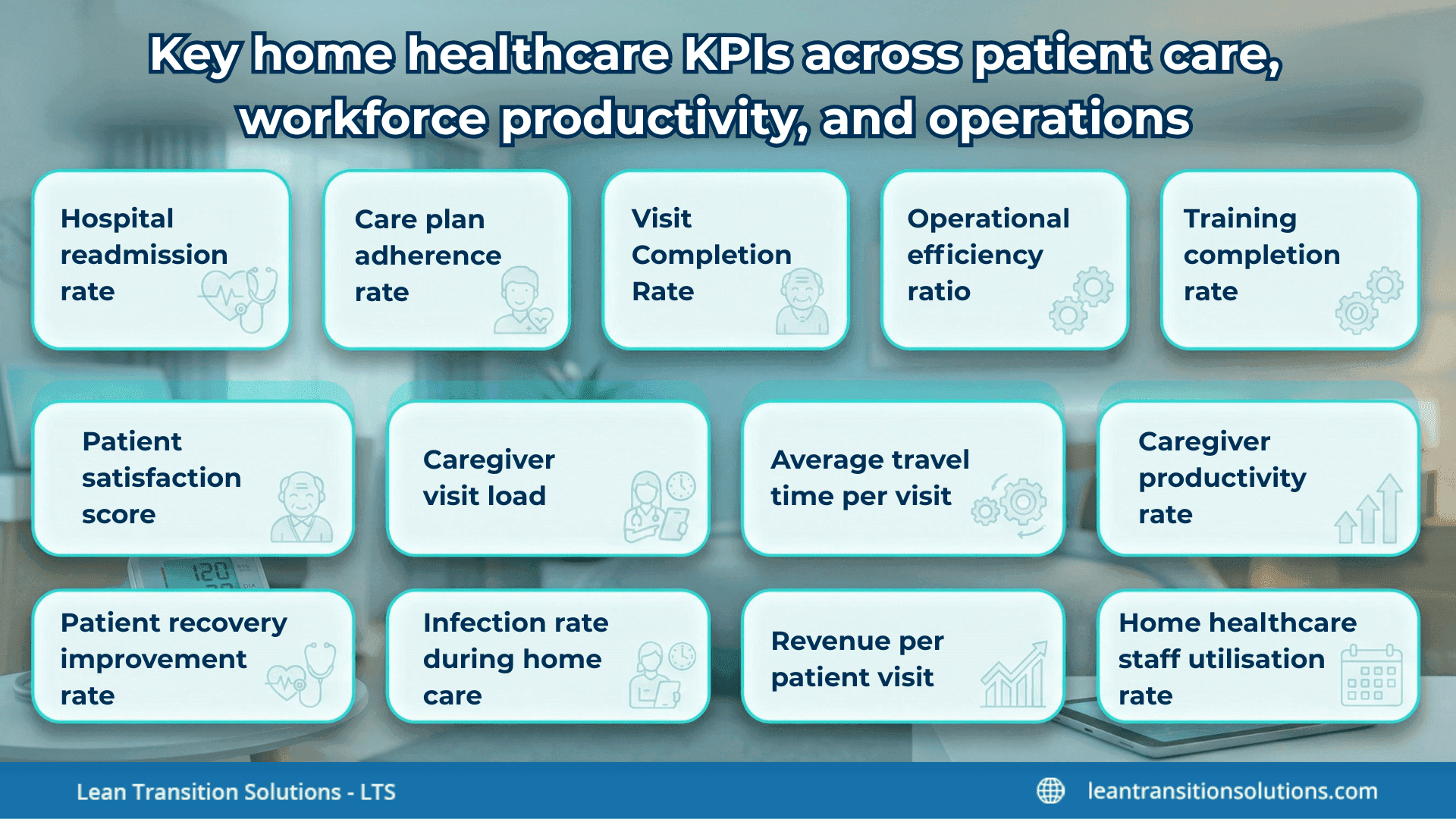
Home healthcare organisations rely on structured home healthcare KPIs to evaluate performance across multiple dimensions of care delivery. These indicators help leadership track patient outcome metrics, monitor caregiver productivity metrics, and assess healthcare operational KPIs that influence both service quality and financial stability. Many of these measures also align with broader quality metrics in healthcare, which help organisations evaluate clinical effectiveness and service reliability.
For practical analysis, these home healthcare metrics are often associated with three areas of performance:
- Patient care and clinical outcome KPIs: Indicators that evaluate patient care quality metrics, recovery progress, and treatment effectiveness.
- Workforce and caregiver productivity KPIs: Indicators that track home healthcare staff utilisation, caregiver workload, and service reliability.
- Operational and financial KPIs: Indicators that measure home care operational metrics, cost management, and service efficiency.
Below are 25 essential home healthcare KPIs commonly used to measure care quality, workforce performance, and operational effectiveness.
Hospital readmission rate
- Why it matters: Measures how often patients receiving home healthcare services are readmitted to the hospital. High readmission rates may indicate gaps in patient outcome metrics or ineffective care coordination.
- How to calculate: Hospital readmission rate = (Number of patients readmitted to hospital within 30 days / Total home healthcare patients) x 100
Patient recovery improvement rate
- Why it matters: Tracks the percentage of patients who demonstrate measurable health improvement during home care. This is a key patient care quality metric.
- How to calculate: Patient recovery improvement rate = (Patients showing measurable clinical improvement / Total patients receiving care) x 100
Care plan adherence rate
- Why it matters: Indicates how consistently caregivers follow prescribed treatment plans, which directly impacts clinical quality indicators.
- How to calculate: Care plan adherence = (Completed care plan activities / Total scheduled care plan activities) x 100
Patient satisfaction score
- Why it matters: Computes how patients perceive care quality, communication, and service reliability using patient satisfaction metrics.
- How to calculate: Patient satisfaction score = Average rating collected from post-care patient surveys
Medication management accuracy
- Why it matters: Tracks medication administration accuracy to reduce clinical risks and strengthen clinical quality indicators.
- How to calculate: Medication management accuracy = (Correct medication administrations / Total medication administrations) x 100
Care transition success rate
- Why it matters: Measures how effectively patients transition from hospital care to home healthcare without complications. This supports stronger patient outcome metrics and continuity of care.
- How to calculate: Care transition success rate = (Patients stabilised after discharge / Total discharged patients receiving home healthcare) x 100
Average length of home care episode
- Why it matters: Indicates how long patients typically remain under home healthcare services, helping assess recovery efficiency.
- How to calculate: Average care episode length = Total care days across patients / Total number of patients
Patients visit completion rate
- Why it matters: Measures the frequency of safety incidents during home healthcare visits, helping organisations improve risk management.
- How to calculate: Patient safety incident rate = (Total reported incidents / Total patient visits) x 100
Patient safety incident rate
- Why it matters: Tracks how consistently scheduled patient visits actually occur, which affects service reliability and care outcome measurement.
- How to calculate: Visit completion rate = (Completed visits / Scheduled visits) x 100
Infection rate during home care
- Why it matters: Tracks infections during treatment to maintain strong patient care quality metrics.
- How to calculate: Infection rate = (Number of infection cases / Total home healthcare patients) x 100
Caregiver productivity rate
- Why it matters: Measures the efficiency of the caregivers by analysing completed visits relative to available working hours. This is a key caregiver productivity metric.
- How to calculate: Caregiver productivity rate = Total completed visits / Total caregiver working hours
Clinician productivity rate
- Why it matters: Tracks clinical staff performance and supports stronger clinician productivity metrics.
- How to calculate: Clinician productivity rate = Total patient visits handled / Total clinician working hours
Home healthcare staff utilisation rate
- Why it matters: Shows how effectively workforce capacity is used across patient visits and care delivery.
- How to calculate: Staff utilisation rate = (Total productive care hours / Total staff hours) x 100
Visit adherence rate
- Why it matters: Measures whether caregivers complete visits according to scheduled times, strengthening service reliability.
- How to calculate: Visit adherence rate = (Visits completed on schedule / Total scheduled visits) x 100
Caregiver visit load
- Why it matters: Tracks the average number of visits assigned to each caregiver to prevent workload imbalance.
- How to calculate: Caregiver visit load = Total visits / Total caregivers
Staff scheduling efficiency
- Why it matters: Evaluates how effectively patient visits are scheduled relative to workforce capacity.
- How to calculate: Scheduling efficiency = (Scheduling productive hours / Total available staff hours) x 100
Caregiver retention rate
- Why it matters: Indicates how successfully the organisation retains skilled caregivers, which affects care continuity.
- How to calculate: Caregiver retention rate = (Number of caregivers retained / Total caregivers at start of period) x 100
Staff turnover rate
- Why it matters: Measures workforce stability and its impact on service consistency.
- How to calculate: Staff turnover rate = (Employees leaving during period / Average total employees) x 100
Training completion rate
- Why it matters: Ensures caregivers and clinicians complete mandatory training programmes for quality care delivery.
- How to calculate: Training completion rate = (Employees completing required training / Total employees required to complete training) x 100
Average travel time per visit
- Why it matters: Evaluates operational efficiency and route planning for home healthcare staff.
- How to calculate: Average travel time = Total caregiver travel time / Total patient visits
Cost per patient visit
- Why it matters: Tracks operational costs associated with delivering a single patient visit, a key home care operational metric.
- How to calculate: Cost per visit = Total operational costs / Total patient visits
Revenue per patient visit
- Why it matters: Helps organisations understand the financial return generated from each visit.
- How to calculate: Revenue per visit = Total revenue from home healthcare services / Total visits
Visit completion rate
- Why it matters: Computes how reliably care services are delivered according to plan.
- How to calculate: Visit completion rate = (Completed visits / Scheduled visits) x 100
Billing accuracy rate
- Why it matters: Tracks the accuracy of billing processes to reduce revenue leakage and administrative corrections.
- How to calculate: Billing accuracy rate = (Accurate bills / Total bills issued) x 100
Operational efficiency ratio
- Why it matters: Measures how efficiently operational resources support care delivery across services.
- How to calculate: Operational efficiency ratio = Total operational output / Total operational costs
How organisations use home healthcare KPIs to improve performance
Collecting data alone does not improve performance – the real value of home healthcare KPIs comes from how organisations use them to guide decisions, prioritise improvements, and strengthen care delivery.
High-performing providers integrate home healthcare performance measurement into regular operational reviews and management discussions. By analysing healthcare service delivery metrics, leaders can identify performance gaps, understand operational trends, and support strategic planning in healthcare by prioritising improvement initiatives that strengthen care delivery.
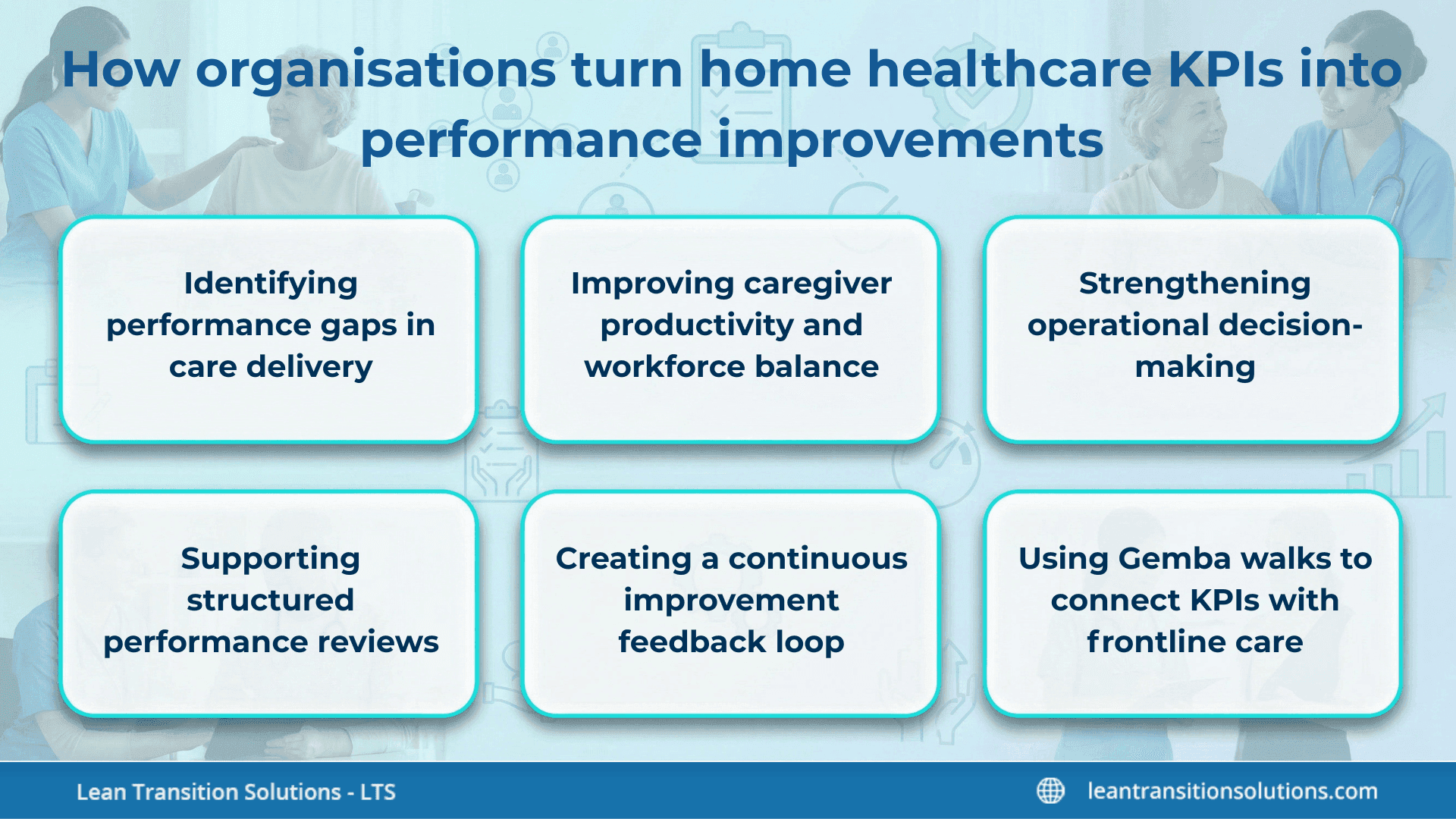
How organisations turn home healthcare KPIs into performance improvements
- Identifying performance gaps in care delivery: Leaders review patient outcome metrics and patient care quality metrics to detect patterns such as rising readmission rates, delayed recoveries, or inconsistent treatment adherence. These insights help organisations address issues before they affect larger patient populations.
- Improving caregiver productivity and workforce balance: Analysing caregiver performance metrics and broader home healthcare workforce metrics helps organisations understand whether workloads are distributed effectively. This allows leaders to adjust staffing levels, optimise scheduling, and reduce burnout among care teams.
- Strengthening operational decision-making: Tracking healthcare operational KPIs enables leadership teams to evaluate service efficiency, monitor cost trends, and improve resource allocation across locations or service lines.
- Supporting structured performance reviews: Many organisations integrate home health agency KPIs into regular management reviews, tiered meetings, or performance dashboards. Applying principles of visual management in healthcare helps leaders present healthcare service delivery metrics clearly, enabling teams to quickly identify performance gaps and prioritise corrective actions.
- Creating a continuous improvement feedback loop: When organisations consistently review home healthcare KPIs, they move beyond static reporting. Performance data becomes a foundation for ongoing improvement initiatives that strengthen care quality, workforce productivity, and operational reliability. By using home healthcare KPIs in the structured way, organisations transform raw data into actionable insights that support better patient outcomes and more efficient care delivery.
- Using Gemba walks to connect KPIs with frontline care: Some organisations complement home healthcare performance measurement with practices like Gemba walk in healthcare, where leaders observe care delivery processes directly. During these reviews, leaders compare frontline observations with healthcare service delivery metrics and patient outcome metrics to understand why certain performance patterns occur. This approach helps connect home healthcare KPIs with real operational conditions, allowing organisations to identify workflow issues, training gaps, or coordination challenges that may not be visible in reports alone.
How LTS Data Point performance management software supports home healthcare KPIs and performance visibility
Managing large volumes of home healthcare KPIs across multiple teams and locations can become complex when organisations rely on fragmented spreadsheets, disconnected reports, or manual tracking methods. Without a structured system, leadership teams often struggle to maintain consistent visibility into home healthcare metrics, workforce performance, and operational outcomes.
LTS Data Point performance management software helps organisations centralise home healthcare performance indicators and monitor healthcare operational KPIs in a structured, connected environment.
How LTS Data Point supports home healthcare KPI management
- Centralised KPI visibility: The platform consolidates critical home healthcare metrics such as patient outcomes, caregiver productivity, and operational performance into one system, giving leadership teams a unified view of organisational performance.
- Structured performance tracking: Organisations can track key home healthcare performance indicators consistently across teams and locations, reducing fragmented reporting and improving data reliability.
- Workforce and operational performance monitoring: Leaders can monitor home healthcare workforce metrics alongside broader healthcare operational KPIs, helping identify trends in caregiver productivity, visit adherence, and service delivery efficiency.
- Improved accountability and review processes: By connecting care outcome measurement with structured performance reviews, the platform helps organisations maintain visibility into progress, identify performance gaps, and ensure improvement initiatives move forward.
By providing a structured system for monitoring home healthcare KPIs, LTS Data Point performance management software helps organisations strengthen performance visibility, support better operational decision-making, and improve overall care delivery.
Tracking the right home healthcare KPIs enables organisations to move beyond basic reporting and gain meaningful visibility into care delivery, workforce performance, and operational efficiency. By monitoring structured home healthcare metrics such as patient outcome metrics, caregiver productivity metrics, and healthcare operational KPIs, leadership teams can better understand how daily activities influence patient care quality and overall service performance.
When these home healthcare performance indicators are reviewed consistently, they help organisations identify improvement opportunities, balance workforce capacity, and strengthen accountability across teams. Ultimately, using well-defined home health agency KPIs allows providers to make more informed decisions, improve care outcomes, and build a more reliable and efficient home healthcare operation.
Speak with an expert to understand how LTS Data Point supports home healthcare KPI tracking and performance management
FAQs
1. How often should home healthcare KPIs be reviewed?
Most home healthcare KPIs should be reviewed regularly to ensure timely decision-making. Operational indicators such as visit completion and caregiver utilisation are often reviewed weekly, while broader home healthcare performance indicators like patient outcomes or financial metrics may be evaluated monthly or quarterly.
2. Who is responsible for tracking home healthcare KPIs?
Tracking home healthcare KPIs typically involves multiple leadership roles. Operations managers monitor home healthcare workforce metrics, clinical leaders review patient care quality metrics, and executives evaluate broader healthcare operational KPIs to guide strategic decisions.
3. What makes a good home healthcare KPI?
An effective home healthcare KPI should be measurable, relevant to care delivery, and aligned with organisational goals. Strong KPIs clearly connect daily care activities with outcomes such as improved patient outcome metrics, better caregiver productivity, or stronger operational efficiency.
4. How do home healthcare KPIs support regulatory compliance?
Many home healthcare KPIs align with regulatory requirements related to patient safety, quality of care, and service reliability. Monitoring indicators such as infection rates, readmissions, and care plan adherence helps organisations demonstrate compliance and maintain high clinical standards.
5. What challenges do organisations face when tracking home healthcare KPIs?
Common challenges include fragmented data sources, manual reporting processes, and inconsistent definitions of home healthcare metrics across teams or locations. Without standardised tracking, organisations may struggle to maintain reliable home healthcare performance measurement.
6. How can technology improve home healthcare KPI tracking?
Digital performance management systems can centralise home healthcare performance indicators, automate data collection, and provide real-time visibility into healthcare service delivery metrics. This helps organisations move beyond static reports and focus on performance improvement.
7. How do home healthcare KPIs differ from hospital KPIs?
While hospitals focus heavily on facility-based operations, home healthcare KPIs emphasise distributed care delivery. Metrics often prioritise caregiver productivity, visit adherence, patient recovery progress, and coordination across remote care environments.
8. Can small healthcare agencies benefit from KPI tracking?
Yes. Even smaller providers benefit from monitoring essential home healthcare KPIs such as patient satisfaction, visit completion rates, and staff utilisation. These home health agency KPIs help organisations maintain consistent care quality as they grow.

Amer Jumah, Senior Lean Consultant
Amer is co-founder of Agile Solutions and a certified Six Sigma Black Belt, Lean Black Belt, and PMP, with over nine years of experience implementing Lean, Six Sigma, and Agile principles across diverse industries. He specialises in process optimisation, waste elimination, and delivering cost savings through organisational change.