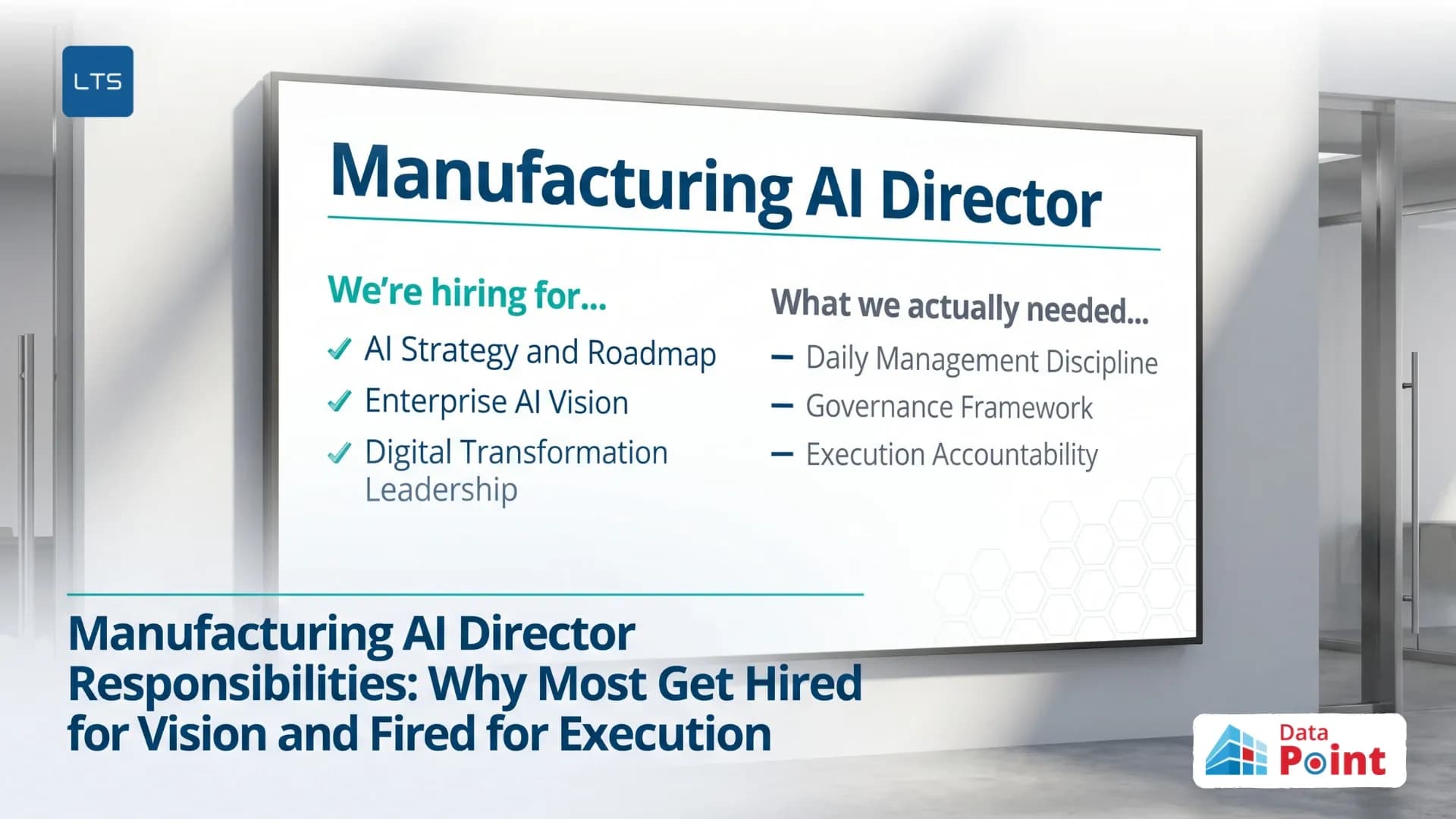
Manufacturing AI Director Responsibilities: Why Most Get Hired for Vision and Fired for Execution
Last updated on : June 25, 2026
Simply adopting AI didn’t help. So, I hired an AI director. But do I even know what manufacturing AI director responsibilities look like, and whether I set the role up to succeed?
If this is how your thoughts formed, you’re not alone. This is one of the most asked questions when it comes to AI adoption.
Recent facts show that the share of organisations with a Chief AI Officer jumped from 26% in 2025 to 76% in 2026, a near tripling in 12 months. Even still, organisations with AI-first C-suite scaled only 10% more AI initiatives enterprise-wide than peers without one. Moreover, 83% of CEOs were of the opinion that AI success is mostly determined not by how the technology works, but whether people actually use it.
See how LTS Data Point gives your Manufacturing AI Director the daily management infrastructure they need to govern AI across the operation
The manufacturing AI director is not a tech role. Here's what it actually owns
Most organisations write the job description for a Manufacturing AI Director the same way they would write a senior data scientist.
That is the first mistake.
The role is no longer the same. AI is no longer a commodity to be sold internally. AI has become operationally heavier, meaning it should work at the plant level, from running pilots to owning implementation across manufacturing AI operations.
The change in the reporting hierarchy confirms this. More than half of manufacturing AI directors now report directly to the CEO or board, not to IT leadership. That structural decision tells you everything about what the role is expected to deliver: not a working model, not a technology roadmap, but measurable operational performance. The board is never interested in algorithms. What they are interested about is why yield dropped on line three and what is being done about it today.
The real skill no longer lies in learning how to use the model. It lies in analysing what an AI system surfaces and connecting it to an operational decision, a shift action, a quality response, a tier meeting escalation.
That is not a technology role that happens to work in manufacturing. It is an operations role that happens to use AI. Manufacturing AI leadership starts with understanding that distinction. This operational focus is exactly what separates AI governance from smart manufacturing more broadly - the director's job is to make sure AI outputs plug into the same daily management structure that smart manufacturing already depends on
Why Manufacturing AI Directors fail before they deliver
The Manufacturing AI Director is not a new kind of failure. This is already a repetition of the past.
The chief digital officer wave a decade ago followed this same arc. They were hired faster, companies were positioned as transformational, then gradually sidelined by organisations that had not changed around them. The technology changed over time. The failure mode did not.
But this ambiguity is not accidental. When Chief Technology Officer, Chief Information Officer, Chief Data Officer, and Chief Digital Officer each hold partial ownership of AI, that Manufacturing AI Director is left in the dark. Instead of solving this together, they step into a negotiation over territory that takes quarters to resolve. This ends up in not fully settling on an issue.
Availability of well-structured data is what ensures the success. Organisations that redesigned five core business areas (technology, finance, HR, operations, cross-functional collaboration) way before expecting results from AI leadership were four times more likely to deliver on their objectives. The role is not the superhero that lifts the company on their shoulders. The organisation should be the one to take the first step.
What makes all of these worse is the urgency.
CEOs expect AI to make nearly half of all codifiable operational decisions autonomously by 2030. Yet 79% of those same executives are already forcing this autonomous decision-making down the organisation without finalising the rules, controls, and accountability structures in place to govern how those decisions get made.
What happens in reality becomes this:
The Manufacturing AI Director is being hired to lead AI adoption inside that vacuum of a company. No clear boundaries on what AI can decide alone is given. No defined escalation path when it gets it wrong. No governance layer to catch the gaps.
And the expectation is roof high. They are expected to fix all of these while also delivering results.
The role does not fail because the wrong person is hired. This is not a failure of manufacturing AI governance. It is a failure of the conditions the role was placed into.
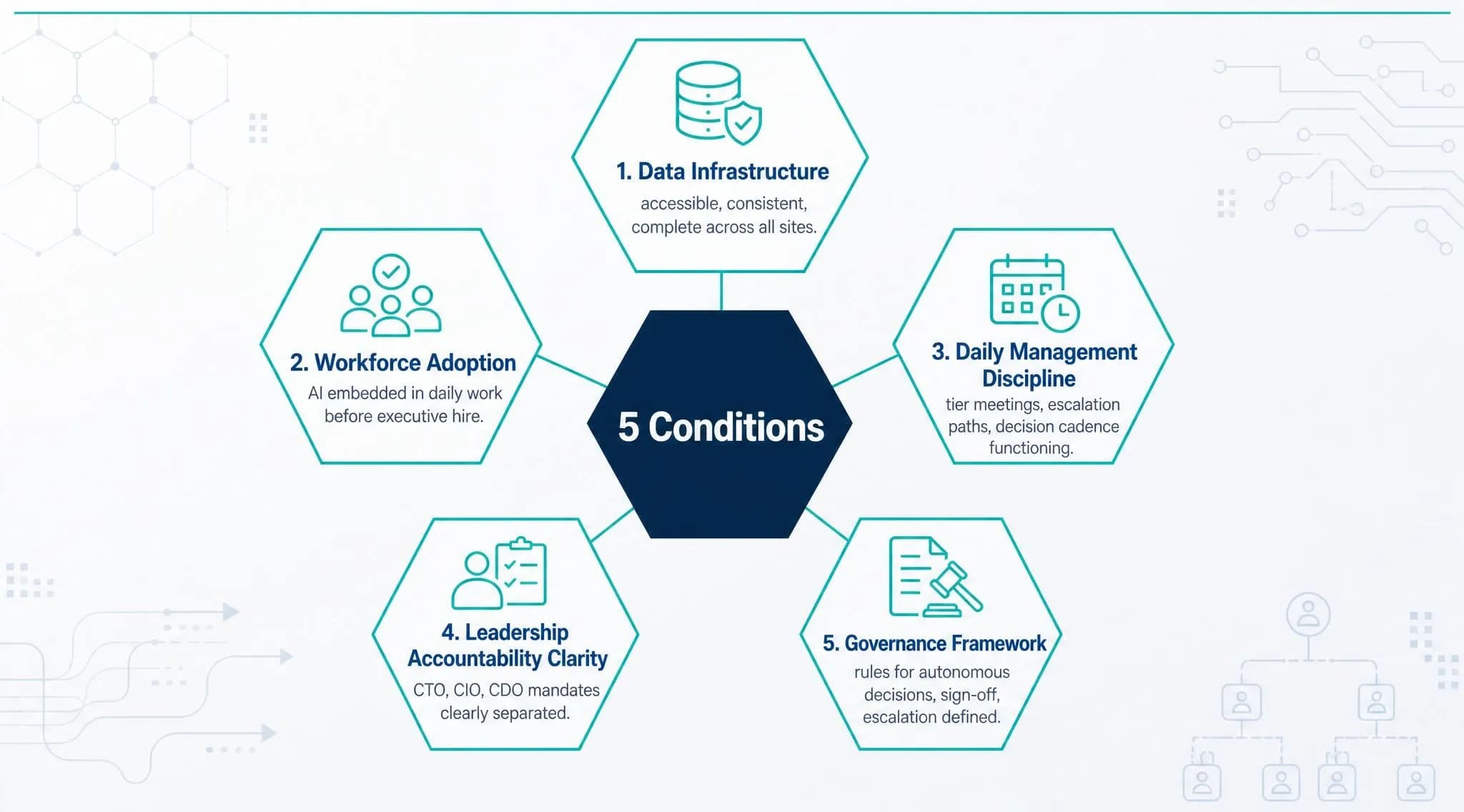
Five organisational conditions that must exist before hiring a Manufacturing AI Director
Most organisations believe they are already there. The data says something else.
Only 26% of Chief Data Officers are confident their organisation’s data can actually support AI-enabled outcomes. If the data foundation is not there, nothing that follows will hold.
We keep discussing how organisations should take the first step and do the right thing. But what does an organisation actually need to get right?
Here is where to start:
- Data infrastructure: Plant floor data must be accessible, consistent, and complete across systems and sites. Siloed or inconsistent data means the AI director has nothing reliable to govern.
- Workforce adoption: AI must already be part of daily work for a meaningful share of the workforce. Manufacturing AI readiness starts here, not at the executive level.
- Daily management discipline: The tier meeting structure, escalation paths, and decision review cadence must be in place and functioning. AI surfaces signals. The AI tier meetings layer is what acts on them. Without it, the signals go nowhere.
- Leadership accountability clarity: Chief Technology Officer, Chief Information Officer, Chief Data Officer, and Chief Digital Officer mandates must be clearly separated before the new role is created. The Manufacturing AI Director cannot spend their first six months in a territory negotiation.
- Governance framework: Rules for what AI can decide autonomously, what requires human sign-off, and what triggers escalation must be defined before deployment, not built reactively after the first failure.
Appointing the director before this work is done does not accelerate transformation. It just gives it a title.
The responsibilities that define the Manufacturing AI Director role
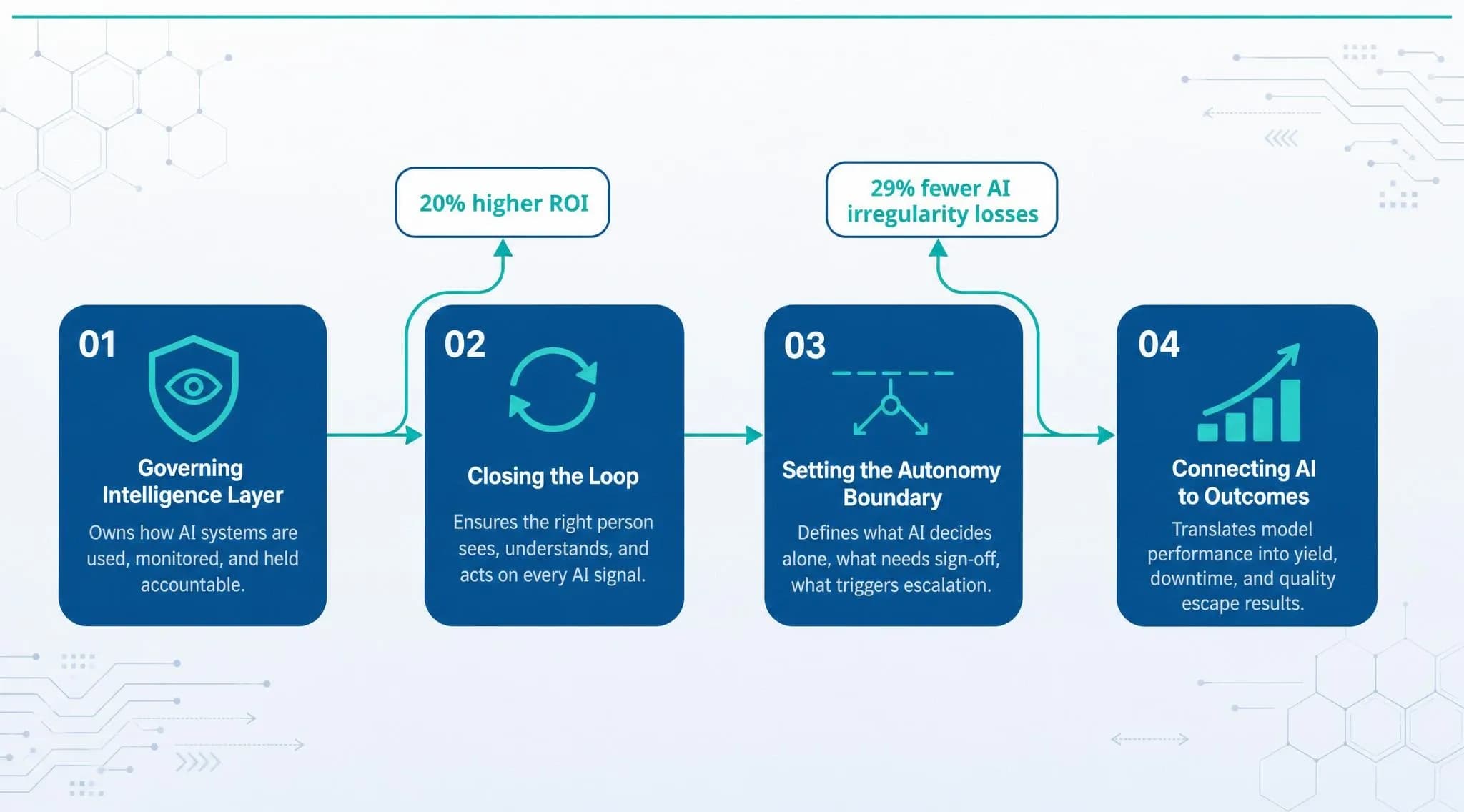
The job description will list competencies. Most of them will sound like any other senior leadership role. What separates the Manufacturing AI Director from every other title on the org chart is not the skills it requires. It is the specific accountabilities it holds that no other role was built to carry.
The core responsibilities a Manufacturing AI Director must handle are:
- Governing intelligence layer: The Manufacturing AI Director does not build AI systems. They own how those systems are used, monitored, and held accountable across the operation.
- Closing the loop between AI output and human action: AI surfaces a signal. Someone has to ensure the right person sees it, understands it, and acts on it within the right timeframe. That ownership sits with the Manufacturing AI Director.
- Setting the autonomy boundary: Defining what AI is permitted to decide without human intervention, what requires sign-off, and what triggers escalation is not a one-time policy decision. It is a standing responsibility that evolves as AI capability grows.
- Connecting AI performance to operational outcomes: Model accuracy is not the measure. Yield improvement, downtime reduction, and quality escape rate are. The Manufacturing AI Director is accountable for translating one into the other.
The role of a Manufacturing AI Director is to be a conductor rather than be a builder. Models, pipelines and dashboards already exist or somebody else is making them. What does not exist in most organisations is someone accountable for whether all of it moves in the same direction, at the same pace, toward the same operational outcome. That is the gap this role was created to close.
Even though by 2030, CEOs expect AI make nearly half of operational decisions without any human intervention, still most organisations haven’t decided on which decisions qualify. That boundary – what AI can action alone, what needs a human signature, and what triggers an escalation – is one of the most consequential governance decisions a manufacturing business will make this decade. And in most plants today, nobody owns it.
AI operational excellence is not a technology outcome. It is a governance outcome.
Organisations with structured AI accountability report 20% higher ROI and 29% fewer losses from AI irregularities. Neither of those is a technology metric. They are operational outcomes. The Manufacturing AI Director is not measured on whether the model is accurate. They are measured on whether the plant is better because the model is running.
How to assess whether your organisation is ready and what to do if it is not
When analysed properly, the entire question changes overnight.
From: Does my organisation need a Manufacturing AI Director? To: Is my organisation structured and ready to let one succeed?
When you finally reach this question, a chain of questions follows this one.
What are the signals that indicate whether my organisation is ready or not?
The Manufacturing AI Director role is evolving from a singular ownership to coordination. In simple terms, the required conditions can be set inside the organisation without the full hire. A cross-functional AI steering group with clear decision rights, a fractional AI leadership arrangement for critical programme phases, or a formally mandated governance committee supported by the right AI platform for enterprise can each close the gaps the full role would otherwise inherit. These are not compromises. They are the structural work that makes the eventual appointment viable.
Most organisations will post the job before they answer these questions. The ones that answer them first are the ones that will not need to post it twice.
The Manufacturing AI Director role is not a hiring decision. It is an organisational readiness decision dressed up as one.
AI does not fail in manufacturing because the technology is wrong. It fails because the conditions were never right. No director, however capable, can govern an intelligence layer that the organisation was not built to act on. The hire does not create the conditions. The conditions create the hire. And the organisations that understand that distinction are the ones that will not be asking the same question two years from now.
The organisations that got this right were never the quickest to hire, but they were the first to build the conditions and then made the appointment count.
Not sure whether your organisation is ready for a Manufacturing AI Director?
FAQs
1. What is the difference between a Manufacturing AI Director and a Chief AI Officer?
The Chief AI Officer sets enterprise-wide AI strategy across all business functions. The Manufacturing AI Director is operationally specific. Their accountability sits on the plant floor. The CAIO sets the direction. The Manufacturing AI Director makes it work in a production environment.
2. What qualifications does a Manufacturing AI Director need?
The role does not require deep technical expertise. The most effective appointments combine operational or lean manufacturing experience with enough AI literacy to govern outputs, set decision boundaries, and connect model performance to plant-floor results. Strategic vision, cross-functional leadership, and the ability to communicate AI outputs to shift-level teams matter more than data science credentials.
3. How does a Manufacturing AI Director differ from a data scientist or AI engineer?
A data scientist builds models. An AI engineer deploys them. The Manufacturing AI Director governs what those systems produce and ensures the operation acts on it. The role sits above the technical layer, not inside it.
4. Can a smaller manufacturing justify a Manufacturing AI Director role?
Not always as a full-time appointment. A fractional AI leadership arrangement or a cross-functional AI governance committee can build the same accountability at a fraction of the cost. The title is secondary to the function.
5. What is the biggest reason Manufacturing AI Directors fail?
Organisational conditions. The role fails not because the wrong person is hired but because the surrounding structure – data infrastructure, governance framework, leadership accountability clarity, daily management discipline – was never in place before the appointment.
6. How do you measure the success of a Manufacturing AI Director?
Not by model accuracy or AI adoption rates. By operational outcomes — yield improvement, reduction in quality escapes, downtime reduction, and the percentage of AI-generated signals acted on within a defined response window.