AI Tier Meetings: Why Generic AI Stops at the Alert and Lean Agentic AI Does Not
Last updated on : June 22, 2026
Remember the time when ChatGPT and Gemini competed in creating images, when social media platforms such as Instagram and Facebook flooded with creative prompts that drew in mass attention?
Yes. But they were just generic hypes intended to draw in the mass. These AIs fail when someone begins to ask the right questions.
Can these AIs actually solve my firm’s operational issues?
The answer will be a fog.
According to Gartner, over 40% of agentic AI projects will be cancelled by the end of 2027.
And the reason?
Unclear business value, escalating costs, and inadequate risk controls.
In manufacturing, that unclear value shows up fastest in AI tier meetings, where generic AI runs out of context and findings stop travelling.
See how LTS Data Point brings lean agentic AI into your tier meeting structure and ensures every finding reaches the level that can act on it
What a generic AI agent does at the tier meeting layer and where it stops
Generic AI can do three things well – it tracks, it spots, and it alerts. Then it stops.
Most agentic AI deployments – including agentic AI for manufacturing operations – are hype-driven and misapplied.
Something goes wrong in the shopfloor. The alert fires. The system has done its job. What happens next lands back in human hands. No structure, no context, no ownership chain, and no connection to the AI daily management system the finding should be travelling through.
Generic AI gives back to the team an alert:
- with no indication on which tier owns the finding
- with no connection to the corrective action already raised at Tier 1
- with no escalation threshold: the system cannot tell the difference between a finding that belongs at the line and one that needs the plant manager
Consider a manufacturing plant where a Tier 2 operations manager receives an AI-generated alert that delivery scores dropped 15% this week. The alert is accurate. The system has no view of which tier 1 issue drove it, who owns the corrective action, or whether it has already been raised at the line. The manager escalates manually. The finding reaches the wrong tier. The action is duplicated.
Every tier meeting guide will tell you that the structure exists to route the right problem to the right level. Generic AI cannot read that structure. It only reads the signal.
Stopping at surfacing the alert is not an AI limitation. It is the limitation of an AI that does not know the context.
What lean operational context actually means in a tier meeting and why it matters
Lean operational context is not a data label. It is a collection of rules that tells a finding where to go and when.
A structured lean operational context actually contains:
- Escalation thresholds: The point at which a finding exceeds the response capability of the current tier and must travel up.
- Ownership structure: Which role at which tier holds accountability for which category of finding.
- SQDCP boundaries: Which pillar the finding sits in and which tier meeting owns that pillar at that level, which is the foundation of any AI lean daily management structure.
The same operational truth looks different at Tier 1 than it does at Tier 3. What a line leader needs to see and what a plant manager needs to act on are two different cuts of the same data. That is the first layer of Lean operational context — data filtered by role and tier.
The second layer is escalation capability. Escalation is not triggered by how bad the number looks. It is triggered by whether the tier that received it has the capability to close it. A system that reads the deviation but not the threshold cannot make that call.
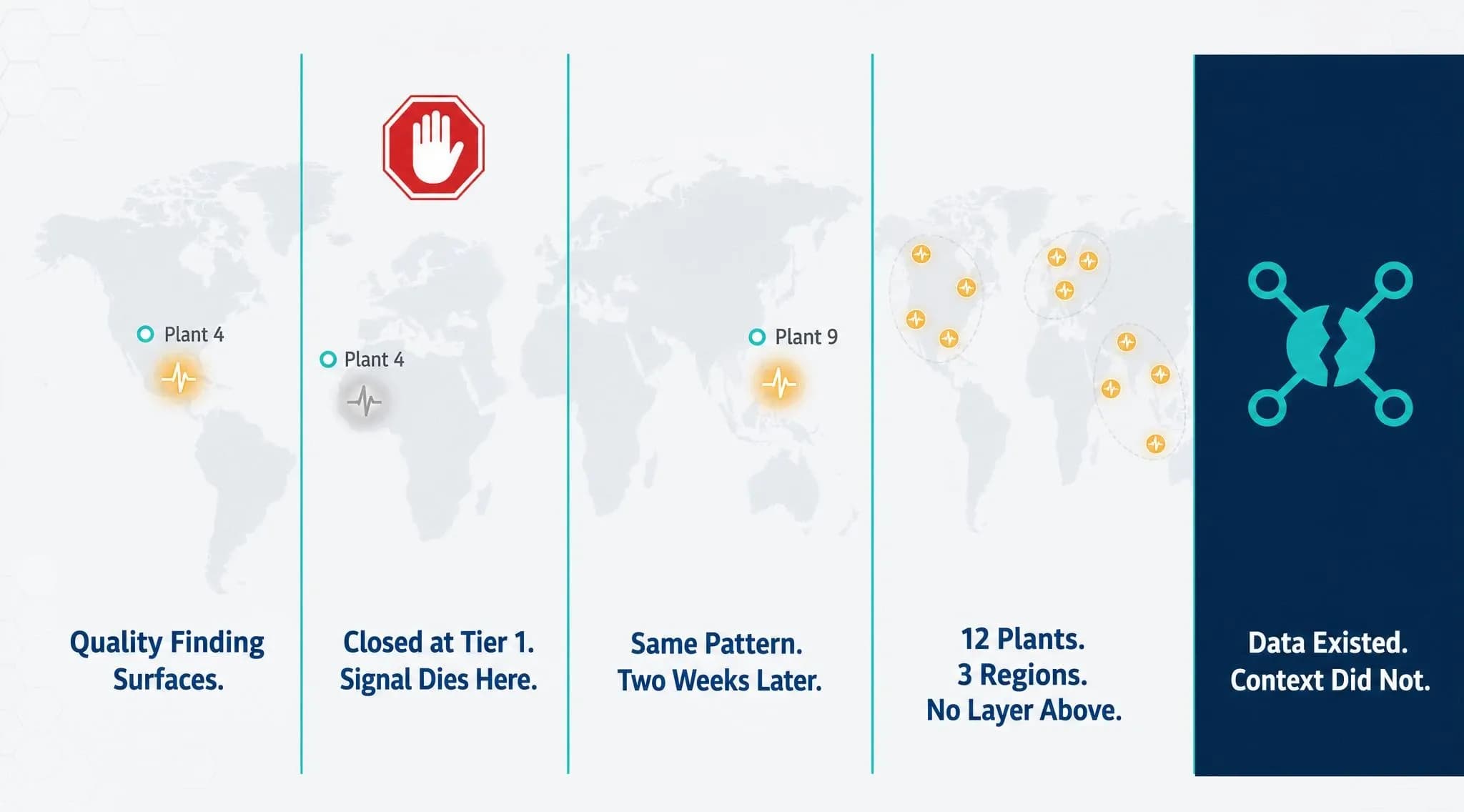
When both layers are missing, this is what happens. A recurring quality finding at Plant 4 gets closed at Tier 1. The same pattern appears at Plant 9 two weeks later. Nobody connected them. Twelve plants. Three regions. Each running its own tier meeting structure with no layer above the site boundary. The data existed. The context that should have connected it did not.
This is precisely why operations meetings fail, not because the data is wrong, but because the structure that should route it is missing.
Why a lean agentic AI changes what the tier meeting can act on
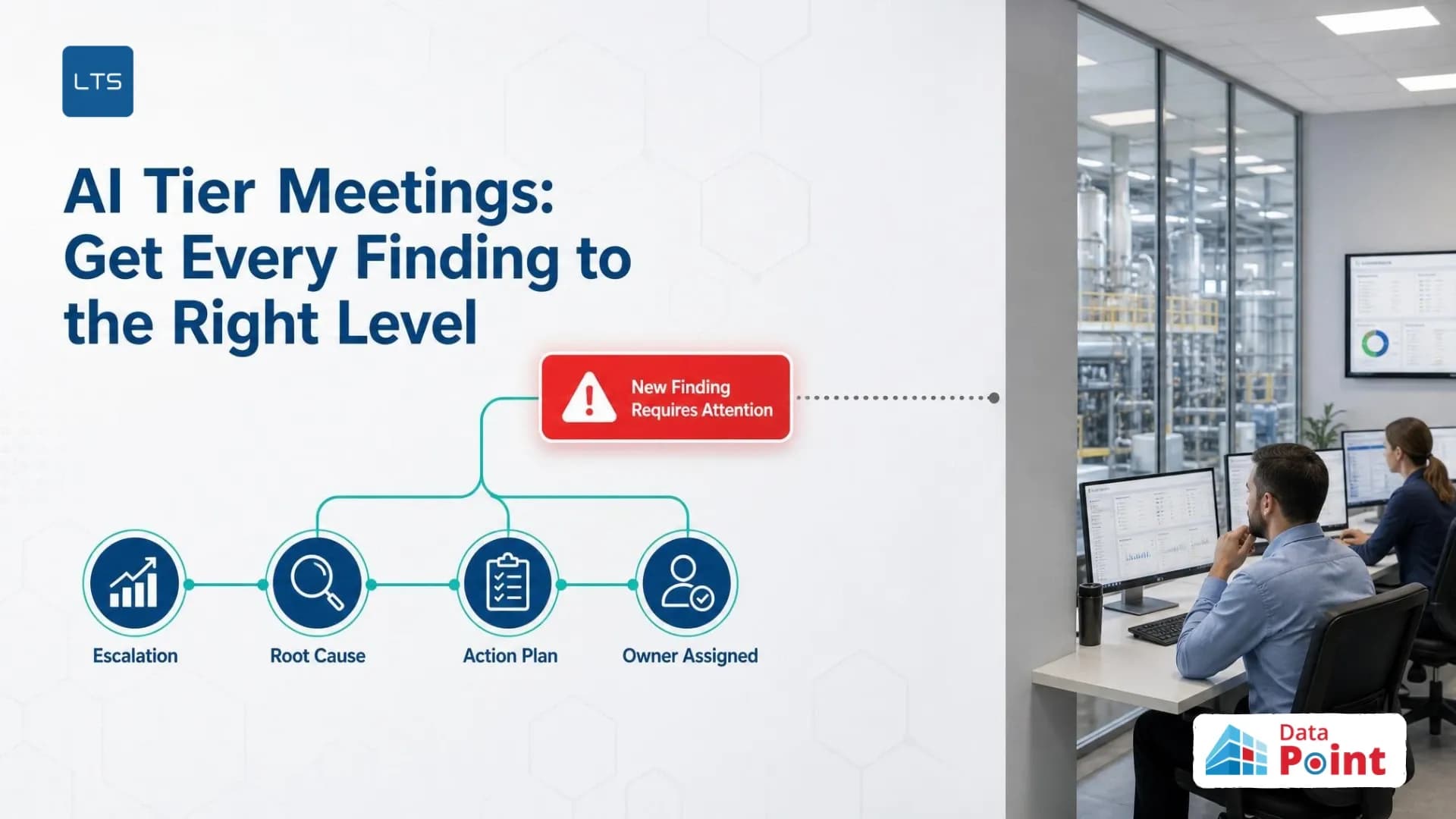
A lean agentic AI does not hand the finding back. It remains in the workflow until the finding has a tier, an owner, and a close date.
When the lean agentic AI remains in the workflow, following changes are bound to happen:
- It maps the finding to the correct tier based on escalation thresholds already defined in the operational structure
- It connects the finding to the ownership layer, the role accountable for that category of issue at that tier
- It holds the action open until the data confirms the fix closed the gap, not until the task is marked complete
The distinction is not technical. It is contextual. A generic AI agent reads the data. A Lean agentic AI reads the data inside the operational structure, knowing which tier the finding belongs to before the shift leader has opened the alert.
That is what moves it from Level 2 to Level 3. At Level 2, AI explains what happened. At Level 3, it tells you what to do next, who owns it, and which tier needs to act. The alert is already behind it. The AI driven decision making that follows is faster because the context was already loaded.
That is what separates a system that closes findings from a system that surfaces them. It is also what separates AI operational excellence from AI noise.
LTS Data Point AI: Lean agentic AI, not a generic assistant
A generic AI agent might not be trained on lean knowledge or on your company’s daily operational functions. It simply brings to your attention what went wrong. Nothing more.
Data Point AI is built exactly for that, to solve this issue that generic AIs pose.
LTS Data Point is not here to compete on features. SAP owns ERP context. Siemens owns automation. Microsoft owns productivity. Data Point AI owns lean operational context that includes daily management, escalation, ownership, strategy deployment, and continuous improvement.
That is not a positioning claim. It is an architectural decision.
The system is built inside the operational structure that tier meetings run on, which means findings do not need to be routed manually. The context is already loaded.
That is not a smarter assistant. That is a different kind of system entirely.
The system routed the finding. The tier acted.
But who in the organisation is accountable for making sure the AI doing that routing is working the way it should?
Your tier meetings run on operational context. Find out if your AI does too.
FAQs
1. Does AI tier meeting software replace the tier meeting structure?
No. AI does not replace the tier meeting structure; it works inside it. The escalation hierarchy, ownership accountability, and cadence of Tier 1, 2, and 3 meetings remain unchanged. What changes is the quality and consistency of what arrives at each tier and whether it arrives at the right one.
2. How is a lean agentic AI different from an AI dashboard?
A dashboard presents data. A lean agentic AI acts on it by mapping findings to tiers, connecting them to owners, and holding actions open until the data confirms closure. One is a display layer. The other is an operational layer.
3. Can generic AI be configured to understand tier meeting structures?
In theory, yes. In practice, the operational context that is required such as escalation thresholds, SQDCP boundaries, ownership structures, shift patterns are specific to each organisation and each site. Generic AI is not built to hold that context natively. Configuration is possible but fragile and requires continuous maintenance.
4. What happens to findings that are not escalated correctly in a tier meeting?
They either get closed at the wrong level actioned by a tier that lacks the authority or resource to fix the root cause, or they disappear entirely. Both outcomes produce the same result: the finding recurs.
5. How does lean agentic AI handle findings that span multiple tiers?
A finding that starts at Tier 1 but requires Tier 3 resource allocation needs to travel through the structure with its context intact – the original finding, the investigation, the attempted fix, and the reason it escalated. A lean agentic AI carries that context through each tier rather than generating a new alert at each level.
6. Does a lean agentic AI work across multiple sites?
Yes, and this is where the operational context argument matters most. Across multiple sites, escalation thresholds, ownership structures, and SQDCP configurations vary. A lean agentic AI holds the context for each site separately while surfacing cross-site patterns that no single site tier meeting would catch on its own.

Amer Jumah, Senior Lean Consultant
Amer is co-founder of Agile Solutions and a certified Six Sigma Black Belt, Lean Black Belt, and PMP, with over nine years of experience implementing Lean, Six Sigma, and Agile principles across diverse industries. He specialises in process optimisation, waste elimination, and delivering cost savings through organisational change.