Nutraceutical Manufacturing KPIs: How to Track Quality, Efficiency, and Compliance in Production
Last updated on : April 8, 2026
Running a nutraceutical plant without clear metrics is like navigating a ship through fog – you're moving, but you can’t see what’s ahead. Nutraceutical manufacturing KPIs are measurable performance indicators used to track product quality, production efficiency, and regulatory compliance across nutraceutical manufacturing operations, helping teams monitor processes, identify gaps, and maintain consistent standards in production. When tracked correctly, they act like a lighthouse and radar, guiding the ship out of the fog with clear visibility into performance, risks, and improvement opportunities.
Discover how LTS Data Point helps track nutraceutical manufacturing KPIs across production and quality operations
Why nutraceutical manufacturing KPIs matter for quality, efficiency, and compliance
The nutraceutical industry focuses on producing products derived from food sources that provide additional health benefits beyond basic nutrition. These include dietary supplements, functional foods, and wellness formulations designed to support health, prevent deficiencies, and improve overall wellbeing.
Because nutraceutical manufacturing combines elements of food processing, pharmaceutical-grade quality control, and scientific formulation, performance measurement becomes essential. This is quality, operational efficiency, and regulatory adherence across the entire production lifecycle.
Why KPI tracking is critical in nutraceutical production

1. Complex multi-stage production
- In nutraceutical manufacturing, production involves several stages including raw ingredient sourcing, blending, granulation, encapsulation, and packaging.
- Each stage of nutraceutical processing must be monitored to ensure consistent product composition and batch performance.
2. High expectations for product safety and quality
- Effective quality control of nutraceuticals ensures products meet formulation specifications and remain safe for consumption.
- Many manufacturers implement strict dietary supplements and nutraceuticals quality control procedures to minimise contamination, potency variation, and product recalls.
3. Growing regulatory and compliance requirements
- Nutraceutical producers must demonstrate traceability, documentation, and quality verification across the production cycle.
- External laboratory validation and nutraceutical safety and efficacy testing services and solution providers are often used to confirm ingredient purity, stability, and health claims.
4. Need for consistent performance visibility
- Without structured nutraceutical manufacturing KPIs, organisations often rely on fragmented reports that make it difficult to identify production inefficiencies or quality risks.
- Clear performance metrics help teams detect deviations early and maintain stable manufacturing outcomes.
Together, these factors make nutraceutical manufacturing KPIs essential for ensuring reliable production, maintaining quality standards, and supporting regulatory compliance in the nutraceutical industry.
Key areas where nutraceutical manufacturing KPIs improve production performance
Tracking nutraceutical manufacturing KPIs helps industries create visibility across critical stages of the production lifecycle. These metrics enable teams to monitor performance, maintain quality standards, and ensure teams to monitor performance, maintain quality standards, and ensure operational efficiency from sourcing to finished product release.
1. Raw material sourcing and procurement
- Nutraceutical procurement transformation focuses on improving supplier reliability, ingredient quality, and traceability.
- KPIs such as supplier quality acceptance rate and raw material rejection rate help ensure that ingredients meet required standards before entering production.
- Monitoring supplier performance reduces the risk of contamination, potency variation, or delays in manufacturing.
2. Product development and formulation
- During nutraceutical product development, performance metrics helps teams evaluate formulation feasibility and production consistency.
- KPIs support nutraceutical formulation development by tracking batch success rates, ingredient compatibility, and formulation stability.
- Monitoring nutraceutical formulation performance ensures that products consistently nutritional specifications and intended health benefits.
3. Production efficiency
- KPIs provide visibility into key stages of nutraceutical manufacturing, including mixing, encapsulation, tableting, and packaging.
- Metrics such as batch cycle time, production yield, and equipment utilisation help identify bottlenecks in nutraceutical processing operations.
- This enables manufacturers to optimise workflows and maintain consistent production output.
4. Quality assurance
- Effective quality control of nutraceuticals requires continuous monitoring of product of product specifications and batch consistency.
- KPIs help track parameters such as specification compliance rates, testing turnaround time, and product stability outcomes.
- These metrics support strong dietary supplements and nutraceuticals quality control practices across manufacturing stages.
5. Compliance and regulatory monitoring
- Nutraceutical manufacturers must maintain strict documentation and testing standards.
- KPIs track audit readiness, deviation rates, and corrective action closure times.
- Collaboration with nutraceutical safety and efficacy testing services and solution providers ensures products meet safety, purity, and regulatory requirements.
By monitoring these areas through nutraceutical manufacturing KPIs, organisations gain clearer insights into operational performance, enabling better decision-making, improved product quality, and stronger compliance management.
15 nutraceutical manufacturing KPIs every manufacturer should track
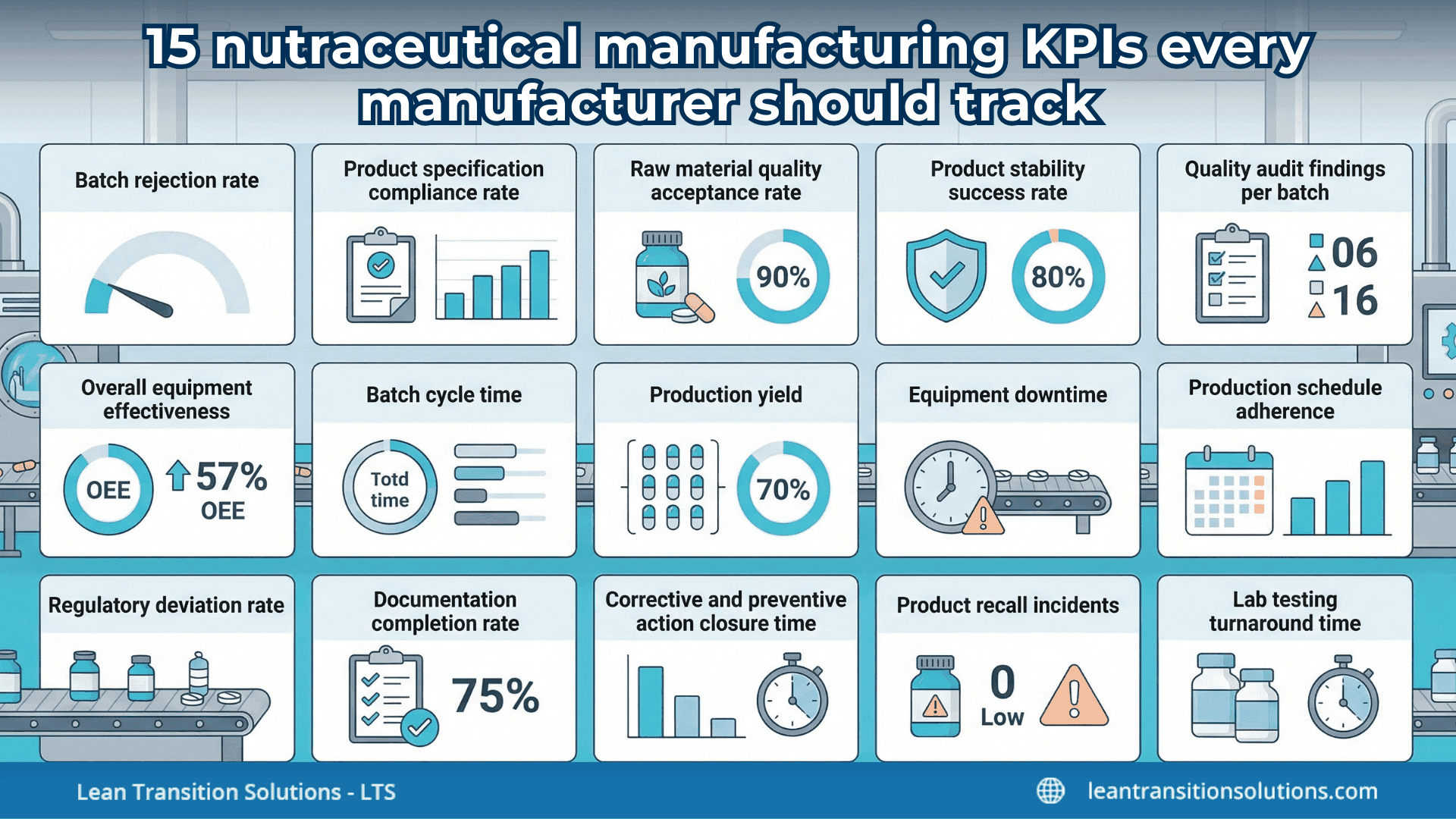
Tracking the right nutraceutical manufacturing KPIs helps organisations maintain consistent production quality, operational efficiency, and regulatory compliance. These KPIs typically support three critical areas: quality performance, production efficiency, and compliance monitoring. Together, they strengthen quality control of nutraceuticals and help industries maintain reliable dietary supplements and nutraceuticals quality control practices across production operations.
Below are some of the most widely used nutraceutical manufacturing KPIs used to monitor performance in manufacturing environments.
Batch rejection rate
- Why it matters: Measures the percentage of production batches rejected due to quality failures or specification deviations. A high rejection rate may indicate problems in raw materials, formulation accuracy, or nutraceutical processing consistency.
- How to calculate: Batch rejection rate = (Number of rejected batches / Total batches produced) x 100
Product specification compliance rate
- Why it matters: Evaluates how consistently finished products meet defined formulation, potency, and quality specifications. This KPI is critical for maintaining strong quality control of nutraceuticals.
- How to calculate: Product specification compliance rate = (Batches meeting specifications / Total batches tested) x 100
Raw material quality acceptance rate
- Why it matters: Tracks the percentage of incoming raw materials that meet required quality standards during inspection. This KPI helps prevent defective ingredients from entering nutraceutical manufacturing processes.
- How to calculate: Raw material quality acceptance rate = (Accepted raw material lots / Total lots inspected) x 100
Product stability success rate
- Why it matters: Computes the percentage of products that pass stability testing during shelf-life evaluation. It helps ensure that nutraceutical formulation remains effective and safe throughout the product’s lifecycle.
- How to calculate: Product stability success rate = (Products passing stability tests / Total products tested) x 100
Quality audit findings per batch
- Why it matters: Indicates how many quality deviations or observations are identified during internal or external audits. Fewer findings suggest stronger dietary supplements and nutraceuticals quality control practices.
- How to calculate: Quality audit findings per batch = Total audit findings / Total batches audited
Overall equipment effectiveness
- Why it matters: Computes how effectively manufacturing equipment operates by combining availability, performance, and quality metrics. This KPI helps identify inefficiencies in nutraceutical processing operations.
- How to calculate: OEE = Availability x Performance x Quality
Batch cycle time
- Why it matters: Tracks the total time required to complete one production batch from start to finish. Monitoring cycle time helps identify delays in nutraceutical manufacturing workflows.
- How to calculate: Batch cycle time = Total production time per batch
Production yield
- Why it matters: Measures how much usable product is produced compared to the expected output. Low yield may indicate inefficiencies in mixing, encapsulation, or packaging stages.
- How to calculate: Production yield = (Actual output / Expected output) x 100
Equipment downtime
- Why it matters: Captures the total time manufacturing equipment is unavailable due to failures, maintenance, or operational delays. High downtime disrupts nutraceutical manufacturing efficiency.
- How to calculate: Equipment downtime rate = (Total downtime / Total scheduled operating time) x 100
Production schedule adherence
- Why it matters: Quantifies how closely production operations follow planned schedules. Poor adherence may indicate workflow inefficiencies or resource constraints.
- How to calculate: Production schedule adherence = (On-time production orders / Total scheduled production orders) x 100
Regulatory deviation rate
- Why it matters: Tracks the frequency of deviations from regulatory or internal quality standards. This KPI helps ensure manufacturing processes remain compliant.
- How to calculate: Regulatory deviation rate = (Number of deviations / Total batches produced) x 100
Documentation completion rate
- Why it matters: Ensures that batch records, testing reports, and compliance documentation are completed accurately and on time. Proper documentation supports regulatory inspections.
- How to calculate: Documentation completion rate = (Completed documentation records / Total required records) x 100
Corrective and preventive action closure time
- Why it matters: Measures how quickly organisations resolve quality or compliance issues once they are identified. Faster resolution helps maintain stable production performance.
- How to calculate: CAPA closure time = Total time taken to close corrective actions / Total CAPA cases
Product recall incidents
- Why it matters: Tracks the number of product recalls over a given period. Recalls can indicate serious quality or safety risks within nutraceutical manufacturing.
- How to calculate: Product recall incident rate = (Number of product recalls / Total products produced) x 100
Lab testing turnaround time
- Why it matters: Computes the time required for laboratory testing of ingredients or finished products. Efficient testing supports faster batch release and regulatory verification, often involving nutraceutical safety and efficacy testing services and solution providers.
- How to calculate: Lab testing turnaround time = Total testing time / Number of tests conducted
Together, these nutraceutical manufacturing KPIs provide a structured way to monitor production performance, strengthen quality control of nutraceuticals, and maintain consistent dietary supplements and nutraceuticals quality control across manufacturing operations.
How technology helps track nutraceutical manufacturing KPIs
As production processes grow more complex, manual tracking methods often struggle to provide accurate and timely insights. Digital systems help manufacturers capture operational data automatically and convert it into actionable nutraceutical manufacturing KPIs, improving visibility across production, quality, and compliance activities.
1. Centralised production data management
- Many organisations use nutraceutical ERP software or specialised nutraceutical manufacturing software to capture production data directly from manufacturing processes.
- These systems help centralise information from raw material sourcing, formulation, processing, and packaging stages.
- This allows manufacturers to track nutraceutical manufacturing KPIs consistently across different production line and facilities.
2. Integration across operational functions
- An ERP for nutraceuticals connects multiple operational areas, including procurement, production planning, quality testing, and inventory management.
- Integrating KPI tracking within a nutraceutical ERP ensures that performance metrics are generated using real-time operational data.
- This reduces manual reporting and improves the reliability of production performance insights.
3. Improved compliance and documentation control
- Regulatory requirements in the nutraceutical sector demand strong documentation and traceability practices.
- Nutraceutical compliance software helps manage batch records, testing reports, and audit documentation in a structured manner.
- When compliance systems integrate with nutraceutical manufacturing software, organisations can monitor quality and regulatory performance through consistent nutraceutical manufacturing KPIs.
4. Real-time performance monitoring
- Digital dashboards allow teams to monitor production and quality performance in real time.
- By combining operational data from nutraceutical ERP software and other systems, organisations can quickly identify deviations, equipment issues, or quality risks.
- This enables faster corrective action and better control over manufacturing outcomes.
Through these technologies, organisations can track nutraceutical manufacturing KPIs more accurately, improve operational transparency, and support reliable decision-making across nutraceutical production environments.
Common challenges in tracking nutraceutical manufacturing KPIs
While nutraceutical manufacturing KPIs provide valuable insights provide valuable insights into quality, efficiency, and compliance, many organisations struggle to track them consistently. The complexity of nutraceutical manufacturing operations and the involvement of multiple departments often make performance monitoring difficult without structured systems.
1. Fragmented data across departments
- In many organisations, teams responsible for nutraceutical formulation development, production, and quality operate in separate systems or databases.
- This fragmentation makes it difficult to consolidate performance data across the full nutraceutical manufacturing lifecycle.
- As a result, organisations may struggle to generate accurate nutraceutical manufacturing KPIs.
2. Manual KPI tracking
- Many manufacturers still rely on spreadsheets or manual reporting to track production metrics.
- Manual methods increase the risk of data entry errors and delayed reporting.
- This makes it harder to monitor performance across complex nutraceutical processing activities in real time.
3. Lack of standardised metrics
- Different teams may define or quantify KPIs differently across departments or facilities.
- Without standardised definitions, comparing performance across multiple nutraceutical manufacturing operations becomes challenging.
- Inconsistent metrics reduce the effectiveness of KPI-driven performance management.
4. Limited cross-functional visibility
- Performance insights are often restricted to individual departments such as quality control, production, or R&D.
- Teams working on nutraceutical formulation development, quality testing, and nutraceutical processing may not have access to shared operational metrics.
- This lack of visibility prevents organisations from identifying root causes behind production delays or quality deviations.
5. Difficulty linking performance to improvement actions
- Even when KPIs are available, organisations may struggle to connect performance metrics with structured improvement initiatives.
- Without clear ownership and review processes, nutraceutical manufacturing KPIs risk becoming reporting metrics rather than tools for operational improvement.
Addressing these challenges is essential for organisations that want to fully benefit from nutraceutical manufacturing KPIs and build more transparent, data-driven production environments.
How LTS Data Point performance management software helps track nutraceutical manufacturing KPIs across operations
Tracking nutraceutical manufacturing KPIs becomes far more effective when organisations move beyond fragmented reports and adopt structured performance management systems. LTS Data Point performance management software is designed to help organisations monitor operational metrics consistently across departments, enabling better visibility into manufacturing, quality, and compliance performance.
1. Structured KPI tracking across performance
- LTS Data Point performance management software provides a central framework for tracking nutraceutical manufacturing KPIs across production, quality, and operational teams.
- Organisations can standardise how KPIs are defined, measured, and reviewed across facilities.
- This structured approach helps ensure that performance data remains consistent and comparable across the entire nutraceutical manufacturing environment.
2. Cross-department visibility
- Production, quality, and R&D teams often operate in separate systems in many organisations.
- LTS Data Point performance management software enables shared visibility of nutraceutical manufacturing KPIs, helping teams monitor performance across different functions.
- This cross-functional visibility helps identify operational bottlenecks and quality risks earlier in the production cycle.
3. Integration with existing operational systems
- Many organisations already use nutraceutical manufacturing software or ERP systems to manage production data.
- LTS Data Point performance management software complements these systems by consolidating operational metrics into structured KPI dashboards.
- It can also work alongside nutraceutical compliance software, allowing organisations to monitor quality and compliance metrics as part of broader performance reviews.
4. Enabling structured performance reviews
- KPI visibility alone is not enough to improve performance.
- LTS Data Point performance management software supports structured review processes where teams regularly analyse nutraceutical manufacturing KPIs and identify improvement opportunities.
- This enables organisations to move from passive reporting to active performance management.
By providing structured KPI visibility and supporting cross-functional performance reviews, LTS Data Point performance management software helps organisations track nutraceutical manufacturing KPIs more effectively and maintain stronger control over manufacturing performance, quality and compliance.
In the nutraceutical industry, maintaining consistent quality, efficient production, and regulatory compliance requires more than periodic reporting. Nutraceutical manufacturing KPIs provide a structured way to monitor critical stages of nutraceutical manufacturing and nutraceutical processing, helping organisations detect performance gaps early and maintain strong quality control of nutraceuticals. When supported by the right systems and review processes, these KPIs enable manufacturers to improve operational visibility, strengthen dietary supplements and nutraceuticals quality control, and make more informed decisions across production operations.
Get guidance on improving KPI visibility in nutraceutical manufacturing with LTS Data Point
FAQs
1. What are nutraceutical manufacturing KPIs?
Nutraceutical manufacturing KPIs are measurable performance indicators used to monitor production efficiency, product quality, and regulatory compliance in nutraceutical manufacturing operations. These metrics help organisations track how effectively manufacturing processes meet quality standards, production targets, and safety requirements.
2. How are nutraceutical manufacturing KPIs different from pharmaceutical KPIs?
While both industries focus on quality and compliance, nutraceutical manufacturing KPIs often place greater emphasis on ingredient sourcing, formulation consistency, and dietary supplements and nutraceuticals quality control. Pharmaceutical KPIs, on the other hand, typically focus more on clinical validation and drug regulatory frameworks.
3. Who is responsible for monitoring nutraceutical manufacturing KPIs?
Monitoring nutraceutical manufacturing KPIs is usually a shared responsibility across multiple teams, including production managers, quality assurance teams, regulatory compliance officers, and operations leaders. Cross-functional collaboration ensures KPIs reflect the full performance of nutraceutical manufacturing processes.
4. How often should nutraceutical manufacturing KPIs be reviewed?
Most organisations review nutraceutical manufacturing KPIs daily or weekly at the operational level and monthly at the management level. Regular review cycles help teams identify performance deviations quickly and maintain consistent quality control of nutraceuticals.
5. What tools are commonly used to track nutraceutical manufacturing KPIs?
Manufacturers often use systems such as nutraceutical ERP software, specialised nutraceutical manufacturing software, and analytics dashboards to monitor operational metrics. These tools help centralise production data and support consistent KPI tracking across departments.
6. Why is traceability important when tracking nutraceutical manufacturing KPIs?
Traceability ensures that every ingredient and production step can be tracked throughout the manufacturing KPIs related to quality assurance, compliance monitoring, and dietary supplements and nutraceuticals quality control.
7. How do nutraceutical manufacturing KPIs support regulatory compliance?
Many regulatory guidelines require manufacturers to maintain detailed production records and quality monitoring systems. Nutraceutical manufacturing KPIs help organisations document production performance, monitor deviations, and demonstrate compliance during audits and regulatory inspections.
8. Can nutraceutical manufacturing KPIs help improve product consistency?
Yes. By monitoring metrics such as formulation accuracy, batch success rates, and testing outcomes, nutraceutical manufacturing KPIs help organisations maintain consistent product composition and ensure reliable performance across production batches.

Geandra Queiroz, Operations Management Consultant
Geandra is an Operations Management Consultant at Lean Transition Solutions, specialising in Lean philosophy, Lean Six Sigma, and strategic planning across manufacturing and healthcare. She is currently completing her PhD in Industrial Engineering at the Federal University of São Carlos, researching the integration of Operations Strategy, Lean, and Green Manufacturing.