How the Sustainability Balanced Scorecard Connects Climate, Cost, and Corporate Performance
Last updated on : March 4, 2026
Business leaders, managing climate goals without a Sustainability Balanced Scorecard is like using a sat-nav that shows the destination but not the traffic, fuel use, or roadblocks. You know where you want to go — lower emissions, better ESG ratings, stronger margins — but you don’t see what it’s costing you to get there. The scorecard gives you real-time visibility into how sustainability choices affect financial performance.
See how LTS Data Point supports a sustainability balanced scorecard for ESG, cost, and performance management
Reimagining the Balanced Scorecard for the ESG era of sustainability in business
Businesses today face pressures not just from the bottom line but from environmental, social, and governance (ESG) commitments. The reimagining of the balanced scorecard for the ESG era means linking traditional performance metrics with sustainability in business priorities, ensuring strategies deliver measurable ESG sustainability outcomes.
Key considerations include:
- Integrating ESG into the existing corporate sustainability scorecard to track environmental and social impact alongside financial metrics.
- Understanding how ESG is changing the balanced scorecard, shifting the focus from pure profit to broader organisational value.
- Measuring sustainability and business performance together to ensure strategy is both responsible and effective.
- Highlighting why ESG matters in strategy, demonstrating long-term risk management, stakeholder alignment, and brand credibility.
- Embedding metrics that make sustainability in business practical, not just aspirational.
Core ESG metrics for a sustainability balanced scorecard
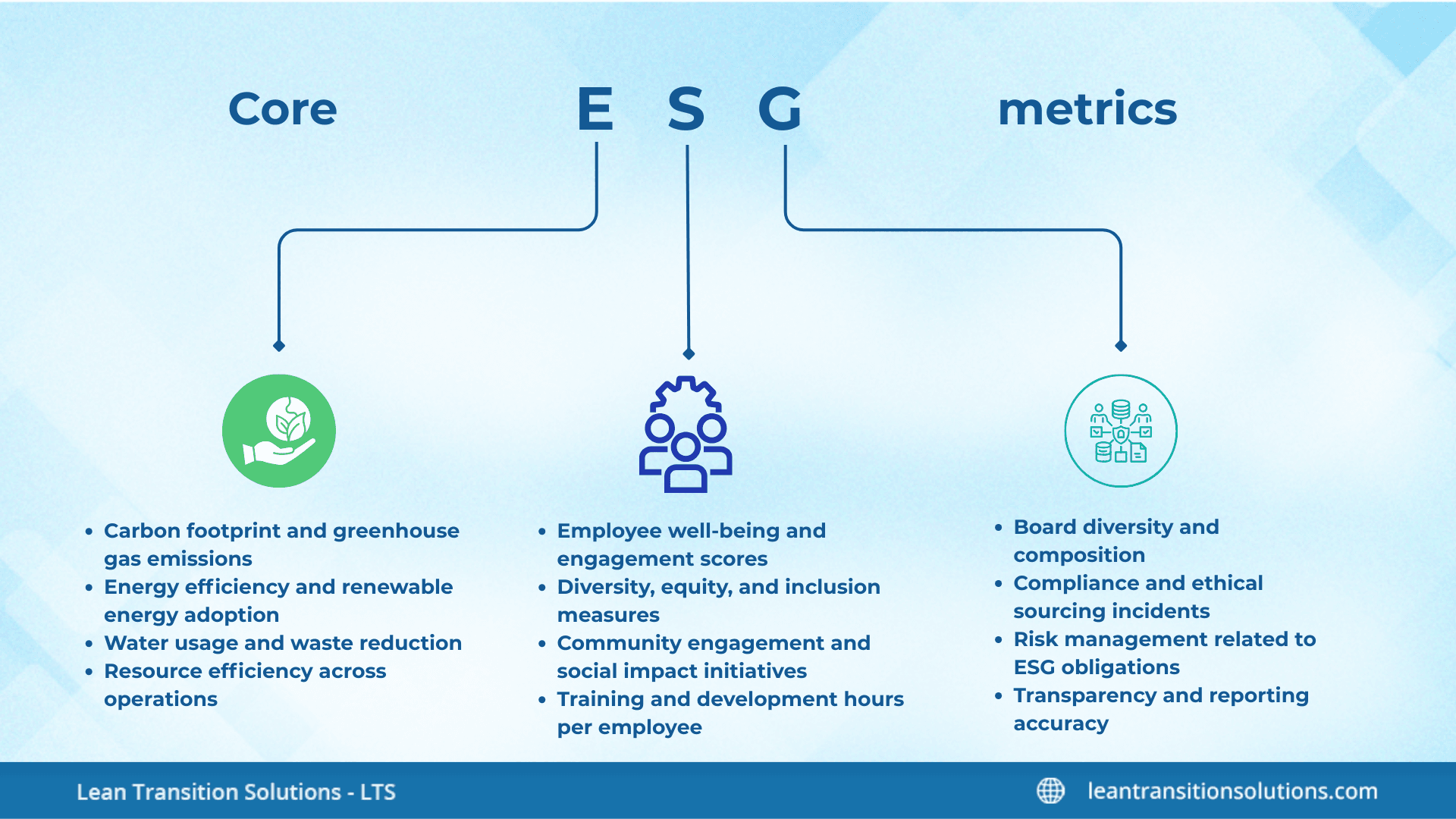
A sustainability balanced scorecard (SBSC) is only as effective as the ESG metrics it tracks. By embedding measurable sustainability KPIs into your corporate sustainability scorecard, businesses can turn abstract ESG goals into actionable insights, connecting environmental and social impact directly to financial outcomes.
Key areas to track in a sustainability balanced scorecard include:
1. Environmental metrics
- Carbon footprint and greenhouse gas emissions
- Energy efficiency and renewable energy adoption
- Water usage and waste reduction
- Resource efficiency across operations
2. Social metrics
- Employee well-being and engagement scores
- Diversity, equity, and inclusion measures
- Community engagement and social impact initiatives
- Training and development hours per employee
3. Governance metrics
- Board diversity and composition
- Compliance and ethical sourcing incidents
- Risk management related to ESG obligations
- Transparency and reporting accuracy
By integrating these ESG metrics into an SBSC, industries gain real-time sustainability performance tracking, making it easier to detect gaps, optimise resource allocation, and align ESG initiatives with business strategy.
Using a sustainability balanced scorecard to link climate goals with financial and operational performance
An SBSC gives business leaders a clear view of how climate goals tracking directly impacts both financial and operational performance. Without it, companies may reduce emissions or enhance resource efficiency but struggle to quantify the financial impact of sustainability or understand the cost of sustainability initiatives.
How the sustainability balanced scorecard connects climate and business outcomes
1. Measuring environmental impact against costs
- Monitor reductions in energy use, water consumption, and waste alongside associated cost savings.
- Measure return on investment for sustainability projects, linking environmental initiatives to profitability.
2. Linking emissions reduction to operational performance
- Observe carbon footprint per unit of production or service delivery.
- Use operational data to optimise processes, minimise resource waste, and improve efficiency.
3. Driving strategic decision-making
- Integrate ESG metrics into executive dashboards for live decision-making.
- Prioritise initiatives that balance environmental responsibility with cost efficiency.
- Make ESG commitments actionable, ensuring climate goals support both long-term sustainability and financial performance.
By combining ESG, financial, and operational insights, a sustainability balanced scorecard makes sure that industries not only meet their climate goals but do so in a way that strengthens profitability, operational efficiency, and stakeholder confidence.
Integrating ESG KPIs into corporate performance management with a sustainability balanced scorecard
A sustainability balanced scorecard becomes truly powerful when ESG KPIs are embedded into everyday corporate performance management. Rather than trending sustainability as a separate reporting exercise, this approach ensures sustainability in business is measured, reviewed, and acted on in the same way as financial and operational performance.
When ESG metrics are integrated into performance dashboards and management reviews, leaders gain a single, connected view of how environmental and social initiatives support strategy execution. This makes it easier to align sustainability goals with business priorities such as cost control, productivity, risk management, and growth.
How a sustainability balanced scorecard supports corporate performance management
- Aligning ESG KPIs with strategic objectives: Climate targets, workforce initiatives, and governance standards are mapped directly to corporate goals, ensuring sustainability contributes to quantifiable business outcomes.
- Providing live visibility: Sustainability data is tracked alongside financial and operational metrics, helping leaders see the impact of ESG initiatives as they happen, not months later.
- Enabling cross-functional accountability: Operations, finance, HR, and procurement teams all work from the same SBSC, ensuring sustainability in business is shared, not siloed.
- Improving decision-making: With ESG KPIs integrated into corporate reporting, organisations, can prioritise projects that deliver both sustainability improvements and commercial value.
By embedding ESG into corporate performance management, a sustainability balanced scorecard transforms sustainability from a compliance requirement into a core part of how the business plans, executes, and measures success.
Best practices for implementing a sustainability balanced scorecard
Implementing a sustainability balanced scorecard successfully requires more than selecting the right sustainability KPIs. It means building a system that turns ESG ambition into actionable sustainability metrics that drive real business improvement.
The following sustainability best practices help organisations move from high-level ESG commitments to measurable results:
1. Start with the business strategy
An SBSC should mirror what matters most to the company – whether that is reducing carbon intensity, improving workforce resilience, or strengthening governance. ESG goals must be tied directly to financial and operational priorities.
2. Limit metrics to what drives action
Too many ESG measures dilute focus. Choose a small set of actionable sustainability metrics that influence decision-making, investment, and daily operations.
3. Assign ownership and accountability
Each ESG KPI in the SBSC should have a clear owner. This ensures sustainability performance is managed with the same discipline as cost, quality, and delivery.
4. Integrate into management routines
Review ESG performance during operational leadership meetings. When implementing ESG KPIs becomes part of standard business reviews, sustainability shifts from a reporting task to a management tool.
5. Use continuous improvement principles
Sustainability goals evolve. Regularly review results, adjust targets, and refine metrics to keep the SBSC aligned with changing regulations, market expectations, and business strategy.
When these best practices are followed, a sustainability balanced scorecard becomes a practical engine for continuous improvement in sustainability, verifying ESG performance supports long-term competitiveness, profitability, and stakeholder trust.
How a sustainability balanced scorecard is operationalised using LTS Data Point performance management software
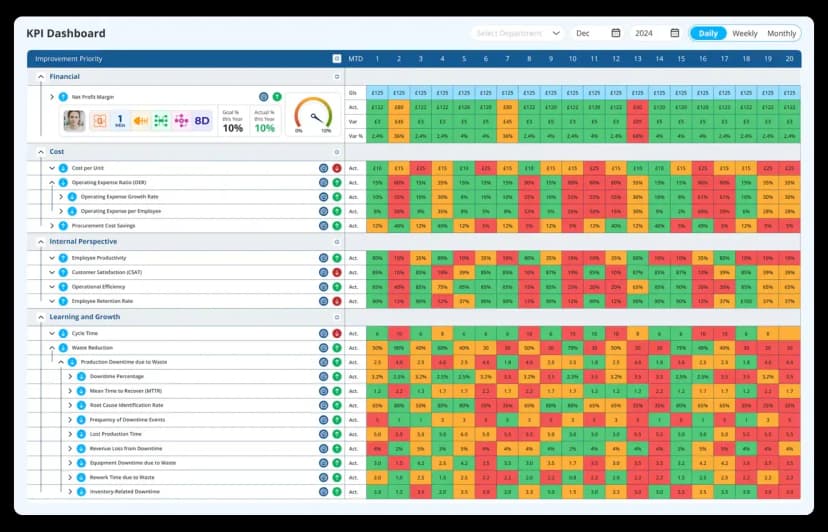
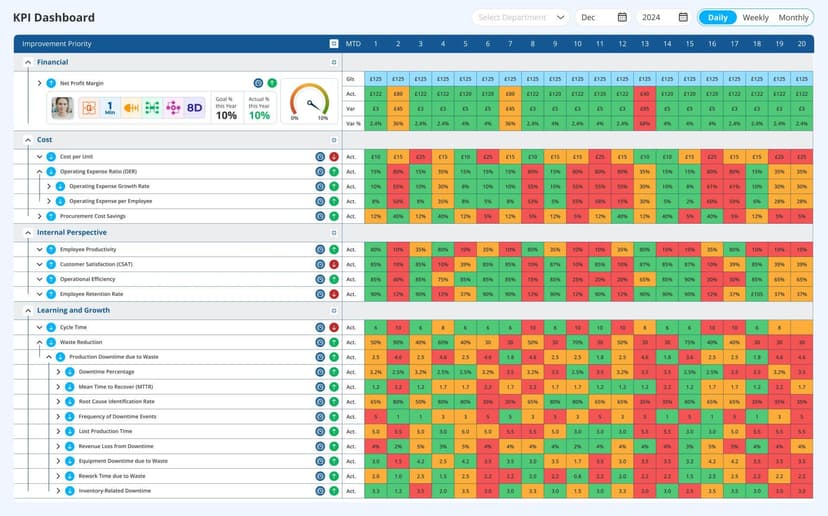
A sustainability balanced scorecard only creates value when ESG goals are translated into daily execution. LTS Data Point performance management software is designed to support this by linking sustainability, operational, and financial measures within a single, governed by balanced scorecard framework.
Rather than treating ESG reporting as a separate activity, LTS Data Point enables organisations to manage sustainability metrics using the same performance structure applied to productivity, cost, quality, and delivery — ensuring sustainability in business is embedded into how performance is run.
Many organisations structure their sustainability balanced scorecard using multi-dimension scorecard models such as EQDCPS, ESQDCP, or extended ESG-oriented models like SHEQCPLDCPS, where sustainability, health, environment, quality, delivery, cost, people, and safety are reviewed together. These balanced scorecard framework examples allow ESG priorities to sit alongside traditional performance drivers rather than in isolation.
How LTS Data Point supports these sustainability balanced scorecard frameworks in practice
1. Single scorecard for ESG and business performance
Environmental, social, and governance KPIs can be structured within EQDCPS, ESQDCP, or SHEQCOLDCPS scorecards, forming a unified corporate sustainability scorecard rather than fragmented ESG reports.
2. Framework-neutral design
LTS Data Point does not force a single methodology. Whether teams use EQCDPS, EQDCP, or SHEQCPLDCPS as their SBSC model, the software supports flexible KPI grouping, weighing and roll up.
3. Target-based sustainability performance tracking
ESG measures such as emissions, energy use, workforce wellbeing, or governance compliance can be tracked against targets and trends, allowing reliable sustainability performance tracking across teams and sites.
4. Action-driven ESG management
Gaps in ESG performance are connected to actions and owners, turning the SBSC from a reporting tool into an execution system.
5. Operational and strategic alignment
Executives and frontline teams view the same SBSC, making sure sustainability goals set in EQDCPS, ESQDCP, and SHEQCPLDCPS structures are linked to daily operational decisions and financial outcomes.
By supporting multiple balanced scorecard framework examples and integrating ESG into normal performance management, LTS Data Point performance management software enables industries to make sustainability measurable, manageable, and commercially relevant.
A sustainability balanced scorecard gives organisations the missing link between climate ambition and business reality. By combining ESG metrics, financial performance, and operational execution in one connected framework, it allows leaders to see not just whether sustainability targets are being met, but how they affect cost, risk, and long-term value. When implemented through structured scorecard models and supported by performance management systems such as LTS Data Point performance management software, sustainability stops being a reporting exercise and becomes a disciplined, data-driven way to run the business — ensuring ESG commitments strengthen both resilience and profitability.
Speak with an LTS Data Point expert about designing a sustainability balanced scorecard for your ESG strategy
FAQs
1. Is a sustainability balanced scorecard the same as an ESG report?
No. An ESG report shows historical performance, while a sustainability balanced scorecard is a management tool that tracks live targets, trends, and actions to drive ongoing improvement.
2. Can small or mid-sized companies use a sustainability balanced scorecard?
Yes. The framework scales easily. Smaller organisations typically start with a focused set of sustainability KPIs and expand as their ESG maturity grows.
3. How often should sustainability balanced scorecard metrics be reviewed?
Most organisations review ESG and sustainability metrics monthly at the operational level and quarterly at the executive level.
4. What is the difference between ESG KPIs and sustainability KPIs?
ESG KPIs focus on environmental, social, and governance risk and compliance, while sustainability KPIs often include efficiency, resilience, and long-term value creation.
5. Can a sustainability balanced scorecard support regulatory reporting?
Yes. It helps organisations maintain consistent, auditable ESG data that can be used for regulatory, investor, and sustainability reporting.
6. How do companies choose the right ESG metrics for their scorecard?
Metrics should be selected based on business risk, regulatory exposure, stakeholder expectations, and where sustainability most impacts cost and performance.
7. Does a sustainability balanced scorecard require new IT systems?
Not always, but performance management software makes it much easier to manage targets, trends, ownership, and cross-functional visibility.
8. How long does it take to implement a sustainability balanced scorecard?
Most organisations can define a working scorecard within 4–8 weeks, with full operational integration typically taking a few months.

Amer Jumah, Senior Lean Consultant
Amer is co-founder of Agile Solutions and a certified Six Sigma Black Belt, Lean Black Belt, and PMP, with over nine years of experience implementing Lean, Six Sigma, and Agile principles across diverse industries. He specialises in process optimisation, waste elimination, and delivering cost savings through organisational change.