VRIO Framework: A Complete Guide to Analysing Resources and Building Sustainable Competitive Advantage
Last updated on : March 30, 2026
Most companies treat their strengths like items in a toolbox — a collection of resources they assume will help them compete. But not every tool is built for the same job. A shiny new tool might look impressive, yet if every competitor owns the same one, it offers little real advantage.
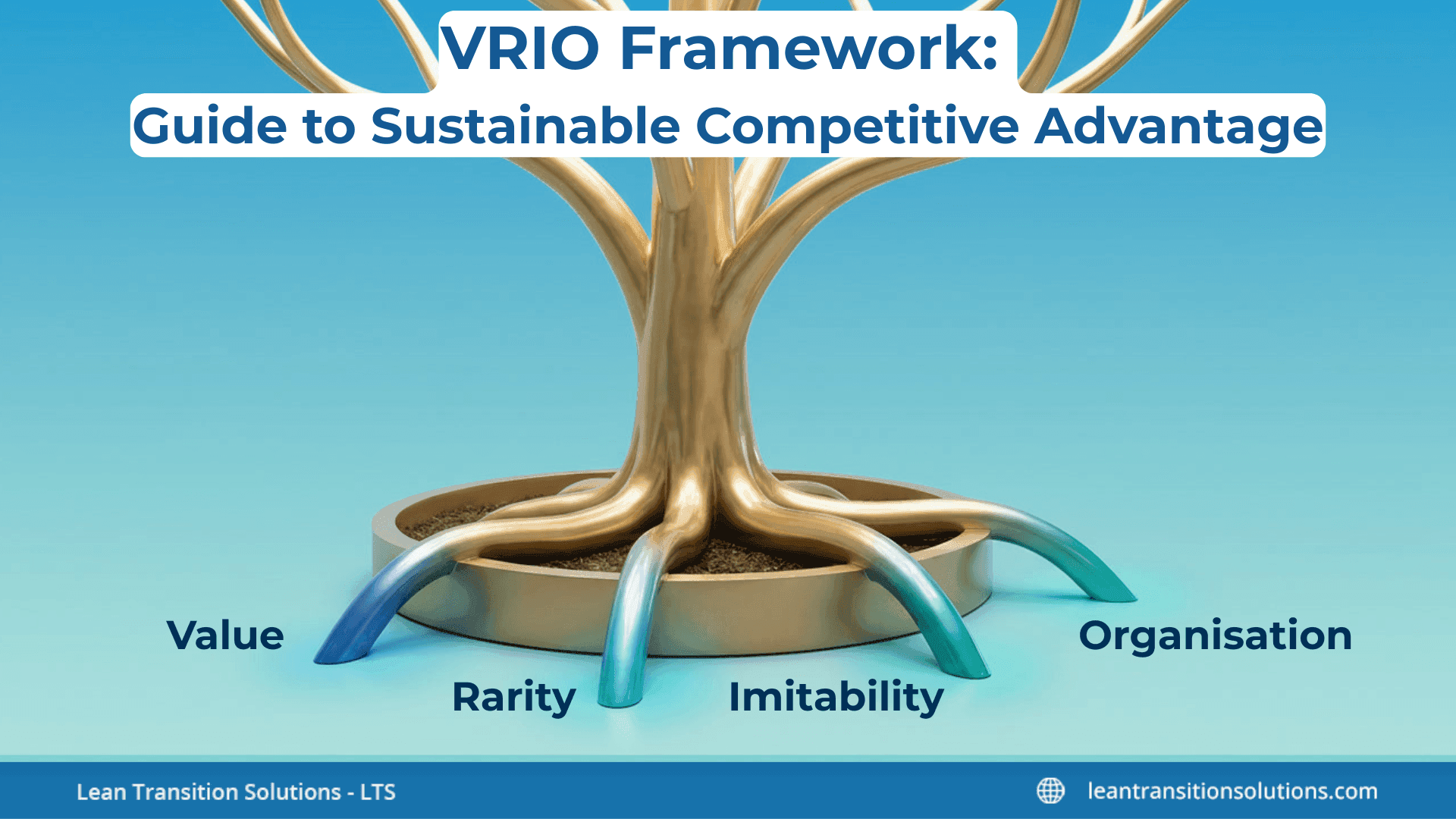
This is where the VRIO framework comes in. The VRIO framework is a strategic analysis model that evaluates a company’s resources using four criteria: Value, Rarity, Imitability, and Organisation. In simple terms, it helps organisations determine whether their internal capabilities can truly create sustainable competitive advantage.
Like a skilled craftsman inspecting a toolbox, the VRIO framework identifies which tools genuinely create value, which are rare in the market, which competitors struggle to replicate, and whether the organisation is structured to use them effectively. By applying this structured approach, businesses move beyond assumptions and gain clarity on which resources can deliver long-term strategic impact rather than short-term advantage.
What is VRIO framework and why it matters for sustainable competitive advantage
The VRIO framework is a strategic tool used to evaluate a company’s resources and capabilities to determine whether they can create a sustainable competitive advantage. The VRIO model examines four key dimensions – Value, Rarity, Imitability, and Organisation – to identify which business strengths truly differentiate an organisation from its competitors. By applying a structured VRIO analysis, companies can distinguish between ordinary resources that support daily operations and strategic capabilities that deliver long-term performance.
As a competitive advantage framework, the VRIO framework helps organisations understand whether their strengths are genuinely strategic or simply industry standards. A resource is considered valuable if it improves performance or solves customer problems, rare if few competitors possess it, difficult to imitate if it cannot be easily copied, and organisationally supported if the business has the systems and processes needed to use it effectively. When all four conditions are met, the resource has the potential to create lasting strategic value.
This structured approach is essential for sustainable competitive advantage analysis because many organisations overestimate the uniqueness of their capabilities. Without a clear method for evaluating resources, business often invest in strengths that competitors can easily replicate. The VRIO framework provides a systematic way to assess internal capabilities, prioritise strategic investments, and focus on resources that support long-term growth and stability.
How VRIO framework evaluates strategic resources and capabilities
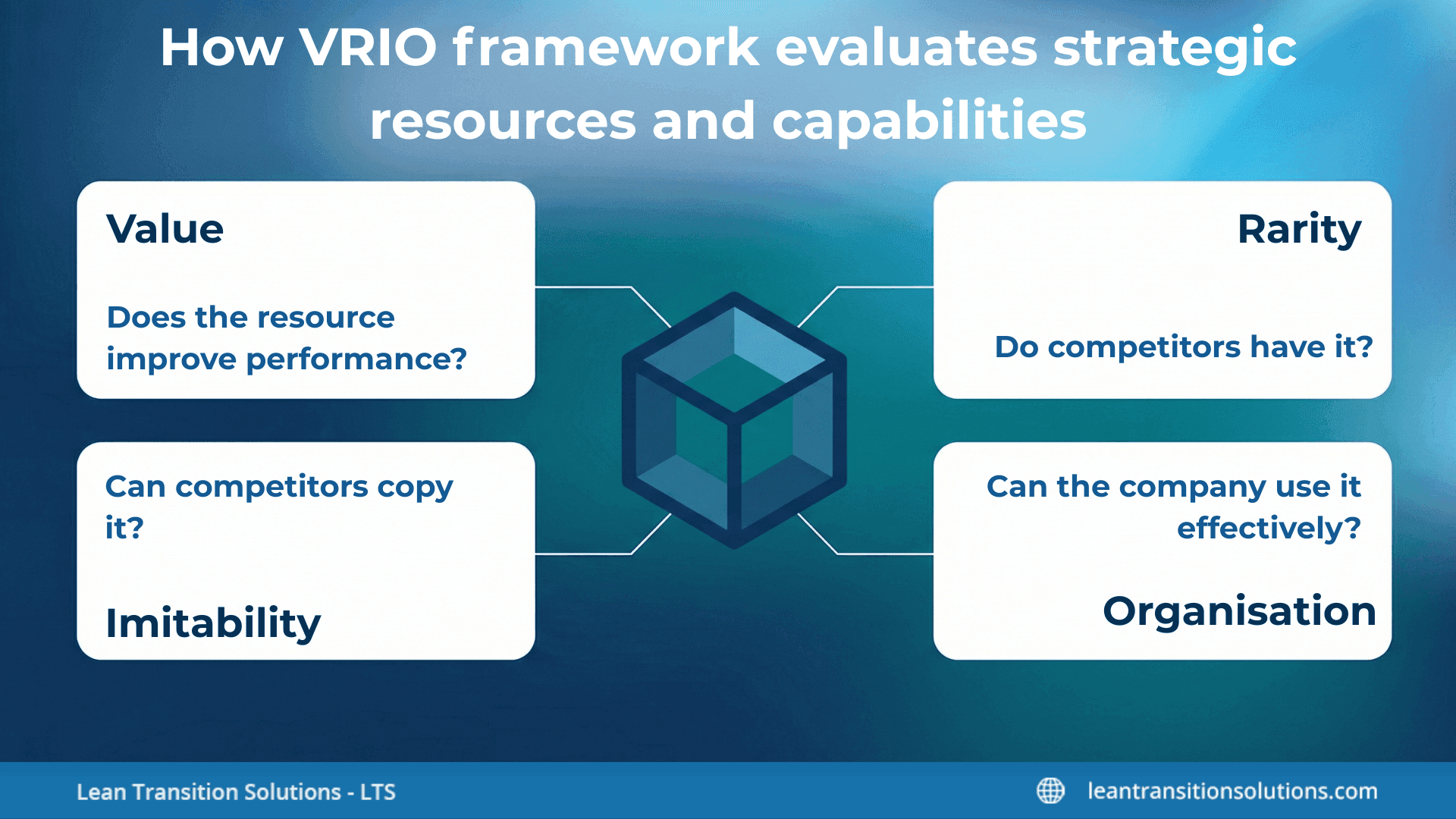
The VRIO framework supports strategic capability analysis by helping industries evaluate whether their internal strengths can create lasting competitive advantage. This structured approach to internal resource analysis allows business to assess resources systematically rather than relying on assumptions.
Each dimension of the VRIO framework plays a specific role in strategic resource evaluation and organisational capabilities analysis:
1. Value – Does the resource improve performance?
A resource is valuable if it helps the organisation improve efficiency, reduce costs, increase quality, or strengthen customer value.
Typical indicators of value include:
- Improves operational or financial performance
- Supports strategic objectives
- Solves important customer or business problems
- Enables better decision-making
- Increases productivity or efficiency
Examples of valuable resources:
- Strong operational processes that reduce delays
- Experienced leadership teams
- Reliable supplier relationships
- Structured performance measurement systems
If a resource does not create measurable value, it cannot contribute to competitive advantage.
2. Rarity – Do competitors have it?
A resource is rare when it is not widely available to competitors. If many organisations have the same capability, it becomes a basic requirement rather than a strategic advantage.
Key questions to evaluate rarity:
- Do only a few competitors possess the capability?
- Is the resource difficult to access in the market?
- Does it reflect unique organisational experience?
- Is it developed internally over time?
3. Imitability – Can competitors copy it?
A resource must be difficult to imitate in order to support long-term advantage. If competitors can easily copy a capability, the advantage will be temporary.
Factors that reduce imitability:
- Requires years of experience to develop
- Depends on organisational culture
- Built through continuous improvement
- Requires coordinated processes
- Relies on accumulated knowledge
Examples of hard-to-imitate resources:
- Mature operational systems
- Strong continuous improvement culture
- Integrated performance management practices
- Cross-functional collaboration models
Low imitability strengthens strategic advantage over time.
4. Organisation – Can the company use it effectively?
Even valuable and rare resources will not create advantage unless the industry is structured to use them effectively. This part of organisational capabilities analysis evaluates whether systems, leadership, and processes support execution.
Key organisational factors include:
- Clear ownership and accountability
- Defined performance metrics
- Leadership alignment
- Structured review processes
- Cross-team coordination
Examples of organisational support:
- Standardised KPI tracking
- Regular performance reviews
- Clearly assigned responsibilities
- Visible strategic priorities
When Value, Rarity, Imitability, and Organisation are aligned, organisations can identify capabilities that support sustainable competitive advantage.
How to use the VRIO framework step by step in strategic planning
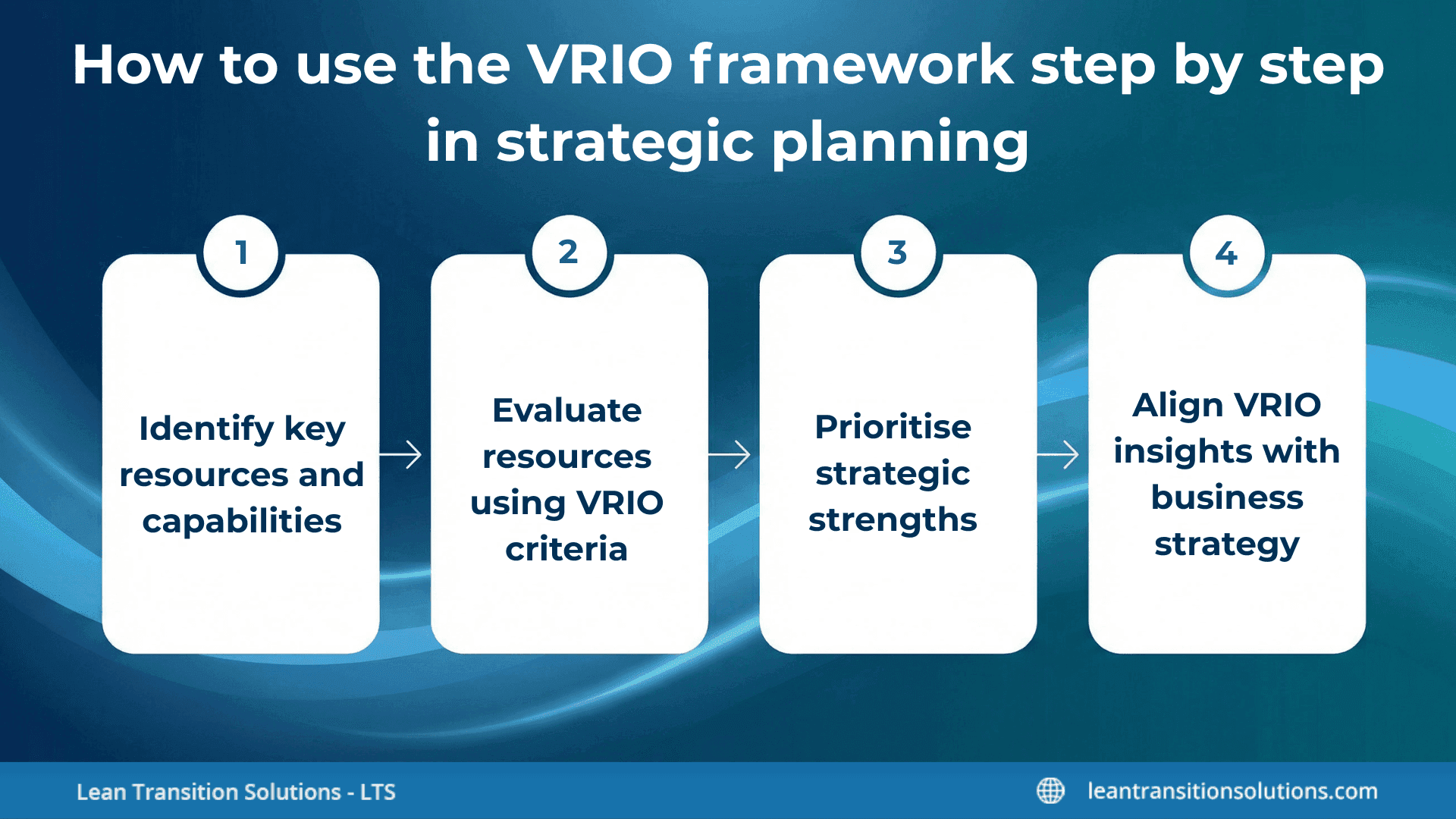
Understanding how to use the VRIO framework requires more than listing company strengths. Effective VRIO framework strategic planning involves a structured process that connects resources to strategic outcomes. This VRIO framework step by step approach helps organisations perform a practical business capability assessment and focus on strengths that support long-term growth.
Identify key resources and capabilities
Start by identifying the internal resources and capabilities that influence business performance. This step forms the foundation of a meaningful business capability assessment.
Focus on areas such as:
- Operational processes and systems
- Employee skills and expertise
- Leadership capabilities
- Technology and data systems
- Customer relationships
- Supplier networks
- Organisational knowledge
- Performance management practices
Tip: Prioritise resources that directly impact business results rather than listing every available asset.
Evaluate resources using VRIO criteria
Next, assess each resource against the four VRIO dimensions. This stage is the core of the VRIO framework step by step approach.
For each source, ask:
- Value – Does this improve performance or support strategic goals?
- Rarity – Do few competitors possess this capability?
- Imitability – Would competitors find it difficult to replicate?
- Organisation – Are processes and systems in place to use it effectively?
A simple evaluation method includes:
- Yes / No scoring for each VRIO dimension
- Basic comparison across resources
- Identifying which capabilities meet all four criteria
This structured approach makes it easier to understand how to use the VRIO framework consistently across teams.
Prioritise strategic strengths
Once the evaluation is complete, identify the capabilities that qualify as true strategic strengths. Resources that meet all four VRIO criteria typically represent the strongest opportunities for sustainable advantage.
Prioritisation helps organisations:
- Focus investment on high-impact capabilities
- Protect unique strengths
- Avoid overinvesting in non-strategic resources
- Clarify strategic priorities
- Strengthen competitive positioning
This stage turns the business capability assessment into clear strategic direction.
Align VRIO insights with business strategy
The final step in VRIO framework strategy planning is linking strategic strengths to measurable objectives and execution plans.
This alignment typically includes:
- Translating strengths into strategic initiatives
- Defining measurable performance indicators
- Assigning ownership for key capabilities
- Integrating strengths into strategic plans
- Reviewing capabilities regularly
Without this final step, VRIO analysis remains theoretical. When properly aligned with strategic goals, the VRIO framework step by step approach helps organisations convert internal strengths into sustainable competitive advantage.
Common mistakes when applying the VRIO framework
The VRIO framework is one of the most effective strategic analysis methods for evaluating internal capabilities, but its impact depends on how it is applied. Many organisations perform competitive resource analysis without fully connecting insights to strategy and execution, which limits value of the exercise.
Avoiding the following common mistakes helps organisations use the VRIO framework as a practical tool for building a capability-based strategy.
1. Treating all resources as strategic
One of the most frequent mistakes is assuming that every internal strength contributes to competitive advantage. In reality, many resources are simply operational necessities rather than strategic differentiators.
Common examples include:
- Standard software tools used across the industry
- Basic operational procedures
- Easily available technologies
- Common industry certifications
Effective competitive resource analysis focuses only on capabilities that truly differentiate the organisation.
2. Ignoring organisational alignment
Some industries identify valuable and rare resources but fail to ensure they are supported by the right structures and processes.
Typical alignment gaps include:
- Unclear ownership of strategic initiatives
- Lack of performance visibility
- Poor cross-team coordination
- Inconsistent review processes
Without organisational support, even strong capabilities cannot deliver sustainable advantage.
3. Treating VRIO as a one-time exercise
Another common issue is performing VRIO analysis once and never revisiting it. However, markets, technologies, and competitors continuously evolve.
Limitations of static analysis include:
- Previously rare capabilities becoming common
- New competitors entering the market
- Changing customer expectations
- Shifts in business strategy
As part of modern strategic analysis methods, VRIO should be reviewed regularly to ensure capabilities remain relevant.
4. No connection between VRIO and execution
Many industries complete VRIO analysis but fail to translate insights into measurable actions. This prevents capabilities from becoming real sources of competitive advantage.
Typical gaps include:
- No link between capabilities and strategic objectives
- Lack of measurable targets
- No defined accountability
- Limited progress tracking
A strong capability-based strategy connects VRIO insights to operational plans, performance measurement, and continuous improvement.
Using the VRIO framework to turn strategic strengths into measurable results
Identifying valuable and rare capabilities is only the first step. Sustainable competitive advantage is created when strategic strengths are consistently executed, measured, and refined. To move from analysis to impact, organisations must embed VRIO insights into a structured strategy execution framework.
Without execution discipline, even the strongest capabilities remain theoretical. Turning VRIO findings into measurable outcomes typically requires four essential elements:
1. Clear ownership
Strategic capabilities need defined accountability.
This includes:
- Assigning responsibility for each key capability
- Defining decision rights
- Establishing leadership oversight
- Clarifying cross-functional roles
When ownership is unclear, strategic strengths weaken over time due to inconsistent follow-through.
2. KPI tracking and performance management
A capability only drives advantage if its performance is measurable.
Organisations should:
- Translate strategic strengths into measurable KPIs
- Define leading and lagging indicators
- Track capability performance regularly
- Monitor impact on strategic objectives
This is where strategic planning tools become critical. They ensure that strengths identified through VRIO analysis are linked to quantifiable results rather than assumptions.
3. Visibility across teams
Sustainable advantage depends on transparency.
Effective organisations ensure:
- Strategic priorities are visible across departments
- Performance data is accessible
- Progress is reviewed regularly
- Leaders can identify gaps early
Visibility reduces misalignment and supports coordinated action.
4. Alignment with business direction
Strategic strengths must continuously support evolving objectives.
Alignment requires:
- Integrating VRIO insights into strategic plans
- Connecting capabilities to enterprise goals
- Reviewing strengths during strategic planning cycles
- Adjusting investments based on performance data
When structured properly, the VRIO framework becomes part of a broader sustainable advantage framework – one that connects internal strengths to measurable business performance.
The difference between analysis and advantage lies in execution. Organisations that embed VRIO insights into structured systems for ownership, measurement, visibility, and alignment are far more likely to convert strategic capabilities into lasting results.
Applying the VRIO framework with LTS Data Point for strategy execution
While the VRIO framework helps organisations identify strategic strengths, turning those strengths into measurable results requires consistent tracking, visibility, and alignment. Identifying valuable, rare, and hard-to-imitate capabilities is only the beginning. Sustaining advantage depends on how effectively those capabilities are managed over time within a structured strategy execution framework.
The LTS Data Point platform is designed for organisations that need to translate strategy into measurable action. It supports leaders who have completed their strategic capability analysis and now need a practical way to operationalise those insights across teams and locations.
Designed for:
- Organisations translating strategy into measurable objectives
- Leadership teams seeking structured execution discipline
- Multi-site operations requiring alignment across locations
- Businesses prioritising continuous performance review
- Teams moving from analysis to accountable action
Rather than replacing strategic thinking, the platform enables structured execution of strategic priorities identified through tools like the VRIO framework.
How LTS Data Point supports strategy execution
1. Structured accountability
Clear ownership of strategic initiatives ensures capabilities do not remain theoretical. Defined responsibilities and transparent tracking help maintain focus on high-impact strengths.
2. Strategic KPI visibility
Capabilities identified as strategically valuable can be connected to measurable KPIs. Performance visibility ensures leadership can monitor progress and detect gaps early.
3. Resource performance tracking
Operational and strategic metrics can be monitored consistently, supporting ongoing evaluation of key capabilities rather than relying on one-time assessments.
4. Cross-team alignment
Shared visibility across departments reduces silos and ensures strategic strengths are supported organisation wide.
5. Continuous strategic review
Because competitive advantage evolves, organisations benefit from ongoing performance review cycles. This reinforces the link between internal capability evaluation and real-world results.
When integrated into broader strategic planning tools, structured performance systems help ensure that insights from VRIO analysis are embedded into daily operations. In this way, internal strengths are not just identified – they are actively managed, measured, and strengthened over time. The VRIO framework clarifies where competitive advantage may exist. A disciplined strategy execution framework ensures those advantages are sustained.
The VRIO framework provides a structured way to distinguish between everyday resources and capabilities that can truly deliver sustainable competitive advantage. By evaluating value, rarity, imitability, and organisational support, business gain clarity on which strengths deserve protection, investment, and continuous development. However, advantage is not created by analysis alone. When VRIO insights are supported by clear ownership, measurable KPIs, visibility, and consistent review, organisations move from theoretical strategy to measurable impact. Used thoughtfully, the VRIO framework becomes more than a diagnostic tool – it becomes a foundation for long-term strategic discipline and sustained performance.
Learn how LTS Data Point can support your strategic planning and accountability goals
FAQs
1. Is the VRIO framework still relevant in fast-changing industries?
Yes. The VRIO framework remains relevant because it focuses on internal capabilities, which often determine how well a company adapts to market change. However, in dynamic industries, VRIO analysis should be reviewed regularly to ensure capabilities remain valuable and rare.
2. Can small businesses use the VRIO framework effectively?
Yes. The VRIO framework is scalable. Small businesses can use it to identify niche strengths, specialised expertise, or unique customer relationships that larger competitors may not replicate easily.
3. How does the VRIO framework differ from SWOT analysis?
SWOT analysis evaluates both internal and external factors, while the VRIO framework focuses specifically on internal resources and capabilities. VRIO provides deeper insight into whether internal strengths can create sustainable competitive advantage.
4. When should organisations conduct a VRIO analysis?
Organisations typically conduct VRIO analysis during:
- Strategic planning cycles
- Market expansion decisions
- Mergers and acquisitions
- Major transformation initiatives
- Competitive repositioning efforts
It can also be used when performance stagnates, and leadership needs clarity on core strengths.
5. Can intangible resources be analysed using VRIO?
Yes. Intangible resources such as brand reputation, organisational culture, leadership expertise, and institutional knowledge are often strong candidates for VRIO analysis because they may be harder to imitate.
6. Does the VRIO framework guarantee competitive advantage?
No. The framework identifies the potential for advantage. Sustainable results depend on execution, market conditions, and continuous organisational alignment.
7. Can the VRIO framework be used for digital transformative initiatives?
Yes. During digital transformation, organisations can evaluate whether their data capabilities, technology infrastructure, and digital skills meet the VRIO criteria and support long-term differentiation.
8. How often should VRIO analysis be updated?
There is no fixed rule, but many organisations review their VRIO assessment annually or alongside strategic planning cycles. In highly competitive markets, more frequent reviews may be necessary.

Amer Jumah, Senior Lean Consultant
Amer is co-founder of Agile Solutions and a certified Six Sigma Black Belt, Lean Black Belt, and PMP, with over nine years of experience implementing Lean, Six Sigma, and Agile principles across diverse industries. He specialises in process optimisation, waste elimination, and delivering cost savings through organisational change.