What is Hoshin Planning?
A complete guide for manufacturing and operational leaders — from definition to implementation.
Contents
- Origin and Core Concepts of Hoshin Planning
- Roots in Lean Management and the Toyota Production System
- Policy Deployment
- The Catchball Process
- The X Matrix
- The Global Acceptance of Hoshin Planning
- Why Hoshin Planning Fails in Practice
- How Hoshin Planning Works: Step-by-Step
- Hoshin Planning vs. Traditional Strategic Planning vs. OKRs
- Measurable Business Outcomes of Hoshin Planning
- Implementation Considerations: What Leaders Need to Know
- Taking the Next Step: From Framework to Practice
Last updated on : September 29, 2026
Hoshin planning, also known as Hoshin Kanri or policy deployment is a strategic management methodology that aligns an organisation's long-term vision with its annual objectives and daily operations. It cascades breakthrough goals through every layer of the business using structured reviews, measurable KPIs, and a collaborative alignment process known as catchball.
Origin and Core Concepts of Hoshin Planning
The term originates from Japanese: hoshin means 'direction' or 'compass needle', and kanri means 'management' or 'control'. Together, they describe a system designed to point every part of an organisation towards the same strategic destination and keep it there. A detailed origin and the core concepts that drives Hoshin Planning is given below.
Roots in Lean Management and the Toyota Production System
Hoshin Planning emerged in Japan during the 1960s and 1970s, developed largely from quality management principles pioneered by W. Edwards Deming and refined through organisations including Bridgestone and Toyota. It became a cornerstone of Lean management, not as a production tool, but as the strategic architecture that made company-wide improvement coherent and directional.
Where Lean tools like 5S, kaizen, and value stream mapping software focus on local operational improvement, Hoshin planning answers the wider question: where do these improvements lead us? It provides the organisational logic that connects daily improvement activity to long-range strategic intent.
Policy Deployment
In Western manufacturing and operational excellence contexts, Hoshin Kanri is often referred to as policy deployment. This term reflects its central function: taking high-level strategic policy -the organisation's chosen direction and systematically deploying it through every layer of the business.
Policy deployment is not simply top-down instruction. It is a structured process of translation: vision becomes breakthrough objectives, breakthrough objectives become annual goals, annual goals become departmental targets, and departmental targets become measurable daily actions. Each translation step requires clarity, accountability, and alignment.
The Catchball Process
One of Hoshin planning's most distinctive features is catchball - a bidirectional communication and negotiation process between leadership and teams during goal setting.
Rather than goals being dictated from above, catchball works like a conversation. Leadership proposes a strategic objective. Teams at the next level review it, assess feasibility given their current capability and capacity, propose how they would achieve it, and surface constraints or dependencies. Leadership responds. The process continues iteratively until there is genuine alignment, not compliance.
Catchball addresses one of the most common failure points in strategy execution: the illusion of alignment. When teams are simply told what to achieve without being involved in shaping how, engagement is low, constraints go unvoiced, and execution suffers. Catchball creates expectation clarity and shared ownership before delivery begins.
The X Matrix
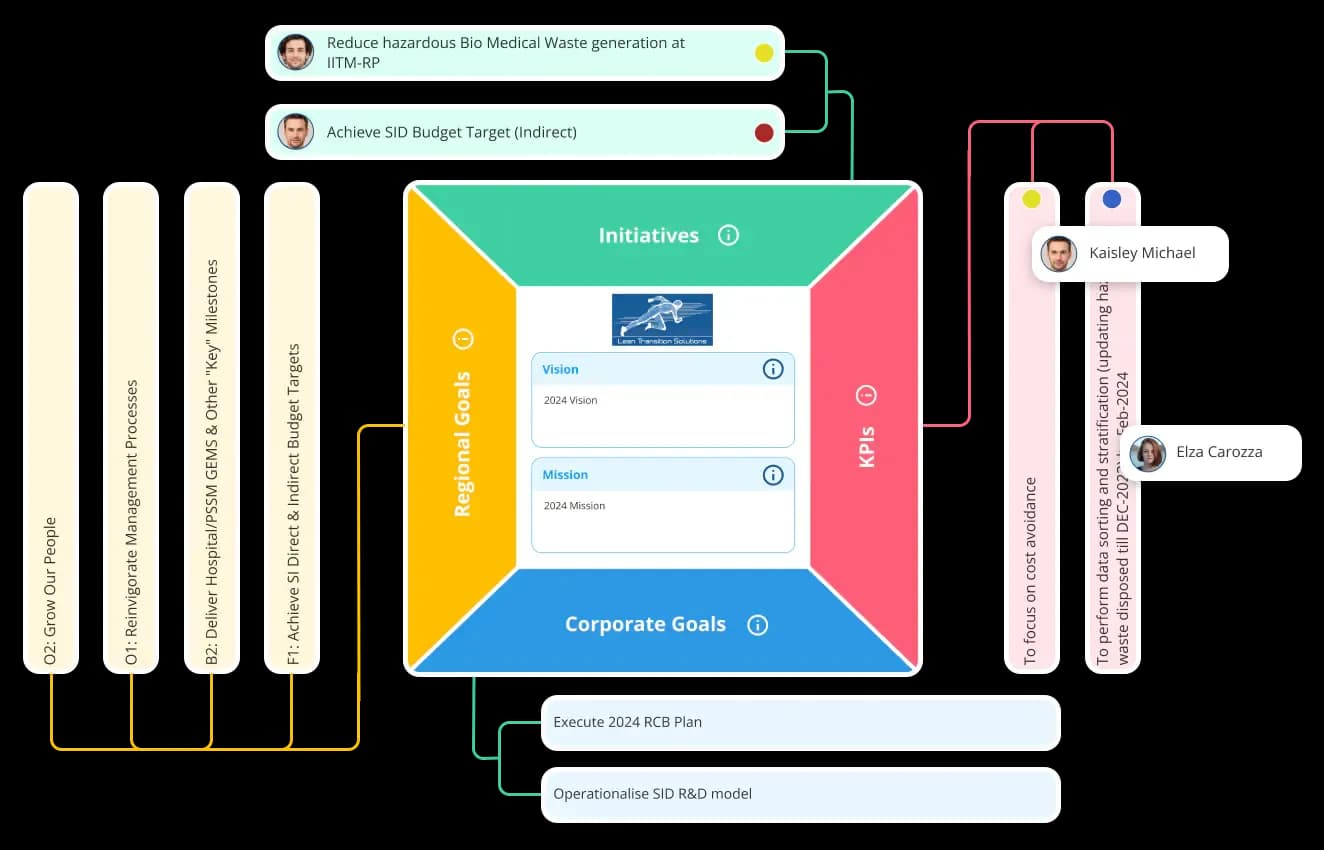
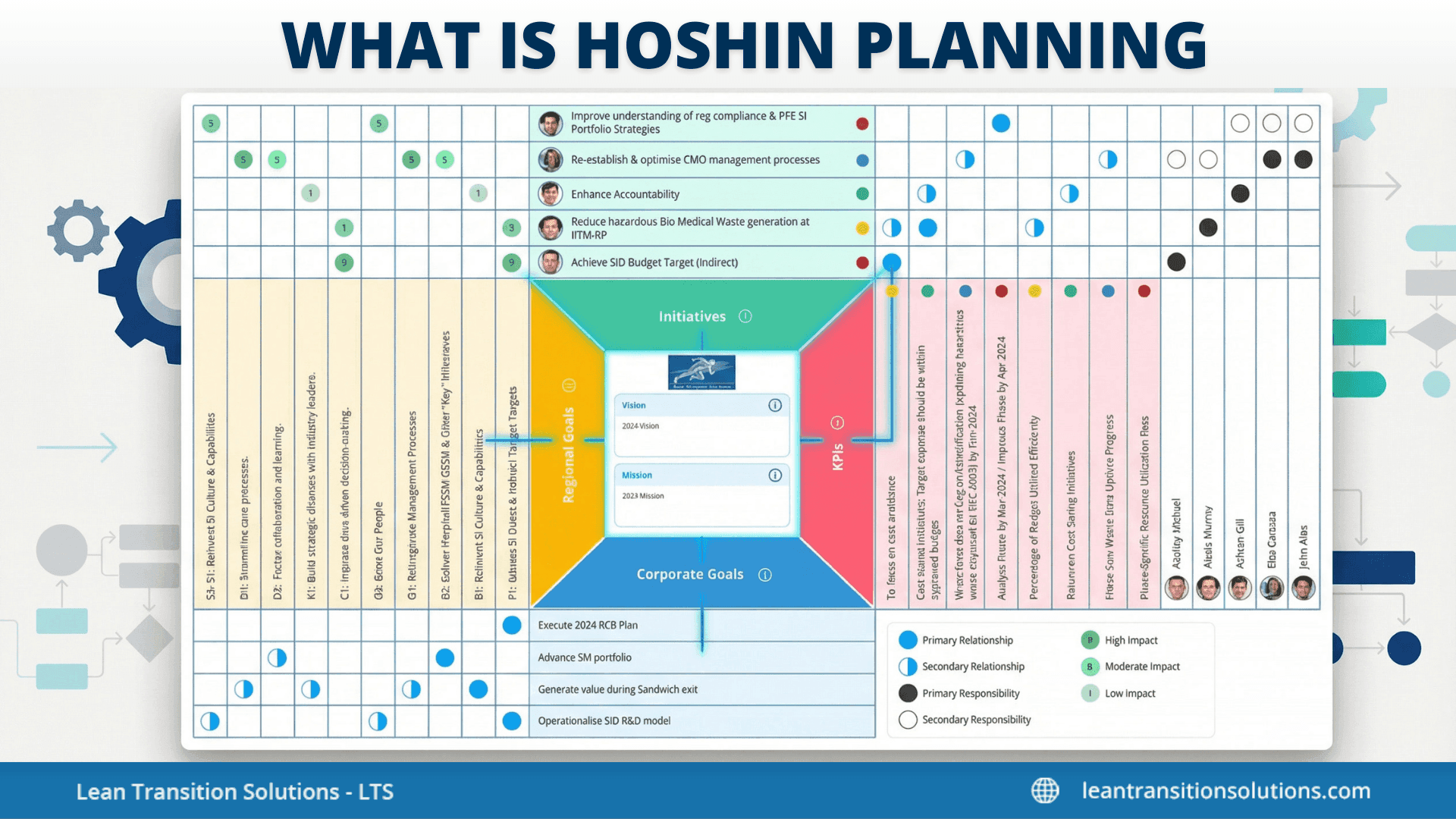
The Hoshin X Matrix is the primary visual tool used to capture the full Hoshin plan on a single page. It maps the relationship between long-term goals, annual objectives, improvement priorities, and the KPIs used to measure progress — with clear ownership assigned across the organisation.
The X Matrix is particularly valuable for leadership teams and strategy reviews because it makes alignment and accountability visible at a glance. However, it is also one of the most commonly misunderstood elements of Hoshin planning, particularly for non-manufacturing roles or teams new to the methodology.
LTS Data Point’s Hoshin Kanri X Matrix makes this process structured and accessible — removing the complexity of manual templates and spreadsheets. Before trying the solution, read the Hoshin Kanri Matrix Complete Guide with examples for more insights.
The Global Acceptance of Hoshin Planning
In the UK, Hoshin planning is increasingly adopted in sectors such as automotive manufacturing, aerospace, food and beverage, and NHS-aligned healthcare operations. UK organisations often encounter Hoshin under the policy deployment label and may be more familiar with its connection to Lean manufacturing programmes.
In the US, Hoshin planning is widely referenced in Industry 4.0, operational excellence, and lean transformation contexts particularly in mid-market manufacturers seeking to scale their strategic alignment capability. American manufacturers familiar with Baldrige criteria or Toyota Production System principles will find significant overlap with Hoshin methodology.
Globally, Hoshin planning remains the dominant strategic deployment framework in Japanese manufacturing and is increasingly adopted by multinational manufacturers seeking to align operations across diverse geographies. Digital platforms make global Hoshin deployment significantly more feasible than legacy manual approaches.
Why Hoshin Planning Fails in Practice
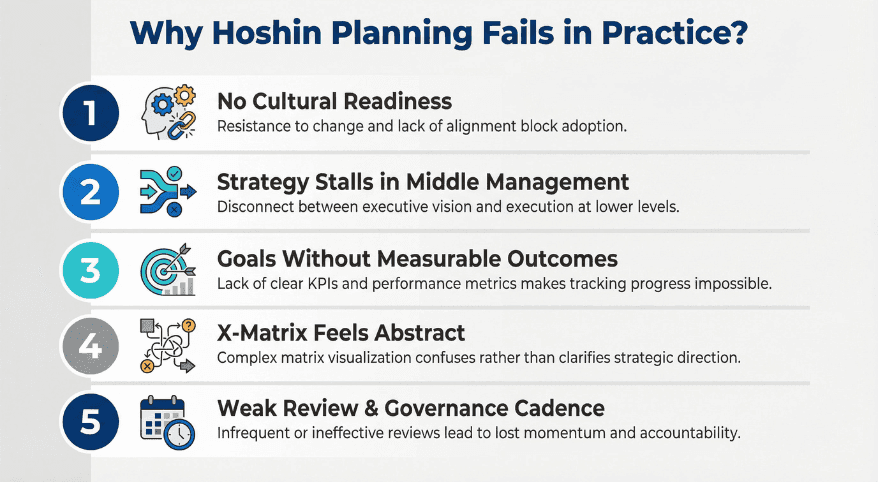
Hoshin planning is a robust methodology. Its failure, when it occurs, is almost never a failure of the framework itself, it may because of the strategic alignment challenges. It is a failure of implementation, and the patterns are consistent across industries and geographies.
Drawing on real feedback from operations and strategy communities, these are the most significant implementation failure points:
1. Implementing Too Early, Without Cultural Readiness
Lean management thinker Michel Baudin has noted that Hoshin Kanri is most effective after an organisation has already built some momentum through local improvements. Teams need enough operational experience to ask meaningfully: 'What does this add up to?' Without that foundation, Hoshin planning becomes an abstract exercise that sits alongside rather than integrating with how work actually gets done.
Many organisations implement Hoshin before they have the cultural maturity, management capability, or measurement infrastructure to support it. The result is a planning process that runs in parallel to operations, rather than driving them.
2. Strategy That Dies in Middle Management
One of the most consistent pain points reported in community discussions is the breakdown of strategic communication at the middle management layer. Executive teams invest significant effort in articulating vision and breakthrough objectives. That clarity rarely survives intact as it moves down the organisation.
Middle managers, often caught between competing operational pressures, default to activity planning rather than outcome management. Departments begin working in isolation, goals become disconnected from the original strategic intent, and performance reviews measure effort rather than results. Strategy becomes a thought experiment rather than an operational discipline.
3. Goals Written Without Measurable Outcomes
A common frustration — frequently surfaced in management and OKR communities — is the tendency for strategic goals to be written as directions rather than destinations. 'Improve customer satisfaction' is a direction. 'Achieve a Net Promoter Score of 65 by Q3' is a destination.
Without reducing efforts to writing with specific, measurable, time-bound outcomes, Hoshin plans create the appearance of alignment without its substance. KPI confusion is widespread: teams track metrics that are loosely related to strategy, and there is no clear line of sight between daily performance and strategic intent.
4. The X Matrix Feeling Abstract or Irrelevant
Feedback from practitioner communities including those in non-manufacturing roles such as enterprise architecture, finance, and HR consistently highlights the X Matrix as a barrier to adoption. The tool can feel complex, overly structured, or disconnected from how non-operational teams think about their work.
This is partly a training and facilitation problem, and partly a technology problem. When the X Matrix for business strategy is managed in Excel or created through static templates, it quickly becomes a document rather than a management system. Digital enablement changes this dynamic significantly.
5. Weak Review Cadence and Governance
Hoshin planning requires structured, regular review cycles to function. Without them, even well-designed plans drift. Monthly and quarterly reviews where actual performance is compared against targets and corrective actions are agreed are non-negotiable. Organisations that treat Hoshin as an annual planning event rather than a continuous management cycle consistently underperform against those that embed regular reviews into their operating rhythm.
Get more insights on how to Break down Organisational Barriers with Hoshin Kanri.
How Hoshin Planning Works: Step-by-Step
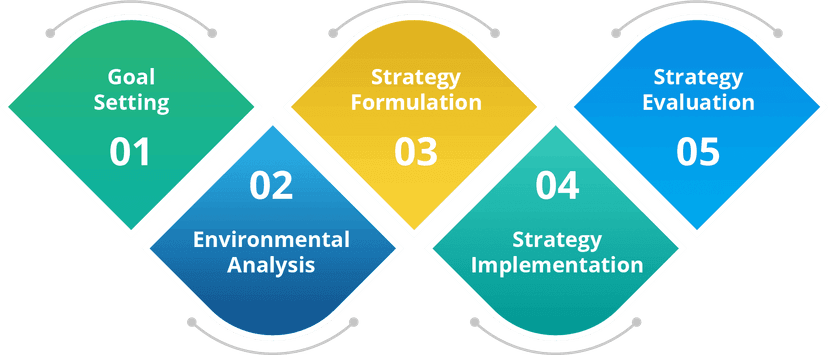
Effective Hoshin planning follows a structured cycle, typically aligned to the organisation's annual planning rhythm and embedded within multi-year strategic horizons.
Define the Long-Term Vision (3–5 Years)
Leadership articulates the organisation's True North, its long-range strategic destination. This is not a financial target. It is a clear statement of what the organisation intends to become, and why that direction matters. Vision must be stable enough to provide direction across multiple annual cycles without being so rigid that it cannot respond to material market changes.
Identify Breakthrough Objectives
From the long-term vision, leadership identifies a small number, typically three to five of breakthrough objectives: the significant, measurable improvements the organisation must make to move towards its vision. These are not business-as-usual improvements. They are transformational priorities that require cross-functional collaboration, dedicated resource allocation, and executive sponsorship.
Set Annual Objectives
Each breakthrough objective is translated into specific annual objectives - what the organisation commits to achieving within the current planning year. Annual objectives must be written with clear KPIs, owners, and timelines. They form the backbone of the X Matrix.
Cascade Through Catchball
Annual objectives are deployed through the catchball process. Teams at each level of the organisation — division, function, department, team - review the objectives, assess what they can realistically contribute, and propose supporting goals and improvement priorities. This iterative dialogue continues until every level of the organisation has aligned its own goals with the strategic plan.
Effective cascading creates a clear line of sight from a plant operator's daily tasks to the organisation's three-year strategic intent.
Align KPIs and Measurement
With strategy cascaded and ownership confirmed, KPIs are assigned at each level. Critically, these must be leading indicators - metrics that predict future performance - as well as lagging indicators that confirm results. KPI alignment across the organisation ensures that performance data at the frontline aggregates meaningfully into strategic performance at the executive level.
Implement Regular Review Cycles
Hoshin planning operates on a structured review cadence:
- Weekly / monthly reviews: Operational teams review progress against their KPIs and escalate constraints.
- Quarterly reviews (Hoshin reviews): Cross-functional leadership reviews aggregate performance, identifies strategic drift, and agrees corrective actions.
- Annual reflection: At year-end, the full plan is reviewed, lessons are extracted, and the process resets for the next cycle - incorporating improvements from the current year.
This review structure is what distinguishes Hoshin planning from a static strategic document. It creates a management system, not a planning artefact.
Hoshin Planning vs. Traditional Strategic Planning vs. OKRs
Understanding how Hoshin planning relates to other frameworks helps organisations make informed decisions about which approach or combination fits their context.
Measurable Business Outcomes of Hoshin Planning
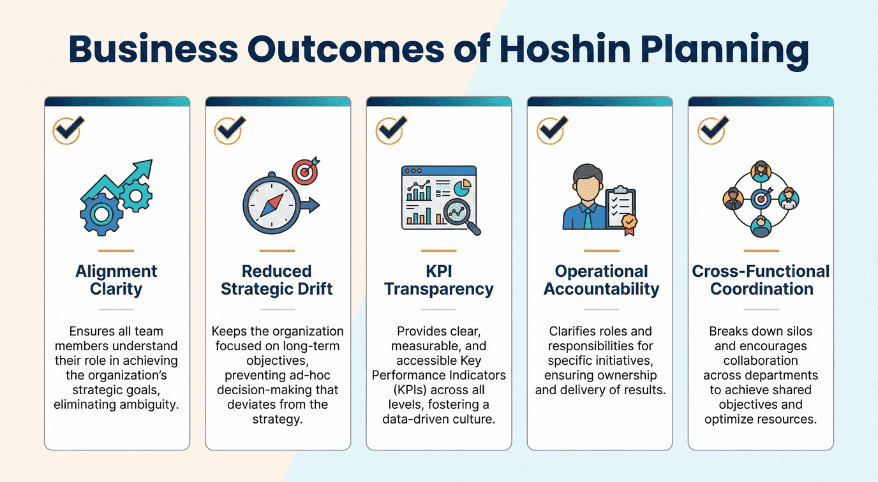
When implemented effectively, Hoshin planning delivers a range of measurable improvements to organisational performance:
Alignment Clarity
Every team, department, and individual understands how their work connects to the organisation's strategic priorities. Strategic drift - the gradual disconnection between stated strategy and actual activity is measurably reduced. Leaders report significantly less time spent resolving priority conflicts and miscommunication between functions.
Reduced Strategic Drift
Subpar performance despite strong market position is a common pattern in organisations without structured strategy deployment. Hoshin planning's regular review cadence creates early warning of misalignment, enabling corrective action before drift becomes a significant performance gap.
KPI Transparency
With goals cascaded and KPIs aligned at every organisational level, performance data becomes meaningful rather than voluminous. Leaders can see at a glance whether the organisation is on track, where it is lagging, and who owns the corrective response.
Operational Accountability
Catchball creates shared ownership of goals before delivery begins. When teams are involved in shaping what they commit to not simply told what to achieve, accountability is genuine rather than enforced. This reduces the blame-and-escalation dynamic that characterises organisations with weak strategy deployment.
Cross-Functional Coordination
Because Hoshin planning explicitly maps dependencies between departments and functions, it reduces the tendency for departments to work in isolation. Strategic improvement priorities particularly those requiring cross-functional collaboration are more likely to succeed when everyone understands their role in the system.
Read more to know why Hoshin Kanri is the better way to True North.
Implementation Considerations: What Leaders Need to Know
Is Your Organisation Ready?
Hoshin planning delivers the greatest value in organisations that have already established basic operational discipline consistent measurement, stable processes, and a management culture that reviews performance regularly. Implementing Hoshin in a highly reactive, measurement-poor environment is likely to produce frustration rather than results.
The question to ask before beginning is simple: do our teams currently know whether they are winning or losing week to week, month to month? If the honest answer is no, building that measurement foundation first will significantly increase the likelihood of Hoshin success.
Digital vs. Manual Approaches
Hoshin planning can be managed through Excel templates, physical X Matrix boards, or purpose-built digital platforms. Each approach has trade-offs.
Excel and manual templates are accessible and low-cost to start. However, they quickly become unwieldy as organisations grow, as multiple sites need to be aligned, or as the review cadence increases. Static documents become outdated, version control becomes a problem, and the X Matrix becomes a reporting artefact rather than a live management tool.
Digital Hoshin platforms such as LTS Data Point's Hoshin Kanri X Matrix solution address these limitations directly. They create a single source of truth for strategic alignment, enable real-time progress tracking, support multi-site and multi-team deployment, and make the catchball process structured and auditable. Read Why Strategy Execution Fails Without Visual Tools to know how important the modern visual tools are rather than the traditional methods.
Governance Structure
Effective Hoshin governance requires clear ownership at each organisational level. Typically:
- The CEO or COO owns the breakthrough objectives and annual strategic goals.
- Division or functional leaders own the departmental cascades and their associated KPIs.
- Team leaders own the operational targets and improvement priorities that support departmental goals.
Without this ownership structure, review meetings become reporting exercises rather than management decisions.
Review Cadence
The review cadence is not optional. Organisations that establish and maintain a structured Hoshin review rhythm- monthly operational reviews, quarterly strategic reviews, annual reflection consistently outperform those that treat Hoshin as a planning-phase exercise.
For UK and US manufacturers operating across multiple sites or geographies, digital tooling makes it possible to maintain this cadence without the logistical burden of in-person review meetings for every level of the organisation.
Taking the Next Step: From Framework to Practice
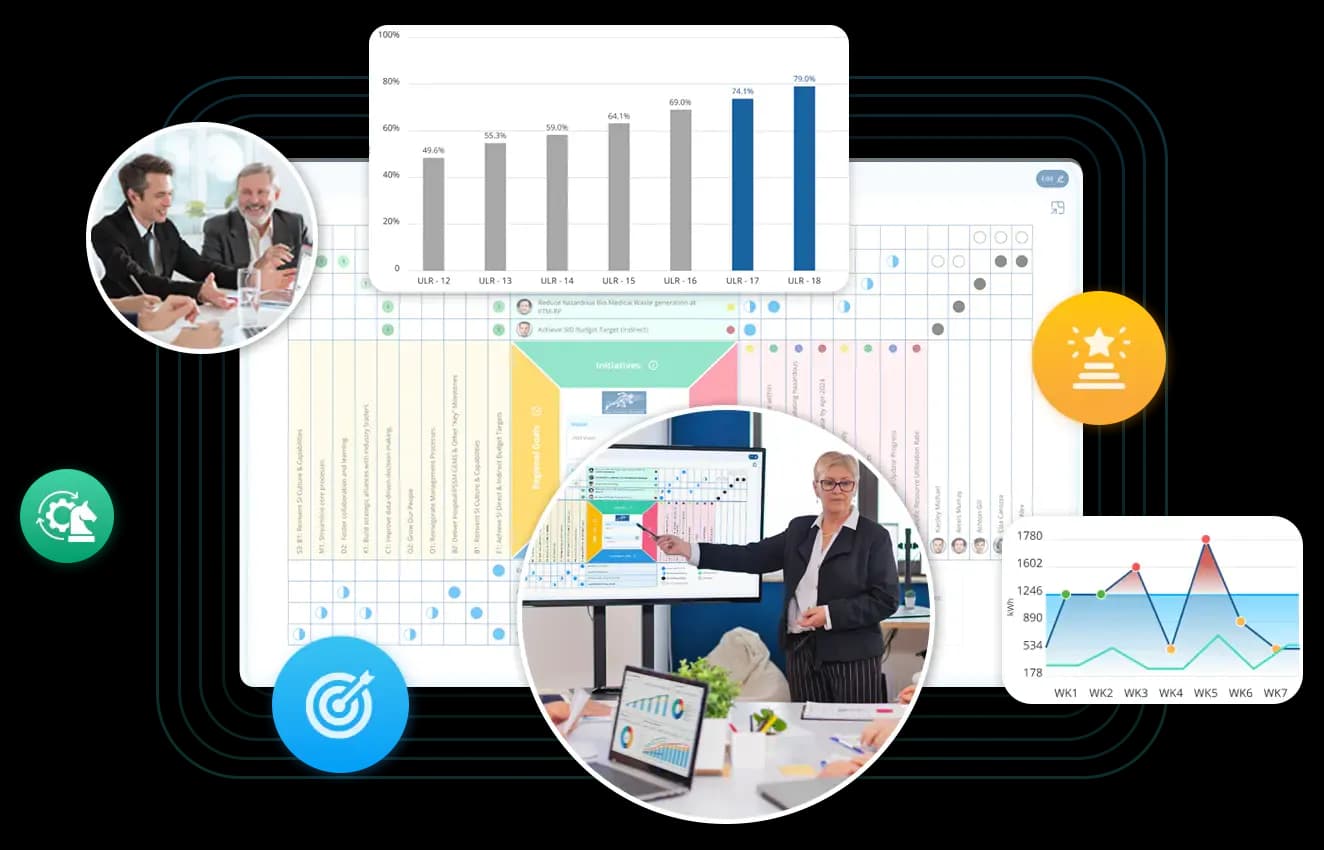
Hoshin planning is not a quick fix. It is a management discipline that, when properly implemented and maintained, creates a sustained competitive advantage: an organisation where strategy and execution are genuinely aligned, where every team understands their contribution to the whole, and where performance gaps are identified and corrected systematically.
For organisations moving from manual or fragmented approaches to a structured, digital Hoshin process, the shift is significant but the operational returns are equally significant.
LTS Data Point's Hoshin Kanri X Matrix platform is built for manufacturers and operational leaders who are ready to close that gap, with the structure, visibility, and governance that Hoshin planning demands.

Amer Jumah, Senior Lean Consultant
Amer is co-founder of Agile Solutions and a certified Six Sigma Black Belt, Lean Black Belt, and PMP, with over nine years of experience implementing Lean, Six Sigma, and Agile principles across diverse industries. He specialises in process optimisation, waste elimination, and delivering cost savings through organisational change.