Strategy Meeting: Why Most Strategy Meetings Fail to Drive Action
Last updated on : April 15, 2026
A strategy meeting is where leadership teams define organisational direction, priorities, and key initiatives. For executives, these sessions are critical to shaping long-term success. However, without clear accountability, structured follow-up, and execution tracking, strategy meetings often generate alignment in theory while operational teams continue without actionable guidance.
Explore how organisations use LTS Data Point to connect strategy meetings with real-time performance dashboards and structured initiative tracking
What a strategy meeting is designed to achieve in organisational governance
A strategy meeting is not a session for creating strategy. It is a leadership governance forum where senior decision-makers review direction, validate priorities, and ensure that previously defined strategy continues to guide organisational actions.
While a strategic planning meeting focuses on defining goals and initiatives, a strategy meeting focuses on monitoring, validating, and steering those decisions over time.
Core purpose of a strategy meeting
A well-structured executive strategy meeting is designed to help leadership teams:
- Review strategic direction against current business conditions
- Validate previously approved initiatives to ensure they remain relevant
- Confirm priorities after the strategic planning phase has been completed
- Identify deviations between planned and actual progress
- Ensure that organisational resources remain aligned with strategic intent
These discussions typically occur after the organisation has completed its strategic planning cycle, making them part of ongoing governance rather than planning.
How strategy meetings function in the leadership hierarchy
In large industries, strategy meetings operate as a bridge between board-level direction and operational execution.
They help translate high-level guidance into coordinated leadership actions across business units.
Key governance roles include:
- Board and executive committees – set direction and approve major strategic shift
- C-suite leadership – review progress, resolve conflicts, and prioritise initiatives
- Business unit heads – report performance, risks, and execution challenges
- Operational leaders – implement approved actions and provide feedback
This structure ensures that corporate strategy meetings are not isolated decisions but part of a structured decision-making chain that connects vision to execution.
Decision validation escalation in strategy meetings
Strategy meetings also serve as formal checkpoints where leadership teams:
- Reassess assumptions used during strategic planning
- Validate whether initiatives are delivering expected outcomes
- Escalate decisions that require cross-functional or board-level approval
- Reallocate when priorities shift
This validation process helps organisations avoid situations where strategic plans remain unchanged despite changing market or operational conditions.
Governance expectations from C-suite participants
For a strategy meeting to be effective, senior leaders are expected to:
- Arrive with performance data and progress updates
- Focus discussions on strategic outcomes rather than operational details
- Challenge assumptions and request evidence before approving changes
- Assign clear ownership when new actions are agreed
When these governance expectations are consistently followed, strategy meetings become a structured mechanism for maintaining strategic direction, rather than recurring discussions that repeat earlier planning conversations.
Why many strategy meetings fail to drive execution in practice
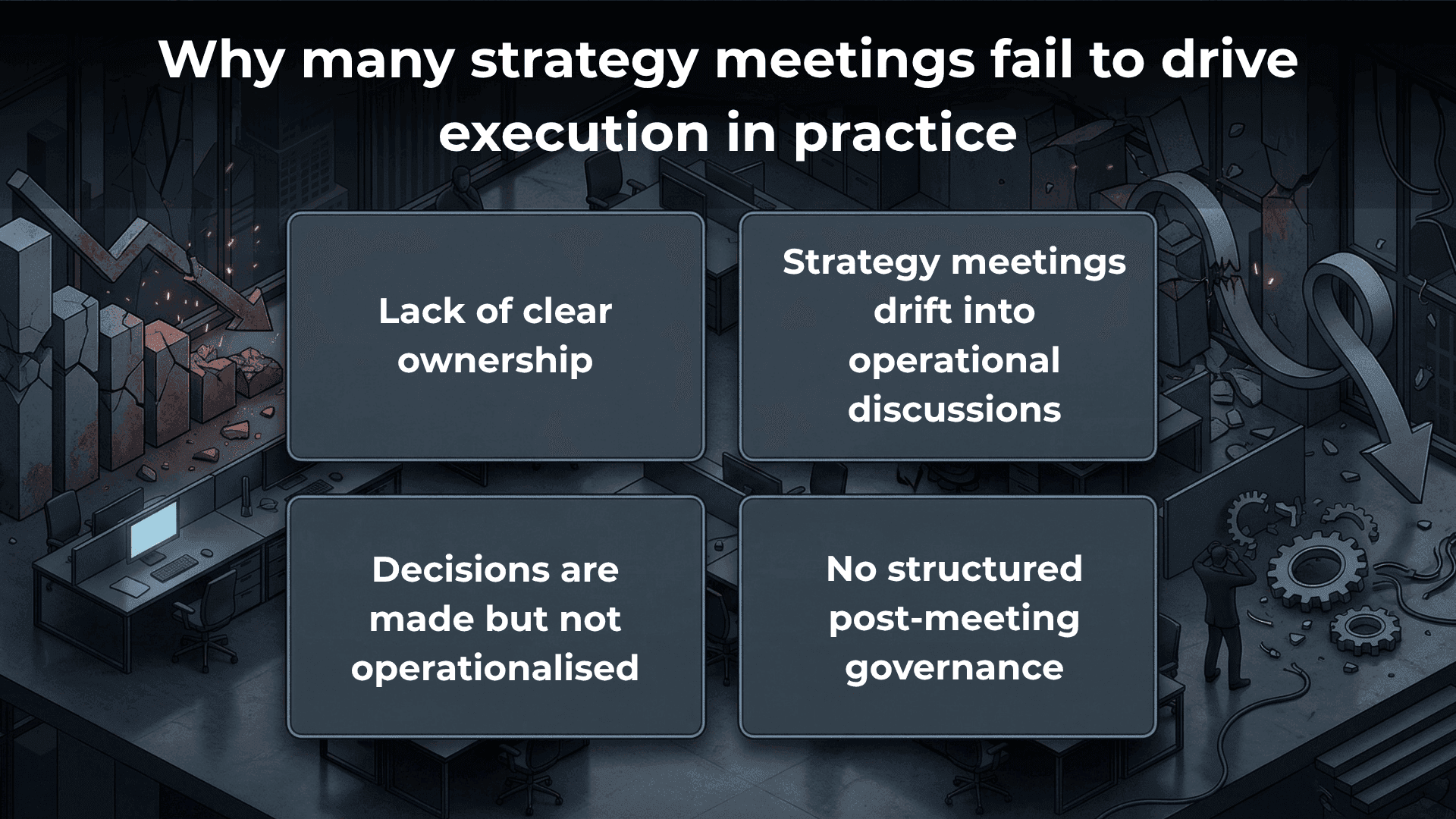
Despite their importance, many companies struggle to convert strategy discussion into measurable progress. Understanding why strategy meetings fail is essential for leadership teams that want to ensure strategic intent translates into organisational outcomes.
In most cases, the issue is not poor strategy design but weak governance after decisions is made.
The most common failure pattern
Across industries, strategy meetings often follow a predictable pattern:
- Strong participation and discussion during the meeting
- Agreement on high-level priorities
- Limited clarity on ownership and next steps
- Little or no structured follow-up after the session
This creates a strategy execution gap, where leadership teams believe decisions have been made, but operational teams receive no clear direction or accountability framework.
1. Lack of clear ownership
One of the primary reasons for the lack of follow-through in strategy meetings is the absence of clearly assigned responsibility.
Typical issues include:
- Decisions recorded without naming a single accountable owner
- Initiatives discussed but not formally assigned to business units
- Multiple leaders assuming someone else will drive implementation
Without clear ownership, even well-supported strategic initiatives tend to lose momentum after the meeting concludes.
2. Strategy meetings drift into operational discussions
Another recurring challenge is that strategy meetings gradually shift focus away from long-term priorities and towards immediate operational issues.
This often happens when:
- Urgent performance problems dominate the agenda
- Leadership teams attempt to resolve day-to-day issues during strategic forums
- Insufficient separation exists between strategic and operational review meetings
In several industries, this drift is linked to confusion between tactical vs strategic topics, where short-term concerns overshadow discussions about long-term direction.
3. Decisions are made but not operationalised
Many leadership teams assume that once a decision is agreed in a meeting, execution will naturally follow. In practice, this rarely happens without structured handover and tracking mechanisms.
Common gaps include:
- No documented action plans following meetings
- Lack of defined milestones and review checkpoints
- No linkage between strategic decisions and performance metrics
As a result, strategy meetings become discussion forums rather than governance mechanisms that actively drive change.
4. No structured post-meeting governance
Even when decisions are documented, organisations often lack formal process to observe whether those decisions are being implemented.
This leads to:
- Repeated discussion of the same topics across multiple meetings
- Limited visibility into progress between review cycles
- Delayed identification of execution risks or stalled initiatives
Without post-meeting governance, strategy meetings fail to maintain continuity, and strategic priorities gradually lose organisational visibility.
The strategy meeting-to-execution gap: Where strategic decisions lose momentum
Even when industries conduct regular strategy meetings, a visible gap often remains between decisions made in leadership forums and results achieved on the ground. This disconnect is commonly described as a breakdown in strategy to execution alignment, where intent is clear but coordinated action is inconsistent.
How strategic decisions weaken across organisational layers
Decisions discussed at the executive level often lose clarity as they move through multiple management layers.
This typically happens when:
- Strategic priorities are communicated verbally rather than documented clearly
- Middle management interprets decisions differently across departments
- Operational teams receive high-level direction without specific expectations
As a result, initiatives that were clearly defined during meetings become diluted or reinterpreted by the time they reach execution teams.
The role of ownership in sustaining momentum
A major contributor to stalled initiatives is the absence of clearly defined ownership across organisational levels.
When ownership is unclear:
- No single leader is accountable for driving progress
- Cross-functional initiatives remain dependent on informal coordination
- Teams focus on local priorities instead of enterprise-level outcomes
This lack of clarity directly contributes to strategy implementation challenges, as initiatives struggle to maintain momentum after initial approval.
Why strategy meetings alone cannot ensure execution
Strategy meetings create alignment at a specific point in time, but execution requires continuity between those sessions. Without mechanisms that persist beyond the meeting room, decisions gradually lose visibility and urgency.
Common symptoms include:
- Initiatives discussed repeatedly but showing limited progress
- Leaders assuming that execution is underway without verified status updates
- Action items becoming disconnected from day-to-day operational management
These patterns illustrate the difficulty organisations face in translating strategy into action when follow-up mechanisms are weak or inconsistent.
Communication gaps between leadership and operations
The strategy meeting-to-execution gap also emerges from communication breakdowns between strategic and operational layers.
Typical communication issues include:
- Strategy discussed in abstract or high-level terms that are difficult to operationalise
- Limited opportunities for operational leaders to clarify expectations
- Inconsistent messaging across departments and business units
Over time, these communication gaps make it harder for industries to maintain consistent interpretation of strategic priorities, leading to fragmented execution.
Linking strategy meetings to strategic implementation
While strategy meetings are intended to steer direction and monitor progress, they must connect directly with the company’s broader strategic implementation processes to sustain results.
When this connection is weak:
- Meetings become periodic checkpoints without operational impact
- Implementation teams operate with incomplete context
- Leadership loses visibility into how decisions are being executed across the organisation
This highlights why governance mechanisms must extend beyond meetings and integrate with structured implementation practices, which are explored in greater depth within the industry’s broader strategic implementation approach.
What high-impact strategy meetings do differently at the leadership level
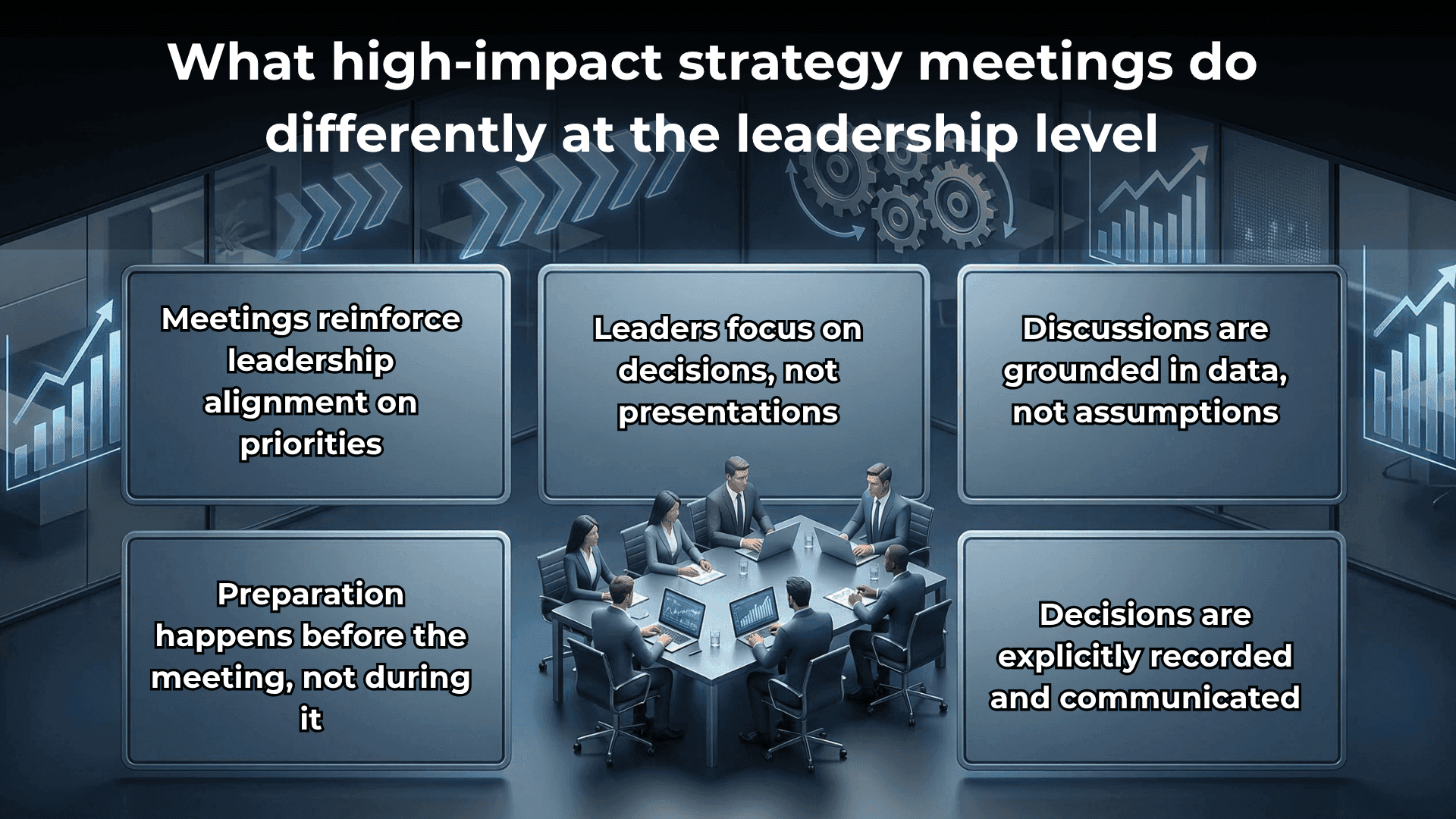
Not all strategy meetings are ineffective. In organisations where these sessions consistently drive results, the difference is rarely the meeting format – it is the behaviour of leaders and the systems that support their decisions. An effective strategy meeting functions as a governance mechanism that reinforces direction, accountability, and organisational focus.
1. Leaders focus on decisions, not presentations
In high-performing organisations, strategy meetings are structured around strategic decision-making, rather than lengthy status presentations.
This is reflected in practices such as:
- Limiting slide-heavy updates and emphasising concise performance summaries
- Reserving meeting time for discussing risks, trade-offs, and priorities
- Ensuring that each agenda item leads to a clear decision, validation, or escalation
This approach helps leadership teams use meeting time to actively steer the organisation rather than passively review information.
2. Preparation happens before the meeting, not during it
High-impact meetings depend on strong pre-read governance, where leaders review data and context in advance. This enables discussions to focus on implications and decisions rather than information gathering.
Typical examples include:
- Circulating performance dashboards and reports before the meeting
- Defining expected decisions or discussion outcomes for each topic
- Ensuring participants arrive prepared to challenge assumptions and propose actions
This preparation ensures that meetings operate at a strategic level and maintain focus on enterprise priorities.
3. Meetings reinforce leadership alignment on priorities
One of the most important outcomes of a well-run strategy meeting is sustained leadership alignment across functions and business units.
These meetings help leaders:
- Confirm that all executives share a consistent interpretation of strategic priorities
- Identify conflicting objectives between departments early
- Resolve disagreements before they affect execution at operational levels
Over time, this repeated reinforcement contributes to stronger strategic alignment, ensuring that organisational actions remain coordinated even as market or operational conditions change.
4. Discussions are grounded in data, not assumptions
Effective strategy meetings rely on structured performance data rather than anecdotal updates or informal assessments.
Leadership teams typically:
- Review trends across strategic KPIs instead of isolated performance metrics
- Analyse deviations from targets and discuss root causes
- Use data to prioritise initiatives, reallocate resources, or pause underperforming programmes
This data-driven approach reduces bias in decision-making and strengthens confidence in the actions agreed during the meeting.
5. Decisions are explicitly recorded and communicated
High-impact meetings treat decisions as formal governance outputs rather than informal agreements.
Common practices include:
- Documenting every strategic decision along with context and rationale
- Clearly identifying responsible owners and expected timelines
- Communicating outcomes to relevant teams to ensure consistent interpretation across the organisation
This disciplined documentation ensures that decisions made during strategy meetings translate into coordinated action rather than remaining confined to leadership discussions.
How to ensure every meeting leads to action and measurable outcomes
A strategy meeting delivers value only when decisions made during the session translate into visible progress afterwards. Industries that consistently achieve this outcome treat meetings as the starting point of governance, not the end of discussion. This approach ensures that strategy meetings actively support ongoing strategy execution rather than functioning as isolated leadership conversations.
1. Convert decisions into structured action flows
To prevent decisions from being forgotten or inconsistently interpreted, high-performing organisations formalise how outcomes from strategy meetings are recorded and tracked.
A commonly used governance flow is:
Decision → Owner → Milestone → Key Performance Indicators → Review
This structure ensures that:
- Every decision is linked to a clearly accountable owner
- Progress is broken into measurable milestones rather than broad goals
- Outcomes are evaluated using defined strategic KPIs instead of subjective assessments
By applying this structure consistently, leadership teams create continuity between discussions and operational follow-through.
2. Assign clear ownership to strengthen decision accountability
One of the biggest barriers to execution is ambiguity around responsibility. Even when decisions are agreed to the executive level, lack of ownership can prevent meaningful progress.
To strengthen decision accountability, organisations should:
- Assign a single accountable leader for each strategic initiative
- Distinguish between decision approvers, implementers, and reviewers
- Document ownership formally rather than relying on informal understanding
Clear ownership ensures that initiatives discussed in strategy meetings remain visible and actively managed between review cycles.
3. Link strategy meeting decisions to performance measurement
For strategy meetings to influence outcomes, decisions must be connected directly to performance measurement systems.
This typically involves:
- Translating strategic priorities into measurable indicators
- Aligning initiatives with relevant strategic KPIs that reflect long-term direction
- Reviewing performance trends in subsequent meetings to verify progress
Without this linkage, leadership teams may continue discussing strategy while having limited visibility into whether initiatives are delivering expected results.
4. Maintain continuous strategy and initiative tracking
Effective organisations do not wait until the next quarterly meeting to assess progress. Instead, they maintain ongoing strategy tracking and initiative tracking processes that provide visibility between meetings.
Key practices include:
- Maintaining a central repository of active strategic initiatives
- Updating progress status regularly rather than only during formal reviews
- Using dashboards or structured reports to highlight delays, risks, and dependencies
This continuous visibility helps leaders identify execution risks early and intervene before initiatives lose momentum.
5. Establish regular review cadences to sustain momentum
Strategy meetings should operate as part of a broader review rhythm rather than isolated events. Establishing consistent cadences helps leadership teams maintain focus on agreed priorities.
Typical review structures include:
- Monthly or quarterly strategy review meetings for progress validation
- Interim operational reviews to monitor milestone completion
- Escalation mechanisms when initiatives fall behind schedule or require leadership intervention
This rhythm ensures that decisions made during one meeting are revisited, evaluated, and adjusted in future sessions, reinforcing a continuous loop between discussion and execution.
Using digital systems to sustain strategy meeting outcomes across the organisation
Strategy meetings create direction and decisions, but sustaining those outcomes requires continuity across the broader strategic management lifecycle. When organisations rely solely on presentations, email threads, or spreadsheets, visibility into decisions and progress often fades between meetings, making it difficult to maintain execution momentum.
A structured digital environment helps ensure that strategic decisions remain visible, measurable, and connected to ongoing organisational performance.
Limitations of slides and spreadsheets in strategy governance
Traditional tools are useful for presenting information during meetings, but they are not designed to support continuous governance or cross-functional tracking.
Common limitations include:
- Static presentations that quickly become outdated after the meeting
- Spreadsheets stored in multiple locations, creating version control issues
- Lack of real-time visibility into initiative progress between review cycles
- Difficulty consolidating updates from multiple departments
These limitations often result in leadership teams revisiting the same discussions repeatedly because the status of earlier decisions is unclear or fragmented.
Need for persistent visibility beyond meeting rooms
To sustain the impact of strategy meetings, industries need systems that provide ongoing visibility into decisions, initiatives, and performance metrics.
This includes:
- Maintaining a single source of truth for strategic priorities
- Ensuring the progress updates are accessible to leadership at any time
- Enabling cross-functional teams to view how their initiatives contribute to enterprise goals
This level of transparency supports enterprise strategy governance, as leaders can monitor progress without waiting for the next formal review session.
How LTS Data Point supports continuity between strategy meetings
A digital performance management system enables leadership teams to maintain continuity between strategy meetings and ongoing performance reviews. LTS Data Point performance management software is designed specifically to support this need by connecting strategic priorities, KPIs, and initiative tracking within one structured platform.
With LTS Data Point, organisations can:
- Capture strategic decisions directly within the system during or after meetings
- Assign ownership and timelines to initiatives in a traceable manner
- Track progress through integrated strategy dashboards rather than isolated reports
- Review performance trends across business units without manually consolidating data
This helps ensure that discussions held in leadership forums translate into continuously monitored organisational actions.
Supporting cross-functional strategy and performance tracking
Large organisations often struggle to maintain consistent visibility across departments and locations. By using structured performance tracking systems, leadership teams can ensure that:
- All business units report progress using standardised metrics
- Interdependencies between initiatives are visible and managed proactively
- Delays or risks are escalated early rather than discovered during periodic reviews
This cross-functional visibility helps reduce silos and ensures that strategic priorities remain aligned across the organisation.
Comparison: Traditional tools vs LTS Data Point for strategy meeting governance
This comparison highlights how structured systems reduce administrative effort while strengthening governance and accountability.
Strategy meetings play a critical role in ensuring that organisational direction is not only defined but continuously governed and executed. When supported by clear accountability, structured follow-up, and a periodic discussion – it becomes a central mechanism within the broader strategic management process. Organisations that strengthen this governance layer are better positioned to maintain leadership alignment, bridge the gap between planning and execution, and translate strategic intent into measurable, sustained results.
Not sure how to operationalise strategy meeting outcomes? Connect with a consultant to see how LTS Data Point can support your execution framework.
FAQs
1. How often should a strategy meeting be conducted?
Most organisations conduct formal strategy meetings quarterly, with monthly or bi-monthly review sessions to monitor progress and address execution risks between major planning cycles.
2. Who should attend a strategy meeting?
A strategy meeting should include senior leadership, key functional heads, and individuals responsible for executing major strategic initiatives to ensure decisions are realistic and actionable.
3. How long should strategy meeting typically last?
Effective strategy meetings usually range from two to four hours, depending on organisational complexity, ensuring enough time for discussion, decision-making, and alignment without causing fatigue.
4. What is the difference between a board meeting and a strategy meeting?
A board meeting focuses on governance, compliance, and oversight, while a strategy meeting is centred on organisational direction, priorities, and execution planning at the executive level.
5. Should strategy meetings include operational performance reviews?
They should include high-level performance insights, but deep operational reviews are typically handled in separate operational or performance meetings to maintain strategic focus.
6. How can organisations document strategy meetings include operational performance reviews?
Many organisations use structured digital platforms such as LTS Data Point to capture decisions, assign ownership, and track progress in a centralised, auditable environment.
7. What is the ideal preparation required before a strategy meeting?
Leaders should review pre-reads, performance reports, and initiative updates in advance, so meeting time is spent on analysis and decisions rather than presentations.
8. How do strategy meetings report long-term organisational resilience?
By providing a recurring forum to reassess priorities, respond to market change, and realign resources, strategy meetings help organisations adapt while maintaining strategic continuity.

Geandra Queiroz, Operations Management Consultant
Geandra is an Operations Management Consultant at Lean Transition Solutions, specialising in Lean philosophy, Lean Six Sigma, and strategic planning across manufacturing and healthcare. She is currently completing her PhD in Industrial Engineering at the Federal University of São Carlos, researching the integration of Operations Strategy, Lean, and Green Manufacturing.