Lean AI: Why the Knowledge Your AI Captures Is Only as Good as the Lean Behind It and How to Make It Keep Getting Better
Last updated on : May 22, 2026
The problem today is not lack of data. It is too much data.
It is not the lack of team effort that leads to failure. It is that their knowledge remains with them and is not transferred into the system they work in daily.
Imagine that you are a lean expert, and you take a session in your company transferring the knowledge to your people. They received it well and practiced for one week. Then, they are back on square one.
Artificial Intelligence sure can capture data, much quicker than any human. But what decides if the data captured is worthwhile to your system and organisation? What ensures that it gets better over time?
See how LTS Data Point embeds lean discipline into your daily operations
Why lean training produces knowledge that doesn’t survive the shift
Research shows that only 10-20% of learning from traditional training transfers to the actual job performance, making 80-90% of training investment unproductive.
Every lean training works in time. Everyone gets the opportunity to learn. Why this huge gap still?
- The core purpose of training is to impart knowledge and skills to the individuals. But unless the knowledge is embedded into strategic direction of the organisation and is supported at every level of the management, it will not be regarded as relevant and will not progress.
- The traditional one-and-done approach to training was never designed for daily operational embedding. It results in limited knowledge retention because it fails to incorporate reinforcement and repetition into the learning process. This makes it structurally misaligned with how operational knowledge actually embeds.
- Most companies who completed lean training successfully and provided certificates failed to adopt it permanently. They satisfied the formal requirements, but embedding the knowledge into the daily operations was still further away.
- Lack of leadership vision and knowledge, and the absence of implementation plan is another reason why lean trainings become utter failure. Training alone will not ensure effective adoption of lean knowledge.
Giving out training is easy. You just need a lean expert ready to impart knowledge. But adopting them into daily operations is still a task, that most organisations fail to achieve. This is the gap lean manufacturing AI is built to close – not by replacing the training, but by ensuring what teams learn does not stop at the classroom door.
What determines whether AI captures the right lean knowledge
This is where the gap exists. AI cannot self-assess the quality of what it receives. The lean discipline behind the input acts as the quality control.
And who checks if this knowledge is right or not?
Humans, of course.
But how?
That's what we’re going to see.
To check if the knowledge fed to AI is right or not, you’ll have to ask the right questions.
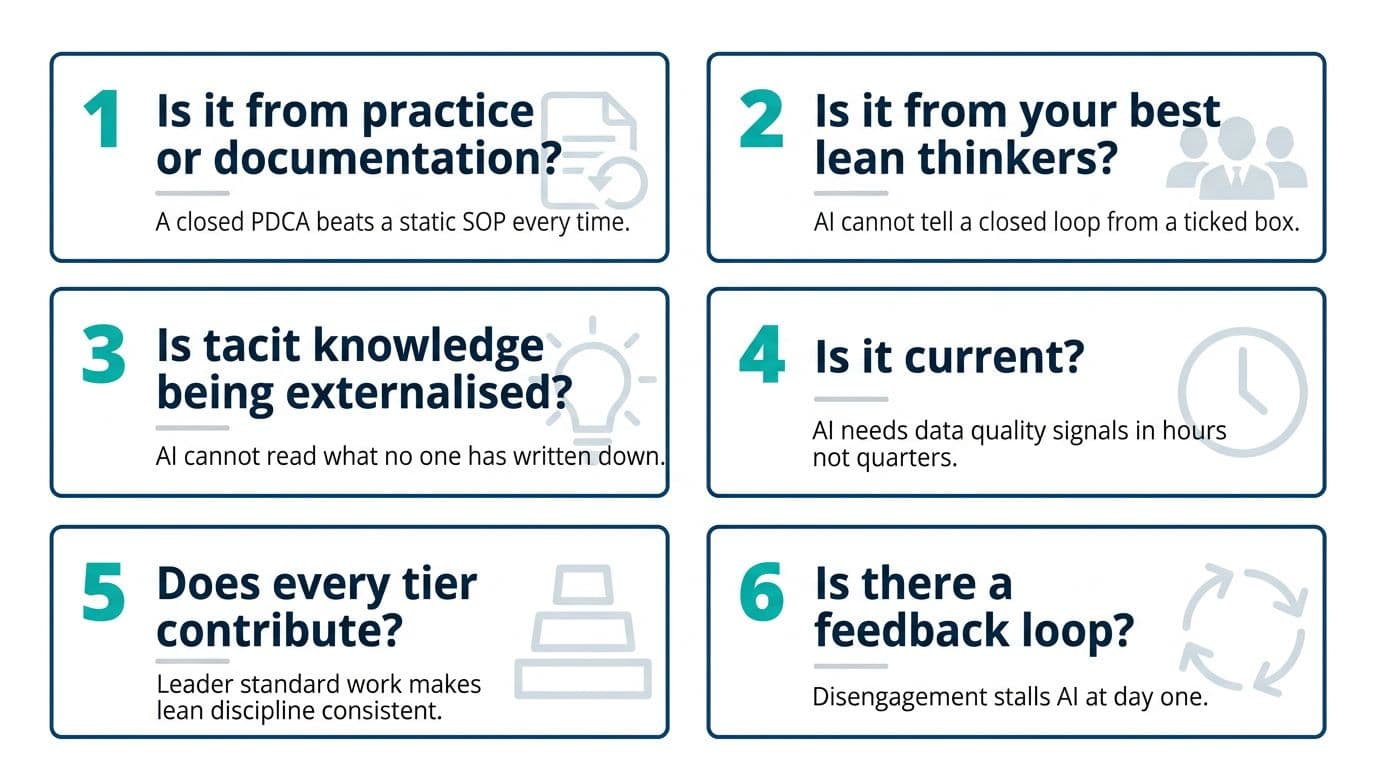
1. Is it coming from practice or just documentation?
Feeding lean knowledge at the time of implementing the AI model and then forgetting to update it teaches the AI what it was, not what it is. Instead of simply feeding a document that remains static throughout the years, it is always better to feed what has been practiced. A static SOP is not timely, but a closed PDCA from last week is.
2. Is it coming from your best lean thinkers?
Suppose two teams submit identical deviation reports, where one shows root cause and the other is a list of ticked checkboxes. AI treats them equally and will end up in a muddled conclusion. If the data fed is inconsistent, that is what AI scales.
3. Is the tacit knowledge being externalised?
Every organisation runs on two operating systems. The official process is always documented. What experts do in the process goes unlogged. The team leader who knows which deviation to escalate, the operator who spots the pattern before it shows up on data – that knowledge is the real lean intelligence. AI cannot read it unless someone actually externalises this information.
4. Is it current?
AI models in production require data quality signals that are measured in hours, not quarterly or annually. This mismatch is where most knowledge quality problems originate. Daily lean practice such as consistent KPI reviews, structured escalations, closed PDCA cycles keeps AI knowledge updated.
5. Does every tier contribute?
Each tier has a different function. Most organisations still struggle to articulate who owns the quality of specific datasets and what good actually means in measurable terms. The organisations making the most progress are those that treat data quality as a shared responsibility rather than an IT function. This is where leader standard work becomes critical. It is the mechanism that makes tiered lean discipline consistent across every level.
6. Is there a feedback loop?
AI tools with no user feedback mechanism cannot improve after launch. User disengagement is a documented root cause of AI project abandonment. When lean teams engage with the system, they actively improve what AI knows. When they disengage, AI stalls at what it knew on day one.
How lean AI keeps getting better as your team does
Lean has always emphasised people. As AI joins hands in this process, the relationship stops being one-directional. When lean teams follow disciplined daily practice, AI learns from it. When AI surfaces better signals, lean teams make better decisions. Each cycle compounds the other.
Instead of leaving the model to learn in an isolated environment, humans with context and expertise review, correct, and feed correction into the system. This builds feedback loops that keep the model learning and improving with every real-world interaction.
When AI models stop receiving accurate inputs, errors compound with each generation. This slows down the rate of improvement in performance, and models eventually stop learning accurately from their inputs.
Each PDCA cycle teaches teams how to observe, think, and act in alignment with purpose, and when improvement is standardised and documented at each cycle, it links directly into daily management. The goal is not perfection in one event but progress through continuous practice. This is exactly what lean AI needs and what lean knowledge transfer has always depended on.
What changes when lean knowledge lives in the system, not the session
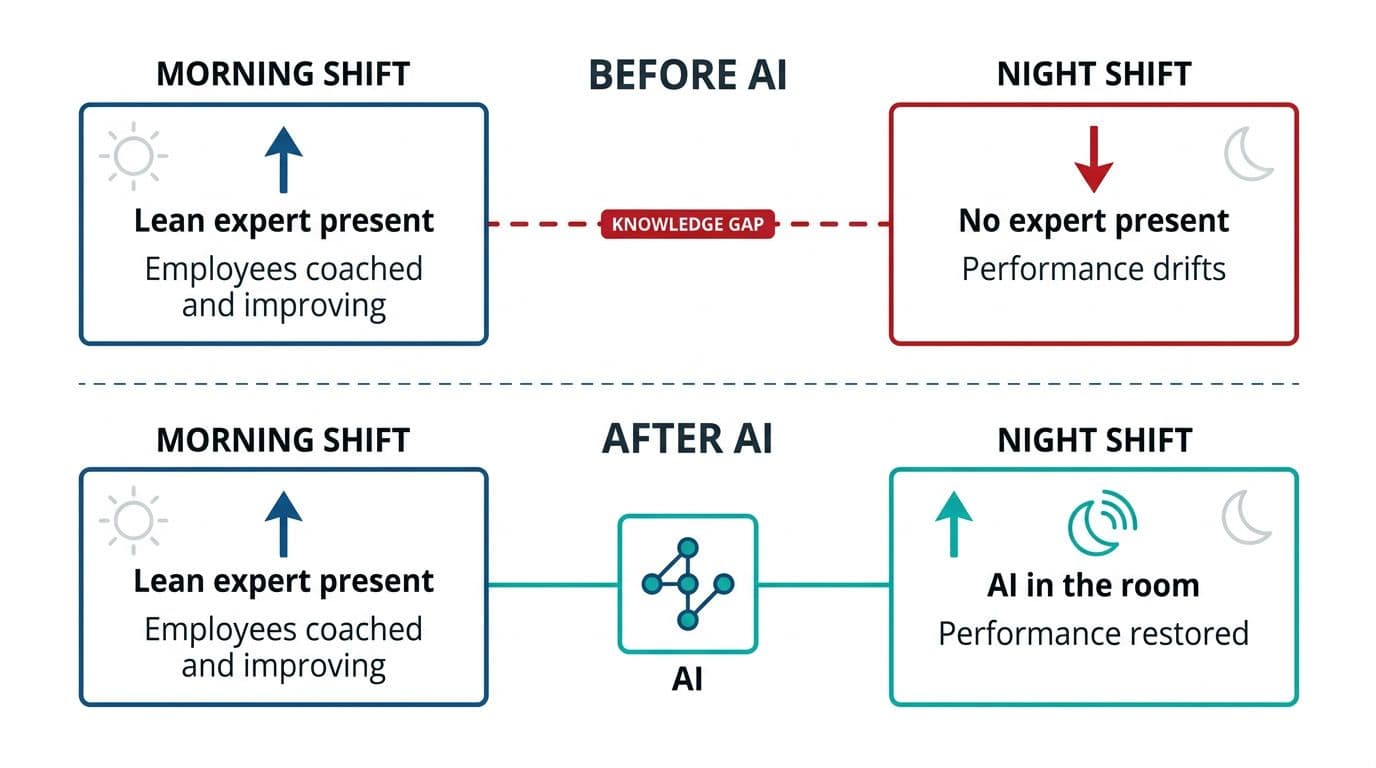
Training delivers knowledge before the decision happens. Lean artificial intelligence delivers it when the decision is actually being made. When the right methodology appears at the moment it is needed, the gap between knowing and doing closes.
Consider a manufacturing plant that runs two shifts. The morning shift is the one where the company’s lean expert is present and is actively coaching, and hence, the knowledge of employees in the morning shift gets updated and checked. They learn, practice, and perfect their work. But by the night shift, there’s no lean expert in the room. The employees of the night shift struggle to get through their shift. The organisation later implemented an AI, and the lean expert documented and fed the lean knowledge into the system which could be accessed even when he is not in the room. This improved the efficiency of the night shift, bringing it in sync with the morning shift.
What this change means for every shift?
Lean daily management works by creating rhythms and routines that catch problems before they escalate. But those rhythms only hold when the right knowledge is available on every shift, not just when the lean expert is in the building.
AI amplifies what is already there. Strong systems get stronger. Weak ones get exposed quicker. Implementing AI does not replace the training that builds lean thinking in people. It gives that training a system to live in. A course attended once is seen as an event. But a system that learns, surfaces, and improves alongside the team becomes infrastructure. Lean AI tools make this shift practical by embedding methodology into the systems teams already use rather than adding another layer of training on top.
The foundation that makes lean AI work
LTS Data Point provides the connected lean foundation for lean teams.
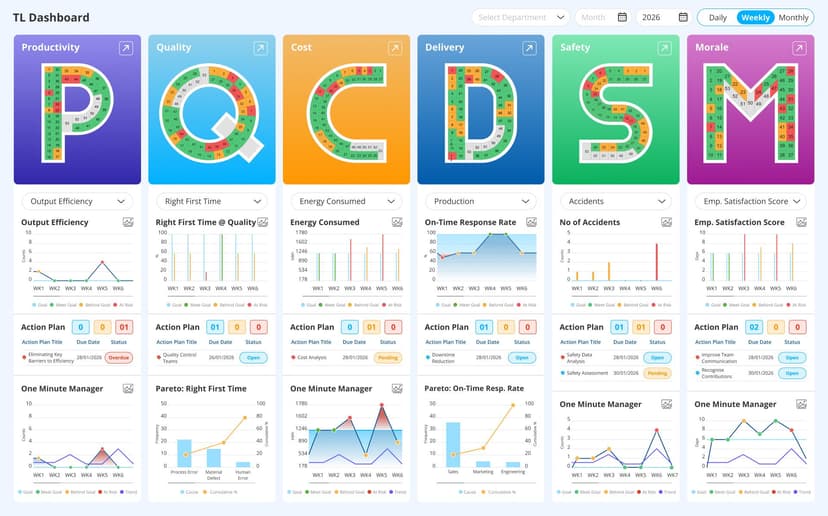
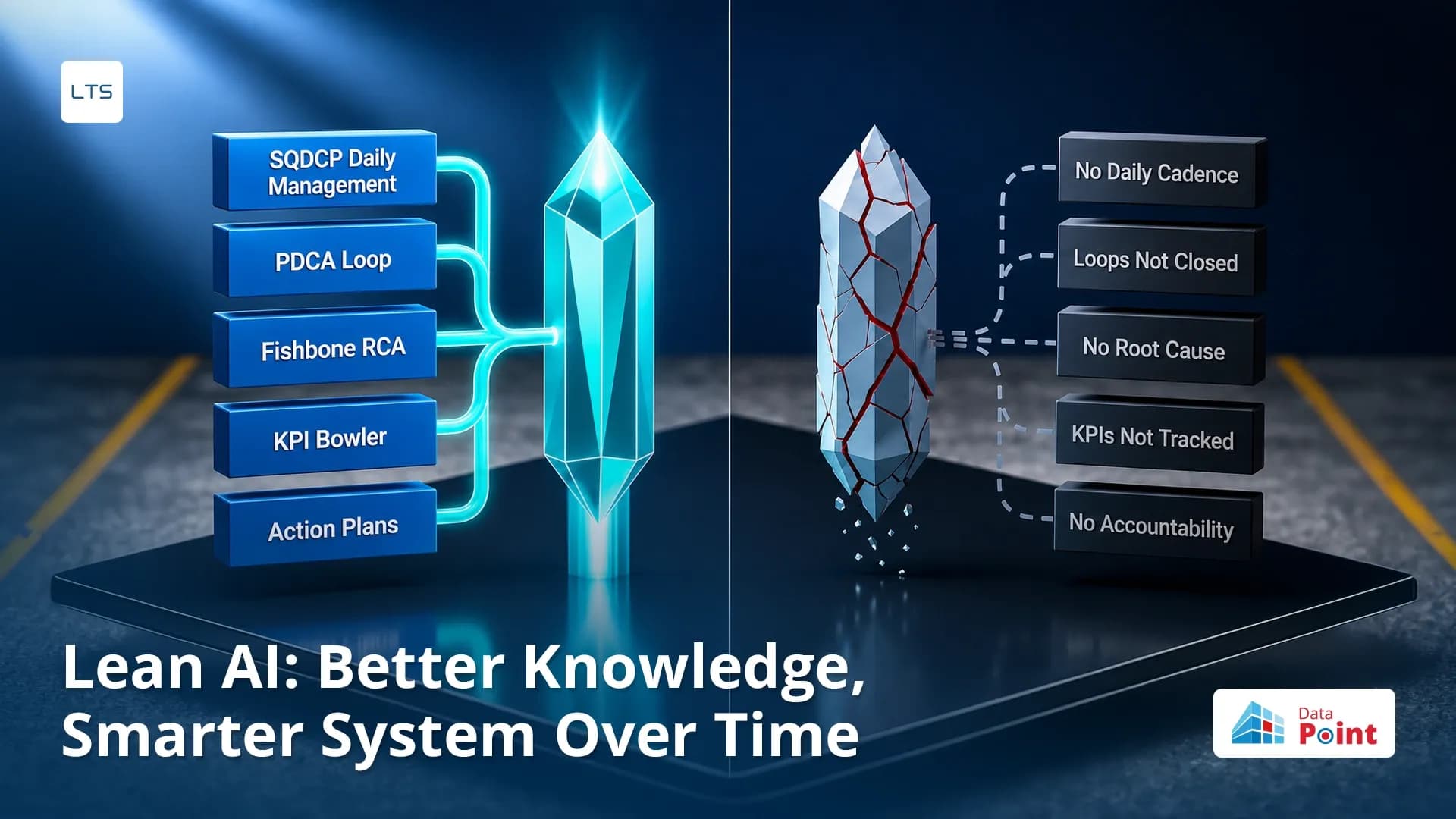
- SQDCP daily management built into one system that makes consistent lean practice visible across every tier and every shift
- Action plans with root cause, owner accountability, and impact review where every loop is closed and made traceable
- Fishbone, Quad Chart, PDCA, and KPI bowler embedded in daily operations that enables lean thinking at the point of decision
Lean artificial intelligence is only as strong as the lean practice underneath it. The knowledge it captures, the signals it surfaces, and the decisions it supports, all of it traces back to how consistently and deliberately your team practises lean every day. Get that foundation right, and AI has something worth learning from. Let it drift, and AI compounds the drift.
The discipline is the starting point. But once the foundation is in place, that is, once the right knowledge is entering the system consistently, the next question is:
What does an AI that actually hold that knowledge look like in practice, and how do teams make it available at every decision point, on every shift, without depending on the expert being in the room?
Not sure if your lean foundation is ready for the next step?
FAQs
1. Does lean AI work for small or mid-size operations, or only large enterprises?
Lean AI scales to the size of the lean practice underneath it, not the size of the organisation. A smaller operation with consistent daily management discipline will get more from lean AI than a large one running inconsistent process. The foundation matters more than the headcount.
2. How long does it take for lean AI to start improving once it is being fed the right knowledge?
There is no fixed timeline. It depends on how consistently structured lean practice is feeding the system. Teams with disciplined daily management in place typically see meaningful improvement signals within weeks. Teams still building that discipline will see AI improve in step with it.
3. Can lean AI work alongside existing lean certifications and training programmes?
Yes. Lean certifications build the thinking. Lean AI gives that thinking somewhere to operate beyond the classroom. The two are not in competition. One creates lean practitioners. The other creates the conditions for what they know to stay in the system.
4. What happens to lean AI if daily management discipline drops?
The compounding loop stalls. AI does not degrade immediately. It simply stops improving. Over time it falls behind the floor, surfacing guidance based on how operations ran, not how they run now. Maintaining lean discipline is not just good practice, it is what keeps AI relevant.
5. Is lean AI only relevant for organisations already mature in lean?
No. Organisations earlier in their lean journey can use AI to embed the right habits from the start, capturing good practice as it develops rather than trying to retrofit it later. The earlier the right knowledge enters the system, the stronger the foundation becomes.

Geandra Queiroz, Operations Management Consultant
Geandra is an Operations Management Consultant at Lean Transition Solutions, specialising in Lean philosophy, Lean Six Sigma, and strategic planning across manufacturing and healthcare. She is currently completing her PhD in Industrial Engineering at the Federal University of São Carlos, researching the integration of Operations Strategy, Lean, and Green Manufacturing.