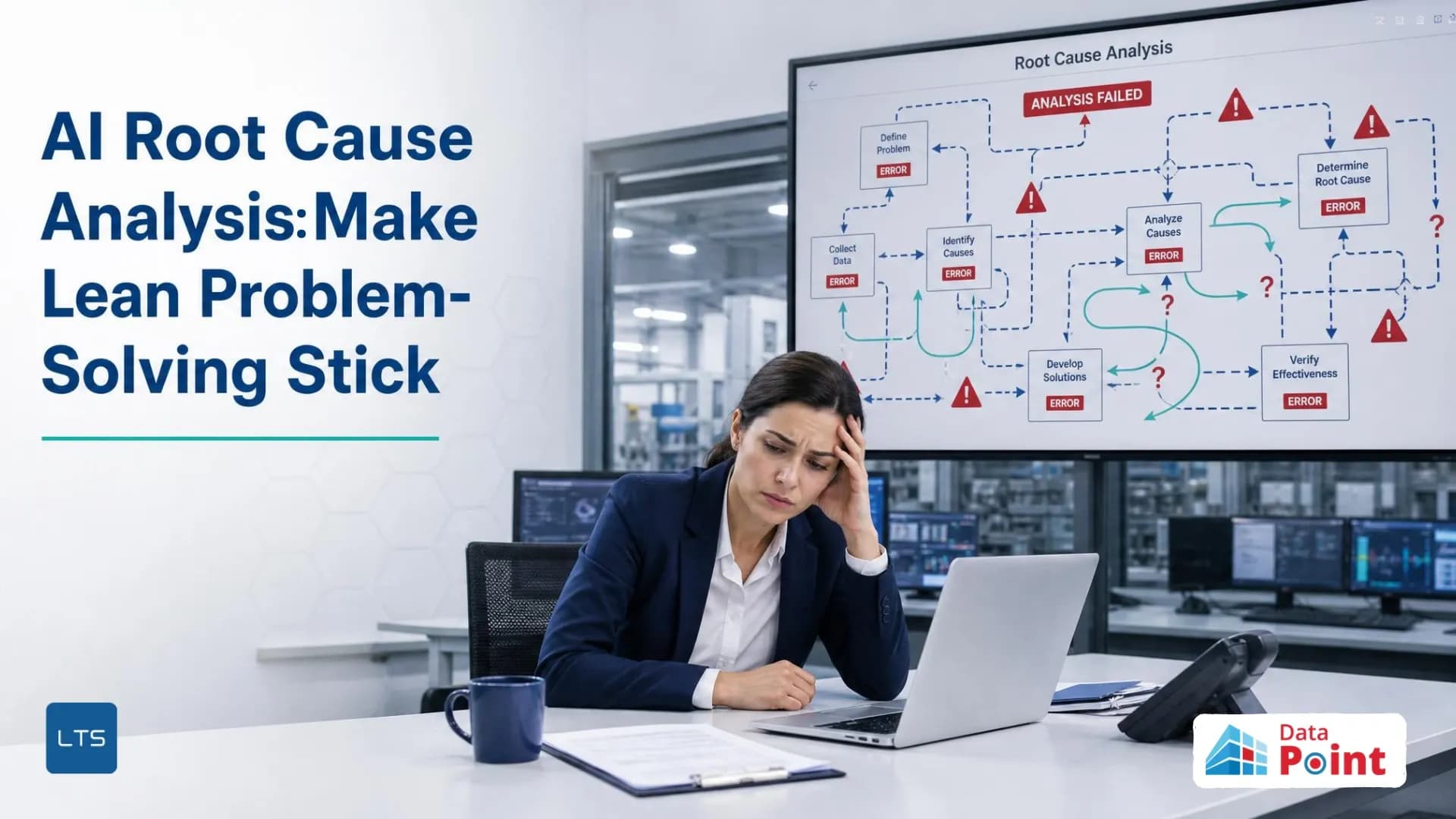
AI Root Cause Analysis: When the Signal Is Right and the Waste Still Comes Back
Last updated on : June 19, 2026
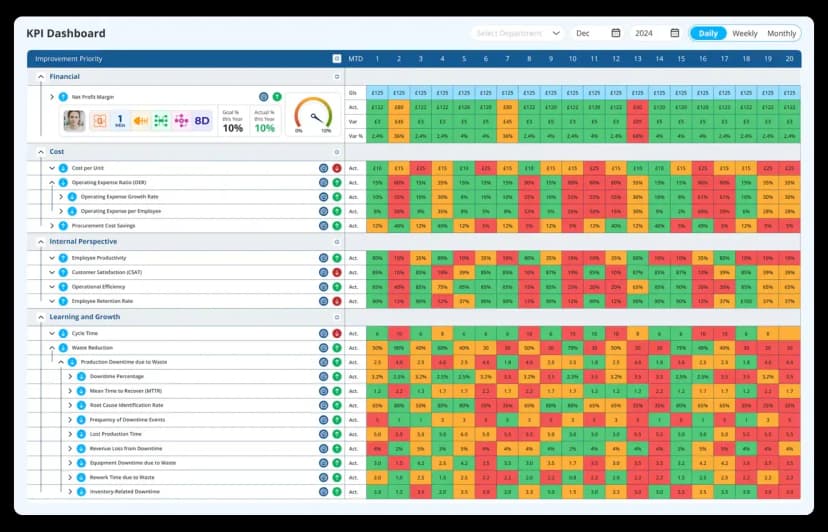
The OTIF goes red. The AI flagged it. The dashboard painted it red. The person in charge fixed it. All went green. The same issue appeared a week later.
Everything is done right. Still, the issue recurs. What now?
Most AI tools are built to flag what went wrong. But that is not how a prescriptive AI works. It does not simply detect. It spots the root cause and recommends the optimal corrective action; a capability majority of deployed AI systems have not yet reached.
See how LTS Data Point embeds structured investigation into your daily management workflow
When the signal is right and the waste still comes back
The signal did its job. The dashboard flagged it. The action was raised and closed. A week later, the same number went red.
The possible cause could be the incomplete execution of 5 Whys.
Consider a food packaging line that runs a morning quality check. The seal integrity failure rate has spiked. The AI flags it. The dashboard goes red. The team lead raises a corrective action – sealing temperature adjusted, action closed, dashboard goes green.
Six days later, the same spike. Same line. Same failure mode.
The team adjusts the temperature again. Green again. Day nine. Red again.
Nobody went back to ask why the temperature was drifting in the first place. The investigation stopped at the setting. The setting was drifting because the heating element was degrading: a gradual wear pattern that has been building for three weeks, visible in the sensor data, never connected to the seal failure because nobody ran the chain back far enough. The corrective action fixed the symptom twice. The cause ran undetected through both cycles.
The AI flagged the right signal both times. The investigation stopped at Why 1. The waste came back because the methodology, not the platform, was where the process broke down.
The detection was never the gap. The investigation layer was.
AI stops at finding the issue and the rest is done by the team without a proper structure. AI root cause analysis changes that specific handover. It does not simply surface the issue. It stays in the investigation, prompting the next why, flagging when the chain is stopping too early, and connecting the current failure to previous instances of the same pattern on the same line.
Where lean RCA breaks down and why it keeps breaking down
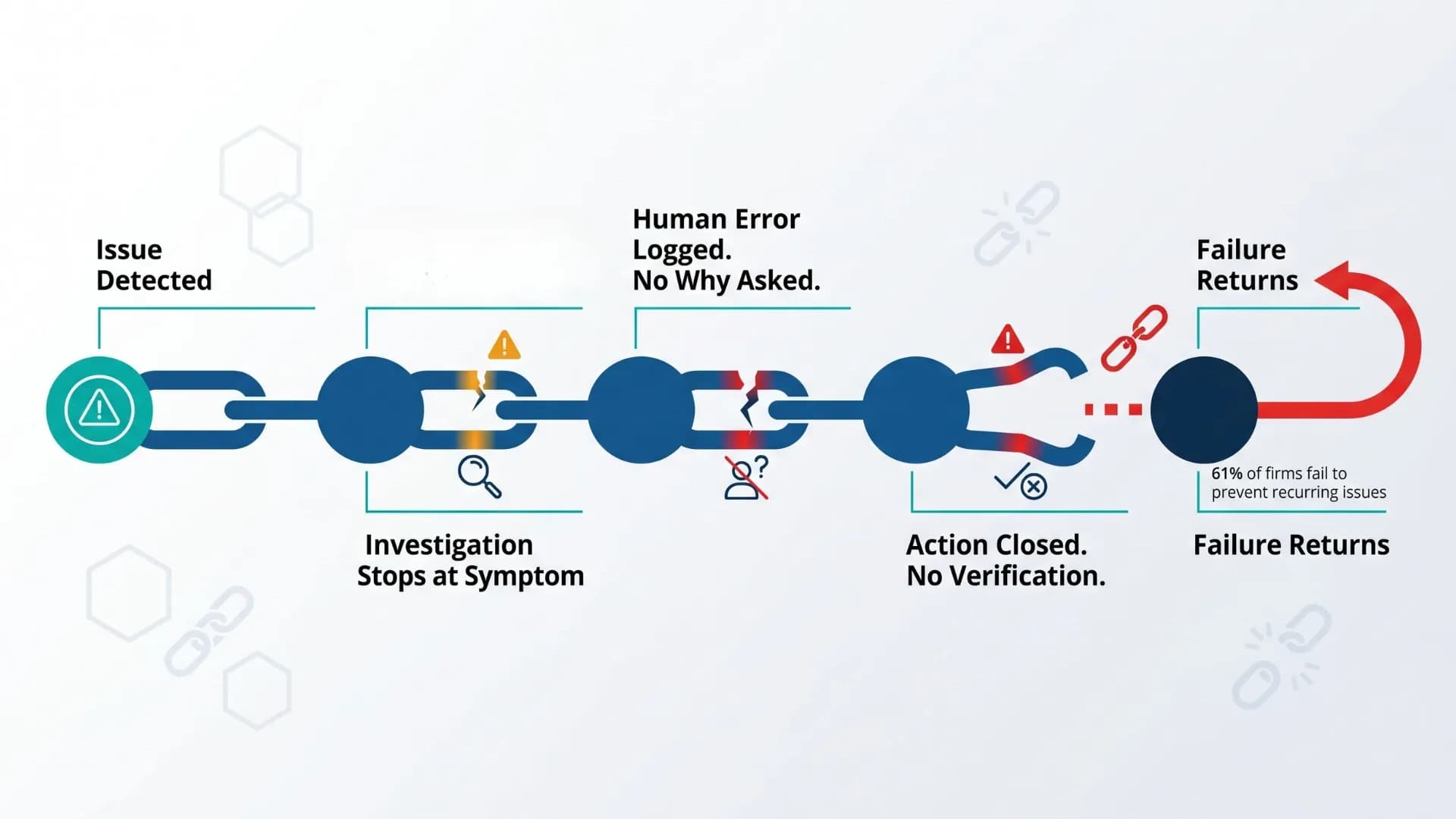
The lean RCA template didn’t fail. The investigation did.
The three main reasons why lean RCA fails are:
- Stopping at the symptom: The chain closes on the nearest observable variable, not the cause behind it.
- Attributing to human error: Sometimes issues are logged and closed without asking why the error occurred in the first place.
- Closing without verification: Verification is incomplete and the action is marked complete as soon as the task is done.
The step that gets dropped most consistently is the effectiveness check, that is, the point at which data must confirm the fix held before the action closes. Without it, the corrective action cycle resets on the same failure mode with a different batch number and a different date.
This is not because they skipped the investigation, but they stopped at the symptom.
✔ The form was filled
✔ The action was raised
✖ The root cause was never reached
Three failure modes consistent across various tools. The question was never about which RCA method should be adopted. It is about what closes the gap no matter the tool. This is where AI root cause analysis changes the investigation.
What AI actually changes in a lean investigation
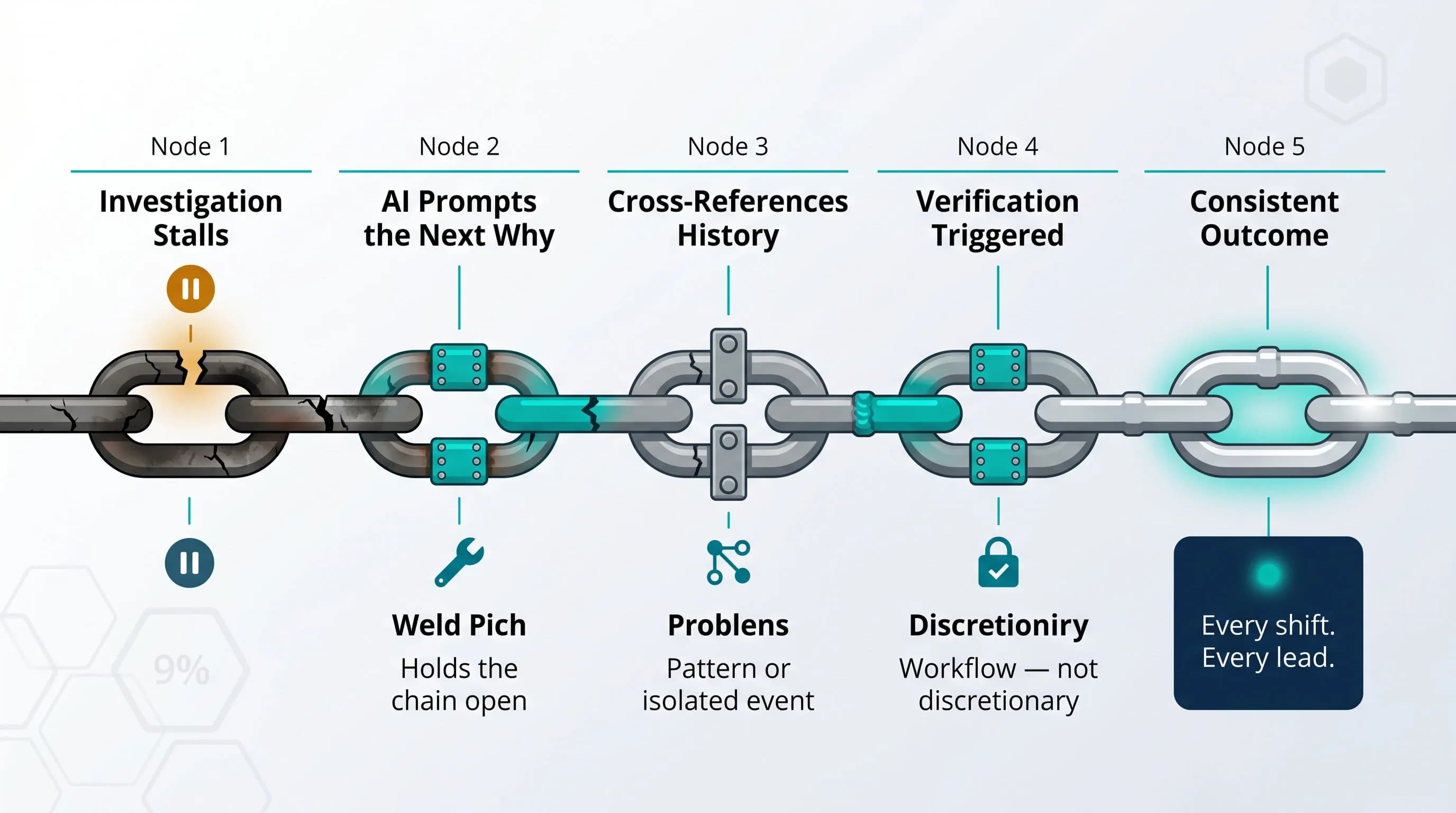
The AI investigation does not need a brand-new tool. What it actually needs is something to hold the existing ones to a higher standard.
Three things change when AI stays in the investigation:
- Stays in the chain: It prompts the next why when the investigation stalls rather than accepting the first actionable answer.
- Cross-references: Connects the current failure to historical instances on the same line, surfacing whether this is an isolated event or a pattern before the cause is confirmed.
- Do not prematurely close: The verification step becomes a triggered workflow, not a discretionary follow-up that gets dropped at shift end.
Each of these three changes targets a different point in the investigation sequence. The detection already happened. The alert did its job. That was never the gap.
Most deployed AI tools hand the investigation back to the team the moment the alert fires. No structure. No next step. AI assisted root cause analysis stays in that gap.
The methodology does not change. What changes is that investigation now runs to the same depth regardless of who is leading it or what shift it lands on. The investigation becomes consistent. The AI decision making that follows it does too.
The investigation quality problem is not a training problem
The standard response of most companies to inconsistent RCA is more training. But that doesn’t work.
Training enhances awareness, no doubt. But it does not change what happens at 11 pm on a Thursday when a failure mode appears that the shift leader has not seen before, the production schedule is running, and the investigation needs to close before the next run starts. The knowledge is there. The application collapses under the conditions.
The consistent finding is that teams know how to run a 5 Why. But it ends up failing during application. The causes could be time pressure, incomplete data, and an unfamiliar failure mode combine to produce a shallow investigation regardless of training level. The classroom does not replicate those conditions. The methodology needs to be in the system, not retrieved from memory under pressure. That is what separates AI problem solving from AI detection. One closes the alert, the other closes the gap.
This is where AI root cause analysis come into play. When AI-assisted prompts are embedded directly into the workflow, at the point where the failure is logged and the investigation begins, the structure is already there. The depth of the investigation does not depend on who opened ticket or what shift it landed on.
That is a different kind of intervention than training. It is methodology available at the moment it is needed; inside the system the team is already using.
The forecast was right. The signal fired. The action closed. The waste came back. It was never a data problem. It was an investigation problem. Investigation quality does not improve by knowing the methodology better. It improves when the methodology is in the system, and that is what separates root cause analysis software that detects from software that investigates. It is where AI continuous improvement either compounds or collapses. The investigation closed correctly.
But what if the gap it exposed never made it to the right tier?
Still finding the same root causes on the same lines?
FAQs
1. What is the difference between AI anomaly detection and AI root cause analysis?
Anomaly detection flags that something went wrong. AI root cause analysis stays in the investigation prompting the cause chain, cross-referencing historical patterns, and holding the corrective action open until the fix is verified. Detection identifies the symptom. Root cause analysis finds what allowed it to occur.
2. Can AI root cause analysis work with the lean tools already in place?
Yes. AI root cause analysis does not replace the 5 Why, Fishbone, or A3. It makes their application more consistent prompting the next step when the investigation stalls and preventing the chain from closing on the first actionable answer.
3. Why do corrective actions keep closing on the wrong cause?
Because the effectiveness check is the most consistently skipped part of the workflow. Without a recurrence threshold, the action closes when the task is done, not when the data confirms the problem stopped.
4. Is consistent RCA a training problem?
Not primarily. Teams know methodology. The failure occurs at the moment of application. The fix is methodology embedded in the system, not recalled from a classroom under pressure.
5. How does AI root cause analysis reduce recurring failures?
By closing the three gaps that make lean RCA inconsistent: stopping the chain too early, attributing failure to human error without asking why it was possible, and consistently, the same failure mode stops reappearing.
6. Does AI root cause analysis require structured data to work?
Yes. AI-assisted investigation relies on process data, equipment history, and shift patterns being structured and accessible at the point the failure is logged. The investigation prompt is only as deep as the data it can cross-reference.

Abel Jiménez, Lean Consultant
Abel is a Lean Consultant with over 30 years of expertise in operational analysis, process improvement, and organisational change across Mexican industries. Currently serving as Director of Insurance Promotions at CESCEMEX, he helps organisations leverage technology and lean practices to improve efficiency and manage change with continuity.