Daily Production Meeting Board: Key Features and Implementation Tips
Last updated on : March 11, 2026
Ever feel like your production meetings are more talk than action? Many leaders do. When priorities aren’t clear and updates get lost, the result delays, wasted time, and frustrated teams. A daily production meeting board changes that. It gives you a single source of truth for what’s happening on the shopfloor. Combine it with quick huddles, Gemba walks, and even digital boards, and you’ll have real-time visibility, faster decisions, and fewer surprises. This blog will guide you on what a daily production meeting board is and why it matters, benefits of switching from physical daily production boards to digital ones, steps to implement a daily production meeting board, best practices for integrating Gemba walks, daily huddle meetings and daily production boards, common challenges and solutions when using the board, and why LTS Data Point is your smart choice.
Discover how a daily production meeting board can help you become the best leader with LTS Data Point
What is a daily production meeting board and why does it matter?
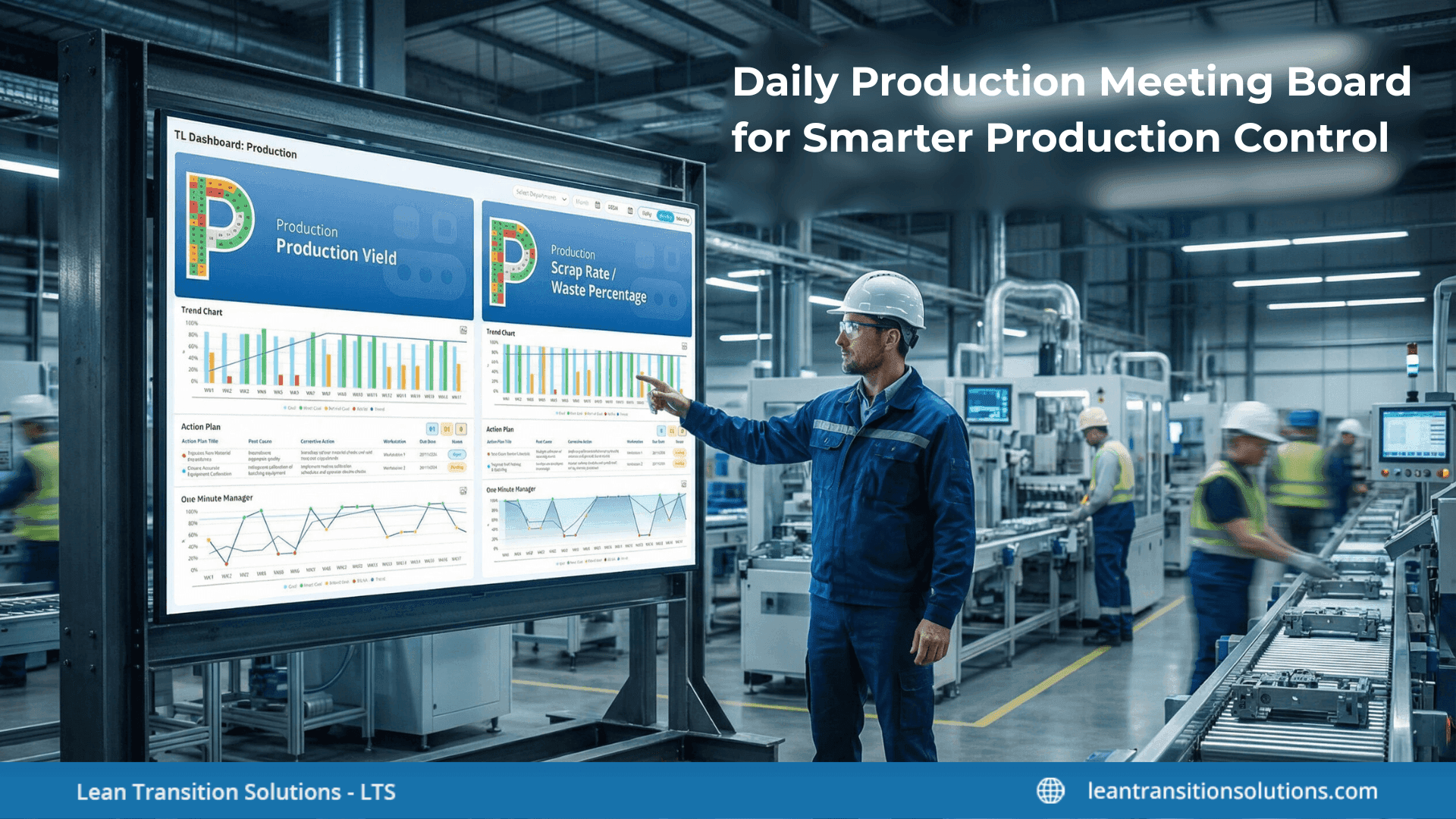
A daily production meeting board is a visual tool used in Lean manufacturing to monitor, communicate, and manage daily manufacturing activities on the shopfloor. It offers teams with a live screenshot of key production metrics, like output targets, quality issues, machine status, and workforce allocation.
The board plays a major role in Lean operations by encouraging transparency, accountability, and faster problem-solving. It aids teams quickly spot bottlenecks, escalate issues, and coordinate actions, assuring that production remains aligned with functional goals by making performance visible. The board goes beyond tracking metrics – it nurtures a culture of continuous improvement, engaging everyone from operators to managers in proactive decision-making.
In short, a daily production meeting board transforms reports into actions, assisting manufacturers minimise waste, enhance efficiency, and maintain a steady rhythm of production.
Key features of daily production meeting board
- Visual management: An effective board presents data in a clear, easy-to-understand format using charts, colour codes, and symbols. Visual cues help teams immediately see the status of manufacturing, detect bottlenecks, and comprehend priorities without sifting through reports.
- Key Performance Indicators (KPIs): The board underlines crucial KPIs such as product output, cycle time, quality metrics, and downtime. By focusing on the metrics that matter most, teams can calculate performance against targets and take corrective actions instantly when deviations happen.
- Live updates: A board that mirrors the status of production assures everyone is working with accurate, up-to-date information. Whether manual or digital, real-time updates assist teams respond quickly to problems, assign resources efficiently and maintain a smooth workflow.
- Problem escalation and continuous improvement: Effective boards include areas to signal issues and track resolutions. This motivates accountability, supports systematic problem-solving, and drives ongoing process improvements across shopfloor.
Transitioning from physical to digital daily production meeting boards
Switching from physical boards to digital daily production boards changes how teams track, manage, and enhance production. While traditional boards provide visual clarity, digital systems add speed, accuracy, and accessibility – minimising limitations of manual updates and static reports.
Key benefits of switching from traditional to digital daily production meeting board
- Remote visibility: Digital boards enable managers and support teams to visualise live production information from anywhere. This is especially valuable for multi-site operations, hybrid teams, or when quick decision-making is needed outside the shopfloor.
- Live data and automated updates: Instead of depending on handwritten numbers or delayed logging, digital boards pull documents directly from machines, sensors, or operator inputs. This makes sure the data is always recent, minimising errors and allowing faster responses.
- Advanced analytics and trends: Digital systems can automatically monitor trends, compare performance over time, and underline recurring problems. With built-in analytics, teams gain deeper insights into quality, downtime, efficiency, and bottlenecks – empowering proactive improvements.
- Integration across Lean systems: Digital boards can link KPIs, skill matrices, maintenance reports, and escalation workflows, creating a more cohesive operational ecosystem. This integration strengthens alignment and cultivates continuous improvement at every level.
- Enhanced collaboration and accountability: With shared access, automated triggers, and clear ownership fields, digital boards make collaboration more organised. Everyone knows the plan, the issues, and the next steps – no matter where they are.
How to implement a daily production meeting board successfully
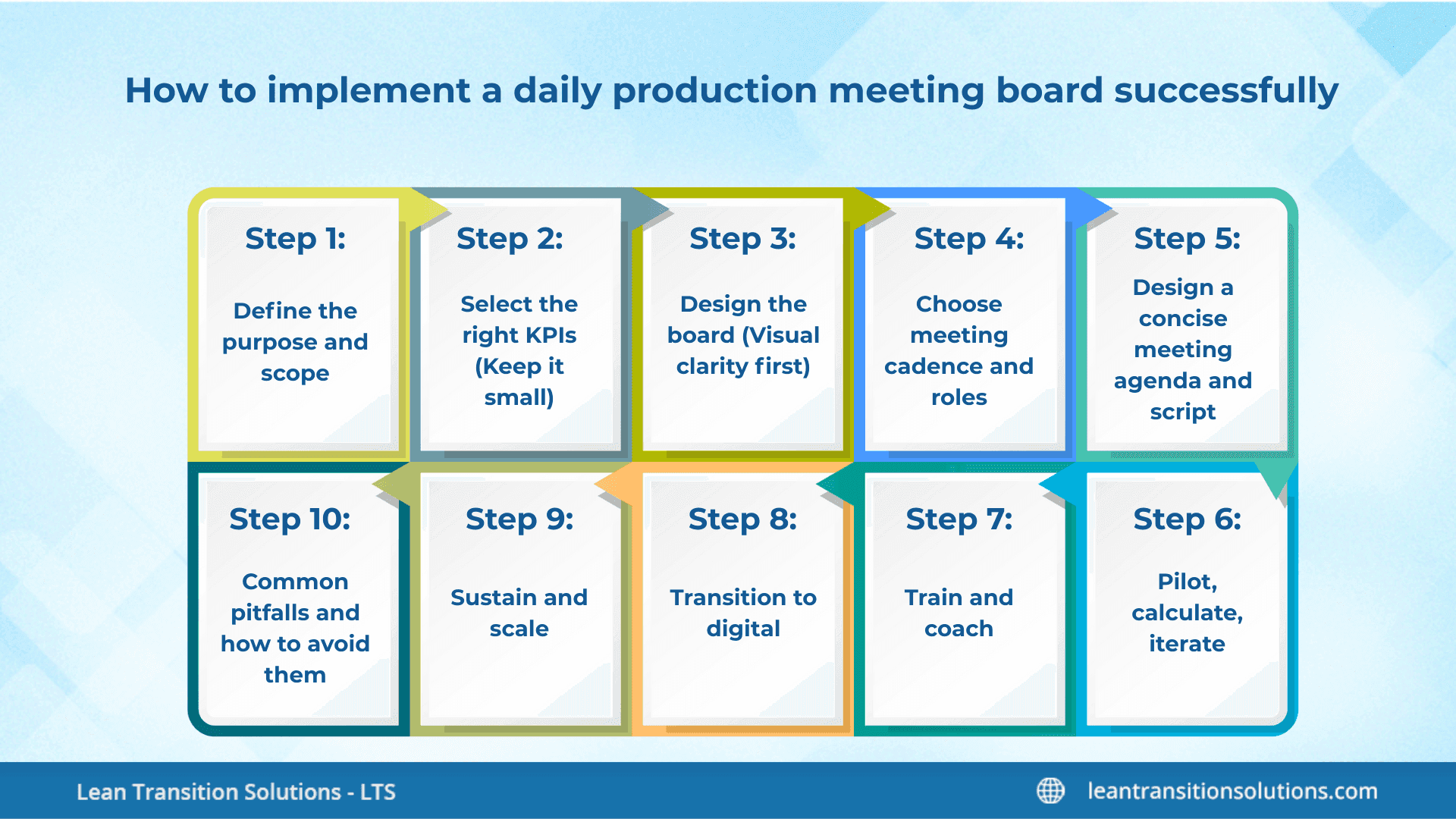
Define the purpose and scope
- Purpose: Be straightforward – e.g., improve on-time output, lower downtime, escalate quality issues, align shift handovers.
- Scope: Begin with one line or area or one shift. Don't attempt a site-wide rollout on day one.
Select the right KPIs (Keep it small)
Choose 3-6 productive KPIs that directly support the purpose, for example:
- Planned vs actual output
- Yield or quality rejects
- Availability or downtime minutes
- First Time Through (FTT)
- Safety or near-misses
For each KPI record owner, goal, current value, trend, and action required if off target.
Design the board (Visual clarity first)
- Layout: Left-to-right flow – targets -> current state -> issues -> actions.
- Visuals: Big numbers, traffic lights (red/amber/green), simple trend sparklines, icons for machine status.
- Problem area: A clear place to list the top 3 problems and allocated countermeasures with due dates.
- Escalation path: Display who to call for level 2 issues (maintenance, quality, planning).
Choose meeting cadence and roles
- When: Daily, at shift start or handover (5-20 minutes depending on complexity).
- Who attends: Team lead, shift supervisor, 1-2 operators, maintenance rep (rotating), planner (remote or on call).
- Roles: Facilitator (briefs and keeps time), Scribe (updates board or records actions), Owners (responsible for actions)
Design a concise meeting agenda and script
Sample 10-minute agenda:
- Quick safety note (30s)
- Production KPI snapshot vs target (2 min)
- Top 3 problems and containment (3 min)
- Allot actions and owners + deadlines (2 min)
- Final checks or escalation (1.5 min)
Pilot, calculate, iterate
- Pilot for 2-4 weeks on one manufacturing line.
- Monitor: meeting duration, percent of actions closed on time, KPI variance.
- Gather operator feedback weekly and iterate layout, KPIs, or meeting timing.
Train and coach
- Short, practical training for participants: purpose, how to read the board, how to raise and log problems, and how to close actions.
- Coach the first 10-20 meetings to keep them focused and on time.
Transition to digital
Verify live updates, remote access, automated data capture where possible, and clear push notifications for owners. Keep the same visual logic as the physical board so the team recognises it.
Sustain and scale
- Governance: Weekly assessment by supervisors to validate action closures and trends.
- Standard work: Add the meeting as a line item in shift standard work records.
- Recognition: Celebrate small wins and visible improvements to keep engagement high.
Common pitfalls and how to avoid them
- Too many KPIs: Keep focus (more metrics = less action).
- Long meetings: Enforce timeboxes and strict facilitation.
- No ownership: Every action must have a named owner + due date.
- Using it as a reporting tool only: The board must drive actions and decisions, not just exhibit numbers.
- Poor data quality: Fix data feeds or measurement methods before scaling.
Gemba, daily huddles, and digital Daily Production Meeting Boards: A unified system for stronger production control
Bringing together Gemba walks, daily huddle meetings and digital daily production meeting boards builds a powerful, combined system for driving visibility, alignment, and continuous improvement on the shopfloor. Each element reinforces the others, turning reports, observations, and team actions into a cohesive lean daily management routine.
Gemba walks: Ground-level insight
Gemba walks take leaders directly to the shopfloor – the real place where value is created. They offer context behind the numbers displayed on daily production boards, helping teams understand the root causes of problems, confirm data precision, and observe workflow realities. With Gemba walks, leaders switch from assumption to evidence, turning the board’s data into practical insight.
Daily huddles: Fast alignment and problem-solving
Short, focused daily huddle meetings bring teams together to analyse production boards, discuss KPIs, and align on immediate priorities. These 5–10-minute check-ins assure everyone knows where performance stands, what the risks are, and who is responsible for the next actions. Huddles convert static data into quick decisions, escalation, and coordinated action.
Digital Daily Production Meeting Board: Live visibility and analytics
Digital production boards strengthen both Gemba and huddles by offering real-time, precise data on output, quality, downtime, and workflow status. Remote accessibility and automated updates minimise manual effort, improve transparency, and allow deeper analytics. Instead of spending preparing information, teams spend time enhancing performance.
Best practices for integrating all three: Gemba walks, Daily huddle meetings, and Daily Production Meeting Boards
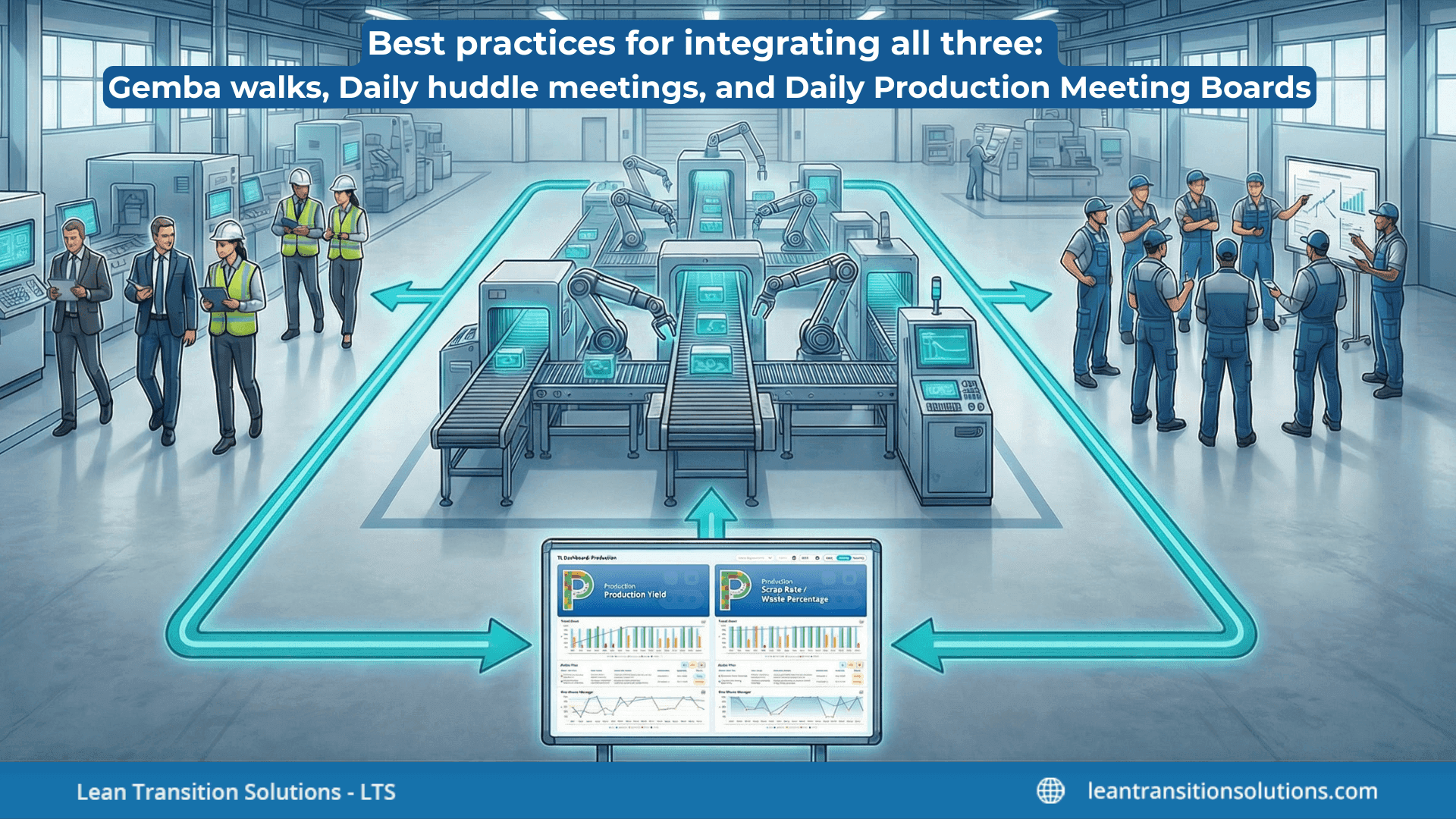
- Begin with the board: Use digital boards as the source of truth for KPIs and problems.
- Verify during Gemba: Confirm data accuracy, monitor processes directly, and gather operator feedback.
- Close the loop in huddles: Evaluate board metrics, prioritise today’s issues, and assign clear actions.
- Use visuals consistently: Keep the same colour codes, categories, and problem indicators across boards and Gemba notes.
- Escalate systematically: Issues identified during Gemba should flow into the board and huddle agenda for closure.
- Leverage digital insights: Use trends, signals, and drilldowns to decide where the next Gemba walk should focus.
- Reinforce daily discipline: Same time, same place, same visual logic – build a repeating rhythm.
When integrated, Gemba, daily huddles, and digital production boards build a holistic lean daily management system (LDMS) that strengthens communication, accountability, and problem-solving – converting daily operations into a continuous improvement engine.
Common challenges and solutions in using daily production meeting board
Even well-designed daily production meeting boards can fail if teams struggle with adoption, data quality, or engagement. Here are the most common challenges – and practical solutions to overcome them.
1. Resistance to using the board
Challenge: Teams may see the board as extra work or a tracking tool rather than something that supports them. Solution:
- Involve operators and supervisors in designing the board layout and KPIs.
- Start small with a pilot area and showcase early wins.
- Emphasise how the board makes their day easier – faster decisions, quicker support, fewer surprises.
- Identify teams publicly when the board leads to a solved issue or enhanced KPI.
2. Poor data accuracy and timeliness
Challenge: Incorrect or outdated numbers make the board unreliable, undermining trust.
Solution:
- Standardise who updates what, when, and how.
- Use simple input methods to avoids lags.
- Move toward digital boards where data flows automatically from machines, sensors, or operator check-ins.
- Cross-verify data during Gemba walks to keep metrics honest.
3. Lack of engagement during meetings
Challenge: Daily huddles become monotone, rushed, or leader-driven instead of team-driven.
Solution:
- Keep huddles short (5-10 min) with a clear agenda: Safety -> KPIs -> Issues -> Actions.
- Rotate facilitation so operators get involved, not just managers.
- Use visual cues (RAG status, icons, trend lines) to make discussion active and intuitive.
- Assure every meeting end with clear action owners and deadlines.
4. Too many KPIs or too much information
Challenge: Overloaded boards overwhelm the team and dilute focus.
Solution:
- Limit to 3-6 KPIs that truly matter for today’s performance.
- Use drilldown or secondary sections for deeper assessment, especially on digital production boards.
- Regularly examine KPIs and remove metrics that aren’t driving decisions.
5. Inconsistent use and follow-through
Challenge: Boards start strong but fade over time when actions aren’t closed or meetings lose rhythm.
Solution:
- Integrate the board into standard work for team leaders and managers.
- Allot every action to a named owner with a due date and follow up daily.
- Use weekly leadership reviews to reinforce discipline and eliminate obstacles.
6. Limited problem-solving capability
Challenge: Problems are raised daily but not resolved; then it becomes a complaint list. Solution:
- Train teams in basic problem-solving tools (5 Whys, Fishbone diagram, containment vs root cause).
- Build a small problem-solving zone on the board to monitor status.
- Connect repeating issues to organised improvement projects.
Find solutions to all your challenges with LTS Data Point
Why LTS Data Point offers best Daily Production Meeting Boards
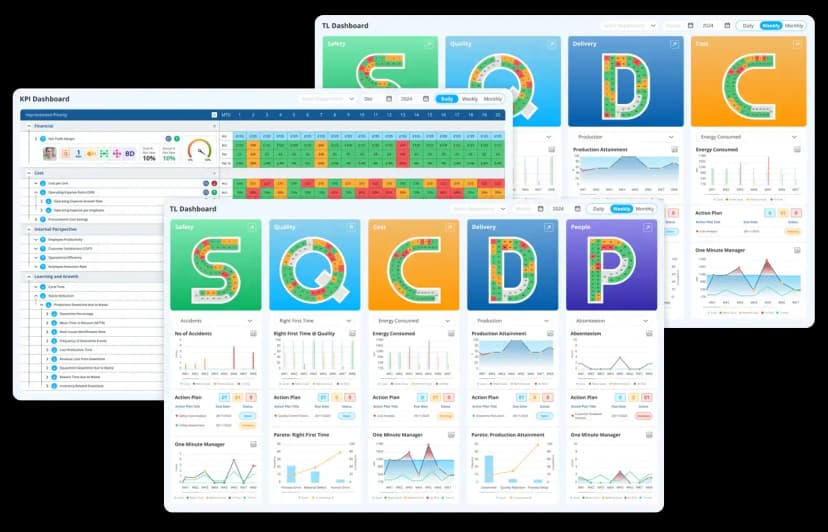
LTS Data Point upgrades the traditional Daily Production Meeting Board by incorporating lean principles with live digital intelligence, giving manufacturers a more precise, practical, and scalable system for daily control.
1. Real-time accurate data
Unlike physical boards that depend on handwritten numbers, Data Point pulls information directly from machines, operator inputs, or integrated systems. This assures every huddle is based on live, error-free reports, eliminating lags and inconsistencies.
2. Remote visibility across shifts, lines, and sites
Supervisors, planners, and leadership teams can access manufacturing status immediately – from anywhere. This makes Data Point perfect for multi-site functions, global teams, or leaders who need quick insight without waiting for information or walking to the shopfloor.
3. Built-in lean structure: KPIs, issues, actions, escalation
The daily production meeting board is not just a screen – it is a working management tool. Data Point embeds lean logic:
- RAG indicators for performance
- Issue recording and tracking
- Action assignments with deadlines and owners
- Escalation pathways
This makes sure daily meetings lead to real decisions and measurable improvements.
4. Integrated problem-solving and root cause analysis
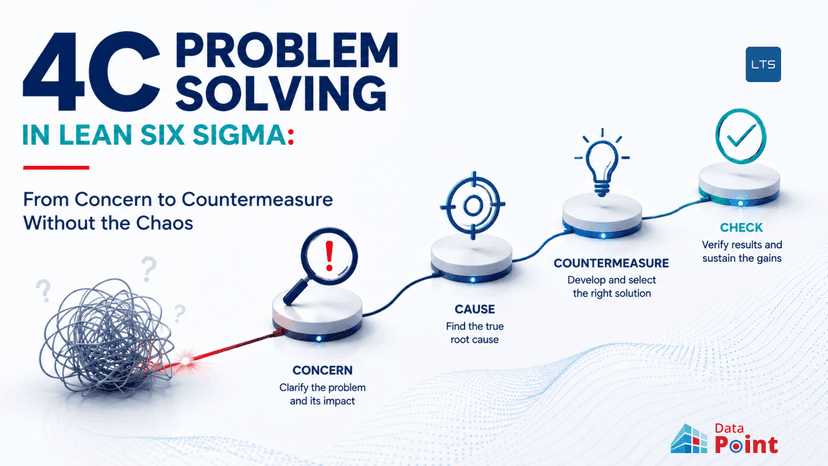
Teams can move flawlessly from spotting an issue to logging root causes, assigning countermeasures, and keeping an eye on closure. This tight integration halts the board from becoming a wall of numbers and turns it into a continuous improvement
5. Customisable dashboards for every team
Different lines and teams can frame their boards with the KPIs and visuals that matter most – output, downtime, quality, safety, or manpower. The flexibility secures every board fits its operational context while maintaining a consistent lean structure.
6. Historical trends and analytics built in
Where physical boards reset daily, Data Point captures and shows trends over time. Teams can instantly see performance patterns, recurring problems, and improvement opportunities – supporting better planning and decision-making.
7. Seamless integration with other LTS tools
Data Point links effortlessly with Skill Matrix, TCard system, Hoshin Kanri X Matrix, and maintenance modules. This creates a unified digital ecosystem where strategy, capability, and processes flow together – something a standalone board can’t deliver.
8. Faster, more effective daily huddles
With clear visuals, real-time numbers, and automated updates, teams spend less time preparing and more time solving issues. Huddles become sharper, faster, and more action-driven.
9. Zero paperwork, zero redundancy
No whiteboards to maintain, no spreadsheets to updates, no parallel logging. Everything updates in one place, removing waste and freeing up operator time.
The truth is, production challenges won’t fix themselves. If you want fewer surprises and more control, a Daily Production Meeting Board is the way forward. It brings clarity to your shop floor, keeps teams aligned, and turns issues into actions fast. Add quick huddles and Gemba walks for real-world insight, then go digital for live data and remote visibility. For leaders aiming to cut downtime and boost efficiency, this simple shift can make a big difference.
FAQs
1. What is the main purpose of a Daily Production Meeting Board?
A Daily Production Meeting Board helps teams track KPIs, spot issues quickly, and align actions to keep production on schedule.
2. How does a Daily Production Meeting Board reduce downtime?
By making problems visible and assigning clear owners, the board speeds up decision-making and prevents delays.
3. Why integrate Gemba walks with a Daily Production Meeting Board?
Gemba walks validate the data on the board and uncover root causes that numbers alone can’t explain.
4. What role do daily huddles play alongside the board?
Huddles turn board data into quick actions, ensuring everyone knows priorities and responsibilities.
5. How often should a Daily Production Meeting Board be updated?
Ideally, it should reflect real-time data or be updated at least once per shift to maintain accuracy.
6. Does using a Daily Production Meeting Board require special training?
Basic training helps teams understand how to read the board, raise issues, and close actions effectively.
7. How does a Daily Production Meeting Board support continuous improvement?
It creates visibility, accountability, and a rhythm for problem-solving, which drives ongoing improvements.

Abel Jiménez, Lean Consultant
Abel is a Lean Consultant with over 30 years of expertise in operational analysis, process improvement, and organisational change across Mexican industries. Currently serving as Director of Insurance Promotions at CESCEMEX, he helps organisations leverage technology and lean practices to improve efficiency and manage change with continuity.