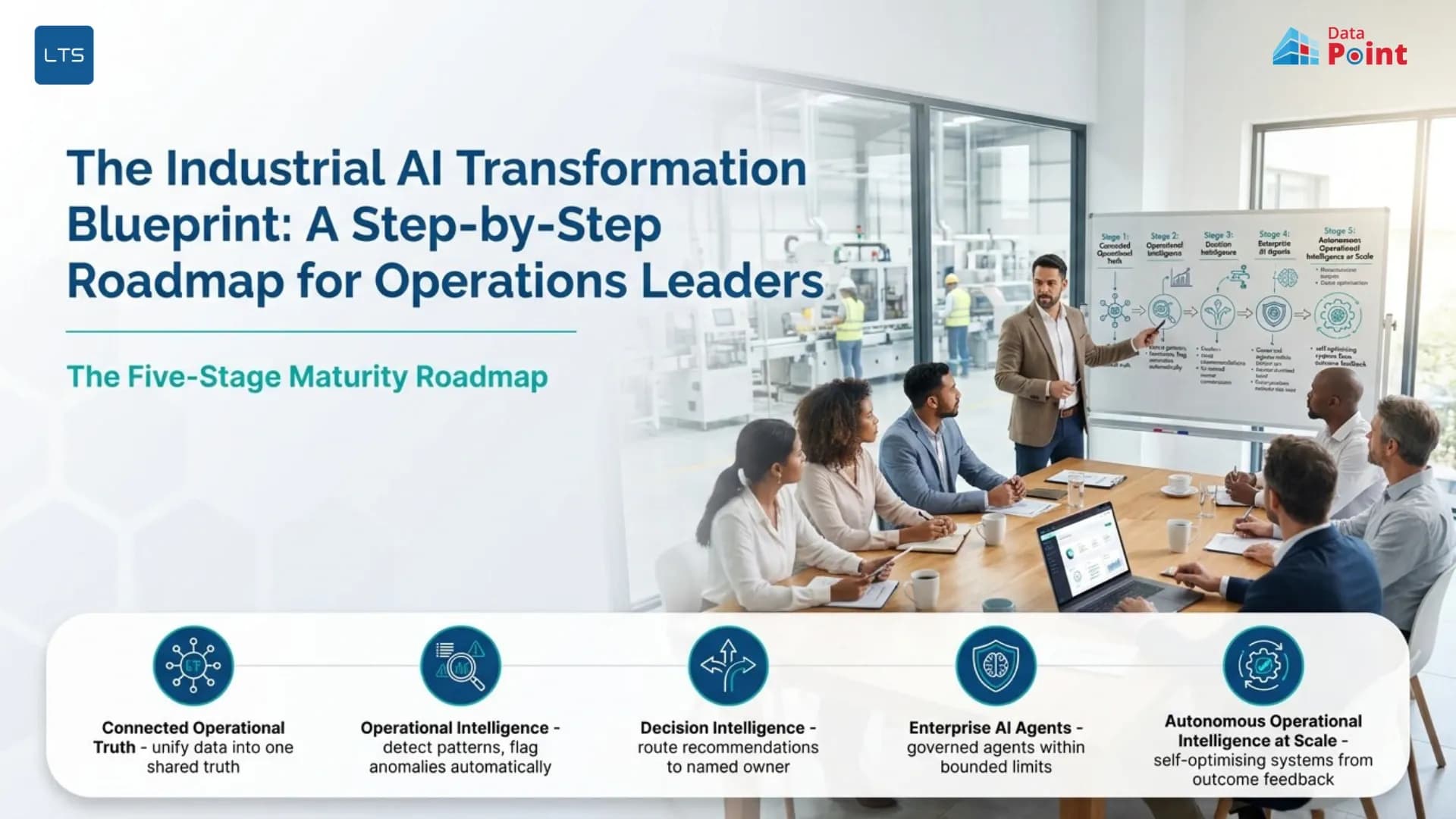
The Industrial AI Transformation Blueprint: A Step-by-Step Roadmap for Operations Leaders
Last updated on : July 23, 2026
Most manufacturers can name the AI capability they want next. But when asked about what stage they are currently on, there's complete silence. What's missing is the industrial AI transformation blueprint that tells them what stage they're actually on.
The companies who are aware of their maturity stage achieve five times the revenue increases and three times the cost reductions compared to companies who are still trapped in fog. And this falling behind is not a fixed distance, but a distance that widens with each passing quarter.
Knowing your stage doesn't close the gap by itself. Knowing what to do next does.
See how LTS Data Point supports connected data, automatic surfacing, and named ownership today
Why the order matters more than the technology
Most operations leaders don't skip a stage on purpose. They skip it because no one told them it was one.
The order of the stage seems futile at first, but when adopting an AI software, this simple awareness on stage level becomes inevitable. This is what separates a real AI adoption roadmap from a wish list of capabilities.
Why each stage is necessary:
- Each stage builds a specific capability such as data discipline, governance, ownership that the next stage assumes is already in place
- Skipping a stage does not save time; it relocates the missing capability to a later, more expensive point in the rollout
- AI adoption challenges cover a wide range of failure points. None of them answer a different question: once you’ve decided to move forward, what order do you actually move in?
This is the pilot to scale AI manufacturing gap in practice: technically complete, operationally nowhere. The order was never the slow way of doing this. It was the only way that does not have to be paid for twice.
The five-stage maturity roadmap
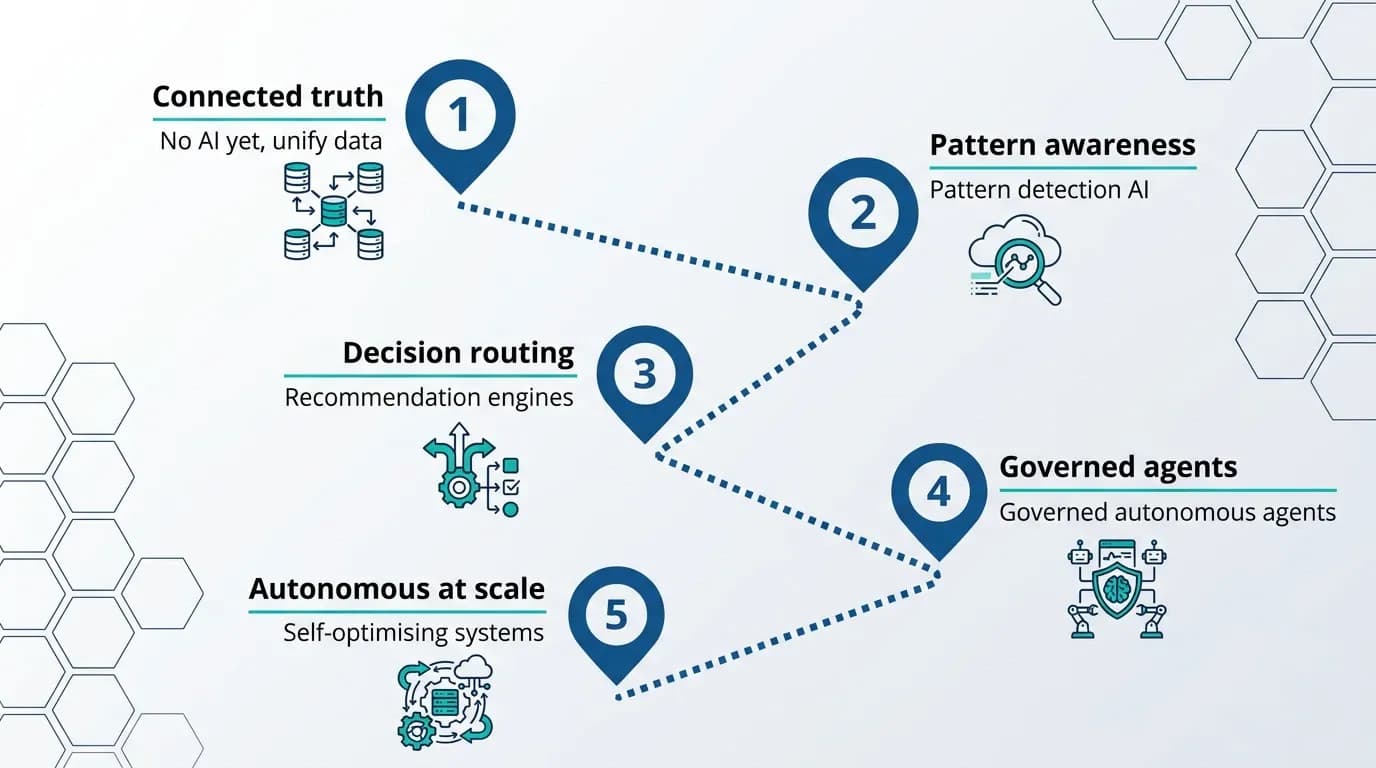
At every stage, something is easy to miss, it costs more than it looks like while it's missed, and there's a specific shift that closes it. The stages differ. The shape of that problem doesn't.
This is what an AI maturity model actually looks like in manufacturing: not a badge to claim, but sequence to walk through.
Stage One: Connected Operational Truth
- What to notice: Teams across sites are still working from different numbers for the same metric; there’s no single figure everyone agrees is correct
- What's at stake: Poor data quality left unaddressed costs organisations an average of $12.9 million a year. This isn’t a neutral starting point; it’s an active cost centre. This is exactly what an AI readiness assessment for manufacturing is meant to catch before the spend happens, not after.
- The right AI move: None yet, and that’s the point. The correct implementation at this stage is data unification and structured reporting, not predictive or decision-making AI. Skipping ahead doesn’t save time. It moves the missing capability to a later, more expensive point.
Stage Two: Operational Intelligence
- What to notice: Issues are still being found by people, well after they’ve already started. Someone has to go looking before a pattern gets flagged
- What's at stake: Stopping here without moving further leaves the organisation watching patterns instead of acting on them
- The right AI move: Pattern-detection and anomaly-flagging AI systems that surface deviations automatically. Not recommendation engines, not autonomous agents; the ownership structure those require doesn’t exist yet at this stage
Stage Three: Decision Intelligence
- What to notice: Recommendations exist, but nobody is clearly accountable for acting on them. They surface and sit
- What's at stake: A recommendation without a named, accountable owner isn’t decision intelligence, it’s just a louder alert. Unowned autonomy is the risk that should be avoided
- The right AI move: Recommendation engines that route each output to a named owner with the evidence attached. This is AI that advises and assigns, but does not yet act on its own
Stage Four: Enterprise AI Agents
- What to notice: Humans are still the ones executing every recommended action, even when the recommendation is consistently correct
- What's at stake: Gartner predicts over 40% of agentic AI projects will be cancelled by 2027 due to escalating costs and inadequate risk controls, consistent with the wider AI project failure rate industry data has been tracking since 2025. Governance added agents are already live rarely closes the gap in time. Getting this right is exactly the tension explored in manufacturing AI director responsibilities: someone has to own the outcomes, not just the recommendation
- The right AI move: Governed autonomous agents operating within bounded, monitored limits deciding and acting inside a domain, not unrestricted autonomy across the operation. What the governance actually looks like in practice is the subject of agentic AI for operational excellence
Stage Five: Autonomous Operational Intelligence at Scale
- What to notice: The organisation is still the one maintaining the system – checking it, correcting it, feeding it
- What's at stake: This stage is easy to declare and hard to actually reach. The gap between the two is invisible until performance is measured over time
- The right AI move: Self-optimising systems that adjust their own actions based on outcome feedback, continuously, without a person driving each cycle. That's a self-optimising factory in practice, not just the phrase used to describe one.
How LTS Data Point supports every stage of the roadmap
LTS Data Point already delivers the core of a manufacturing AI strategy: connected truth, automatic surfacing, and named ownership as one platform.
Unified role-based KPI dashboards, digital SQDCP huddle boards, automated escalation workflows, and CAPA management connect ERP, MES, CRM and BI systems into one shared operational picture, routing issues to a named, accountable owner as they arise.
Data Point AI Intelligence adds a further layer on top of this foundation. The Ask and Understand feature support the earlier stages by making operational data searchable and explaining the patterns within it. Act moves into recommending priorities and action plans with a named owner attached. Predict extends toward forecasting risk before it becomes a problem.
Governed autonomy and self-optimising systems are where the category is heading next. Getting there starts with the stages already in place, not with skipping to the ones that aren't.
Most operations leaders can still name the AI capability they want before they can name the stage, they're actually on. Closing that gap was never about choosing the right tool first. It was about knowing where you stand before you choose anything at all.
But the reality is this:
The stage comes first. Everything else follows from it.
Not clear on which stage your organisation is currently on?
FAQs
1. How long does it typically take to move through all five stages?
Industry data on AI maturity models generally puts the full journey at 24-36 months for organisations that commit to systematic progression, though the transition out of the earliest stage is usually the fastest (3-6 months) and the middle transitions, particularly pilot-to-scale, take the longest (12-24 months), largely because of data readiness rather than technology.
2. Can different sites within the same organisation be at different stages at the same time?
Yes, and this is common rather than exceptional. Multi-site manufacturers frequently run a phased approach, bringing lower-performing or pilot sites through the early stages first before extending later-stage capability to additional sites, rather than moving the entire organisation through each stage in lockstep.
3. How do you actually assess which stage your organisation is on?
The clearest indicator isn't the AI tools in use but the organisational capability underneath them, specifically whether data is unified, whether recommendations carry a named, accountable owner. Assessing capability rather than tooling avoids the common mistake of judging maturity by what's been purchased rather than what's actually in place.
4. Is it possible to regress to an earlier stage?
Yes. Losing the data discipline or governance a stage depends on can push an organisation back toward the practices of an earlier one, even after AI tools remain technically deployed. Maturity describes an organisational capability, not a one-time purchase, which means it can erode without ongoing attention.
5. Does this roadmap apply differently to smaller manufacturers versus large enterprises?
The sequence itself doesn't change, but pace and resourcing typically do. Smaller manufacturers often move through the early stages faster, since unifying data across fewer sites and systems is a smaller undertaking, while larger enterprises tend to spend required across multiple sites.
6. What team or skills are typically needed to progress through these stages?
Requirements shift by stage. The early stages depend most on data and process discipline, typically owned by operations and IT together, while the later stages depend more on governance capability, meaning a named owner accountable for outcomes rather than purely technical skill. Underinvesting in governance capability is a more common cause of stalling than lacking technical expertise.

Geandra Queiroz, Operations Management Consultant
Geandra is an Operations Management Consultant at Lean Transition Solutions, specialising in Lean philosophy, Lean Six Sigma, and strategic planning across manufacturing and healthcare. She is currently completing her PhD in Industrial Engineering at the Federal University of São Carlos, researching the integration of Operations Strategy, Lean, and Green Manufacturing.