AI Adoption Challenges in Manufacturing: Every Failure Point from Data to Scale, and How to Get Past Each One
Last updated on : July 3, 2026
AI adoption is more like a blind adoption compared to software adoption.
Software adoption often includes interface unfamiliarity and a resistance from employees who are used to the old one.
But AI adoption is more like a walk in the dark. AI came to the public by 2022, which is just a four-year time period. Unlike software adoption that comes with a standardised vendor training, AI adoption usually doesn’t come with one.
And the result? Self-taught silos with no shared language or process. This leaves the leadership stranded out in the open, unable to standardise or scale what individuals have privately figured out.
Data scattered. Ownership unclear. Pilots that never scale. See how LTS Data Point fixes all three.
What “AI adoption challenges” actually means in manufacturing
Call it what it is. AI adoption challenges aren’t a training problem or a budget problem. It's what happens when a business tries to run two different clocks at once – one part of the operation moving at AI’s pace, everything else moving at its own.
Enterprise software is implemented as one complete system bound to fixed workflows. AI, on the other hand, is adopted incrementally at the task level. This may result in improving one part of an operation without the rest of the system keeping pace. This only causes the whole company to fall out of sync.
And it doesn’t fail randomly. The same four fault lines show up everywhere: the data isn’t ready, the teams aren’t connected, nobody agrees on what success looks like, and leadership never fully backs it. Every deployment that stalls, stalls at one of these four points.
The first of those four is where nearly every deployment starts, and where most quietly go wrong first: the data.
AI adoption challenges in data readiness
Data readiness for AI always looks fine on the dashboard. But that can also be a trap.
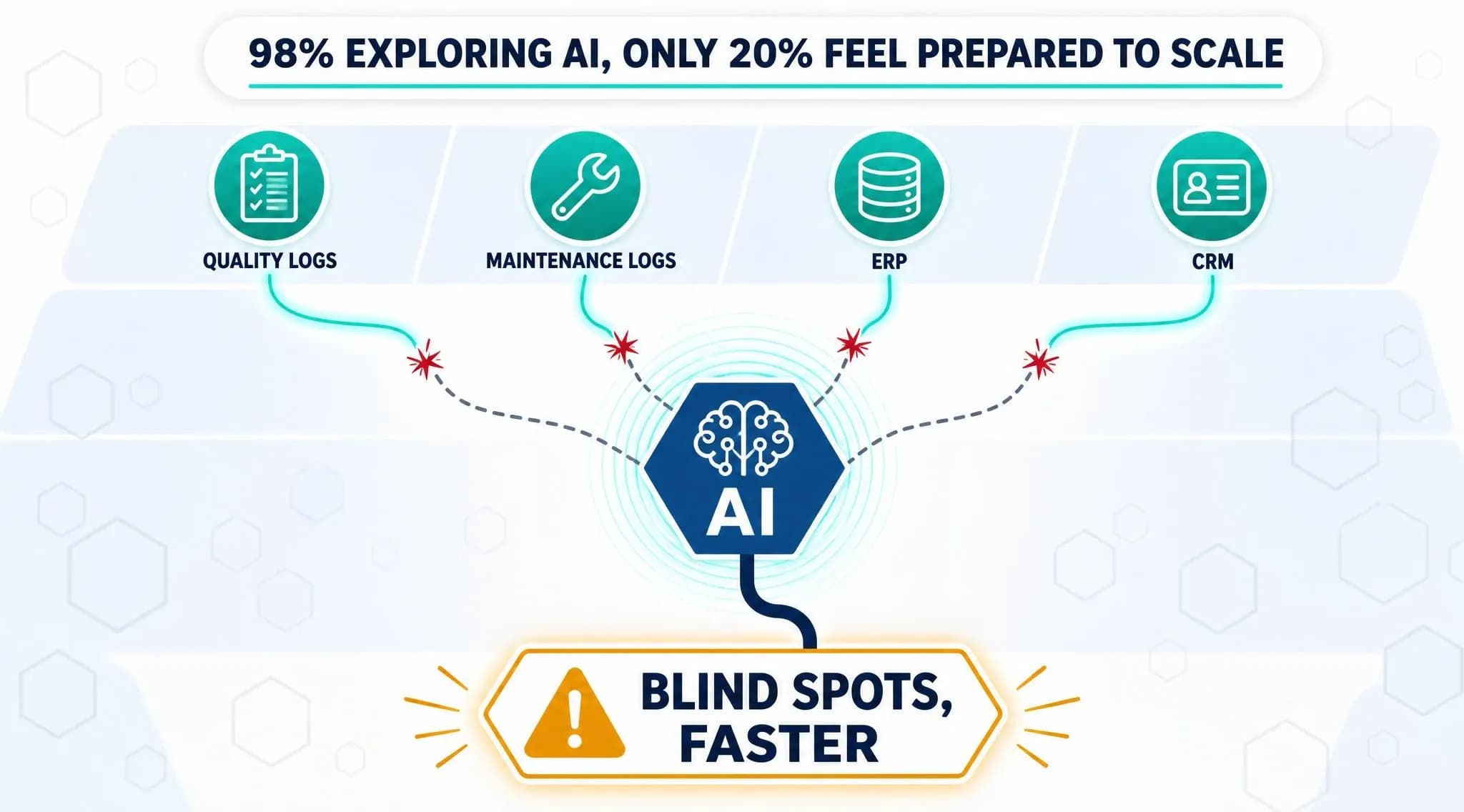
Numbers populate, charts update, everything looks like it’s talking to everything else. But almost every manufacturer chasing AI right now is standing on the same shaky ground: 98% exploring it, and only 20% feel prepared to actually run it at scale. That gap isn’t a confidence problem. It's a wiring problem. The plant floor got automated one system at a time, over years, and nobody went back and automated the handoffs between those systems. Quality logs one thing. Maintenance logs another. The ERP has its own version of the truth, and none of them were built to agree with each other. This is the same disconnect AI for manufacturing has to be solved before AI adds any value at all.
That's what “OT and IT never talked to each other” actually means in practice. Most manufacturers still describe that connection as basic or non-existent, and it caps how far AI can go no matter how good the model behind it is. Strip away the acronyms and it’s the same familiar mess: a CRM nobody’s cleaned up, an ERP running on old assumptions, and no record of where any given number actually came from. Feed that into an AI model and you haven’t given it data. You've given it your same blind spots, just faster.
AI adoption challenges in governance and ownership
The model can be right, and the deployment can still fail. Nobody has to make a mistake for that to happen. Nobody has to own one, and that’s the actual problem. Most manufacturers have already pointed AI at their operations, but almost none have a plan for what happens when it gets something wrong. That's not a technology gap. It's a decision nobody is on the hook for. It's an AI change management gap before it’s anything else.
That's what unclear ownership actually looks like in practice. When an AI-driven call goes wrong, the postmortem rarely lands on the model. It lands on the fact that nobody had both the authority to act on that call and the responsibility for what happened next – precisely the gap Manufacturing AI director can close. The system worked exactly as built. It just wasn’t anyone’s job to catch what it missed.
Assign that ownership at one site, and it holds. Carry it to the next site, the next line, the next plant, and it’s a different fight altogether.
AI adoption challenges in scaling beyond the pilot
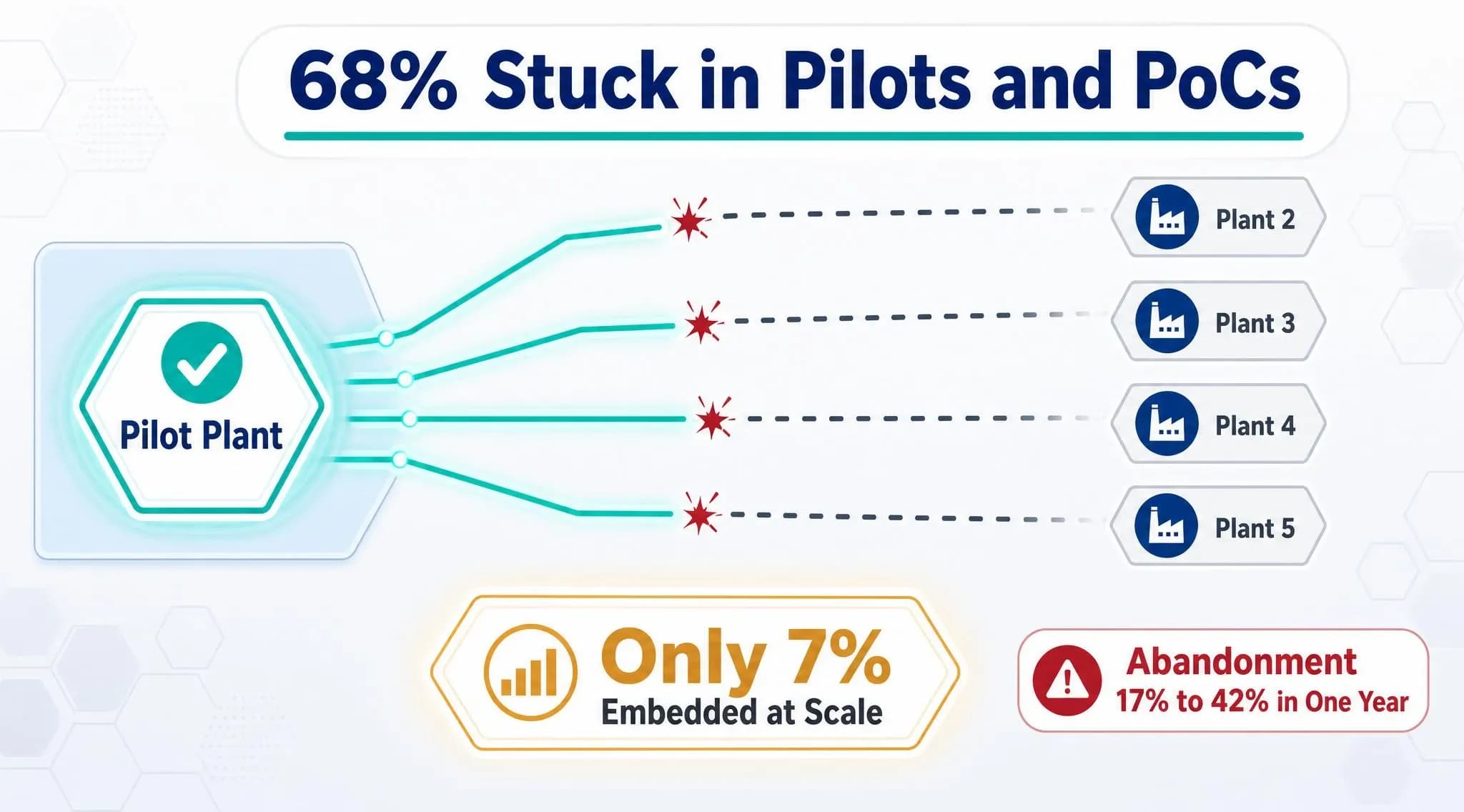
The pilot worked. Downtime dropped, the operations team saw it, the plant manager signed off. Then someone asked what it would cost to run the same thing at the other four plants, and the room went quiet. That’s not a failure story. That's the most common story there is: 68% of industrial organisations are stuck exactly there, pilots and proof-of-concepts that never make it further, while only 7% have AI actually embedded in how the business runs.
It's not that the pilots don’t work. It's that working once, in one place, was never the actual test. Across every industry chasing this, the number tells the same story from a different angle: abandonment before production jumped from 17% to 42% in a single year, and the average organisation now scraps nearly half its proof-of-concepts before they ever get the chance to run for real. What survived the sandbox doesn’t automatically survive the plant next door. That’s where Lean AI picks up: what happens to the knowledge an AI system captures once it has to hold up across more than one site.
Every one of the first three fault lines shows up again here, just at a bigger scale. What you need isn’t another pilot. It’s a foundation built to hold all four at once.
Closing AI adoption gaps with a connected foundation
Data scattered in five places. Nobody owning the decision once the alert fires. What works at one site quietly falling apart at the next. None of that gets fixed by a better model. It gets fixed by rebuilding what the model depends on.
LTS Data Point does exactly that:
- Connects to ERP, MES, CRM, and BI platforms, unifying every KPI into one real-time system instead of leaving them scattered across disconnected tools
- Runs every action through the 4C workflow, so nothing gets assigned, tracked, or closed without a named owner and a full audit trail behind it
- Scales from a single site to the entire enterprise, with the same dashboards and structure holding at every tier, not reinvented plant by plant
Clients running this system have cut two and a half hours from executive meetings per session, worth an estimated £151,000 a year in time alone, before AI even enters the picture.
AI adoption doesn't fail because the technology isn't ready. It fails because the foundation underneath it isn't. Data, ownership, and scale decide whether AI holds or quietly falls apart. Fix those first, and the model finally has something solid to stand on. That's the difference between a pilot and a system that lasts.
Still not sure where your AI initiative is actually stuck?
FAQs
1. How long does it typically take to see results from an AI adoption initiative in manufacturing?
Results usually differ by initiative. Narrow use cases with clean data show measurable results in a few months; anything requiring cross-system integration or multi-site rollout typically takes longer, closer to a year or more before it holds reliably.
2. How do you measure ROI on an AI adoption program?
Tie ever initiative to one clear metric tied to revenue, cost, or time saved before it starts, not after. Proof-of-concepts that launch without a defined success measure rarely get the budget to scale, regardless of how the demo looks.
3. How do you choose the right AI vendor for a manufacturing environment?
Start with what needs to integrate with your existing ERP, MES, and CRM systems, not with which platform has the most features. A tool that doesn’t fit your existing ecosystem adds a new fault line instead of closing one.
4. Does AI adoption require hiring new AI-specific talent?
Not necessarily new hires across the board, but it does require the right mix of skills, product, governance, engineering, and deployment, working together. A team of smart people without that mix still struggles to take an initiative from concept to production.
5. Is the cost of implementing AI the biggest barrier to adoption?
Rarely. The larger cost is usually the rework required when something is built without a governance structure or execution plan behind it. Getting the foundation right the first time costs less than fixing it after the fact.
6. Can AI adoption succeed without support from senior leadership?
Not for long. Even a technically successful pilot stalls without leadership backing it past the first site, since scaling requires resourcing, cross-functional buy-in, and decisions that only leadership can make.

Geandra Queiroz, Operations Management Consultant
Geandra is an Operations Management Consultant at Lean Transition Solutions, specialising in Lean philosophy, Lean Six Sigma, and strategic planning across manufacturing and healthcare. She is currently completing her PhD in Industrial Engineering at the Federal University of São Carlos, researching the integration of Operations Strategy, Lean, and Green Manufacturing.