Laboratory Capacity Planning: How to Balance Testing Demand with Available Resources and Keep Turnaround on Track

Last updated on : November 18, 2026
A laboratory can have enough capacity for the average week and still miss the turnaround it promised production. Laboratory capacity planning decides what the lab can reliably commit to, with room left for demand to change.
Production, release and project teams need dependable dates, yet their requests compete for the same capacity. QC teams across pharmaceutical companies keep struggling with variable demand, uneven workloads and missed deadlines that trigger expediting.
So, what happens when an urgent request lands? Something moves, or someone finds more capacity, and both need agreed rules and an owner.
The fix is not more effort, but protective capacity held across quarter, week and day, with demand agreed early and risks escalated fast.
The fix is not more effort, but protective capacity held across quarter, week and day, with demand agreed early and risks escalated fast.
Explore how LTS Data Point can help your lab spot capacity risks early and track the actions needed to protect turnaround commitments
What a turnaround commitment really asks of lab capacity
A turnaround date is a promise made against the busiest week, not the average one. Production, release and project teams plan around the date. The lab carries the variation underneath it.
- Fixed work shrinks the room. Stability studies, investigation support and batch release analysis are fixed in place. The more hours they take, the harder unplanned work lands, such as health authority asking for more data or an experiment that fails. One planning guide suggests blocking a share of hours for it, for example 10%.
- Targets need a tracker. WHO guidance expects labs to set measurable, time-bound targets in management review, monitor them regularly and act where needed. Its examples include the share of analytical test reports issued within a specific time frame.
Picture two labs with identical variation in arrivals and processing time. One books 80% of its available hours. The other books 95% of its hours. In the standard queueing formula, the part driven by how full the lab is, rises from 4 to 19. Average waiting stretches almost fivefold. That is a model, not a forecast for any one lab.
So, how much margin does a promise need? Enough for the variation the lab really sees. The commitment is not a date on a plan, but a margin held for the week that goes wrong.
Which capacity decisions belong to the quarter, the week and the day
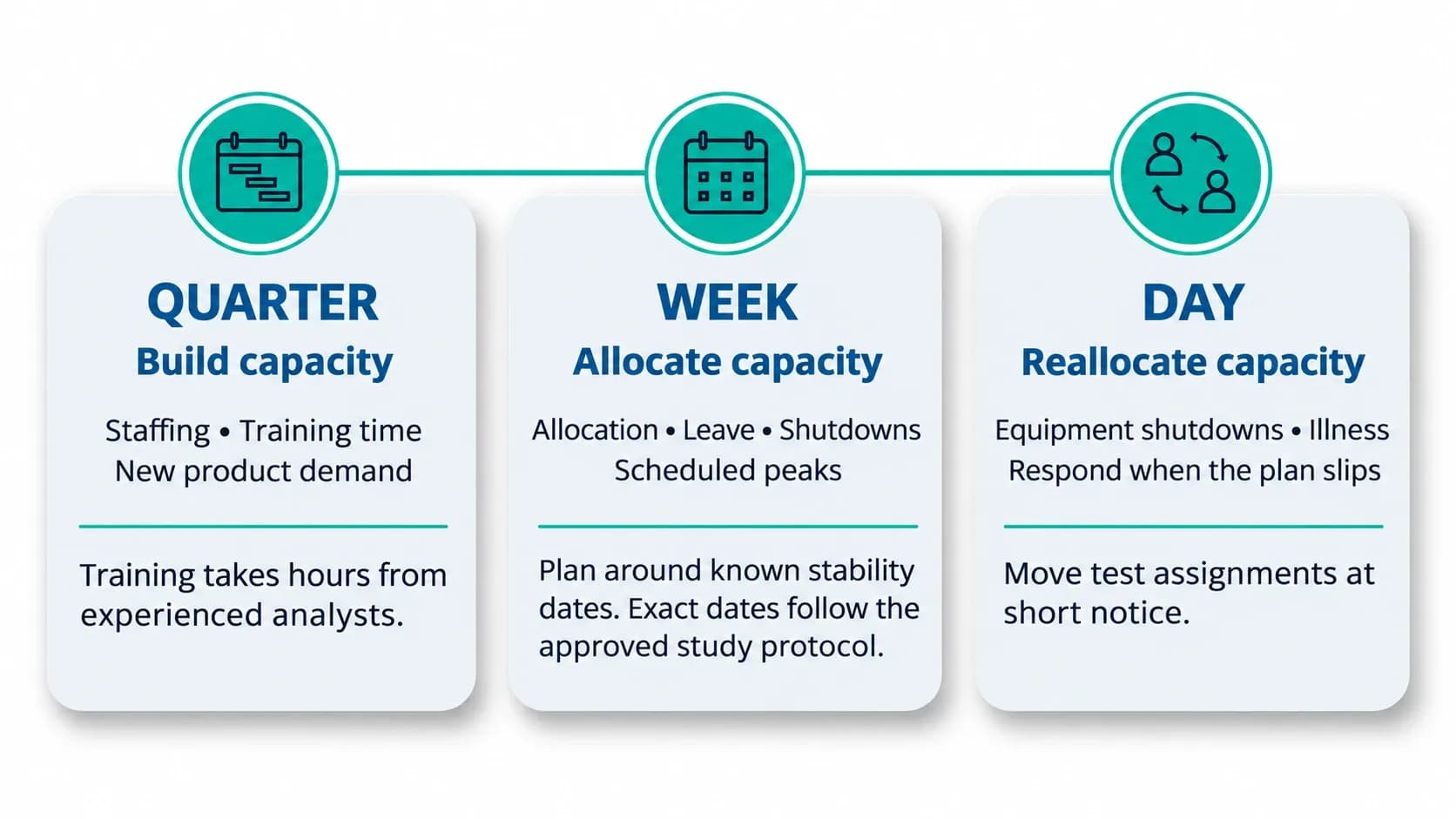
Capacity decisions run at three speeds.
- Quarter: staffing, training time and new product demand.
- Week: allocation, leave, shutdowns and scheduled peaks.
- Day: reallocation when the plan slips.
Start with the slow one. Hiring is a quarter-sized decision. The more complex the role, the longer the training. That training draws hours from the analysts already in post.
The week has fixed points of its own. For products with a shelf life of at least 12 months, ICH guidance puts long-term stability testing at every three months in year one, every six months in year two, then annually. Those dates are known early. Leave and shutdowns are placed around them. Each lab's approved study protocol fixes its exact dates.
The day is where plans slip. Schedule planning is repeated daily or weekly. Equipment shutdowns and illness force a reaction at short notice.
Picture a lab that counts a new analyst as fully available in week one. Two experienced analysts are still teaching them. The weekly plan takes on too much work. Reassigning tests each morning treats the symptom, not the assumption.
How to agree demand with the teams that create it
Most lab demand starts outside the lab. QC labs test samples from different parties and different stages of manufacturing. The results decide whether manufacturing continues or a product is released. The lab's plan rests on other teams' submissions.
So, agree the input and the output together. WHO's laboratory implementation guidance lists what to settle with the customer: how many samples, when they are delivered, the turnaround time, and when and how results are reported. One agreement, two halves: what arrives and what leaves.
Then check each request against the work already accepted. WHO guidance asks the lab to review every test request.
- Is the sample enough?
- Does the lab have the capability and resources?
- Do the methods fit?
Any issue goes back to the requester before testing starts, and the review is kept on record.
Agreements move. For contracted laboratory work, WHO guidance asks that differences are resolved before work begins, that the customer agrees any deviation, and that a change made after work starts is reviewed with the affected staff informed. Picture a production team that pushes a sample set into an already committed week. But once demand is agreed, which resource sets the limit?
How to find the constraint and rebalance before adding headcount
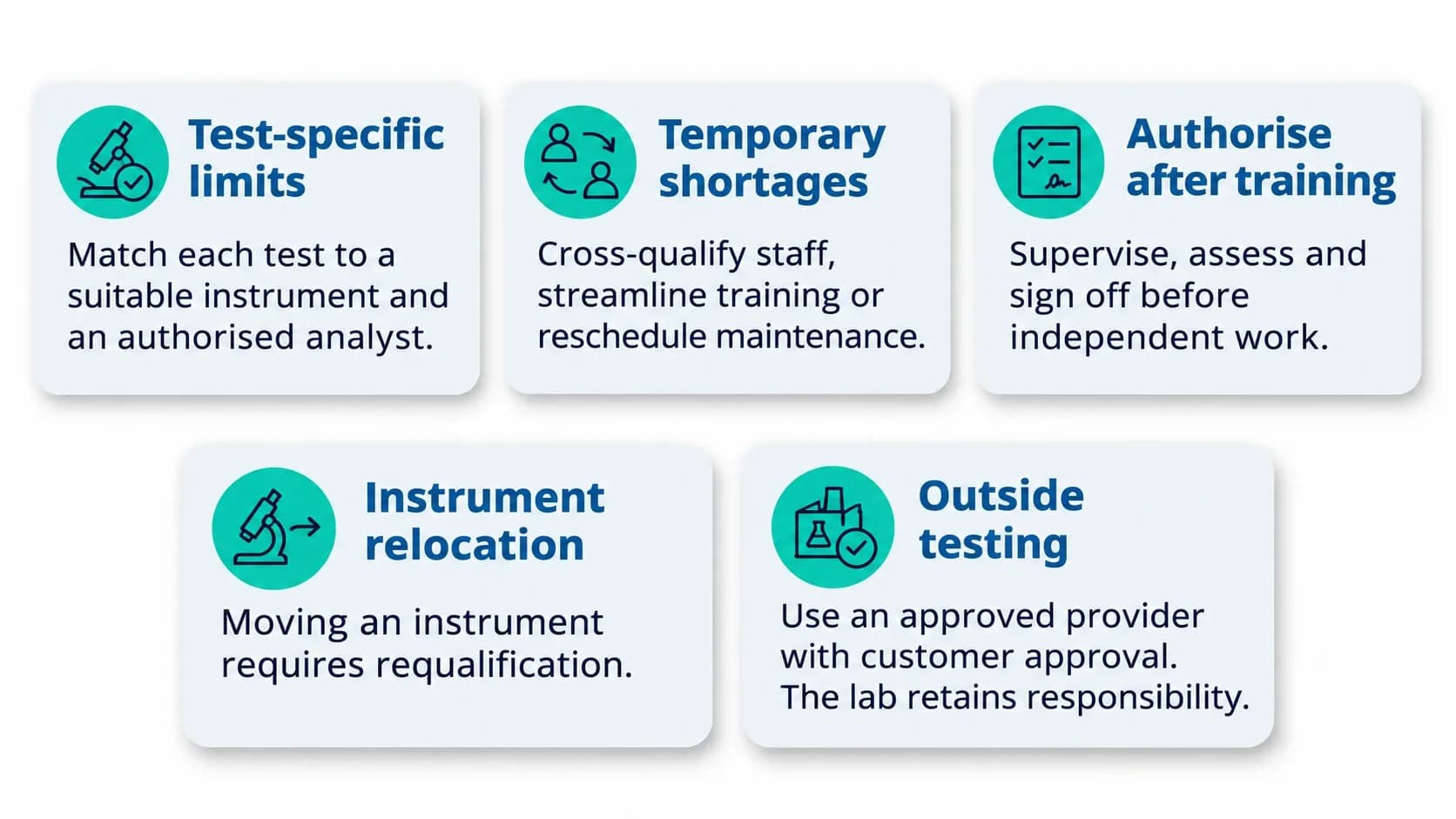
More people help only when people are the limit. Which resource is it?
- Each test has its own limit: In QC labs, a sample type is a fixed set of tests. Only certain instruments can run certain tests, and analysts are trained on some analyses, not all.
- Temporary shortages have quick levers: For a shortage on one method or instrument, one planning guide lists cross-qualifying staff, leaner training and moving maintenance.
- Cross-training has to end in authorisation: WHO guidance asks for supervision during training, a documented assessment at the end, and sign-off by the laboratory director or a designated person before staff perform a specific activity. That makes authorisation the data extra cover starts.
- Moving an instrument is itself a change: WHO guidance lists relocation, modification and a change of use among the events that call for requalification.
- Outside testing has prerequisites: WHO guidance allows subcontracting to organisations approved for the activity, with customer approval and periodic checks on the contractor's competence. The lab stays responsible for every reported result.
Take a simulated QC lab with seven instruments. A daily workload of ten jobs finished in a similar time from three analysts to seven. The authors read that as possibly meaning extra analysts add little. A weekly workload of seventy jobs kept improving as analysts were added. It is a simulation, but the logic is plain: find the limit first.
The question is not whether to add headcount, but which resource the work is waiting for, and what each fix costs before it helps.
How LTS Data Point supports laboratory capacity planning
A capacity plan only works while it stays visible. LTS Data Point is a performance management system that connects people, data and decisions across every tier, and it sits alongside the systems a site that already runs.
- Huddles that escalate: Daily huddles run on live boards from Tier 1 to Tier 3, so issues escalate on time and actions are followed through. ICH Q10 asks for communication across all levels and timely escalation of certain quality-system issues.
- Actions that close: Action Plans follow 4C workflow, and each action is assigned, tracked, escalated and closed. ICH Q10 expects corrective and preventive actions to use a structured investigation aimed at root cause, with effort matched to risk.
- Records that can be followed: Every action carries a full audit trail. WHO data integrity principles ask for records that show who did what, are made at the time, and stay accurate, complete and available.
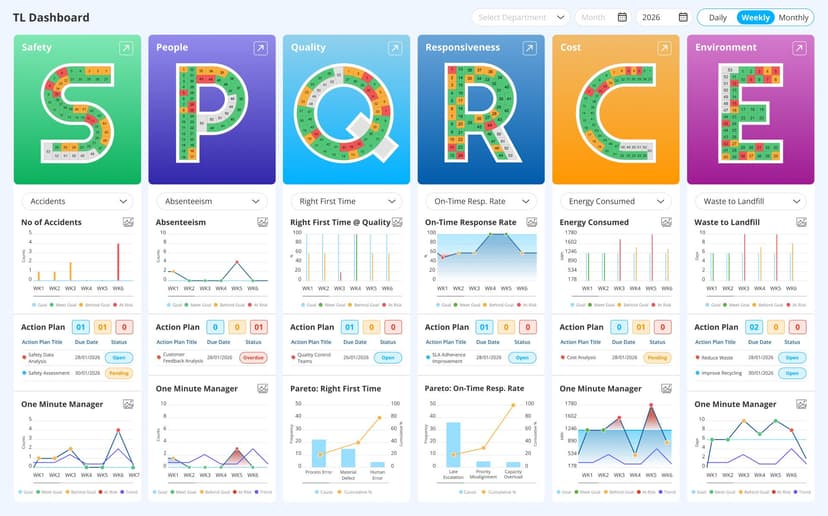
- Plan against actual: KPI dashboards show daily, weekly and monthly views, with Pareto chart behind a miss.
- Skills in view: The Skills Matrix supports competency planning. WHO guidance asks a lab to keep a matrix of each analyst's competencies, with criteria for assessing them.
The tool is not a replacement for the quality system, but the daily loop that keeps it current.
Laboratory capacity planning is not a calculation made once, but a margin held and defended. Agree demand early. Find the resource that sets the limit. Hold room for the week that goes wrong and review it at the speed of the decision. When the plan stays visible and owned, the turnaround promise holds.
Discuss your laboratory capacity challenges with an LTS Data Point expert to identify where clearer visibility could support more reliable commitments
FAQs
1. Which KPI shows a lab capacity problem before turnaround slips?
Turnaround is a result, so it reports the damage after the fact. Track a leading figure beside it. One planning guide recommends the hours of unplanned work requested in the last month. It shows pressure building, and it forces everyone to think about priorities. Treating an unplanned task as something the team can absorb with no effect on other work is an illusion.
2. Can a lab plan too much?
Yes. In a busy, changing lab, a plan that expects no movement is an illusion. Too little planning leaves waiting time, because tasks depend on each other. A plan earns its place by creating transparency, which gives the lab evidence to justify its resources and settle conflicting priorities.
3. Who owns a delayed task that involves several people?
One named person. When several people are involved and time is critical, one planning guide recommends a task owner who is the single point of contact. Everyone reports delays to that person keeps the activities in step.
4. What should a lab huddle board show?
What is off plan today, and who has it. Every item on the board needs an owner, a deadline and a next action, so the huddle ends with names against problems. Anything the team cannot fix goes up a tier. The board is live, so the numbers are today's, not last week's.
5. How many tasks does one batch create for a lab?
Far more than one. Each batch produces samples of raw materials, in-process material, finished product and stability. Each sample represents several tests, and each test needs specific instruments and skills. Weekly lab activities can amount to the tens of thousands.