Manufacturing PESTLE Analysis: What's Actually Changing in Your Industry and How to Respond Before It Hits the Shopfloor
Last updated on : May 6, 2026
In a manufacturing factory, everything is going as planned. The machines are running smoothly, the people are working hard, and the team leaders keep track of everything very efficiently. And yet, the results are poor.
Why is everything still chaotic even after doing everything right?
The answer is simple. As a manufacturing operations leader, you’re still stuck inside the four walls. Your visibility is limited.
A manufacturing PESTLE analysis clears this fog. It helps you to understand what’s happening outside by covering Political, Economic, Social, Technological, Legal, and Environmental factors.
See how LTS Data Point helps manufacturing leaders track operational performance against shifting external pressures
What is a manufacturing PESTLE analysis?
The PESTLE framework was developed in the late 1960s by Harvard professor Francis Aguilar. It was developed as a tool for scanning the macro-level factors that sits outside a company’s direct control but directly shape its operating conditions.
Let's see a real-world example.
A factory was doing just fine, reaping all the profits and hitting all its targets. A new environmental regulation was passed suddenly. Nobody predicted it. This resulted in a huge expenditure on updating the equipment to comply, exhausting almost all the profit the factory has made so far.
For a factory manager, this means that PESTEL is not simply an exercise, but a practical early warning system. It predicts what might go wrong and how drastically it can affect the industry, giving it enough insight to prepare for the impact.
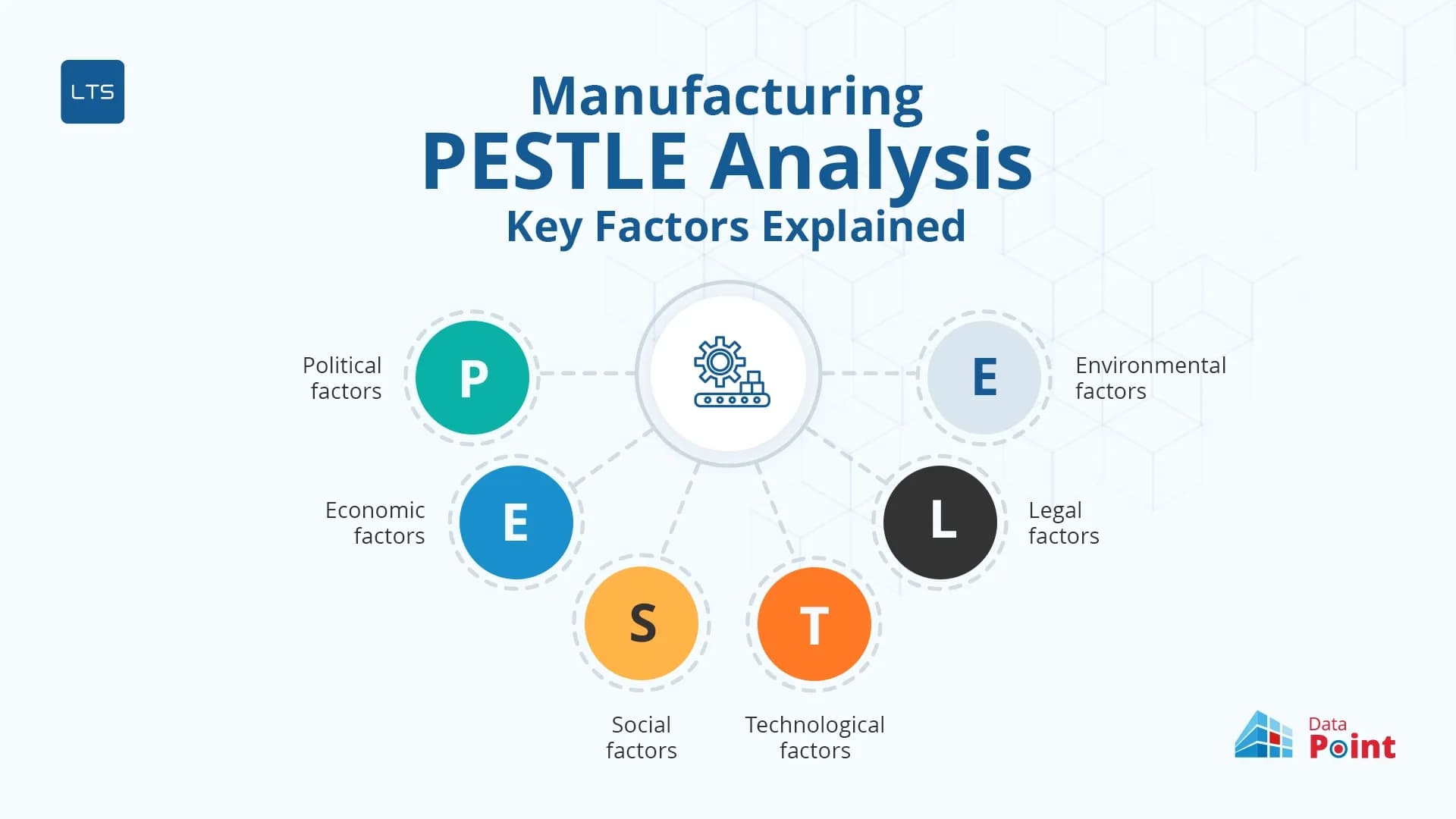
A manufacturing PESTEL analysis shows what changes might surface across six pillars – Political, Economic, Social, Technological, Environmental, and Legal.
Manufacturers who analyse external factors only annually, are in fact, reacting not preparing.
The six PESTLE factors in manufacturing
1. Political factors
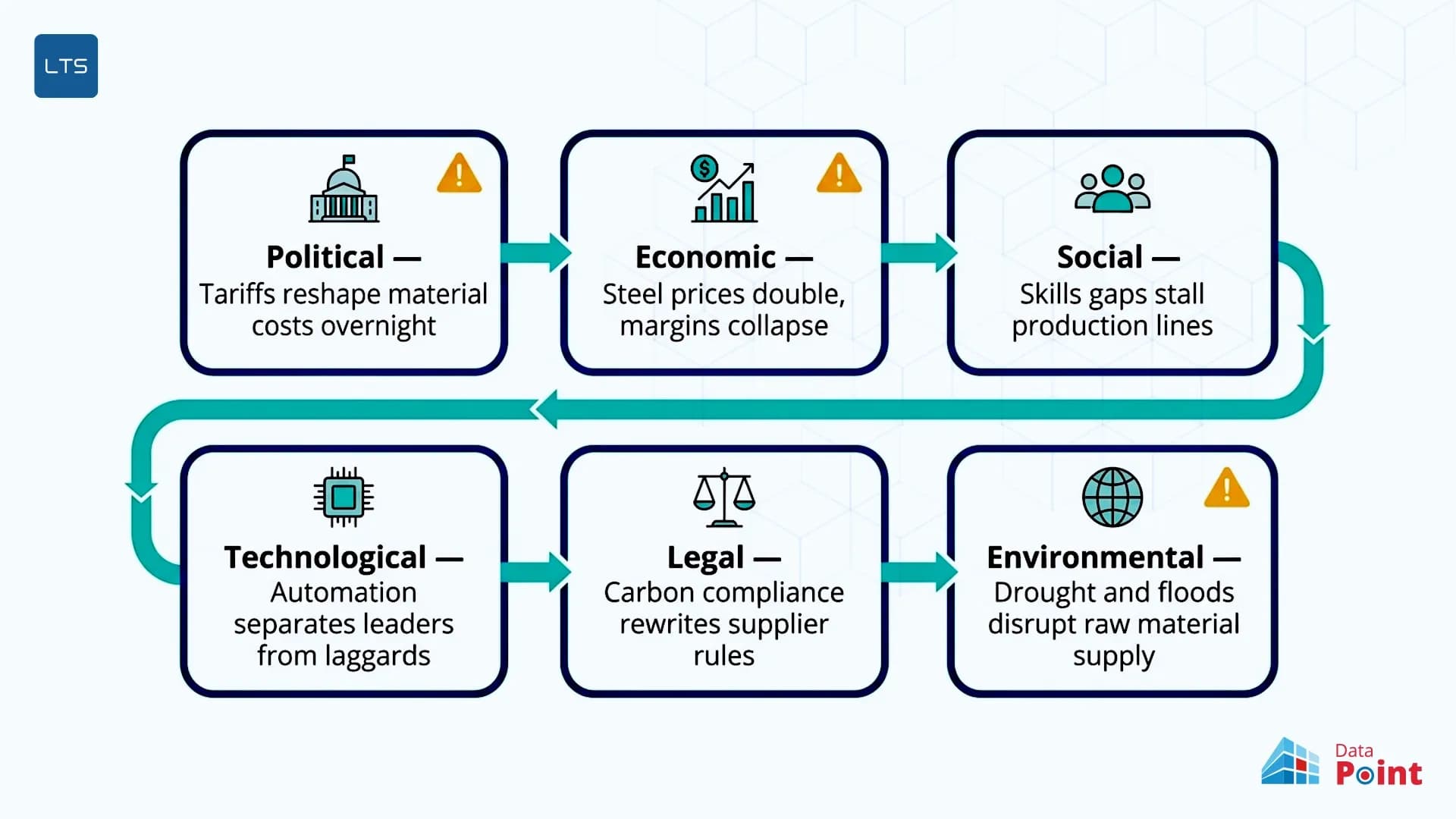
82% of supply chain leaders say their supply chains are affected by new tariffs. Political decisions made in the government chambers affect the organisations directly. Policies regarding tariffs, trade restrictions, shifting import rules decide the pace of every manufacturing industry. For a factory manager, these changes are never abstract political events. They affect the cost of materials, components, and margins.
2. Economic factors
Economic conditions decide what production costs. Looking deeper into how external factors, be it political, environmental or social, economy gets the first strike. For example, in 2025, US tariffs on steel and aluminium doubled to 50%. This sudden increase reshaped global trade flows and putting supply chain resilience under pressure across every sector.
3. Social factors
Some of the core social factors that affect factories directly include workforce demographics, skills gaps, and changing worker expectations. 90% of manufacturers report that labour shortages affect the manufacturing department greatly, with operations cited as the hardest hit function. The people available to work in the manufacturing sector and what they expect from it is changing faster than most operations plans account for.
4. Technological factors
Technology is improving at rocket speed. A recent survey of 600 manufacturing executives found that 80% plan to invest more than 20% of their improvement budgets in smart manufacturing initiatives. Automation and digital tools are no longer optional for growth. Manufacturers that track technology trends through PESTLE can plan adoption before competitors force them to.
5. Legal factors
Regulations do not wait for convenient timing of the manufacturers. In 2026, the EU’s Carbon Border Adjustment Mechanism (CBAM) comes into practice, requiring companies to account for the embedded carbon emissions in certain imported goods. Any legal change, be it labour law or emissions rules, rarely announce themselves with enough lead time.
6. Environmental factors
Environmental changes also affect manufacturers drastically, as it is getting unpredictable as years go by. Climate changes directly affect the availability of raw materials, logistics, and regulatory exposure. In the summer of 2025, Europe went through a combination of heat, drought, and flood. This resulted in an estimated €43 billion in losses, especially with agricultural and manufacturing supply chains. The damage is real.
At first glance, all these six pillars appear separate entities independent of each other. But if you look closer, it is more than easy to see how each of these affect each other in an interconnected manner.
Why manufacturing PESTLE analysis is important and how to conduct one effectively
Company A and Company B are two competing companies around the same region. Company A runs a quarterly PESTEL review while Company B runs only once a year. Company A also pulls data from procurement, HR, and compliance. Company B reviews external factors at the leadership offsite. A new labour law gets implemented mid-year. Company A has an action owner and a plan within two weeks, while Company B is still escalating three months later.
Treating a manufacturing PESTEL analysis as one-time exercise is what got Company B in trouble. Company A, on the other hand, treated it as a recurring discipline that has the capability to predict an unexpected change.
But how do I conduct a manufacturing PESTLE analysis effectively?
How to conduct a manufacturing PESTLE analysis
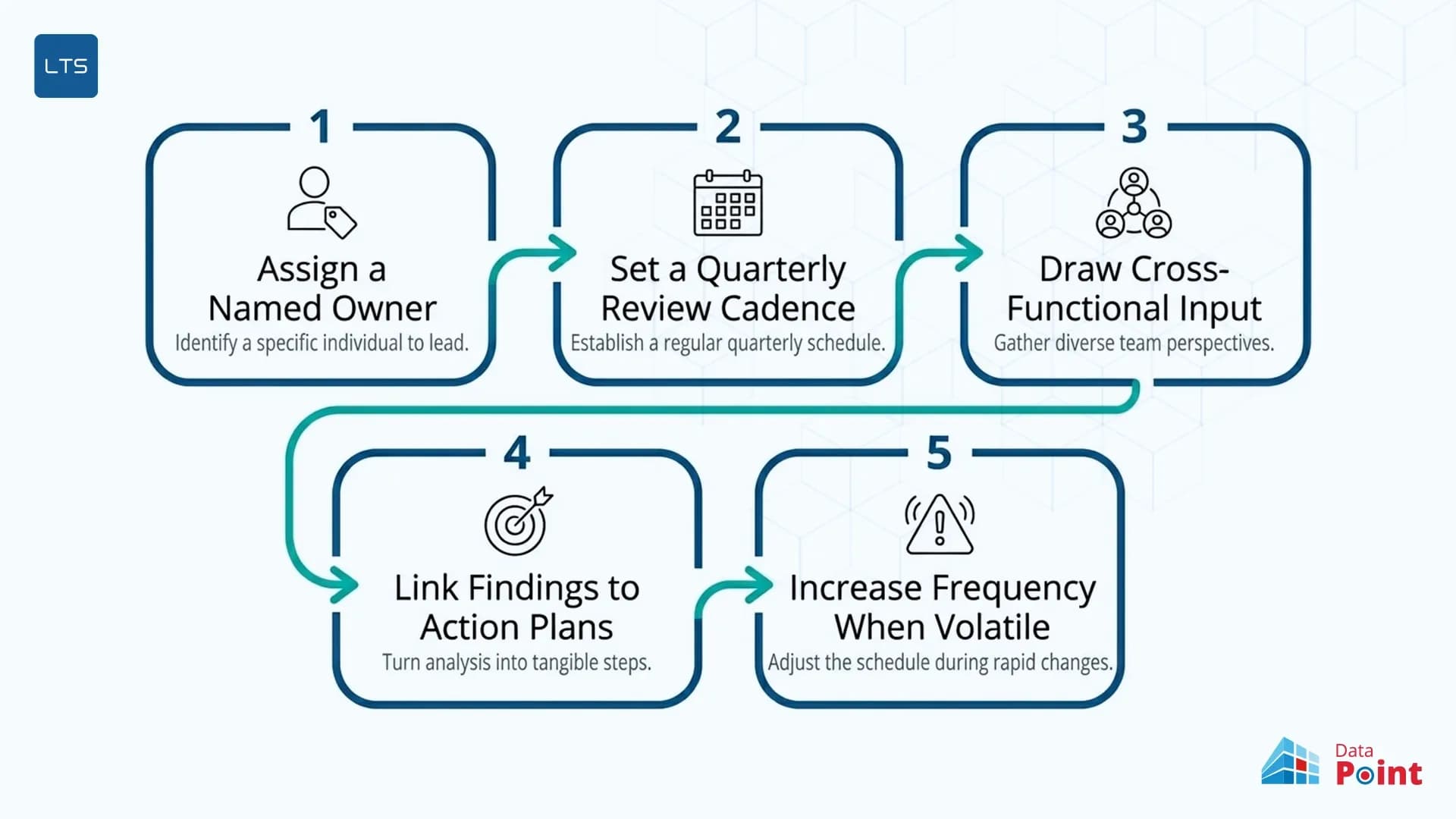
1. Assign a named owner:
Assign an owner for each of the six pillars of the PESTLE analysis. Without proper accountability, findings remain in a shared platform and go untouched.
2. Set a quarterly review cadence:
Setting an annual review only spots what has already happened, not what is going to. Setting up a quarterly cadence and keeping track of it frequently will enable industries to predict and plan accordingly.
3. Draw input from cross-functional department:
Drawing input from operations, procurement, HR, finance, and compliance provide insight into various external risks that sit under these six pillars.
4. Link every finding directly to an operational decision or action plan:
More than 65% strategic efforts fail at the execution stage, not at the analysis stage. Analysis without action fails.
5. Increase review frequency when external conditions are volatile:
Certain external changes such as tariff changes, regulatory shifts, and supply disruptions do not follow an annual schedule – they keep changing as other external factors change.
Taking PESTEL analysis as one-time exercise will not bring results. What bring results is adopting PESTLE analysis as a recurring discipline.
PESTLE vs Porter’s Five Forces: Which framework does your factory actually need
How LTS Data Point connects your PESTLE findings to daily operations
Identifying external risks through a manufacturing PESTEL analysis is only half the work done. The other half is building a fully functional system that keeps those risks visible and actionable every day.
But how can I build a system? Isn’t PESTLE analysis framework enough?
Actually, no. Once you’ve analysed the external factors, you must build a system that ensures findings are owned, tracked, and acted on.
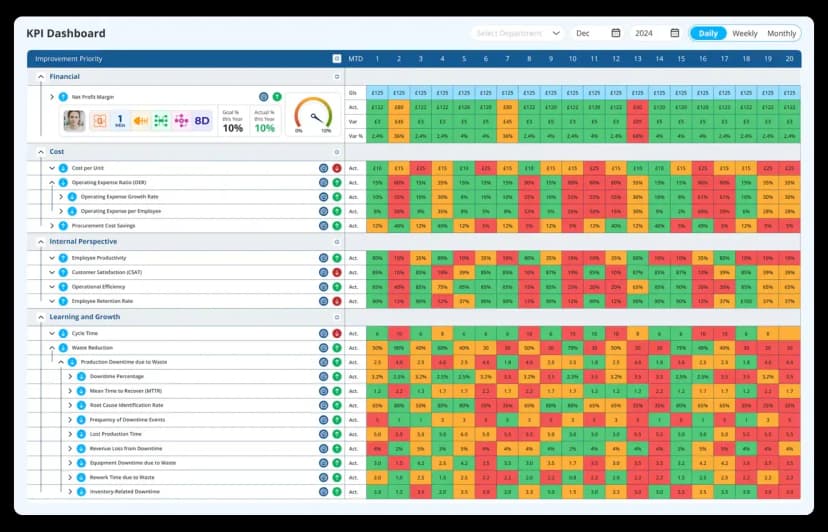
LTS Data Point platform enables you to build one. Once these factors are tracked, these can be converted into relevant KPIs which can be tracked using customised KPI dashboards and frameworks.
Every KPI tracked in LTS Data Point platform is linked to a named owner, deadline, and a corrective action. It further integrates ERP, MES, CRM, and BI platforms putting an end to your disconnected data tracking terror permanently. By using these automated platforms, organisations have shortened executive meetings around two and a half hours per session.
A PESTLE analysis without an operational system to act on it becomes simply a strategy but with no opportunity for proper execution. LTS Data Point bridges that gap.
A manufacturing PESTEL analysis is not a strategy document kept untouched somewhere. It is a discipline that keeps your company operation one step ahead of the factors shaping it. External factors such as political, economic, social, technological, legal, and environmental are mostly volatile and change without any warning. Manufacturers who track them systematically can plan and respond much easier.
Not sure how your site is positioned for the six factors? Let LTS Data Point guide you
FAQs
1. Is a manufacturing PESTLE analysis only relevant for large manufacturers?
No. Tariffs, energy costs, labour shortages, and compliance changes affect manufacturers of every size. Smaller manufacturers are often more exposed, with less financial buffer to absorb sudden shifts. A structured quarterly conversion across procurement, operations, and finance is enough to get started.
2. How is a PESTLE analysis different from a SWOT analysis?
SWOT covers both internal and external factors. PESTLE focuses exclusively on the external macro-environment. The two complement each other: PESTLE findings feed directly into the Opportunities and Threats sections of a SWOT. Most manufacturers run PESTLE first, then build their SWOT from there.
3. How often should a manufacturing PESTLE analysis be updated?
Quarterly. More frequently during periods of rapid change such as new tariffs, legislation, or supply disruption. Manufacturers in heavily regulated sectors often run a light monthly scan of their highest-risk factors alongside a full quarterly review.
4. Who should be involved in a manufacturing PESTLE analysis?
Each factor sits closest to a specific function – procurement owns a tariff and supplier risk, HR owns workforce factors, finance owns economic conditions, compliance owns legal and environmental exposure. Cross-functional input ensures no external risk goes untracked.

Abel Jiménez, Lean Consultant
Abel is a Lean Consultant with over 30 years of expertise in operational analysis, process improvement, and organisational change across Mexican industries. Currently serving as Director of Insurance Promotions at CESCEMEX, he helps organisations leverage technology and lean practices to improve efficiency and manage change with continuity.