What Is Smart Manufacturing — And Why Every C-Suite Leader Needs to Act Now
Last updated on : April 21, 2026
Every shift produces data. Every machine generates signals. Yet in most factories, that data sits in silos – reported late, acted on slowly, and disconnected from the decisions that matter most.
Smart manufacturing changes that entirely.
What is smart manufacturing? It is the use of connected digital systems to create a production environment that captures performance data, surfaces it in real time, and structures how every level of the organisation acts on it – from team leader to boardroom.
For C-suite leaders facing a widening manufacturing productivity gap, it is the most powerful and proven lever available – combining smart manufacturing tools for continuous improvement with the factory performance visibility that makes improvement sustainable across the entire enterprise.
Watch LTS Data Point in action and discover how smart manufacturing performance management works in practice
What is smart manufacturing? The definition senior leaders need
Smart manufacturing is the information-driven, event-driven orchestration of physical and digital processes across factories, plants, and supply chains.
The international standards community deliberately chose the term over “Industry 4.0” as the preferred global designation – because it more precisely captures what manufacturers actually implement:
- A specific, operational system for connected manufacturing
- Built to respond to real-time signals – not yesterday’s reports
- Sustained through structured management disciplines, not technology alone
A smart factory is where this comes to life – digital and physical systems fully integrated, enabling decisions at the right level, at the right time.
For C-suite leaders, the definition that matters most is:
- Decisions come from live performance signals – not overnight batch reports
- The gap between strategic intent and operational outcome becomes visible in real time
- Operational excellence in manufacturing is sustained – not achieved once and lost
Why the definition matters for investment strategy
Many organisations invest in individual tools and then wonder why returns are modest.
The reason is almost always the same – technology without an integrated manufacturing performance management architecture does not constitute smart manufacturing.
Boards that invest at the system level – rather than chasing individual technology trends – are the ones achieving measurable, scalable returns.
Smart manufacturing and Industry 4.0: Why the distinction matters
Industry 4.0 is the broader vision. Smart manufacturing is its operational execution.
What smart manufacturing software actually looks like in practice
The most strategically valuable software is not the infrastructure layer – it is the manufacturing performance management layer above it:
None of these delivers full value in isolation. Integrated together, they connect real-time production data to daily decisions – and daily decisions to strategic objectives. That same real-time visibility also feeds back into production planning, so schedules adjust to what's actually happening on the floor rather than a static plan set days in advance.
How does smart manufacturing improve productivity? The evidence
How does smart manufacturing improve productivity is one of the most extensively validated questions in modern industrial research.
Industry evidence consistently shows:
- Lean alone delivers approximately 15% cost reductions
- Smart factory technology alone yields 10-15%
- Integrated as a single system – up to 40% cost savings
That multiplier effect explains why the most successful data-driven manufacturing deployments are not technology projects – they are lean transformation programmes accelerated by digital transformation in manufacturing.
The tools driving those outcomes are not abstract. They are specific, structured, and consistently applied:
- SQDCP and SQDCM frameworks – align daily team performance tracking across Safety, Quality, Cost, Delivery, People, Morale etc., in a single structured view.
- OEE tracker - surface availability, performance, and quality losses in real time, so improvement effort is targeted precisely.
- KPI bowling charts – track performance trends across defined periods, making it immediately clear where targets are being consistently missed
- CAPA software – connect problem identification to structured corrective and preventive action, closing the loop between detection and resolution
Each tool is only as powerful as the management system it sits within. Deployed in isolation, they generate data. Integrated into a tiered daily management structure, they drive improvement. Increasingly, this same data layer is also where AI plays its role in lean transformation - surfacing patterns and predictive signals that structured daily management alone cannot catch.
KPI dashboards and digital daily management: Making data drive action
The most immediately impactful application of smart manufacturing tools is live factory performance visibility – structured dashboards embedded within a digital daily management system.
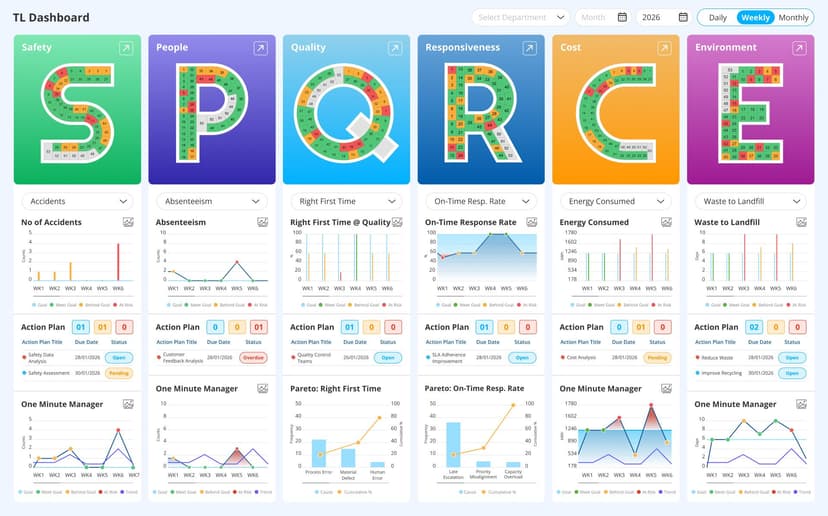
Dashboards display live OEE, throughput, cycle times, scrap rates, and delivery performance – fed through manual entry or integration with existing business systems. The operational shift is immediate:
- Deviations visible the moment they are logged – not at end of shift
- Team leaders act on structured data – not memory or manual tallies
- Issues escalated with context attached – not reconstructed after the fact
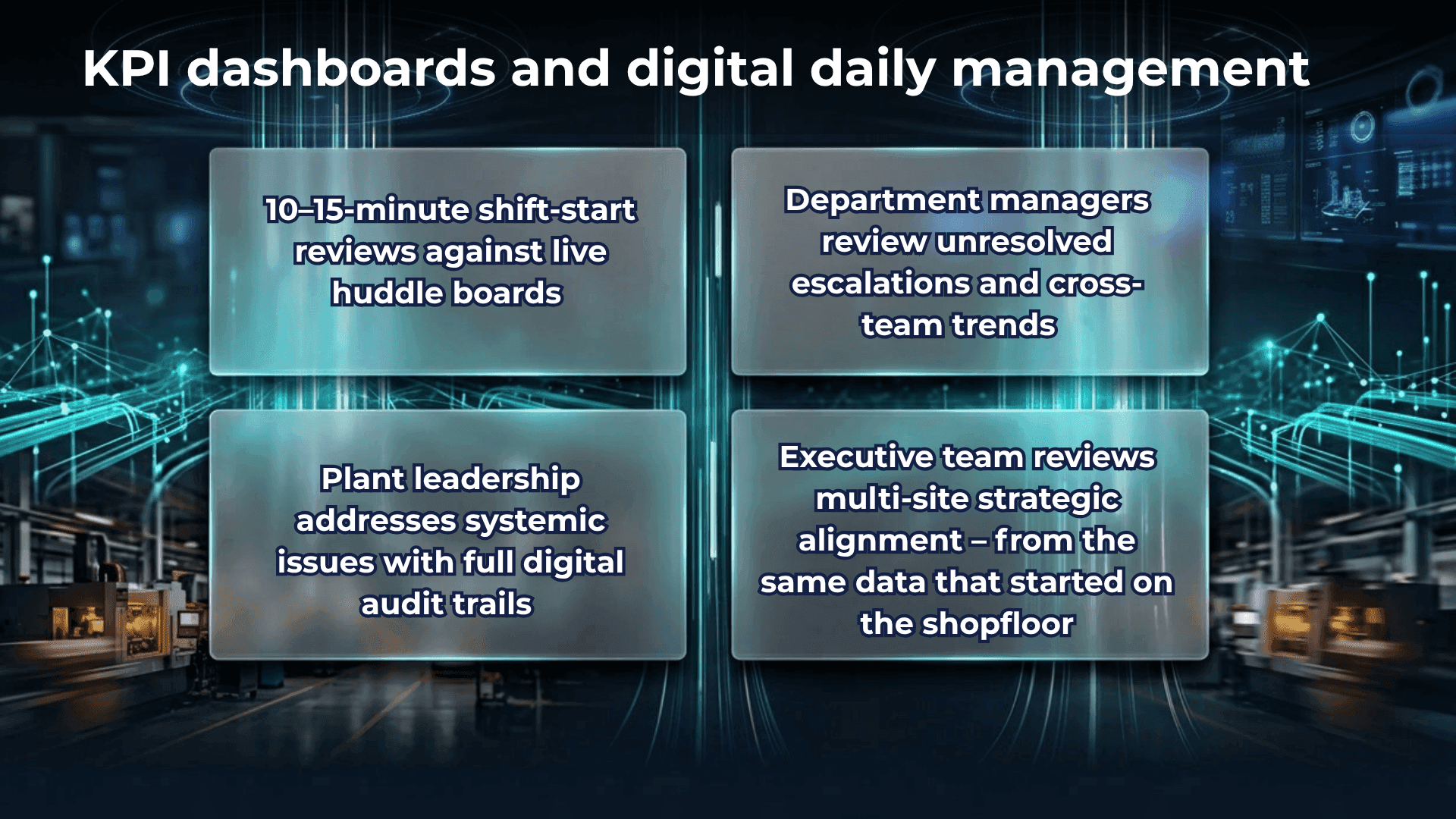
A digital tiered system designs how that data drives action at every level:
- Tier 1 – 10–15-minute shift-start reviews against live huddle boards
- Tier 2 – Department managers review unresolved escalations and cross-team trends
- Tier 3 – Plant leadership addresses systemic issues with full digital audit trails
- Tier 4 – Executive team reviews multi-site strategic alignment – from the same data that started on the shopfloor
Short Interval Control Board (SICB) takes this further – breaking shifts into two-to-four-hour intervals with structured reviews against target. Deviations are identified while output is still recoverable, not after the shift has closed.
Visual management and strategy deployment: The floor-to-boardroom connection
Digital transformation in manufacturing fails if it stops at the shopfloor.
Digital visual management replaces paper-based displays with always-on, automatically updated systems. When performance drops below target, alerts surface instantly – no manual input required. Cross-shift trend analysis identifies chronic issues that individual teams may not recognise as patterns.
Hoshin Kanri X-Matrix platforms take strategy deployment into real time:
- C-Suite sets priorities within digital X-Matrix platform
- Objectives cascade digitally to plant, department, and team level
- KPIs connect directly to live operational data
- Progress updates automatically – green, amber, red from actual performance
- Deviations trigger structured action cards with ownership and deadlines assigned
- C-Suite reviews a live dashboard – not a monthly compiled report
That floor-to-boardroom connection is what separates smart factory leaders achieving operational excellence in manufacturing from those still navigating the manufacturing productivity gap with static reports.
The barriers – and what actually solves them
The financial case for smart manufacturing is clear – the global market is estimated at £226–309bn in 2025 and growing toward £527bn–£1 trillion by the early 2030s.
The manufacturing productivity gap varies by market, but the direction of investment is consistent:
Across every market, the conclusion is the same – the manufacturing productivity gap is not closed by technology alone. It is closed by the management system that turns data into daily decisions.
The barriers to scale are consistently organisational, not technological:
- Change management – 30% of manufacturers cite resistance to change as the primary hurdle
- Pilot purgatory – success at one site rarely replicates without a standardised manufacturing performance management framework
- Data underutilisation – 44% of collected data not being used effectively is not a data problem, it is a management system problem
The tools that most reliably address these barriers are not the most complex. They are the most consistently applied:
- Digital Gemba boards – connect floor walks to digital action tracking so observations become owned actions
- Quad charts – give leaders a single-page summary of objectives, status, issues, and actions
- A3 problem-solving – structure root cause analysis so problems are genuinely resolved, not symptom-treated
How LTS Data Point powers smart manufacturing performance management
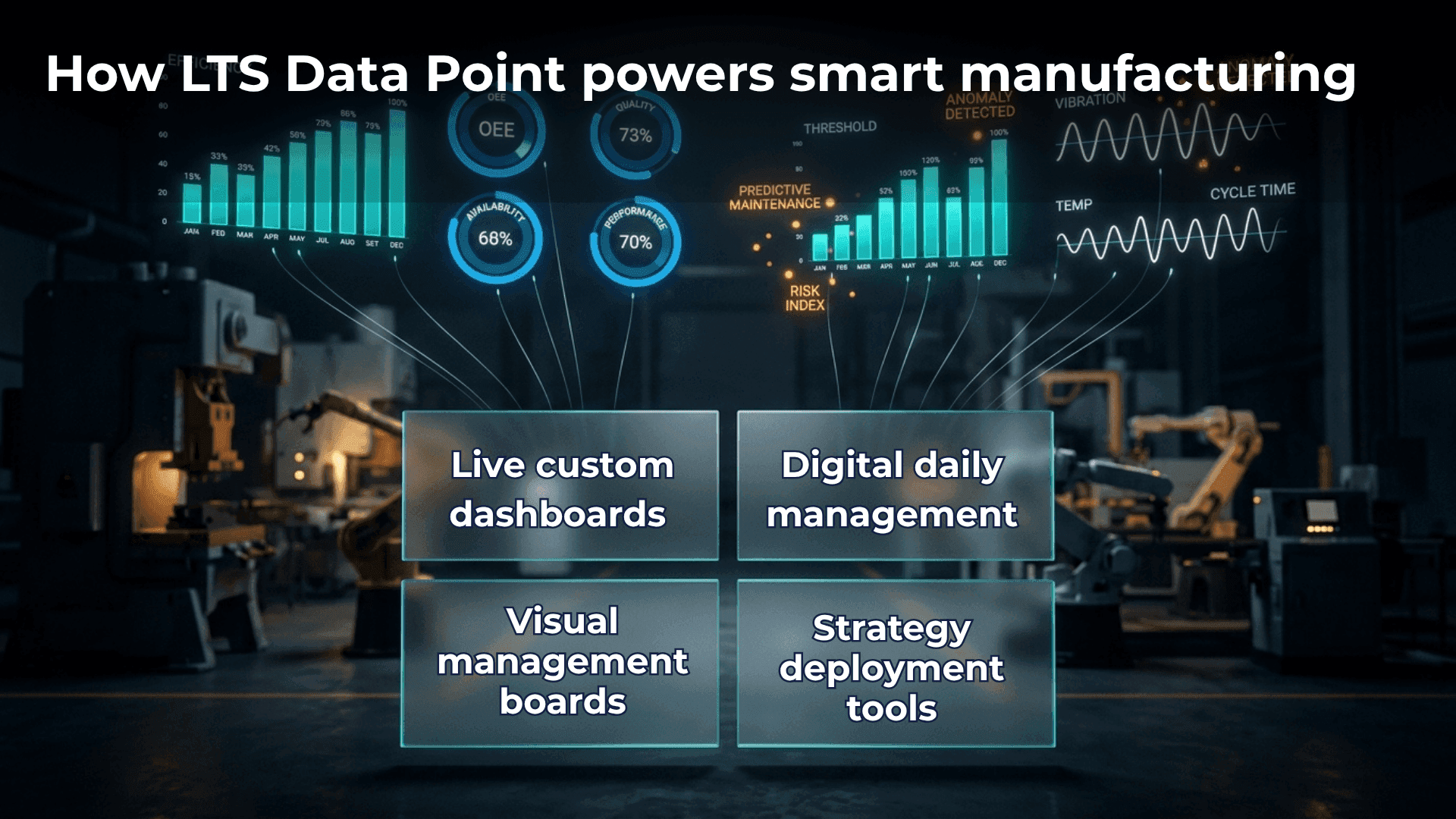
For C-suite leaders seeking to close the gap between smart manufacturing investment and measurable operational results, LTS Data Point provides the performance management layer that makes the difference – at site level and at scale.
Built specifically for lean manufacturing organisations navigating digital transformation in manufacturing, LTS Data Point delivers:
- Live custom KPI dashboards - role-specific views of OEE, SQDCP, for every level of the industry
- Digital daily management – structured tiered workflows from Tier 1 huddles to Tier 4 executive reviews, with automated escalation and full audit trails
- Visual management boards – auto-updating SQDCP displays replacing paper-based tracking across all shifts and sites
- Strategy deployment tools – cascade objectives from boardroom to shopfloor with a live feedback loop between strategic intent and operational performance
It sits at the intersection of connected manufacturing and smart manufacturing tools for continuous improvement – turning the performance data your systems already generate into daily management disciplines that drive sustained improvement.
Smart manufacturing is the active competitive battleground for manufacturing leaders in 2026. The combination of connected manufacturing disciplines with lean thinking delivers up to 40% cost savings – but only when real-time production data drives structured daily action, not just fills a dashboard. The barriers to scale are organisational, not technological. A standardised manufacturing performance management architecture – providing the factory performance visibility to act at every level – is what turns smart manufacturing investment into operational excellence in manufacturing.
Not sure where to start with smart manufacturing? An LTS Data Point expert can help you identify the right first step
FAQs
1. How long does it typically take to implement a smart manufacturing system?
Implementation timelines vary by scope. A digital daily management system can be live within weeks. Full enterprise-wide deployment across multiple sites typically takes 6-18 months depending on integration complexity and change management readiness.
2. What is the difference between a smart factory and a digital factory?
A digital factory uses technology to capture and store operational data. A smart factory goes further – it acts on that data in real time through connected systems, structured management processes, and closed-loop improvement cycles.
3. Do small and mid-sized manufacturers need smart manufacturing tool?
Yes. Smart manufacturing is not reserved for large enterprises. Many of the highest-impact tools – digital dashboards, tiered daily management, and visual performance boards – are scalable and deliver rapid returns regardless of site size.
4. Where should a manufacturer start with smart manufacturing?
Start with visibility. Before investing in automation or advanced technology, establish a live picture of current performance across safety, quality, cost, delivery, and people. That foundation determines where technology investment will deliver the most value.
5. What role does culture play in smart manufacturing success?
Culture is decisive. Technology surfaces the data – but people have to act on it consistently. Organisations that invest in change management and leadership engagement alongside technology consistently outperform those that treat smarter manufacturing as a purely technical project.
6. How does smart manufacturing support sustainability goals?
By making energy consumption, waste, and material usage visible at shift level, smart manufacturing gives operational teams the data to reduce environmental impact as part of daily improvement – not just in annual sustainability reporting.
7. Can smart manufacturing work across multiple sites?
Yes – and multi-site deployment is where the greatest strategic value is found. A standardised performance management architecture across sites enables benchmarking, shared learning, and consistent execution of strategic priorities at scale.
8. How do you measure ROI from smart manufacturing investment?
ROI should be measured against specific operational baselines – OEE improvement, scrap reduction, downtime frequency, and labour productivity – tracked over defined improvement cycles. Without a performance management system capturing those baselines, ROI measurement is guesswork.

Amer Jumah, Senior Lean Consultant
Amer is co-founder of Agile Solutions and a certified Six Sigma Black Belt, Lean Black Belt, and PMP, with over nine years of experience implementing Lean, Six Sigma, and Agile principles across diverse industries. He specialises in process optimisation, waste elimination, and delivering cost savings through organisational change.