Four Perspectives of the Balanced Scorecard: Master it for smarter strategy execution
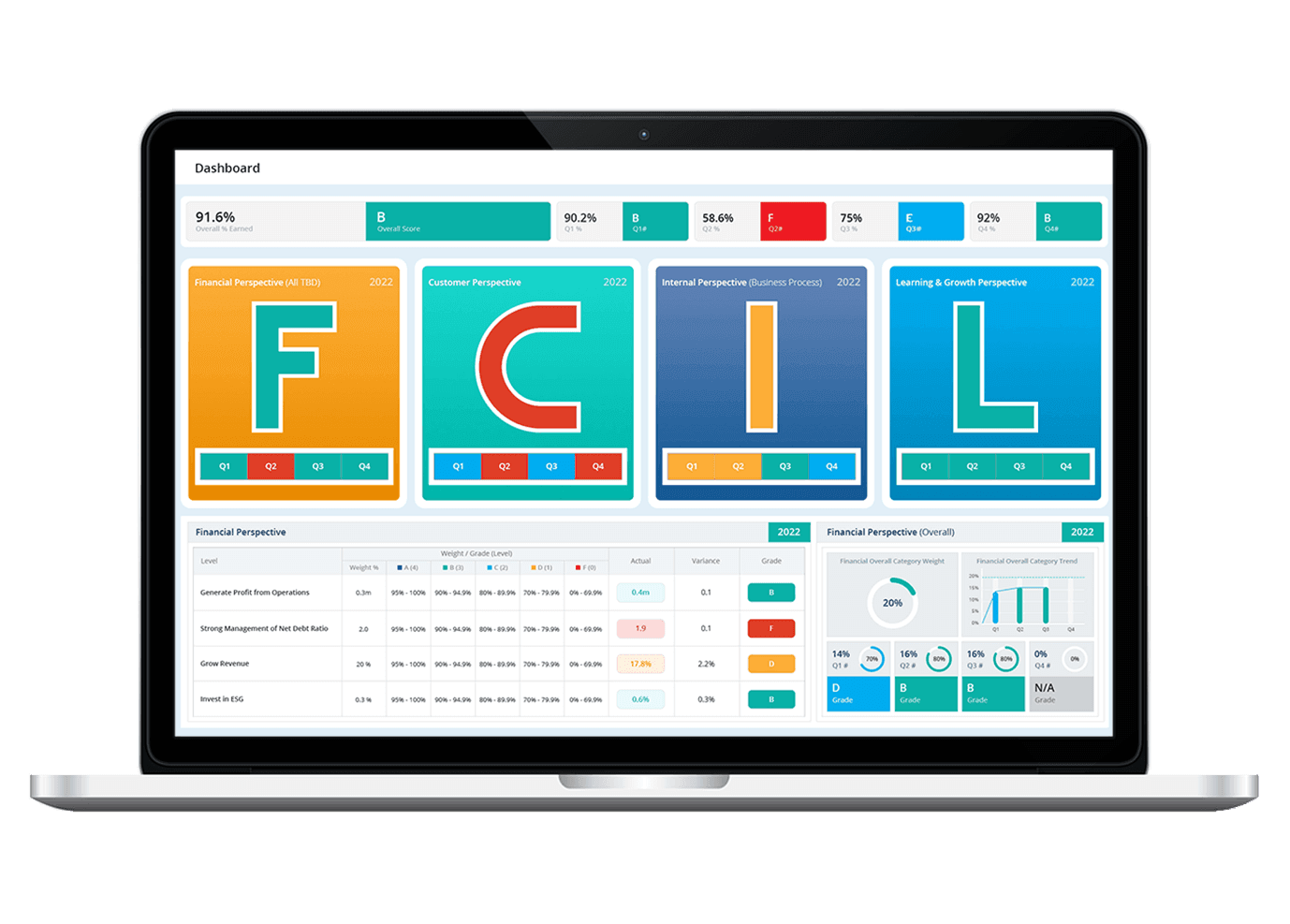
FCIL Balanced Scorecard integrates the four key perspectives: financial, customer, internal processes, and learning & growth metrics. This comprehensive framework empowers organisations to drive strategic alignment, monitor performance, and ensure continuous improvement across all areas.
Contents
- What are the Four Perspectives of Balanced Scorecard?
- Balanced Scorecard Four Perspectives Explained with Examples
- Understanding the role of perspectives in the Balanced Scorecard Framework
- Balanced Scorecard Perspectives: Cheat Sheet – 101
- What is a Strategy Map and How Do Perspectives Shape It?
- How Balanced Scorecard Perspectives Support Strategy Planning and Execution?
- Strategy map template: What is it and how to use it?
- KPI Examples for Each Balanced Scorecard Perspective
- How to choose the Right KPIs for Each Balanced Scorecard Perspective?
- How to measure the KPIs within the Balanced Scorecard perspective?
- What Next? Does Your Organisation Need a Balanced Scorecard?
- Signs your Balanced Scorecard perspectives need updating
- Driving Strategic Performance with Balanced Scorecard Perspectives and KPIs
- What is Strategic Performance and how to evaluate in the Four Perspectives?
- How can organisations effectively implement a Strategic Performance Management System?
- What are the benefits of using FCIL system to track Strategic Performance?
- Enhancing Organisational Performance with the Data Point Balanced Scorecard Software
Last updated on : May 8, 2026
What are the Four Perspectives of Balanced Scorecard?
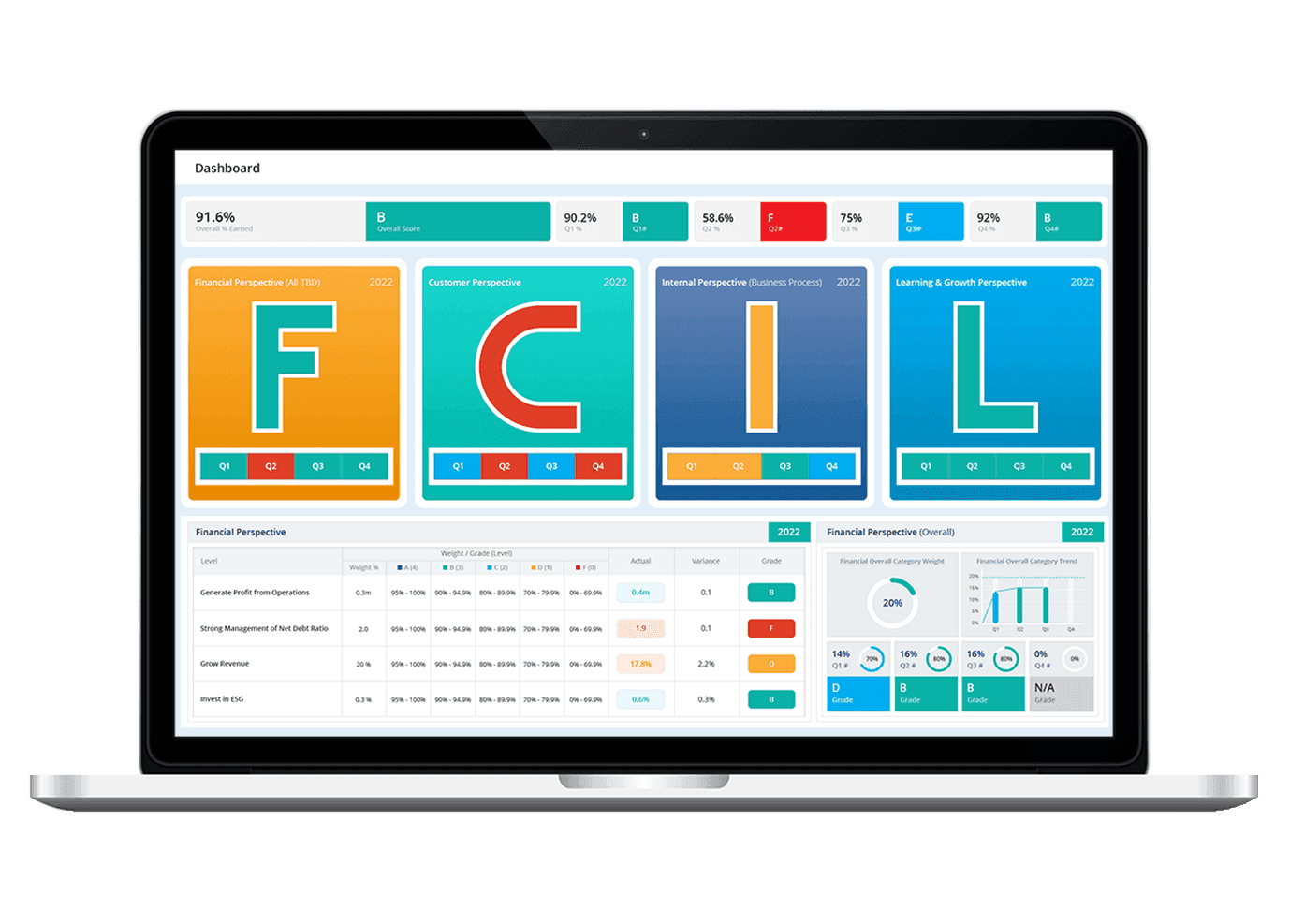
The balanced scorecard (BSC) is a strategic performance management tool that identifies and improves various internal business or organisational functions and their outcomes. It translates the mission and vision of organisations into measurable actions. The balanced scorecard is anchored on four perspectives: Finance, Customer, Internal Process, Learning & Growth. Analysing these perspectives will enable the top-level management to make meaningful decisions that shape the organisation's future.
Balanced Scorecard Four Perspectives Explained with Examples
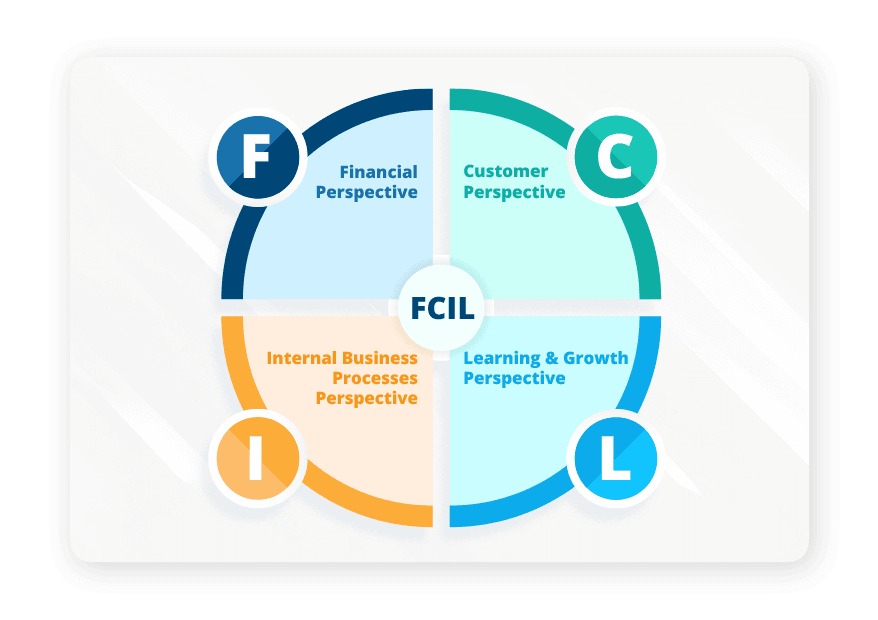
● Financial Perspective
This perspective includes any key objective that is related to an organisation's financial health and performance. Organisations should continually generate revenues and meets goals such as developing new revenue sources and improving profitability. Steps taken to achieve such goals are tracked and evaluated.
Example: Using the financial perspective of Balanced Scorecard a manufacturer tracked cost-reduction targets alongside revenue growth, ensuring profitability improved without sacrificing investment in innovation.
● Customer Perspective
The customer perspective in BSC monitors and analyses how the business entity provides value to its customers. It also determines the percentage of customer satisfaction with the company's products or services. Customer satisfaction indicates an organisation's success; how well a company treats its customers can affect its profitability.
Example: By applying the BSC customer perspective, a retailer measured satisfaction scores and aligned them with service improvement initiatives, which directly supported financial outcomes.
● Internal Business Processes Perspective
The internal processes of a company define how well it functions. An important aspect of this perspective is that it answers "What are we good at"? The answer to this question helps the organisation formulate marketing strategies and drive innovations that result in new and improved ways of meeting customers' needs.
Example: With the Internal Process Perspective a logistics company monitored delivery times as a key internal metric, improved efficiency, and balanced it with higher customer satisfaction and cost savings.
● Learning & Growth Perspective
A balanced scorecard's learning and growth perspective is the basis of any strategy. It focuses on an organisation's intangible assets, particularly the internal skills and capacities required to support value-creating internal processes. The learning and growth perspective is mainly concerned with the enterprise's human capital, information capital, and organisation capital.
Example: Using the learning and growth perspective of BSC, a healthcare provider focused on staff training and IT upgrades, creating capabilities that sustained better processes and long-term performance.
Create your Balanced Scorecard with FCIL Perspectives!
Experience the benefits of the FCIL Balanced Scorecard Board with a free trial.Understanding the role of perspectives in the Balanced Scorecard Framework
We have heard the term 'Balanced Scorecard' (BSC). What exactly does a balanced scorecard bring to an organisation. Let us have a look at what a balanced scorecard is, how it adds value to your business and whether your organisation should be using it.
In simple terms, a Balanced scorecard is a framework that organisations widely use to track and manage their strategies. It is anchored on the four perspectives: Finance, Customer, Internal Process, Learning & Growth. Organisations define their strategic objectives & outcomes, assign KPIs and monitor them regularly to get the desired results. These indicators will tell you whether you are on the right path in achieving the set strategic goals. Using a balanced scorecard, organisations can describe and measure strategies by continuously monitoring the actions initiated to improve the end results. Balanced scorecard, the strategic performance management system, has three components.
- It helps companies to set their strategic goals.
- It helps companies to define action plans that will deliver those strategic goals.
- It helps companies develop KPIs or metrics that will help them monitor the delivery of their strategic goals.
The origin of the balanced scorecard can be traced back to the early 1990s. It was Robert S Kaplan and David P Norton who developed a Balanced Scorecard model to help organisations analyse and measure performance using both financial and non-financial data. Kaplan and Norton outline the five foundational principles required for building Strategy-Focused Organisations:
- Translate the strategy to operational terms
- Align the organisation to the strategy
- Make the strategy everyone's everyday job
- Make strategy a continual process
- Mobilise change through robust and effective leadership.
A balanced scorecard enables an organisation's vision, mission, and strategy to be translated into quantifiable goals and action plans. For the following reasons, the Scorecard is described as "balanced":
- It maintains a balance between financial and non-financial success metrics.
- It balances internal staff and process requirements and external customer and shareholder demands.
- Compares and contrasts historical and current performance to determine improvement options.
- Finally, it balances the organisation's short- and long-term goals and objectives.
Balanced Scorecard Perspectives: Cheat Sheet – 101
While considering a balanced scorecard, you will be confronted with the following terms, Objectives, Measures, Initiatives and Action Items. Let us have a look at what these terms mean regarding organisational strategic planning and management process.
- Objectives - They are high-level organisational goals; that is what the organisation is planning to achieve strategically. An example would be: “To increase revenue by 47% by the end of this year”.
- Measures - Measures help organisations understand whether they are achieving their pre-set objectives strategically. For organisations to achieve the objectives, the measures can be altered or changed; in other words, objectives remain the same, whereas measures might change.
- Initiatives - They are action programs that need to be developed to achieve organisational objectives. Initiatives are often referred to as “actions,” “projects,” or “activities.
- Action Items - Technically, action items are not part of the BSC but belong to the management process as a whole. Action items rise from review meetings and are allocated to an individual or a team, and they help teams achieve initiatives in an organised and timely manner.
To sum it up, An organisation will have a high-level goal in their mind, that is, objective; measure denotes how you are going to achieve that objective whether they are achieving it or not. Initiatives answer the question, “ What actions should be taken to achieve or accomplish the objectives. And lastly, action items help delegate jobs that help complete the initiatives.
Note: There can be multiple initiatives that are focused on improving measures and achieving objectives. If those initiatives are not helping you improve the focus areas, then you may have to rethink the overall strategy.
An ideal case of a Balanced Scorecard will have organisations set four perspectives; for each perspective, there will be 3-4 objectives, for each objective 2-4 measures and for each measure, 4-6 initiatives. Once the organisation identifies what they need to achieve and how they are going to achieve it, the Balanced scorecard is ready to be implemented.
What is a Strategy Map and How Do Perspectives Shape It?
A strategy map is a core component of the Balanced Scorecard framework that visually defines how organisational goals are interconnected and how they are planned to meet their future goals.
It translates an organisation’s strategy into a clear, visual story, showing how objectives across different areas connect to drive long-term success. Unlike generic diagrams, a strategy map aligns directly with the four BSC perspectives—Financial, Customer, Internal Process, and Learning & Growth—and places them in a cause-and-effect sequence. At a glance, strategy maps can tell both the leadership and employees how they are performing and how well the goals are being achieved.
How Balanced Scorecard Perspectives Support Strategy Planning and Execution?
Strategic planning defines the organisation’s vision, outlines initiatives, allocates resources, and aligns teams to move towards common objectives. Research shows that over 55% of strategies fail during implementation, highlighting the need for a clear bridge between strategy design and execution. But executing the oragnisational strategy with the help of Balanced Scorecard’s perspectives aids better achivement of results. Here is how:
- The Balanced Scorecard provides a structured way to translate strategy into action by connecting long-term vision with measurable goals across financial, customer, internal process, and learning and growth perspectives.
- Communicating strategy clearly to employees ensures they understand their role in achieving objectives and how their contributions fit into the broader perspectives of organisational success.
- Once the strategy is communicated, planned actions must be regularly tracked and monitored through scorecard measures to ensure progress stays aligned with targets.
- Organisations that adopt this approach are better positioned to close the execution gap, as every initiative can be linked back to strategic priorities and continuously adjusted if needed.
Strategy map template: What is it and how to use it?
A strategy map template is typically designed in formats such as Excel, PowerPoint, or diagram sheets, where strategic objectives are listed under the four Balanced Scorecard perspectives. These objectives are then connected with arrows to show cause-and-effect relationships, helping teams understand how one goal drives another. Organisations can fill in the template by writing objectives in the relevant perspective boxes and linking them to create a clear roadmap.
Alongside these manual formats, many organisations now use digital strategy map software or dashboard-based templates, which allow real-time updates, easy collaboration, and automatic alignment with performance data, making strategy execution more transparent and trackable.
KPI Examples for Each Balanced Scorecard Perspective
As mentioned earlier, there are four perspectives of balanced scorecards: finance, Customer, process, and Learning & Growth. These perspectives include a mix of financial and non-financial indicators that aid in the growth of a business. Organisations assign key performance indicators (KPIs) to these perspectives and regularly track them to see where they are in their journey to achieve strategic goals. Finance, Customer, Process, and Learning & Growth are all interconnected in a loop. They work together to generate a result that aligns with an organisation's goals and strategy.
🔹Financial Key Performance Indicators (KPIs) Examples
Financial KPIs reflect an organisation's financial outcomes and performance and also give information on expenses, profit, sales, and cash flow, in order to optimise and meet the organisation's financial goals and objectives. It is important to keep track of financial KPIs as it will help identify and remove monetary bottlenecks and maintain a healthy condition concerning the financial aspect of the business.
- Gross Profit Margin
- Operating Expense Ratio
- Operating Profit Margin
- Net Profit Margin
- Working Capital
- Accounts Payable Turnover
- Accounts Receivable Turnover
- Cash Conversion Cycle
- Vendor Payment Error Rate
- Return on Assets
- Budget Variance
- Return on Equity
- Revenues/total assets
- Revenues from new products or business operations
- Revenues/employee
- Profits/total assets
- Profits from new products or business operations
- Return on Investment
- Cash flow
- Return on investment
- Profit as % of sales
- Compound Growth Rate
- Dividends
- Market Value
- Share Price
🔹Customer Key Performance Indicators (KPIs) Examples
Satisfied customers = Successful Business. Customers are the backbone of every business, as the relationship with its customers directly affects the business's success. Customer KPIs are an excellent indicator of what is going well in a company. Customer KPIs measure how efficient the respective team is handling various service requests relating to customers. It provides you with the necessary information about your team's grey areas and upgrades plans and training sessions to meet customer service benchmarks.
- Customer Satisfaction Score (CSAT)
- Cash conversion cycle (CCC)
- Net Promoter Score (NPS)
- Customer Effort Score (CES)
- Customer Retention Rate (CRR)
- Customer Response Rate
- Average First Response Time
- Average Resolution Time
- Average First Contact Resolution
- Average Wait Time
- Customer Lifetime Value
- Customer Lifetime Cost
- Customer Lifetime Profit
- Annual sales/customers
- Average customer size
- Customer rating
- Average time spent on customer relations
- Customer-loyalty index
- Market Share
- No.of Customer Complaints
- Customers Lost
- Annual sales per customer
- Number of proposals made
- Sales volume
- Number of visits to customers
🔹Internal Process Key Performance Indicators (KPIs) Examples
Internal Process KPIs evaluate the internal organisational goals and strategies that are put in place to deliver finance and customer-related objectives. By monitoring and analysing process KPIs, you will be able to understand what needs to be done to improve performance.
- No. of New Innovations
- Earned Value Management (EVM)
- Cycle Time to Fulfil and Order
- Process Downtime
- Quality
- Maximise Labour Effectiveness
- Availability
- Efficiency
- Capacity
- Productivity
- Profitability
- Competitiveness
- On-Time Delivery
- Administrative expense/total revenues
- Administrative expense/customer
- Average Lead Time
- Contracts filed without error
- Lead time, product development
- Lead time, from order to delivery
- Capacity utilisation rate (CUR)
- Earned value (EV) metric
- Project schedule variance (PSV)
- Order fulfilment cycle time (OFCT)
- Delivery in full, on time (DIFOT) rate
- Project cost variance (PCV)
🔹Learning & Growth Key Performance Indicators (KPIs) Examples
Choosing the right KPIs is important when designing learning and development programs and evaluating their effectiveness. KPIs aligned with organisational strategies and initiatives will help you drive better business results. Learning & Growth (KPIs) are used to assess the impact of organisational training and development programs on the employees. The KPIs measure whether employees are engaging and benefiting from the initiatives. A well-run program will be beneficial to both the employees and the organisation.
- Employee participation
- Training hours per employee
- Average years of service
- Absenteeism
- Employee suggestions
- Employee satisfaction index
- Employee’s view(empowerment index)(No)
- The ratio of new products
- Non-product-related expense/customer/year
- Value-added per employee
- Diversity rate
- Work-Life Balance
- Employee productivity
- Personal goal achievement
- Leadership development
- Knowledge management
- R&D expense/total expenses
- R&D resources/total resources
- Investment in training/customers
- Investment in new product support and training
- Ethics violations
- Cross-functional assignments
- Problem-solving teams
- Learning rate
- Suggested improvements/employee
Boost Your Strategy with FCIL and the Four Perspectives
Align strategy and operations through Financial, Customer, Internal, and Learning perspectives with the FCIL Balanced Scorecard.How to choose the Right KPIs for Each Balanced Scorecard Perspective?
Selecting KPIs is about ensuring that what you track truly represents progress towards strategic objectives. A good KPI is specific, measurable, and aligned with long-term goals rather than short-term activity.
Key points for selecting KPIs:
- Link to strategic goals – Each KPI should clearly support one of the four Balanced Scorecard perspectives: Financial, Customer, Internal Process, or Learning & Growth.
- Focus on impact, not volume – Avoid tracking too many metrics; select those that show progress on what matters most.
- Define outcomes, not just outputs – For example, instead of only measuring training hours (output), track improvement in skill levels or employee performance (outcome).
- Ensure clarity and relevance – Chosen KPIs must be easy to understand, relevant to the teams using them, and actionable.
- Balance leading and lagging indicators – Combine predictive KPIs (e.g., customer satisfaction trends) with outcome-based ones (e.g., revenue growth).
This approach ensures that KPIs not only reflect performance but also drive decisions and improvements in the right areas.
How to measure the KPIs within the Balanced Scorecard perspective?
Once the right KPIs are selected, the next step is to measure them consistently and meaningfully. Measurement should be based on reliable data sources and presented in a way that supports real-time decision-making.
Ways to measure KPIs effectively:
- Set clear definitions – Establish what each KPI measures, the unit, and the formula used (e.g., % customer retention = retained customers ÷ total customers × 100).
- Assign data sources – Define where the information comes from, whether financial systems, CRM tools, HR platforms, or production databases.
- Establish baselines and targets – Compare current results against past performance and future goals to track progress.
- Use dashboards or scorecard software – Digital tools provide real-time updates, trend analysis, and visibility across departments.
- Track frequency of measurement – Some KPIs need daily monitoring (e.g., production efficiency), while others may be monthly or quarterly (e.g., employee turnover).
By combining accurate definitions, reliable data, and digital monitoring, organisations can measure KPIs in a way that ensures accountability and supports strategic alignment.
Boost Your Strategy with effective KPI Planning
What Next? Does Your Organisation Need a Balanced Scorecard?
There is nothing like "Whether your organisation needs a balanced scorecard or not?". Irrespective of which industry or what kind of business you run, all can benefit from a balanced scorecard framework. The relevant question that needs to be asked is which version of the balanced scorecard should you be using? Is it the paper-based, excel, PowerPoint or digital version?
Usually, organisations start their strategic planning and management process with a paper-based, excel spreadsheet or PowerPoint. But as the organisation grows, the previously mentioned solutions might restrict the scope of a balanced scorecard. Be it paper-based, excel spreadsheet or PowerPoint, they are not appropriate for the long term strategic planning and execution process. Without the collaboration of real-time data and retrieval of automated reports, the process becomes highly time-consuming and limits the entire organisational performance view. These traditional templated of Balanced Scorecard lacked features such as:
- Real-time data visibility
- Version control
- Data security
- Centralised data
- Historical data analysis
- Global access
- Flexibility
- Advanced search, filter and sort options
- Data Analytics and reports
Signs your Balanced Scorecard perspectives need updating
Below given are a few signs that your organisation is outgrowing the traditional balanced scorecard system:
- Your current Balanced Scorecard is unable to scale up as the organisation grows, i.e. multiple spreadsheets with endless tabs and no proper understanding of how the objectives, measures or initiatives align with your strategic goals and plans.
- Lacks online collaboration and limits the ability to assign access levels. No version control; you never know who made changes and will not be able to identify the latest version.
- Delays in reporting. Accurate reporting is vital in making data-driven decisions. Traditional systems provide no data visualisation until it is pulled into a PowerPoint or word format.
- No historical data is available to compare the success rate in strategy planning and management process as a whole.
When the organisation grows, and more people are involved in the strategic planning and management process, it becomes difficult to manage all the data in a traditional template. Without proper planning and coordination, a complex strategic plan tends to fail in the long run. The chances are high that the organisation will confront various measures and KPIs that feed into each other. A balanced scorecard software hierarchically organises these strategy elements and gives you a clearer understanding of the relationship between your measures and goals. Successful strategy implementation and execution result from the combined effort of both bottom and top-level management. Hence it is crucial to have a solution that combines both and gives a better outcome. A balanced scorecard software visualises the organisation's journey and helps individuals understand the importance of their performance or inputs in achieving the organisation's strategic goals. The effort put forth by employees is measured and valued. Using Digital Balanced Scorecard, the organisation can stay up-to-date, track relevant information, improve efficiency, and gain visibility over each perspective, their objectives, measures and initiatives throughout the strategic planning and execution process.
Driving Strategic Performance with Balanced Scorecard Perspectives and KPIs
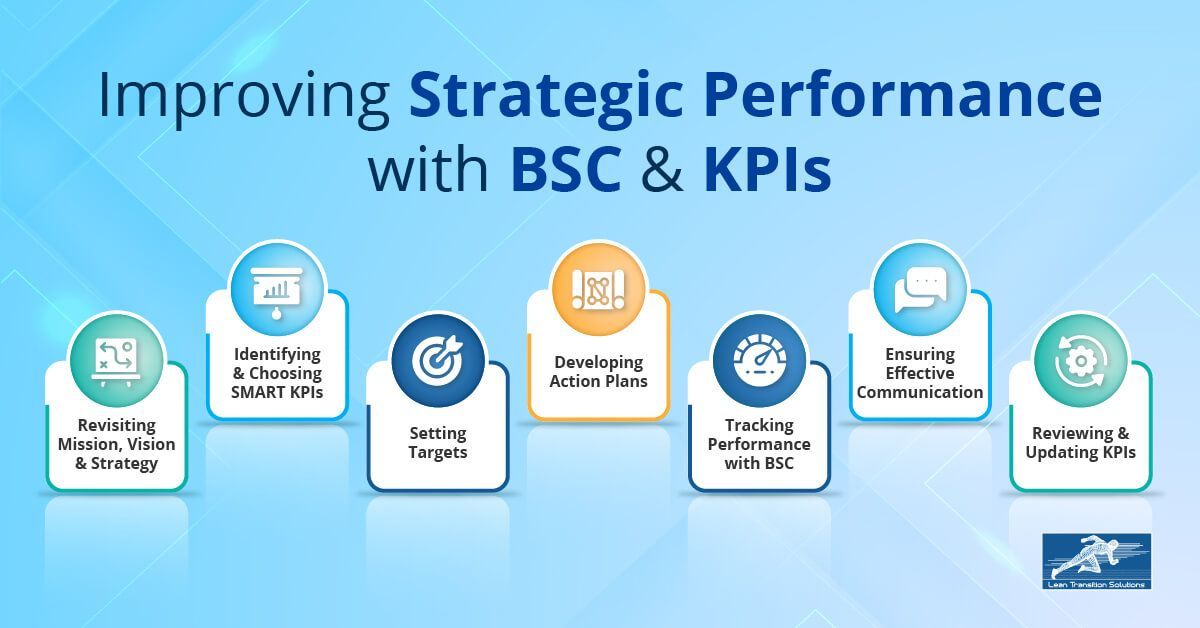
Improving strategic performance with Balanced Scorecard and KPIs requires a structured approach that aligns your organisation's vision, mission, and strategy with your actions and outcomes.
Revisiting Mission, Vision and Strategy
Take time to review your organisation's vision, mission, and strategy. This will help you determine the critical success factors for achieving your goals.
Identifying and Choosing SMART KPIs
Identify the key performance indicators (KPIs) relevant to your organisation's critical success factors. Choose specific, measurable, achievable, relevant, and time-bound KPIs.
Setting Targets
Set targets for each KPI aligned with your overall goals and objectives. These targets should be challenging but achievable.
Developing Action Plans
Create initiatives or action plans to enhance performance on each KPI. These strategies must be tailored to bridge current and target performance gaps.
Tracking Performance with BSC
Monitor progress towards your targets and adjust your initiatives as needed. Use the Balanced Scorecard framework to track performance across Finance, Customer, Internal Process, and Learning & Growth perspectives.
Ensuring Effective Communication
Continuously communicate your progress to stakeholders, including employees, customers, and investors. This will help build support for your strategic performance improvement approach.
Reviewing and Updating KPIs
Regularly review and update your KPIs to ensure they remain relevant to your organisation's goals and objectives.
Boost your Strategic Performance with Balanced Scorecard
Book a Demo to learn more on the balanced scorecard benefitsHow can you create a meeting cadence that fits your business?
Annual Strategic Planning Update
Annual strategic planning is a process that organisations undertake to assess their current performance, plan for the future, and set goals for the upcoming year. The process involves assessing the organisation’s current state, analysing the external environment, and setting goals that should be achieved in the upcoming year. Strategic plans are developed for 3 to 5 years and are reviewed. These plans may aim for a long-term goal, often broken down into short-term goals. Quarterly strategic reviews are a part of these strategic plans and implementation where necessary updates and changes are made to the ultimate strategic plan.
Strategic meeting
Strategic meetings bring together key stakeholders to determine a plan of action for the upcoming year. The agenda includes the following:
- Discussing the organisation's long-term vision.
- Analysing our current market position and trends.
- Developing strategies to meet customers' needs.
Operational Meetings
Operational meetings are an essential part of any business. They provide an opportunity to discuss the progress of current projects, brainstorm solutions to everyday challenges, and review the organisation's overall performance. It is important to ensure that all members of the organisation who need to be involved in operational meetings are present and that the meetings are productive. Weekly operational meetings or huddles ensure the targeted short-term goals are met.
How do you Cascade your Organisational Strategy to different Tiers?
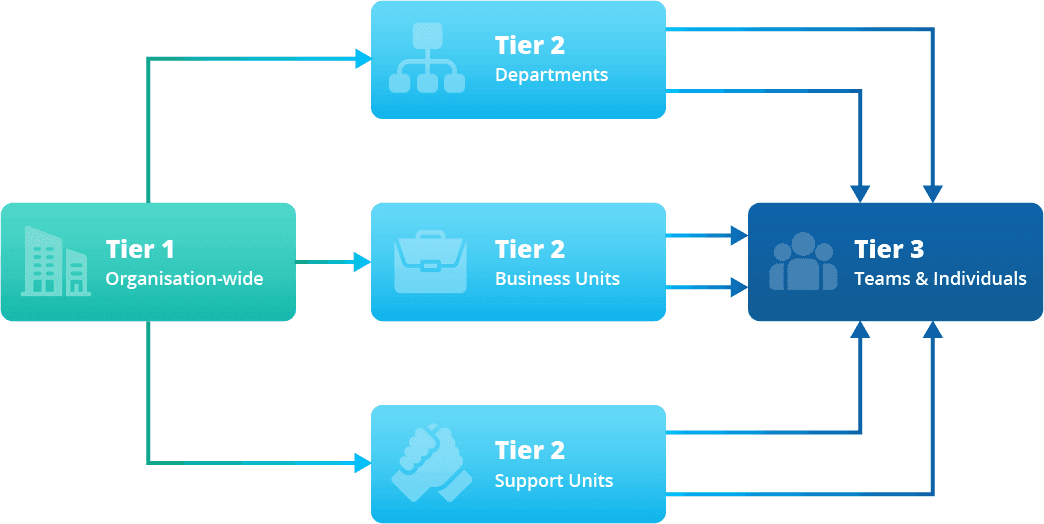
Organisational strategy can be aligned by cascading to different tiers within the organisation. Cascading involves communicating the strategic plan from the organisational level to the departmental level and then to the individual level within the organisation.
Organisational level ( Tier 1 )
The strategy is defined in a top-level strategy map and scorecard, which has a complex idea about the concepts within the vision and mission of the organisation. The complex concept is then broken down into objectives at the departmental level.
Departmental level ( Tier 2 )
The departmental level consists of departments, business units and other support units. When strategy for business is aligned with objectives, opinions and work progress within the departmental levels, the teams work together to achieve the common goal and focus efforts to reach those.
Teams and Individual level (Tier 3)
These are personally aligned objectives defined by job descriptions and work assignments. It helps to align goals and objectives at the individual level for each organisation member. It creates a sense of ownership and accountability among members of an organisation.
How to connect Hoshin Kanri X matrix with FCIL system?
The Hoshin Kanri X matrix in Balanced Scorecard is a valuable tool for strategic planning that aims to communicate strategic goals throughout an organisation and implement them effectively. This matrix is designed to align long-term needs with strategic initiatives and identify improvement areas. The name of this framework comes from the X that divides the matrix into four parts: long-term goals, annual objectives, top-level priorities, and metrics to improve. By utilising the X matrix, organisations can establish a clear roadmap for achieving their strategic objectives while effectively allocating their resources.
How does FCIL framework drive better Strategic Planning and Strategy Execution?
The Balanced Scorecard provides organisations with a comprehensive view of their performance, allowing them to measure progress and identify areas for improvement. The Balanced Scorecard helps organisations achieve greater alignment, improved communication, and better performance. In the following ways, a Balanced Scorecard system is useful for better Strategic Planning and Strategy Execution:
- Achieve greater alignment between strategy and operations by setting objectives and strategies consistent with the organisation’s mission and vision.
- Improve communication and understanding of the organisation’s objectives and strategies among all stakeholders.
- Monitor performance in multiple areas, including financial, customer, process, and learning and growth.
- Identify areas for improvement and allocate resources more efficiently.
- Utilise performance data to inform decisions, improve processes, and allocate resources.
- Establish clear goals and objectives for each team and individual.
- Track progress, identify trends, and make mid-course corrections.
- Analyse data and trends to create predictions and forecasts.
What is Strategic Performance and how to evaluate in the Four Perspectives?
Strategic performance refers to how an organisation measures its success in achieving its goals and objectives. This involves analysing key activities and processes to determine their performance against predetermined targets. By doing so, organisations can identify improvement areas and make necessary changes to reach their desired outcomes. It's essential to continuously monitor and review Key Performance Indicators (KPIs) to identify the gaps in strategic performance. It helps organisations to make the necessary adjustments to achieve their goals more effectively.
How can organisations effectively implement a Strategic Performance Management System?
Organisations must adopt a Strategic Performance Management System to ensure long-term success. Strategic performance management is a systematic approach to managing an organisation by setting and tracking goals and objectives. By establishing clear goals, organisations can measure their activities' progress, identify improvement areas, and develop strategies to achieve their desired outcomes.To effectively implement a strategic performance management system, organisations need to take the following steps:
- Establish Clear Goals and Objectives - Organisations need to have a well-defined set of goals and objectives that they can use to guide their performance management efforts. Goals should be Specific, Measurable, Achievable, Realistic, and Time-bound.
- Assign Roles and Responsibilities - Assigning roles and responsibilities to the right people is essential for successfully implementing the strategic performance management system. Once roles and responsibilities have been established, organisations should provide regular training and support to ensure everyone is working towards the same goals.
- Monitoring Performance - Organisations need to regularly monitor their performance to ensure that the strategic performance management system is working effectively. This includes tracking key performance indicators, such as employee engagement, customer satisfaction, and financial performance.
- Implement Continuous Improvement - Once the performance is monitored, organisations should look for opportunities to improve their performance. This could include introducing new processes and technologies or changing existing ones.
- Evaluate Results - Finally, organisations need to review the results of their performance management system to determine if it is meeting their goals. This could include looking at the overall performance of the organisation, as well as the performance of individual employees.
What are the benefits of using FCIL system to track Strategic Performance?
Tracking strategic performance is crucial for the success of any organisation. Balanced Scorecard (BSC) is an effective tool to facilitate a holistic approach to performance measurement by considering multiple perspectives, such as financial, customer, internal processes, and learning and growth. The BSC offers several benefits, including enhanced communication, strategy alignment, improved decision-making, and increased accountability and transparency. Here are some of the benefits of using BSC to track strategic performance:
- Alignment of Goals - BSC helps align the organisation's goals with its strategy.
- Clarity of Vision - BSC provides a clear vision of the organisation's strategy, which helps decision-making.
- Measurement of Progress - BSC enables the organisation to measure its progress towards achieving its goals.
- Communication of Strategy - BSC helps communicate the strategy to all stakeholders, including employees, customers, and investors.
- Continuous Improvement - BSC facilitates continuous improvement by identifying areas that need improvement and monitoring progress towards achieving the desired outcomes.
How to incorporate KPIs into your Strategic Performance Framework?
KPIs are an effective way to monitor progress and measure success when you seek to improve strategic performance. By integrating KPIs into your strategic performance framework, you'll better understand how your organisation is performing and equipped to achieve your goals.
- Start with Precise Objectives - You must know what you want to achieve to choose KPIs. Define specific goals for your organisation or department.
- Select Relevant KPIs - Once you've established your objectives, choose KPIs aligned with your goals. Ensure they are measurable and provide meaningful insights into your performance.
- Establish Targets and Benchmarks - Set targets for each KPI and establish benchmarks for comparison. This will help you track progress and determine whether you're on track to meet your goals.
- Monitor and Analyse Performance - Regularly monitor your KPIs and analyse the data to identify trends and areas for improvement. Use this information to make informed decisions and adjust your strategy as needed.
How can you implement KPIs for Organisational Success?
Key Performance Indicators (KPIs) can be a powerful tool for organisations to measure their performance against their goals. KPIs are measurable values that track the performance of the organisation over a period of time. By tracking KPIs, organisations can identify areas of strength and areas that need improvement to ensure success. KPIs can provide valuable insights into the performance of an organisation. For example, they can measure customer satisfaction, revenue growth, operational efficiency, employee engagement, and more. By tracking KPIs, organisations can measure their progress and make informed decisions about improving performance.
Organisations can use KPIs to benchmark their performance against competitors, set goals for improvement, and monitor progress. They can also use KPIs to evaluate the effectiveness of certain initiatives, such as marketing campaigns or product launches. By tracking KPIs, organisations can identify areas to make changes and improvements to achieve tremendous success.
KPIs can also be used to motivate employees and help them stay focused on the organisation’s goals. When employees have clear goals and KPIs to track, they have a greater sense of accountability and are more likely to put in the effort to reach those goals.
By tracking KPIs and using them to measure performance and set goals, organisations can ensure that they stay on track and make the necessary changes to succeed.
What is a RAG Measure Report, and how can it help Strategic Performance?
RAG—or red, amber, green—statuses are KPI traffic lights. This report can be quickly developed using a balanced scorecard. When a red status is shown, it indicates an issue or problem that requires immediate attention. On the other hand, an amber or yellow status signals caution and suggests potential issues that must be addressed. Finally, a green status means that everything is proceeding smoothly and that progress is being made as planned. A RAG measure report is used to analyse areas lacking performance. The report identifies all Key Performance Indicators (KPIs) with a red or amber-coloured indication. This allows teams to identify and refocus their efforts on areas where they are underperforming. By focusing on these areas, teams can make the necessary changes to improve their overall performance and achieve their goals.
What are the challenges faced by organisations to improve Strategic Performance?
Organisations face many challenges to improve their strategic performance. A rapidly changing external environment is one of the most prominent challenges businesses face. Organisations must adjust their strategies as the market changes to keep up with the competition. This can be difficult for organisations, especially those with limited resources.
Many organisations also face the challenge of continually monitoring their strategies. The data and information about the performance of an organisation and its competitors are essential to this process. It also requires organisations to be able to interpret this data and make informed decisions about the most effective strategies to pursue.
Organisations must also be able to implement their strategies effectively. Coordinating various departments and functions is a complex process. It also requires organisations to have the right personnel and resources to implement the strategy effectively. Finally, organisations must also be able to measure the success of their strategies. The impact of a strategy on an organisation's performance can often take time to measure accurately. Organisations need to identify areas of improvement and adjust their strategies accordingly to overcome any challenges they face.
Enhancing Organisational Performance with the Data Point Balanced Scorecard Software
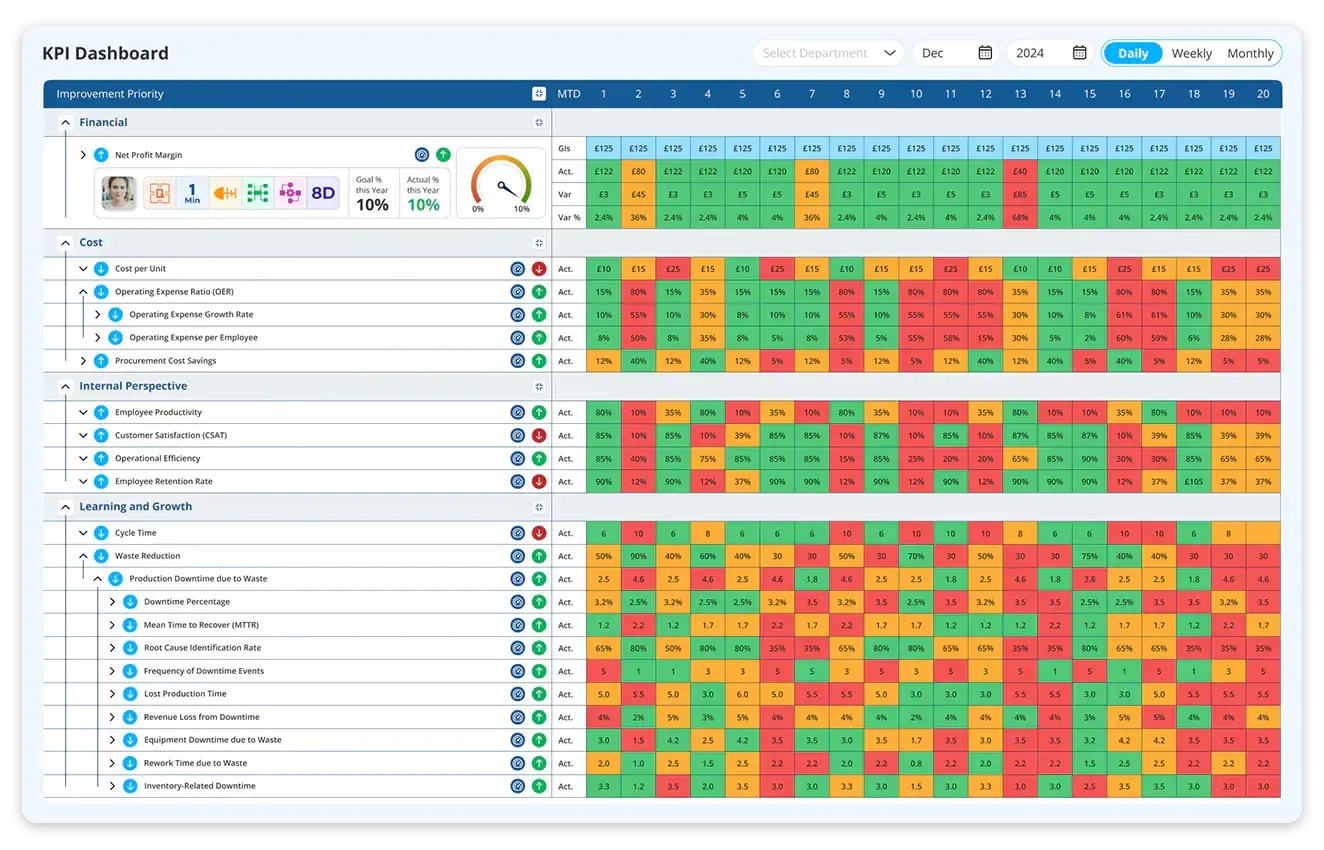
The Data Point Balanced Scorecard is a strategic management tool designed to help organisations measure and manage their performance effectively. It provides a comprehensive view of an organisation's performance by tracking key data points across four perspectives: Financial, Customer, Internal Processes, and Learning & Growth. By integrating these diverse metrics, the Data Point Balanced Scorecard enables organisations to align their activities with their strategic goals, identify areas for improvement, and make informed decisions that drive success. This holistic approach ensures that all aspects of the business are considered, promoting balanced growth and long-term sustainability.
Your questions, answered!
Which is the best modern software to manage the four perspectives of a Balanced Scorecard?
Is Data Point Balanced Scorecard software customisable?
How does Data Point differ from traditional Balanced Scorecard methods?
Can small and medium-sized businesses use Data Point Balanced Scorecard software?
Can a Balanced Scorecard have more than four perspectives?
What is the difference between Balanced Scorecard and KPIs?
Who should use the Balanced Scorecard four perspectives?
How does the FCIL Balanced Scorecard improve organisational focus?
How does the FCIL Balanced Scorecard measure learning and growth?
What makes the FCIL Balanced Scorecard different from traditional performance measurement tools?
How can the FCIL Balanced Scorecard be customised for different industries?
Four Perspectives of the Balanced Scorecard: Master it for smarter strategy execution
Get a Demo