AI for Industrial Performance: What Different Sectors Are Learning About Lean Operations and Intelligence and the Gap No Tool Has Closed Yet
Last updated on : June 11, 2026
AI for industrial performance is no longer an option. From the 78% AI adoption just a year ago to 88% this year, AI efficiency has dramatically risen up.
But the thing is, diving in deep, this AI adoption varies greatly across industries.
For instance, 90% of technology firms have adopted AI, which is the highest of any sector. While 12% of companies in healthcare, information services, and manufacturing adopted AI, only 4% of firms in construction and retail have followed this path.
Why this huge variation?
Because AI does not know your industry. You do.
See how LTS Data Point gives your team the operational foundation AI needs to deliver
Every industry is different and so is the AI opportunity
Despite 88% AI adoption in specific industries, the success rate is still very low – around 6%.
What did the 6% do differently?
It's simple. They sat and noted down what their problems were before implementing AI.
Operational industries such as manufacturing, energy, pharmaceuticals, and healthcare are not slow adopters. They are the lean AI adopters — the careful ones. AI in lean manufacturing does not change that. One wrong signal still means a production loss, a compliance failure, or a safety incident.
What AI actually looks like across different sectors
The operational pressure looks very different in different sectors. But the question before implementing AI is same across all the industries:
What problem are you solving, and what does a wrong signal cost you here?
Pharma and Biotech
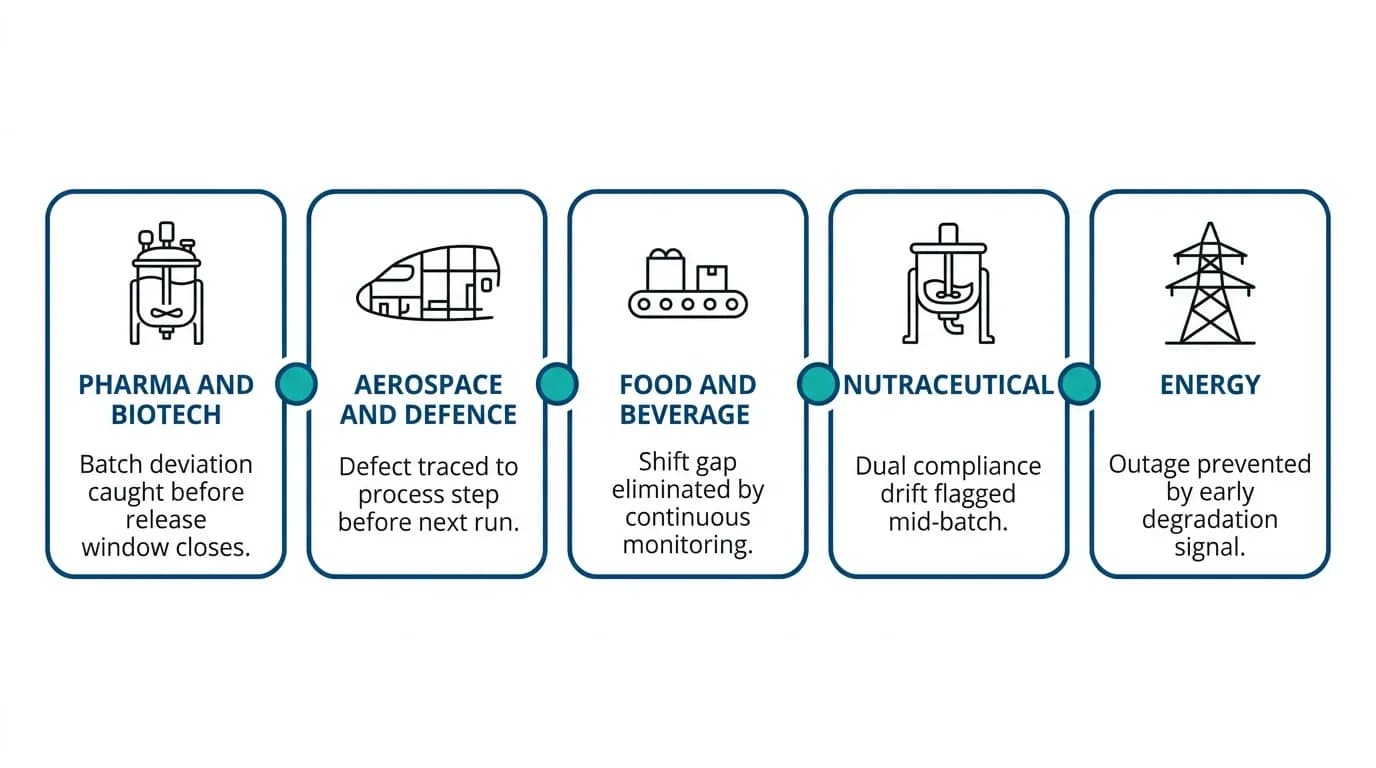
In pharma and biotech, a quality deviation does not just trigger an investigation. AI in pharmaceutical industry operates under a different clock to every other sector.
A batch nears its release window. A deviation is logged but the data sits across four systems. The quality team spends two days pulling it together manually. By the time the investigation is complete, the batch window has closed.
A manufacturer running AI-driven batch monitoring flags the same deviation on hour three. The data is already assembled. The batch decision is made on time.
Before implementing AI in pharma and biotech, look for:
- Validation capability that meets FDA ALCOA+ principles: Audit-ready from day one, not retrofitted after go-live
- Connection to structured investigation workflows, an alert that does not trigger the right response is just a notification
- Audit trail output that satisfies regulatory requirements without additional manual effort
The cost of getting this wrong is not a process inefficiency. It is a warning letter, a batch recall, or a delayed release.
Aerospace and Defence
In aerospace and defence, a quality escape is not a rework problem. It is a traceability failure that can ground a programme.
Engineers troubleshoot recurring quality issues in a hydraulic system. The dashboard shows the defect rate. But connecting it back to the specific process step takes weeks. By the time root cause is confirmed, the same failure mode has appeared twice more.
A team running AI-driven process traceability isolates the same deviation in hours. The root cause is identified before the next production run begins. Engineering capacity shifts from triage to systemic improvement.
Before implementing AI in aerospace and defence, look for:
- Process-level traceability: AI that links defect patterns to specific process steps, not just flags that a defect occurred
- Structured escalation support: The system should guide the investigation path, not just surface the anomaly
- Audit-ready documentation output: In aerospace, the evidence trail is as important as the fix itself
The cost of a missed defect is not measured in rework hours. It is measured in programme delays, regulatory findings, and grounded aircraft.
Food and Beverage Manufacturing
In food and beverage manufacturing, the signal that precedes a safety incident is almost always visible in the data before anyone acts on it.
A facility runs four shifts across a 24-hour cycle. A temperature deviation at a critical control point appears at 2am. The night shift logs it. The corrective action is not raised until the morning team arrives at 6am. Four hours of production have already run on a compromised line.
A facility running continuous AI monitoring flags the same deviation at 2am and escalates it automatically without waiting for a shift handover. The line is held before the next four hours run.
Before implementing AI in food and beverage, look for:
- Continuous tracking across shift transitions, not batch checks that only catch the problem after it has run
- Escalation through the correct tier structure automatically, the alert needs to reach the right person without depending on a handover conversation
- Consistency independent of who is in the building, the standard should not change when the experienced supervisor is off
The gap between a flagged signal and a recalled product is measured in how many shifts passed before someone acted on it.
Nutraceutical Manufacturing
In nutraceutical manufacturing, the compliance bar sits at the intersection of two regulatory frameworks, and a deviation acceptable in general food production becomes a batch rejection here.
A facility produces a supplement line under both FDA cGMP and food safety standards. A batch drifts on a critical quality parameter midway through production. The deviation is not visible until the end-of-batch review because the two monitoring systems run separately. By the time the drift is confirmed, the batch cannot be reworked.
A facility running AI-driven dual compliance monitoring flags the same drift at the midpoint of the run. The team intervenes while rework is still possible. The batch is released.
Before implementing AI in nutraceutical manufacturing, look for:
- Dual compliance tracking: AI that handles both food safety and pharmaceutical-grade quality standards in the same system
- Batch-level visibility: Lot-specific tracking through every production stage, not just line-level monitoring
- Connection to corrective action workflows: The flag needs to trigger the right CAPA response automatically, not wait for the end-of-shift review
The batch that almost passed is as costly as the batch that failed. The difference is whether the system caught it in time.
Energy
In energy, an unplanned outage does not just cost production time. It creates safety risk and regulatory exposure simultaneously.
An operator manages twelve distributed sites. Maintenance teams are dispatched reactively when a fault is reported. But the fault rarely arrives without warning. It builds across days in sensor data that legacy OT systems were never designed to analyse.
A network running AI-driven asset monitoring flags the degradation pattern eleven days before the fault develops. The maintenance team schedules an intervention during a planned low-demand window. The outage never happens.
Before implementing AI in energy, look for:
- Distributed asset monitoring: AI that works across multiple sites and asset types, not just a single facility
- Safety signal prioritisation: A safety anomaly and a performance anomaly are not the same escalation
- Structured maintenance response integration: AI process optimisation in distributed infrastructure only works when the flag triggers a planned intervention, not just a dashboard notification
The gap between a flagged degradation signal and an unplanned outage is exactly the lead time AI is designed to protect.
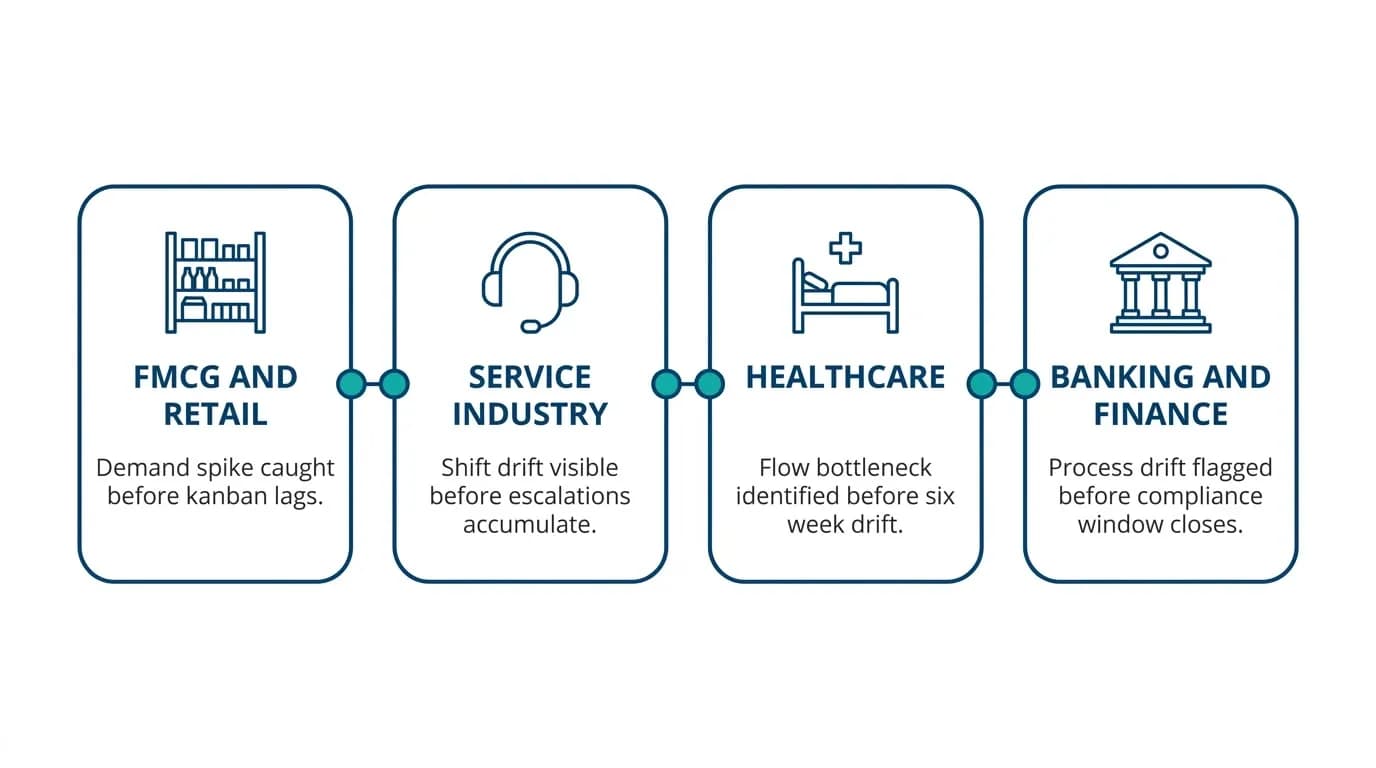
FMCG and Retail
In FMCG and retail, overproduction and stockouts do not happen because lean is not working. They happen because the demand signal arrived too late.
A lean team has the kanban system set. Replenishment triggers are in place. But the signal feeding the system is last week's sales data. A promotional campaign runs on Tuesday. Demand spikes 40% on Wednesday. The kanban does not respond until Thursday. By Friday, two SKUs are out of stock. One line is running overproduction on a product nobody is pulling.
A team running AI-driven demand monitoring catches the consumption shift on Tuesday evening. The kanban sizing is updated Wednesday morning. The line adjusts before the gap opens.
Before implementing AI in FMCG and retail, look for:
- Demand signal reliability: AI that connects actual consumption to lean inventory decisions, not sales forecasts that lag the floor by a week
- Connection to lean waste elimination: The signal needs to lead to a kanban adjustment, not just a forecast report
- Shelf-level and line-level integration: The signal needs to travel from point of consumption back to the production schedule
AI supply chain visibility closes the gap between the demand signal and the lean decision. The stockout and the overproduction often happen in the same week because that gap was never closed.
Service Industry
In service operations, the performance gap between your best shift and your worst shift is not a staffing problem. It is a visibility problem.
A service centre runs two shifts across five locations. The KPI dashboard shows aggregate performance by site. But the afternoon shift at location three has been missing first-call resolution targets for three weeks. Nobody has flagged it because the site average still looks acceptable. By the time it surfaces in the monthly review, twelve customer escalations have already run.
A centre running AI-driven shift-level monitoring flags the drift at location three in week one. The team lead receives the alert. A structured response is initiated before the escalations accumulate.
Before implementing AI in service operations, look for:
- Shift-level KPI visibility: AI that tracks performance at team and shift level, not just aggregate site numbers
- Escalation to structured response: The drift signal needs to trigger a conversation or investigation, not just update a dashboard
- Visibility across teams and locations: The gap between your best and worst performing shift is where AI finds the most traction
In service operations, the problem that sits in the aggregate number for three weeks is always more expensive than the one that was caught in week one.
Healthcare
AI in the healthcare industry is being adopted faster than almost any other sector. Yet a KPI that stalls for two weeks still does not just cost operational efficiency.
A mid-sized hospital has lean improvement programmes running across three wards. The tier meeting boards are updated daily. But the improvement momentum on Ward B has been slowing for six weeks. Bed utilisation is down. Patient wait times are creeping up. Nobody has identified where the stall started because the KPI dashboard shows ward-level averages, not where in the patient flow the bottleneck is forming.
A hospital running AI-driven operational monitoring identifies the stall point in Ward B by week two. The system has been tracking patient flow KPIs across admissions, discharge planning, and bed allocation simultaneously. The bottleneck is in discharge coordination, not bed availability. The lean team targets the right intervention. The wait times recover before the six-week drift becomes a patient outcome problem.
Before implementing AI in healthcare, look for:
- Cross-department KPI tracking: Patient flow problems rarely originate where they appear. AI needs visibility across wards, departments, and shifts simultaneously
- Improvement momentum visibility, not just current performance, but whether improvement trends are holding or reversing
- Connection to structured lean response: The operational signal needs to lead to a PDCA cycle or a tier meeting action, not just a report
In healthcare, the stall that goes undetected for six weeks is never just an operational problem. It is always a patient problem too.
Banking and Financial Services
In banking, the back-office process that drifts for three weeks does not show up as a performance metric. It shows up as a regulatory finding or a customer complaint.
A regional bank runs loan processing across four operations teams. The KPI dashboard tracks volume and turnaround time by team. But one team's manual verification step has been taking 40% longer than standard for two weeks. It is not visible in the aggregate turnaround number because the other three teams are compensating. By the time it surfaces, a backlog has built, two compliance deadlines have been missed, and a customer escalation has reached the branch manager.
A bank running AI-driven process monitoring flags the verification drift in week one. The operations manager receives the alert. The workflow is reviewed before the backlog builds and before the compliance window closes.
Before implementing AI in banking and financial services, look for:
- Process KPI visibility at workflow level, not just transaction volume, but where in the process the bottleneck is forming
- Compliance signal monitoring: AI that flags drift from regulatory standard before an audit finds it, not after
- Connection to structured corrective action: the compliance flag needs to trigger an investigation and resolution workflow, not just sit in a log
In banking, the process that looks fine in the aggregate is often the one that is quietly building the next audit finding and AI continuous improvement is what closes it before it does.
AI adoption is not the hard part. Every sector is doing it. The hard part is knowing which problem you are solving before you start and what a wrong signal costs you specifically.
Pharma, automotive, aerospace, food, nutraceuticals, electronics, energy, FMCG, service, healthcare, banking — the operational pressure is different in every one of them. But the pattern is the same. AI surfaces the signal faster. What the team does next is still an AI decision making challenge and lean methodology is what structures the answer.
The sectors winning with AI are not the ones that moved fastest. They are the ones that knew what question they were answering.
Every sector is reacting to signals. But what if the signal itself is the problem?
Every industry hits a different wall with AI. Find out where yours is
FAQs
1. Do I need to replace my existing lean systems before implementing AI?
No. AI works best when lean is already in place. The dashboards, the KPI frameworks, the tier structures — these are what give AI the operational context it needs to surface a signal worth acting on. AI on top of broken processes accelerates the wrong things.
2. How do I know which AI features are actually relevant to my industry?
Start with the failure mode that costs you most. In pharma, it is a missed deviation. In energy, it is an unplanned outage. In food manufacturing, it is a shift transition that nobody monitored. The right AI features are the ones that address your specific failure mode, not the most advanced ones on the market.
3. Is AI implementation different for regulated industries like pharma and aerospace?
Yes. In regulated environments, AI must meet specific validation and traceability requirements from day one. Audit trail capability, ALCOA+ compliance in pharma, and structured escalation documentation in aerospace are not optional features, they are pre-conditions for deployment.
4. What is the most common reason AI implementations fail in operational industries?
Skipping the response workflow. Most teams invest heavily in the data layer and the detection layer, and nothing in the action layer. An alert that nobody knows how to respond to stops being used within three months.
5. Can AI work across multiple industries in the same organisation?
Yes, if the underlying operational data is structured consistently. A diversified manufacturer operating pharma, food, and electronics lines needs AI that can apply different escalation logic per sector while feeding into the same operational performance framework.

Geandra Queiroz, Operations Management Consultant
Geandra is an Operations Management Consultant at Lean Transition Solutions, specialising in Lean philosophy, Lean Six Sigma, and strategic planning across manufacturing and healthcare. She is currently completing her PhD in Industrial Engineering at the Federal University of São Carlos, researching the integration of Operations Strategy, Lean, and Green Manufacturing.